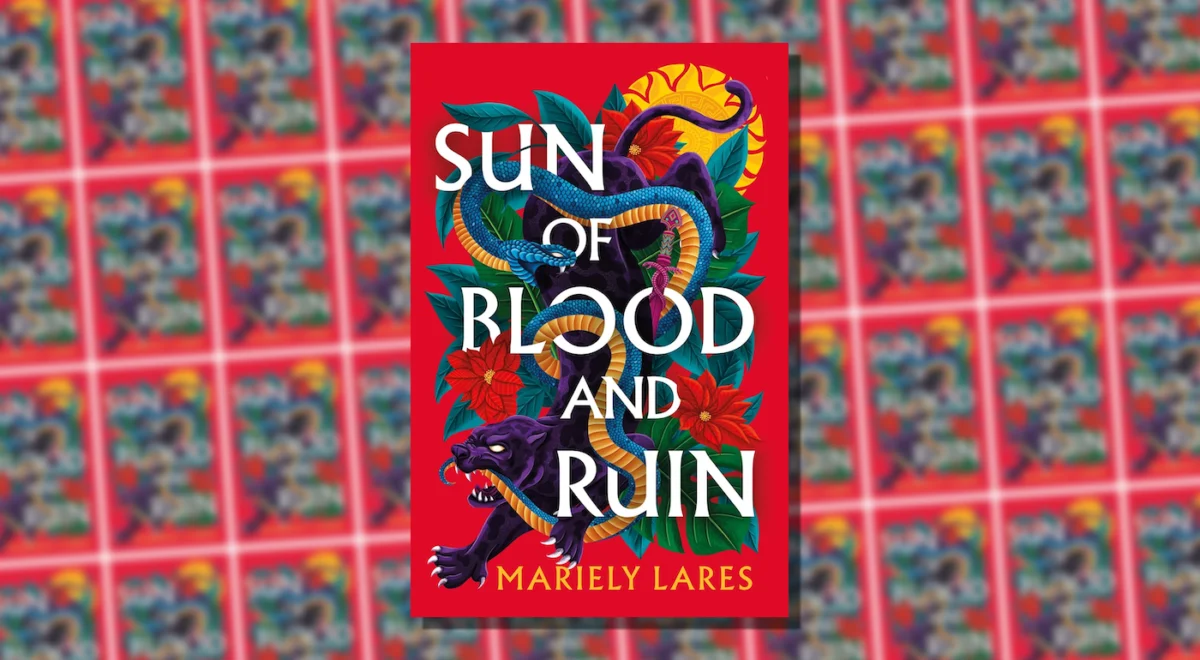
Mariely Lares’ debut novel, Sun of Blood and Ruin, plunges readers into the complex tapestry of sixteenth-century New Spain, a fictionalized yet historically resonant depiction of colonial Mexico. While initially drawing readers with its promise of a Zorro-esque reimagining featuring a sorceress, the novel quickly establishes itself as a rich, speculative historical fiction that grapples with the brutal realities of colonialism and the interwoven threads of indigenous mythology and prophecy. The narrative, told from the perspective of the eighteen-year-old noblewoman Leonora, unfolds a compelling dual identity as she navigates treacherous court politics and a secret life as the masked folk hero, Pantera.
The novel’s setting in New Spain, the Spanish colonial territory encompassing present-day Mexico, provides a potent backdrop for the inherent conflicts. Lares skillfully positions Leonora, the daughter of the first viceroy and a Mexica woman, as a character caught between two worlds. This liminal existence is not merely a personal struggle but a microcosm of the broader societal tensions. The Spanish regime, as depicted in the novel, is actively engaged in the systematic suppression of indigenous peoples, referred to collectively as the Nahuas, a term encompassing seven distinct tribes. Leonora, despite her noble standing within the colonial court—now led by her fourteen-year-old half-brother, Viceroy Jerónimo, and his ambitious mother, the vice regent—finds herself compelled to act as a political advocate for the native residents. Her clandestine persona, Pantera, directly confronts this oppression, meeting colonial violence with swift, strategic force against figures like the cruel Captain Nabarres, who spearheads the persecution of those who adhere to Nahua traditions.
The genesis of Pantera’s extraordinary abilities lies deeply rooted in indigenous lore. The narrative reveals that Leonora, as a child, once wandered away from the palace and was lost in the wilderness for ten years. During this extended period, she resided in Tamoanchan, a mythical paradise central to Mesoamerican cosmology. It was here that she received training as a Nagual, a shapeshifter integral to many indigenous belief systems. Although Leonora did not complete her full Nagual training, her return to the city endowed her with significant power. She can wield her tonalli, or life force, in combat, transform into a panther, and stand her ground against formidable adversaries. This integration of pre-Hispanic spiritual concepts into a narrative of resistance provides a unique and powerful dimension to the story.
Sun of Blood and Ruin opens with its protagonist facing crises on both fronts of her life. As Pantera, she suffers a significant setback when she fails to rescue a beloved local wise man from Captain Nabarres, a failure compounded by the loss of her magical Sword of Integrity. Simultaneously, as Leonora, she is confronted with an unwanted betrothal to the Crown Prince of Spain. This impending marriage not only signifies a personal entrapment but also threatens to remove her from her homeland and her clandestine mission of protection. The novel weaves in the concept of Leonora’s birth during the Nemontemi, the "Dead Days" at the end of the Aztec calendar, a period associated with ill fortune and a predestined, early demise in battle. As the prophesied collapse of the Fifth Sun—a significant cosmological concept in Mesoamerican cultures—draws nearer, Leonora-Pantera feels the inexorable pull of her fate, intertwined with the potential end of the world, threatened by demons and vengeful goddesses. Over the course of approximately 350 pages, Leonora-Pantera navigates a complex web of political intrigue, encounters a charismatic guardsman whose potent tonalli suggests a hidden agenda, uncovers unsettling truths about her intended fiancé, embarks on a quest to find the indigenous resistance movement known as La Justicia, and even engages in negotiations with divine entities.

A World Steeped in Research and Mythology
Mariely Lares’ meticulous research is evident throughout Sun of Blood and Ruin. The author constructs a richly detailed world, weaving in elements of indigenous belief, colonial administration, and nascent revolutionary sentiment with a skilled hand. The narrative’s intricate plot is a testament to Lares’ ability to create surprising connections and deliver revelatory twists. She unfolds the world of sixteenth-century New Spain with patience and care, introducing new aspects of magic and startling creatures that enhance the speculative nature of the historical setting. The author’s approach is described as guiding the reader through this multi-layered narrative with a judicious balance of exposition and discovery, allowing for a visceral connection to the researched historical context and mythological underpinnings. The novel concludes with a sense of resolution, yet hints at a sequel through a cinematic teaser scene, suggesting that the narrative arc is designed to continue.
The Juggernaut of an Ambitious Plot
While Lares’ ambition in crafting such a densely packed narrative is commendable, the sheer scope of Sun of Blood and Ruin presents both its greatest strength and its most significant challenge. The intricate plot, brimming with political machinations, revolutionary fervor, and cosmic struggles, could arguably sustain two or even three novels. The narrative’s relentless pace, with every event closely following the last, can lead to reader overwhelm. Revelations and action sequences frequently occur in rapid succession, potentially hindering the reader’s ability to fully absorb character development or appreciate the nuances of the vividly rendered settings.
Instances where characters seemingly die and reappear within a few pages, while new characters are introduced and major internal revelations occur in parallel, highlight the frenetic pacing. This rapid accumulation of plot points, while indicative of the story’s dynamism, can inadvertently diminish the impact of individual character arcs. Given the compelling setup of the characters, the sacrifice of deeper emotional exploration and nuanced development in favor of plot propulsion is a point of frustration for some readers. The novel’s rich tapestry of ideas, though magnificent, sometimes feels compressed, leaving less room for the immersive experience that could allow readers to truly get lost in the world and its inhabitants.
Implied Adaptation Potential and Enduring Themes
The potential for Sun of Blood and Ruin to be adapted for television is a sentiment echoed by those captivated by its imaginative scope. The compelling characters, particularly the conflicted Pantera, and a universe shaped by Mesoamerican deities like Quetzalcoatl, offer a departure from more conventional fantasy epics often inspired by medieval European settings. The visual and narrative richness of Lares’ creation lends itself naturally to a cinematic interpretation, potentially providing the immersive depth that the novel’s pacing sometimes precludes.
Despite the narrative’s sometimes overwhelming density, the novel leaves a lasting impression. By the conclusion of this gripping and original tale, the initial inspiration from Zorro fades, replaced by a profound engagement with Leonora-Pantera’s unique struggle and the richly imagined world. Sun of Blood and Ruin presents a powerful exploration of resistance against colonial oppression, the complex interplay of fate and free will, and the enduring power of indigenous mythologies. The novel’s core themes of identity, defiance, and the cyclical nature of existence resonate long after the final page, underscoring Lares’ achievement as a storyteller. The inherent tension between the exhilarating inventiveness of the narrative and its demanding pace suggests a promising foundation for future installments in the duology, with the hope that subsequent works may offer a more balanced exploration of its remarkable elements.