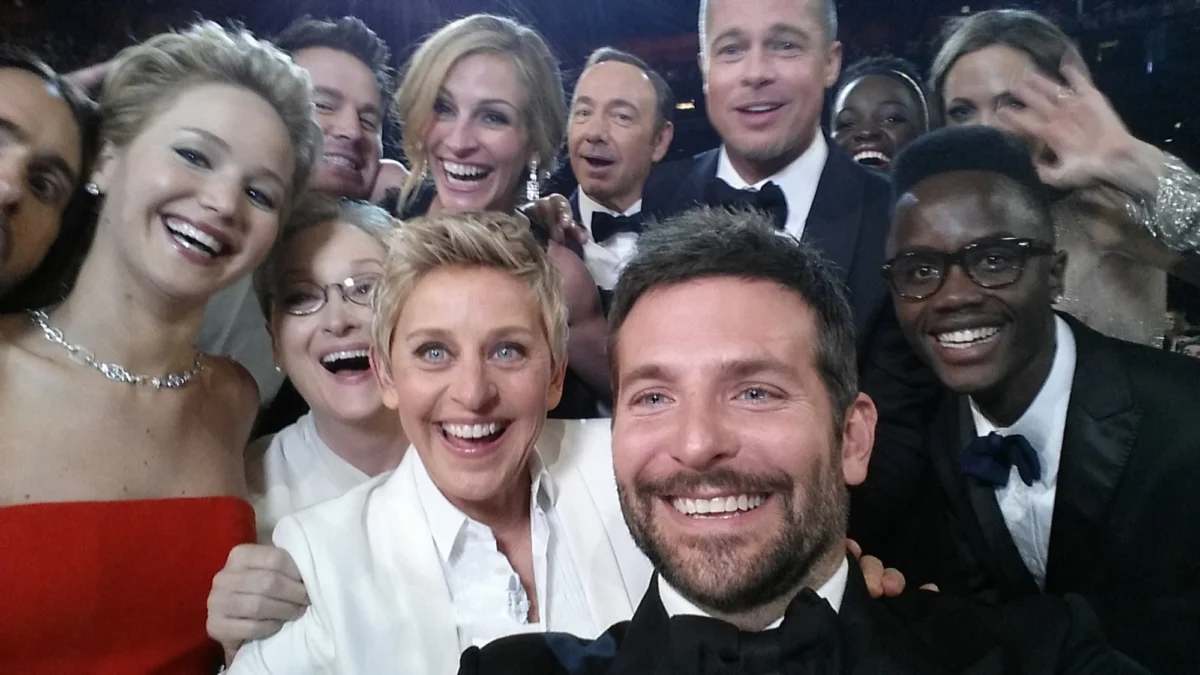
On the night of March 2, 2014, during the 86th Academy Awards, host Ellen DeGeneres wandered into the audience with a white Samsung Galaxy Note 3. What followed was a carefully orchestrated yet seemingly spontaneous moment of celebrity proximity that would define an era: a group selfie featuring Bradley Cooper, Jennifer Lawrence, Meryl Streep, Brad Pitt, Angelina Jolie, Julia Roberts, Kevin Spacey, Jared Leto, Channing Tatum, and Lupita Nyong’o. Within minutes of being posted to Twitter, the image shattered the platform’s retweet record, temporarily crashing the service and garnering over 3.4 million shares.
In the decade since that flashbulb pop, the image has transformed from a viral sensation into a historical marker. To many cultural critics and industry analysts, the 2014 Oscars represent the last peak of the "monoculture"—a period when a significant majority of the population consumed the same media, understood the same references, and participated in a unified cultural conversation in real-time. Today, that shared landscape has been replaced by a fragmented ecosystem of algorithmic feeds, niche streaming services, and siloed social communities.
The Anatomy of a Cultural Apex
The 2014 Academy Awards telecast drew an average of 43.74 million viewers in the United States, the largest audience for the ceremony in 14 years. At the time, the industry viewed the selfie as a triumph of modern marketing and social media integration. Samsung, a major sponsor of the telecast, had reportedly integrated its devices into the show as part of a $20 million advertising buy. The "viral" moment was a hybrid of traditional broadcast reach and the burgeoning power of social platforms.

The event took place in a specific technological window. In 2014, social media was largely seen as a "second screen" experience that enhanced traditional television rather than replacing it. Viewers watched the Oscars on ABC and used Twitter or Facebook to discuss it simultaneously. This synergy created a massive, singular "water cooler" moment. According to Nielsen data from that period, the telecast was not just an awards show but a dominant cultural event that transcended demographics, a feat that has become increasingly difficult to replicate in the current media environment.
A Chronology of Fragmentation: 2010–2024
The decline of the monoculture did not happen overnight; it was a steady erosion driven by technological advancement and shifting corporate strategies.
2010–2012: The Infrastructure of the Selfie
The term "selfie" had existed in the digital lexicon since the early 2000s, but it was the 2010 launch of the iPhone 4, the first Apple device with a front-facing camera, that democratized the format. In 2012, Facebook acquired the photo-sharing app Instagram for $1 billion. By 2013, the Oxford English Dictionary named "selfie" its Word of the Year, signaling that the digital behavior of the youth had moved into the mainstream.
2013–2014: The Streaming Warning Shot
While traditional TV was peaking, the "Albanian Army"—a dismissive term used by then-Time Warner CEO Jeff Bewkes to describe Netflix—was beginning its march. In 2013, Netflix released House of Cards, proving that high-prestige, "appointment" television could exist outside the broadcast and cable bundle. However, in 2014, there were still only 14 original streaming series across Netflix, Hulu, and Amazon Prime.

2017–2019: The Streaming Wars Begin
The turning point for the industry occurred in August 2017, when Disney CEO Bob Iger announced that the company would pull its content from Netflix to launch its own streaming service. This sparked a "streaming arms race," leading to the launches of Disney+ and Apple TV+ in 2019, followed by HBO Max and Peacock in 2020. The result was a massive influx of content; in 2019, a record 532 English-language scripted series were produced, making it impossible for any single show to capture the collective consciousness in the way The Big Bang Theory or NCIS did in 2014.
2020–Present: The Pandemic and the Algorithmic Shift
The COVID-19 pandemic accelerated the demise of shared experiences. With movie theaters closed and live events canceled, audiences retreated further into personalized digital spaces. The rise of TikTok and the refinement of YouTube’s recommendation algorithms meant that two people sitting in the same room could be exposed to entirely different cultural universes.
Supporting Data: The Quantifiable Decline of Mass Attention
The shift from a unified culture to a fragmented one is most visible in the viewership data for major live events. In 2014, the Oscars reached 43.7 million people. By 2023, that number had settled near 18.7 million—a decline of over 50%. The Grammy Awards followed a similar trajectory, falling from 28.5 million viewers in 2014 to roughly 16.9 million in 2024.
The erosion is also evident in scripted television. In the 2013-2014 season, 24 network and cable shows averaged more than 12 million viewers per episode. Shows like The Big Bang Theory (21.3 million) and The Walking Dead (13.3 million) were cultural pillars. By the 2023-2024 season, the number of non-sports programs reaching that 12-million-viewer threshold had plummeted to just three: Tracker, High Potential, and Marshals.

The music industry reflects this trend as well. While 2014 saw massive, inescapable hits from artists like Pharrell Williams ("Happy") and Taylor Swift (1989), the modern charts are dominated by "micro-trends." A song may go viral on TikTok and reach number one, but a significant portion of the population may never hear it, as radio play and MTV-style curation have lost their gatekeeping power.
Industry Reactions and Strategic Pivots
The response from Hollywood executives has shifted from denial to reluctant adaptation. In the early 2010s, the prevailing sentiment was that streaming was a "niche" or "supplemental" service. Jeff Bewkes’ 2010 comparison of Netflix to the "Albanian Army" suggested that the upstart could never take over the global media landscape.
By 2024, the rhetoric has changed. Industry leaders now speak of "total reach" and "multi-platform engagement" rather than overnight Nielsen ratings. "We are no longer in the business of reaching everyone at once," a former network executive noted in a recent industry forum. "We are in the business of owning the specific niches where people spend their time."
The Academy of Motion Picture Arts and Sciences has attempted to reclaim the monoculture through various initiatives, such as the short-lived "Popular Film" category and the hiring of younger, social-media-savvy hosts. However, these efforts have largely failed to return the telecast to its 40-million-viewer glory days, as the underlying infrastructure of how humans consume information has fundamentally changed.

Broader Impact and the Loss of a Common Language
The death of the monoculture has implications that extend beyond entertainment. Sociologists argue that shared pop-cultural moments act as a "social glue," providing a common language for people of different backgrounds to communicate. When everyone watched the same Oscar ceremony or the same Breaking Bad finale, it created a baseline of shared experience.
In a fragmented world, the "gatekeeping" of the past—often criticized for being exclusionary or "dumbing down" content—has been replaced by "algorithmic curation." While this allows for greater diversity of content and the rise of independent creators, it also facilitates the creation of echo chambers. Without a shared cultural center, the ability to generate a national conversation becomes limited to a few remaining outliers: the Super Bowl, Taylor Swift’s "Eras Tour," and major political events.
The 2014 Oscar selfie stands as a monument to a time when a single photograph could be seen, understood, and discussed by the entire world simultaneously. It was a moment of peak connectivity before the very tools that enabled it—smartphones and social media—fragmented the audience beyond repair. As the industry continues to chase the ghost of the monoculture, the 2014 telecast remains a reminder of a bygone era of collective attention, a digital "last stand" for a unified popular culture.