History, a sprawling and often bewildering chronicle of human endeavor, is a complex weave of chance encounters, peculiar events, unconventional theories, and seismic shifts that collectively shape our present reality. Intertwined with this historical fabric is the rich and boundless domain of science fiction and fantasy. Within these genres, authors are free to explore everything from meticulously researched alternate timelines to wildly imaginative flights of fancy. These narratives feature time travelers grappling with paradoxes, shadowy conspiracies operating throughout documented history, and creative interpretations of history’s most bizarre coincidences. To celebrate the myriad possibilities within temporal storytelling, this article delves into seven unique and often secret science fiction and fantasy histories that offer fresh perspectives on familiar and imagined pasts.
To Say Nothing of the Dog by Connie Willis
Oxford University’s groundbreaking discovery of time travel has ushered in an era of unprecedented scientific advancement. However, this monumental achievement comes with a rather unusual funding requirement: the patronage of a wealthy benefactor with a peculiar passion for historical restoration. The benefactor’s singular objective is to return Coventry Cathedral to its pre-World War II splendor, a task that requires the intervention of Oxford’s overworked temporal agents.

The novel centers on Ned Henry and Verity Kindle, two researchers tasked with a seemingly straightforward mission: journeying back to Victorian England to retrieve a specific, aesthetically questionable vase. This artifact is deemed crucial for the cathedral’s restoration. Yet, as they navigate the intricate currents of time, they find themselves in a constant battle to preserve the integrity of the timeline, acutely aware that any alteration, no matter how small, could lead to catastrophic paradoxes.
What unfolds is a comedic farce, reminiscent of classic door-slamming farces, as Ned and Verity desperately try to outmaneuver the temporal ripples they inadvertently create. Their shared love for literature, particularly the works of Dorothy L. Sayers, as evidenced by recurring, charmingly anachronistic quotes from Gaudy Night, alongside a mutual appreciation for art and history, forms the emotional core of their increasingly complicated escapades. Willis masterfully blends high-concept science fiction with witty dialogue and a deep affection for the historical periods she invokes, creating a narrative that is both intellectually stimulating and hilariously entertaining. The novel, first published in 1997, earned the Hugo Award for Best Novel and the Nebula Award for Best Novel, solidifying its place as a modern classic in humorous science fiction.
A History of What Comes Next by Sylvain Neuvel
Sylvain Neuvel’s A History of What Comes Next presents a stark and gripping alternate history of humanity’s audacious push into space. The narrative unfolds across generations, following the Kibsu family, a lineage spanning 99 generations, whose sole purpose is to ensure humanity’s survival by reaching the stars before an unspecified, yet palpable, doom engulfs their home planet.

The story prominently features Mia, a member of the 99th generation, who is thrust into the perilous final days of World War II. Her mission, codenamed Operation Paperclip, involves the clandestine retrieval of Wernher von Braun, the brilliant but morally compromised rocket scientist, for the burgeoning American space program. Simultaneously, Mia’s mother operates in the shadows, a master manipulator of intelligence agencies, strategically influencing both the American and Soviet space programs to steer humanity toward its extraterrestrial destiny.
Neuvel’s approach to the Space Race is refreshingly devoid of romanticization. The narrative confronts the ethical complexities of Operation Paperclip head-on, portraying von Braun not as a hero, but as a self-serving figure with a clear Nazi affiliation. The internal monologues of the characters reveal a profound moral struggle; their actions, while often grimly necessary for the survival of the species, are fraught with ethical compromises. This nuanced perspective underscores the immense sacrifices and difficult choices inherent in humanity’s quest for survival beyond Earth. The novel, published in 2021, is part of Neuvel’s Take Them to the Stars series, which explores ambitious speculative futures rooted in historical context.
Last Call by Tim Powers
Tim Powers is renowned for his intricate "secret histories," and Last Call stands as a particularly potent and surreal example. This epic noir plunges readers into a hidden world where chaos mages converge on high-stakes poker tournaments, where Bugsy Siegel’s construction of the Flamingo Hotel was not merely an act of ambition but the establishment of an occult temple designed to install him as the Fisher King. The narrative further reveals a shadowy underworld ruled by a body-swapping crime lord, and where games of chance serve as conduits for divine communion.

At the heart of this maelstrom is Scott Crane, a man whose life was irrevocably altered after participating in a bizarre poker game, only to find a crucial part of himself missing. Drawn back to the glittering, treacherous landscape of Las Vegas and a peculiar houseboat on Lake Mead, Scott and his allies are ensnared in a bizarre ritual. Powers masterfully weaves together the historical narrative of Las Vegas, ancient occult mythology, the grim realities of true crime, and the sweeping scope of epic fantasy. The result is a profound exploration of loss and redemption, set against the backdrop of a city that thrives on constant reversals of fortune, where fortunes are won and lost not just with chips, but with fragments of the soul. Last Call, first published in 1992, won the World Fantasy Award for Best Novel, cementing Powers’ reputation for weaving the arcane into the fabric of reality.
The Beheading Game by Rebecca Lehmann
Rebecca Lehmann’s historical picaresque begins with a disquietingly surreal premise: a headless heroine awakens within a chest, her severed head cradled in her hands. After a rather swift, albeit anatomically improbable, reattachment, she finds herself disoriented on the rough streets of Southwark. This era and location, already fraught with peril for any woman, are exponentially more dangerous for one who has recently experienced a literal decapitation.
Despite the extraordinary circumstances, Anne, the protagonist, is driven by a fierce resolve. She vows to exact revenge on her former husband and his current paramour, a dual mission aimed at securing her daughter Elizabeth’s rightful claim to the throne. While Lehmann deftly sidesteps the biological absurdity of Anne’s rapid recovery, the true brilliance of the story lies in Anne’s transformation. She evolves from an out-of-touch ingenue, whose naive pronouncements to a public torture victim ("I’ll pray for you") highlight her initial detachment, into a shrewd and worldly woman. This arc offers a compelling "second chance at life" narrative, allowing Anne to achieve a level of agency and cunning that her historical counterpart was likely never afforded. Published in 2023, The Beheading Game offers a darkly humorous and empowering reimagining of a historical figure’s potential.

Backmask by OF Cieri
OF Cieri’s Backmask delves into the uncanny intersection of 1960s American pop and rock music with the occult. The novel posits that beneath the polished veneer of popular music production lies a far more sinister and esoteric undercurrent. The narrative follows Valerie Chill as she navigates this hidden world, encountering dangerous cult leaders and attempting to manage her volatile, weapon-wielding record producer boss.
This producer, known as Hush, harbors an audacious plan: to fuse occult practices with rock music, thereby recreating the sonic landscapes of his prophetic visions. As is often the case when delving into forbidden knowledge, Hush’s ambitious project attracts the attention of rival occultists and competing record executives. His endeavor becomes the focal point of a secret war, waged through the very medium of popular music. Despite its seemingly far-fetched premise, Cieri’s meticulous research into the period lends the narrative an unsettling authenticity. The novel evokes a sense of historical plausibility, as if the names have been altered to protect those deeply, and perhaps dangerously, involved. Published in 2023, Backmask offers a chilling exploration of how culture and the occult can become intertwined.
Doctor Benjamin Franklin’s Dream America by Damien Lincoln Ober
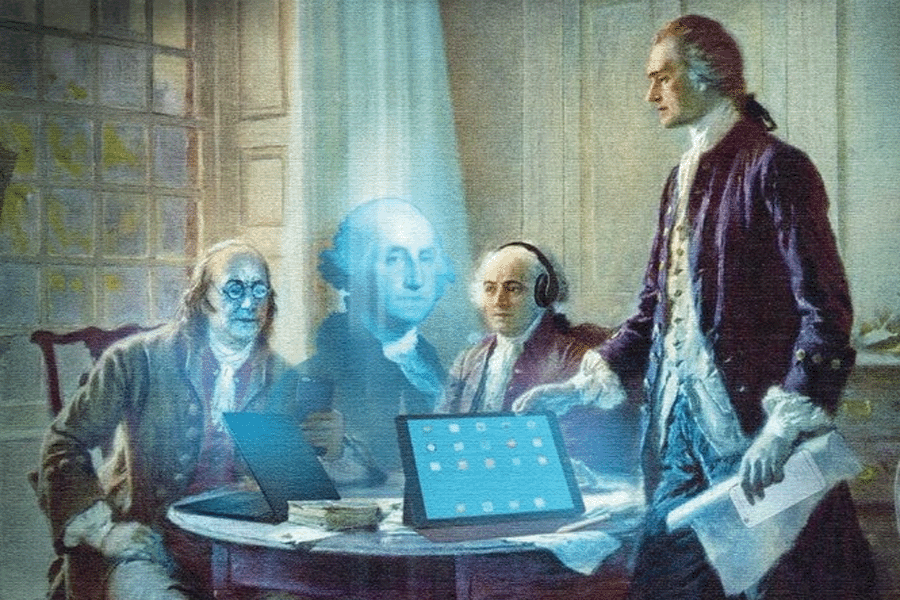
Damien Lincoln Ober’s Doctor Benjamin Franklin’s Dream America offers a sharp, satirical reimagining of America’s founding myths, beginning with a seemingly straightforward, yet ultimately disorienting, premise: the actual deaths of Benjamin Franklin and his contemporaries serve as the prologue to an increasingly bizarre narrative.

This retelling reimagines the nation’s genesis in a digitally saturated, wi-fi enabled world. The Declaration of Independence is drafted through "net-speak," Button Gwinnett engages in fierce online "flame wars" with his rival before their historical duel, and social media campaigns are launched to garner support for the ratification of the Articles of Confederation. While the story is undeniably science fiction, culminating in the fledgling United States battling sinister hiveminds and brain-infecting viruses, its core strength lies in its surprising fidelity to the underlying relationships and historical events. This creates a wild and incisive satire that comments not only on the political engagement of the past but also on the dynamics of contemporary political discourse. The novel, published in 2017, offers a prescient commentary on how historical narratives can be reinterpreted through the lens of modern technology and social interaction.
Everfair by Nisi Shawl
Nisi Shawl’s Everfair presents a multi-perspective chronicle detailing the fictionalized founding of a nation. The narrative constructs the vast and complex history of Everfair, a sovereign Congo liberated from the brutal exploitation and atrocities perpetrated by Belgium. This newly independent nation is established as a sanctuary, open to both its indigenous inhabitants and freed slaves.
Upon this foundation, Shawl meticulously builds an intricate tapestry of interlocking narratives focused on the arduous process of establishing a free state. The story incorporates the wondrous post-industrial technologies often associated with steampunk, envisioning their use in the creation of a nascent utopia. While many narratives might focus solely on the utopian aspects, glossing over the wrenching labor pains inherent in nation-building, Shawl’s approach is far more nuanced and expansive. She vividly portrays the political, ideological, and religious clashes, alongside the profound hardships faced both before and after Everfair’s eventual establishment. The result is a utopia that feels tangibly real, imbued with the turbulent history and complex realities that such an undertaking would inevitably entail. Everfair, published in 2015, was a finalist for the Nebula Award for Best Novel and the Otherwise Award, lauded for its ambitious scope and intricate world-building.