In a world where science fiction often mirrors our evolving understanding of the cosmos, Alan E. Nourse’s 1954 novel, Trouble on Titan, stands as a testament to both the enduring appeal of classic space opera and the remarkable advancements in our scientific knowledge. This bi-weekly series, dedicated to exploring the "front lines and frontiers" of science fiction and fantasy, delves into Nourse’s enduring work, a story set on Saturn’s largest moon, Titan. While the technological extrapolations and scientific suppositions within the novel reflect the era of its creation, the core narrative of intergenerational conflict, unlikely friendships, and the pursuit of truth remains remarkably resonant.
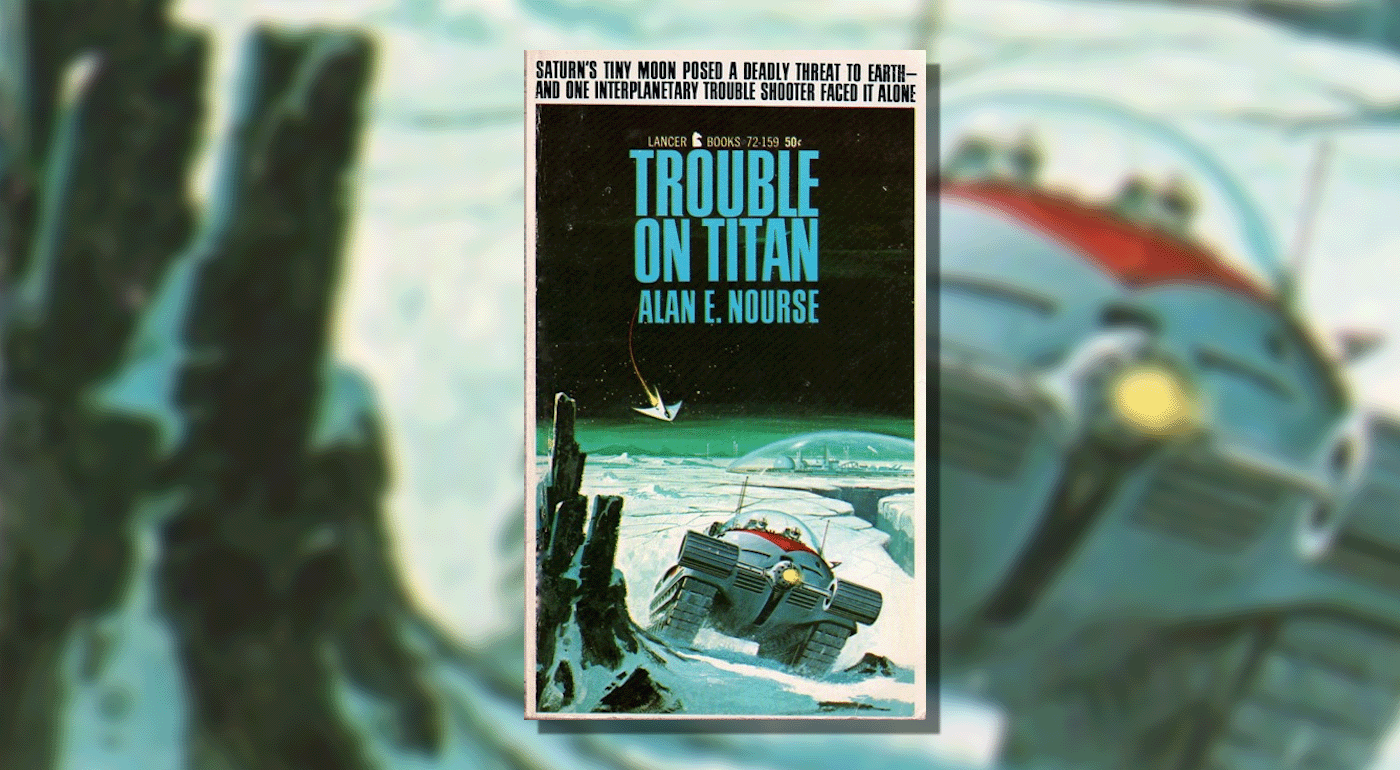
Nourse, a physician with a prolific writing career spanning multiple genres, crafted Trouble on Titan for a younger audience, yet its themes of colonial unrest, resource scarcity, and the clash between established authority and burgeoning independence resonate with a broader readership. The novel, originally published by the John C. Winston Company, has seen numerous reprints, with the 1986 Ace Books paperback edition featuring a captivating astronomical illustration by Don Dixon, depicting Titan, Saturn, and a spacecraft against a cosmic backdrop. The presence of a stamp from Cal’s Paperback Exchange in Spokane, Washington, on the reviewer’s copy, hints at the book’s journey through the hands of countless readers, a common trajectory for beloved science fiction novels of its generation.
The Enduring Fascination with Titan
Titan, the subject of Nourse’s imaginative exploration, continues to be one of the most scientifically intriguing celestial bodies in our solar system. Discovered in 1655 by Christiaan Huygens, Titan’s initial characterization was that of a simple, icy moon. However, subsequent observations, particularly from the Voyager 1 and 2 probes in the early 1980s and the Cassini-Huygens mission which arrived in 2004, have revealed a world far more complex and dynamic than previously imagined.
The novel Trouble on Titan posits a future where humanity has established a significant presence on the moon, primarily for mining a critical mineral, ruthenium, essential for advanced solar energy conversion and broadcasting. This narrative choice, while scientifically speculative for the 1950s, taps into the fundamental human drive for resource acquisition and technological advancement. Today, our understanding of Titan is shaped by data indicating a dense atmosphere, composed primarily of nitrogen and methane, creating a greenhouse effect that maintains surface temperatures around a frigid -291 degrees Fahrenheit (-179 degrees Celsius). This atmospheric density, unique among moons in our solar system, allows for the existence of liquid methane and ethane lakes and oceans, and even weather patterns, including methane rain.
Nourse’s depiction of a rocky surface and a clear, blue sky, offering a direct view of Saturn, deviates from current scientific consensus. The Cassini-Huygens mission revealed that Titan is perpetually shrouded in a thick, orange haze, and its surface is predominantly icy, shaped by cryovolcanism and erosion from methane precipitation. Astronomical artist Chesley Bonestell’s iconic 1944 painting, "Saturn as Seen from Titan," which portrays a crisp view of the ringed planet above jagged peaks and a snowy plain, likely influenced Nourse’s visualization. Modern understanding, however, suggests a much more obscured and geologically distinct landscape.
The novel also features colonists living under a Plexiglas dome, a concept that, while plausible for a contained habitat, would face significant engineering challenges given Titan’s extreme temperatures. Plexiglas, or acrylic, becomes brittle at such low temperatures, potentially compromising its structural integrity as a barrier against the frigid outer atmosphere. Furthermore, Nourse’s reliance on ruthenium mined from tunnels filled with a breathable, oxygen-based atmosphere presents a challenge to the moon’s known composition. While ruthenium exists and possesses unique electrical properties, its abundance in Titan’s icy surface, and the feasibility of maintaining warm, breathable tunnels within such an environment, are subjects of considerable scientific debate and artistic license.
However, Nourse’s grasp of certain physical principles, particularly concerning atmospheric conditions and resource utilization, remains prescient. His accurate depiction of a jet aircraft operating on Titan, which would require gathering atmospheric hydrocarbons as fuel and carrying its own oxygen supply, contrasts sharply with Earth-based jets. Similarly, his suggestion that welding torches might not require acetylene, relying instead on released oxygen, demonstrates an insightful understanding of how different atmospheric compositions would necessitate novel technological approaches. These "topsy-turvy" conditions are precisely what make Titan such a compelling subject for scientific inquiry and imaginative fiction.
The Narrative Unfolds: Earthly Ambitions and Titan’s Troubles
Trouble on Titan opens with a preface that, in keeping with its juvenile target audience, thoughtfully explains some of Titan’s unique environmental conditions and the complexities of space travel. The narrative then shifts to the perspective of Tucker Benedict, a recent high school graduate from Earth embarking on a journey home to New York. Tucker’s immediate future is bright, marked by an acceptance letter and scholarship offer from the prestigious Polytechnic Institute of Earth. His path seems set for a life of academic pursuit and, potentially, a career in the burgeoning field of space travel.
A pivotal moment arrives with a telegram from his father, Colonel Benedict, a member of the Security Commission, who has returned early from a mission on Mars and is eager to reunite with his son. The father-son relationship is portrayed as close, particularly given that Colonel Benedict raised Tucker alone after the early death of his mother. However, as Tucker matures, his father’s demanding missions across the solar system have led to increasing periods of absence, creating a subtle undercurrent of longing and perhaps a yearning for connection.
Tucker’s worldview is shaped by a society powered by massive solar energy converters that beam power across the planet, a technological feat facilitated by the very mineral, ruthenium, mined on Titan. Yet, Tucker’s personal passion lies not in the terrestrial infrastructure but in the allure of the cosmos – space travel. His aspirations for a career among the stars, however, are met with an unexpected subdued reaction from his father when he shares news of his scholarship. Colonel Benedict reveals that he had hoped Tucker would accompany him on his next mission to Titan, a long journey that would preclude accepting the scholarship. The mission, he explains, is to investigate growing unrest within the Titan mining colony. Historically a penal colony, the miners on Titan have long been characterized as "unreliable and difficult."
The narrative takes a sharp turn when Tucker, left alone in their apartment, discovers a peculiar letter addressed to his father, purportedly from him but never sent by Tucker himself. Upon opening it, he finds not a conventional letter but a dangerous incendiary device, which he manages to neutralize. This discovery immediately alerts Tucker to a plot against his father’s life, likely orchestrated to prevent his investigation into the volatile situation on Titan. In a decision that the reviewer notes as "incredibly poor" but fitting for a young, naive protagonist, Tucker resolves to accompany his father to Titan, foregoing his scholarship and the planned academic path, in order to protect him, choosing to keep the assassination attempt a secret for fear of his father’s disapproval.
Escalating Tensions and the Mystery of "The Big Secret"
The two-month journey to Titan is largely condensed, allowing the narrative to focus on the unfolding drama upon arrival. During the voyage, Tucker does confide in his father about the letter-bomb, which, while concerning, does not surprise the Colonel. He reveals that mysterious disappearances of significant quantities of supplies and materials on Titan suggest a deeper conspiracy at play.
Upon landing near the colony, they are met by Anson Torm, the elected head of the mining colony. Torm delivers a stark warning: without concessions from Earth’s government, the flow of ruthenium, vital to terrestrial power, may cease. His tone is not overtly threatening but rather a desperate plea, indicating that he is losing control of the increasingly restive miners, and an uprising appears imminent. The Colonel, understandably angered by this ultimatum, retreats with Torm to a cabin for a heated discussion.
Seizing this opportunity, Tucker dons a protective suit to explore the alien landscape. His excursion is cut short by the arrival of a crudely built jet plane. The pilot is David Torm, Anson’s son, who warns that a troublemaker within the colony, identified as Cortell, is exploiting his father’s absence to sow discord. The Colonel, Torm, and Tucker re-board their half-track vehicle, while David departs.
As David’s jet begins to crisscross their path at low altitude, concern arises about a potential explosive device. Their fears are realized when a large explosion rocks the area, forcing David’s jet into a rough landing. The others rescue him, and Anson Torm immediately suspects Cortell of orchestrating the assassination attempt and the subsequent sabotage.
The group proceeds to the colony, where, while the fathers engage in their tense negotiations, David takes Tucker on a tour. Nourse skillfully uses this segment to organically introduce the reader to the colony’s operations and the mining endeavors, seamlessly weaving exposition into the unfolding plot. During their exploration, it becomes apparent that both young men share a passion for space travel and rocketry. This shared interest fosters an unlikely friendship, bridging the decades of accumulated prejudice between the mining colony and Earth.
David, emboldened by their burgeoning camaraderie, reveals a critical piece of information: the colony is harboring "The Big Secret," the underlying reason for the disappearing supplies that the Colonel is investigating. This revelation sets the stage for a thrilling climax.
Climax and Resolution: A Twist on Colonial Narratives
What follows is a sequence of intense events: political upheaval, violent confrontations, a desperate overland journey in the half-track, and the hurried repair of David’s jet. This repaired aircraft becomes crucial for the search for "The Big Secret" and for uncovering the full extent of Cortell’s plot. While the specifics of the ending are withheld to preserve the narrative’s impact, the reviewer notes that the conclusion is satisfying and the journey to reach it is exhilarating. Crucially, the nature of "The Big Secret" elevates the novel beyond a simple retelling of the American Revolution in a futuristic setting, offering a unique twist that subverts conventional expectations.
Final Analysis: A Timeless Tale of Exploration and Friendship
Having finally read Trouble on Titan, the reviewer concludes that it represents the pinnacle of Alan E. Nourse’s literary output. The novel is praised for its well-developed characters, the captivating setting of Titan, and its abundance of action and adventure that ensures a gripping reading experience. Nourse’s adept execution of a surprising yet well-foreshadowed twist at the end is highlighted as a significant strength. The evolving friendship between Tucker and David, and their relationships with their respective fathers, provide a robust emotional core that anchors the story.
While acknowledging the presence of dated scientific elements, a common characteristic of mid-20th-century science fiction, the novel is considered to have held up remarkably well over the decades. The enduring themes of exploration, the consequences of societal division, and the power of human connection continue to resonate with readers.
The reviewer concludes by inviting further discussion on Trouble on Titan, Alan E. Nourse’s broader body of work, and recommendations for other books that explore the fascinating moon of Titan. This invitation reflects the ongoing engagement with classic science fiction, a genre that not only entertains but also prompts reflection on our place in the universe and the potential futures we might forge.