The Strategic Shift in Animation Programming
The inclusion of We Are Aliens in the Director’s Fortnight is not an isolated occurrence but rather the result of a deliberate editorial shift within the sidebar’s leadership. Since 2024, when the sidebar recruited Alex Dudok de Wit as an animation consultant, the programming has undergone a rigorous transformation. Dudok de Wit, a respected figure in animation journalism and curation, has been instrumental in bridging the gap between traditional live-action cinema and experimental animation. By introducing medium-pushing talent to accredited guests and international distributors, the Director’s Fortnight has effectively become a launchpad for visionary artists who might otherwise remain in the periphery of the industry.
This strategic pivot has allowed the works of prolific creators such as Cristóbal León, Joaquín Cociña, Kōji Yamamura, Félix Dufour-Laperrière, Alex Boya, Elizabeth Hobbs, and Honami Yano to reach a global audience. While the main festival selection, overseen by Thierry Frémaux, often leans toward high-profile studio productions or established auteurs, the Director’s Fortnight offers a more granular and accurate reflection of the current landscape of independent animation. The screening of We Are Aliens serves as a centerpiece of this initiative, highlighting the sidebar’s commitment to providing essential screening space and distribution opportunities for underrepresented talents from the Japanese independent scene.
Directorial Vision and Narrative Structure
Kohei Kadowaki, serving as both director and writer, brings a rhythmic sensibility to We Are Aliens that is rooted in his previous experience directing music videos. This background is evident in the film’s brisk pacing and its reliance on visual montage to propel the narrative forward. The story begins in a small, quiet Japanese town where an ordinary boy’s choice to betray a friend sets off a chain of events that haunts him well into adulthood. The central premise revolves around a cryptic question—“What if I told you I am an alien?”—which serves as a metaphor for the alienation and social performativity inherent in childhood friendships.
The film is structurally divided into two distinct halves, a choice that allows Kadowaki to examine the long-term consequences of a single moment of moral failure. By splitting the perspective between two central characters whose lives eventually coalesce in a mutually destructive climax, the narrative functions as a psychological character study. This "before and after" approach enables the audience to witness the transformation of youthful innocence into adult cynicism. The use of match-cutting is particularly effective here, as it underlines the themes of trauma and memory by visually linking the characters’ childhood actions with their present-day realities.
Technical Execution: The Role of Rotoscoping
One of the most discussed aspects of We Are Aliens is its use of rotoscoping as the primary animation technique. Rotoscoping, which involves tracing over live-action footage frame by frame, creates a visual style that occupies the "uncanny valley"—a space where characters appear almost human but retain a stylized, ethereal quality. In the case of Kadowaki’s debut, this technique results in a world that is photorealistic yet unsettlingly rigid.
The film’s character designs have been noted for their hyper-realistic resemblance to their live-action counterparts, played by Ryota Bando and Amane Okayama. While some critics argue that this proximity to reality can be distracting, the film utilizes the technique to great effect during moments of psychological distress. When the characters experience hallucinatory fears or bouts of manic aggression, Kadowaki deliberately breaks the consistency of the rotoscope. The animation becomes less detailed, more erratic, and visually frantic, mirroring the internal chaos of the protagonists. These aesthetic detours serve as a visceral immersion into the characters’ dissociative states, separating their subjective experiences from the objective reality of their environments.
Environmental Storytelling and Atmospheric Depth
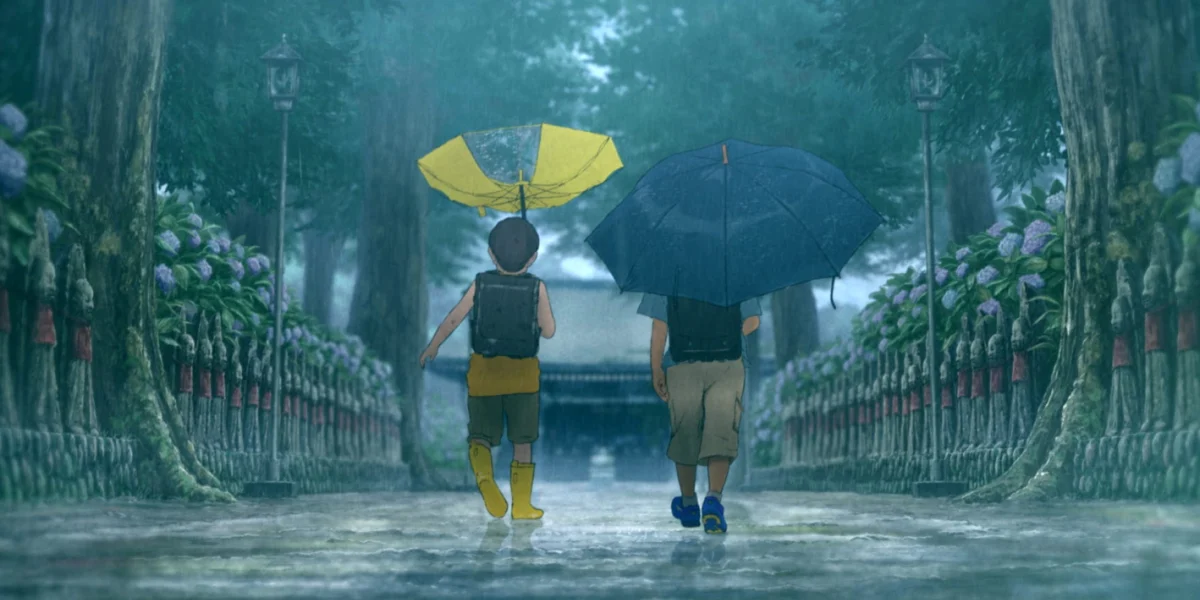
Beyond its character animation, We Are Aliens is distinguished by its intoxicating landscapes and environmental worldbuilding. Kadowaki utilizes weather and light to reflect the shifting emotional states of his characters. The transition from the rural, water-rich environments of the characters’ youth to the sterile, claustrophobic urban spaces of their adulthood is handled with subtle precision.
The director’s focus on the flow of water and the ferocity of rainfall serves as a recurring motif for the passage of time and the inevitability of change. As the boys are forced to enter the adult world, the atmospheric shift in the film signals a loss of autonomy. The urban settings are depicted as cold and indifferent, emphasizing the isolation felt by the protagonists as they grapple with the guilt of their past. This attention to detail in the background art provides a necessary counterpoint to the sometimes-stiff character movements, grounding the film in a tangible sense of place.
Casting and Performance
The emotional weight of We Are Aliens is carried by its lead actors, Ryota Bando and Amane Okayama. Bando, known for his versatile performances in Japanese television and film, provides the voice and physical basis for the character’s descent from a rambunctious child to a self-destructive adult. Okayama, a veteran of the independent film scene, brings a nuanced intensity to the role of the betrayed friend, whose lingering presence in the narrative serves as the catalyst for the film’s existential inquiries.
The collaboration between Kadowaki and his cast is essential to the film’s success, as the rotoscoping technique requires a high degree of physical expressiveness from the actors during the live-action filming phase. The performances are captured with a level of detail that allows for the transmission of subtle emotional cues—a slight hesitation, a shifting gaze, or a change in posture—that are often lost in more traditional forms of animation.
Industry Implications and Market Context
The premiere of We Are Aliens at Cannes comes at a time when the global market for adult animation is expanding. Data from recent years suggests a growing trend in the commercial viability of non-children’s animation, driven in part by the success of streaming platforms and international film festivals. In the Japanese market, while mainstream "anime" continues to dominate the box office, there is a burgeoning sector of independent creators who are utilizing digital tools to produce auteur-driven content that challenges traditional genre boundaries.
Kadowaki’s emergence as a "true unknown talent" at the Director’s Fortnight highlights the importance of festival sidebars in discovering and nurturing new voices. For independent animators, a screening at Cannes is often the primary vehicle for securing international distribution deals and festival invitations across Europe and North America. The positive reception of We Are Aliens suggests that there is a significant audience for narratives that avoid "miserablist" tropes in favor of complex, decade-spanning pleas for compassion and understanding.
Chronology of Production and Release
The development of We Are Aliens followed a meticulous timeline that reflects the labor-intensive nature of rotoscoped animation.
- Pre-Production (2021-2022): Kohei Kadowaki began drafting the script while finishing several high-profile music video projects. The casting of Ryota Bando and Amane Okayama was finalized in early 2022.
- Live-Action Filming (Summer 2022): The primary footage was shot on location in various Japanese prefectures to capture the specific environmental textures required for the film’s backgrounds.
- Animation Phase (2022-2024): A team of specialized animators worked on the rotoscoping process, focusing on the interplay between the realistic movements of the actors and the more abstract, manic sequences directed by Kadowaki.
- Festival Submission (Early 2024): The film was submitted to the Director’s Fortnight committee, where it was selected as one of the three animated features to screen at the 2024 event.
- World Premiere (May 2024): We Are Aliens debuted at the Cannes Film Festival, marking Kadowaki’s first appearance on the international stage as a feature film director.
Conclusion: A New Voice in Independent Cinema
We Are Aliens is more than just a coming-of-age story; it is an examination of how the actions of youth are inseparable from the consequences of the present. While the film’s technical choices—specifically the "uncanny" nature of its rotoscoping—may remain a point of debate among animation purists, its narrative depth and structural innovation are undeniable. Kohei Kadowaki has successfully transitioned from the short-form world of music videos to the complex demands of feature filmmaking, offering a vision that is both culturally specific and universally resonant.
As the Director’s Fortnight continues to champion animation as a vital pillar of independent cinema, films like We Are Aliens will play a crucial role in defining the medium’s future. By avoiding tiresome tropes and focusing on the raw, often uncomfortable realities of human connection, Kadowaki has delivered a debut that is both a tragedy and a call for empathy. For anime fans and cinema scholars alike, We Are Aliens represents a bold step forward in the evolution of animated storytelling, proving that the most profound human truths can often be found through the lens of the "alien" experience.