A New Chapter for a Master Filmmaker
Andrey Zvyagintsev, renowned for his unflinching examinations of the human condition within the complexities of modern Russia, marks a significant turning point in his illustrious career with Minotaur. The film, a French-German-Latvian co-production shot in Latvia, deviates from his previous works which were deeply embedded in the Russian cinematic landscape both in production and setting. Despite this geographical shift, Minotaur is described by early critics as profoundly Russian, evoking the very essence of the nation with the intensity of horseradish vodka, the stark imagery of forest steppe marmots, and the ineffable weight of toska.
Zvyagintsev, a Palme d’Or winner for The Return (2003) and a multiple Cannes laureate whose films like Leviathan (2014) and Loveless (2017) have garnered international acclaim for their stark realism and allegorical power, finds himself in a new creative and personal space. His move to France as an exile, coupled with a severe bout of COVID-19 in 2020 that left him in a coma and temporarily unable to move, undoubtedly informed the profound sense of vulnerability and sharpened critical edge evident in Minotaur. The film, running 2 hours and 21 minutes, premiered in competition at the Cannes Film Festival, where it was immediately hailed as "an immaculate exercise in irony and indirection."
The Unbearable Weight of "Toska"
Central to Minotaur‘s emotional core is the concept of toska, a uniquely Russian term that connotes a profound melancholy far more complex than simple sadness. As described by Vladimir Nabokov, toska encompasses a spectrum of feelings from "great spiritual anguish" to "physical or metaphysical dissatisfaction, a sense of longing, a dull anguish, a preying misery, a gnawing mental ache." Zvyagintsev masterfully imbues every frame of Minotaur with this pervasive emotional state, reflecting the collective spiritual and moral malaise he perceives in his homeland. The film’s characters, from the protagonist Gleb Morozov to the nameless figures populating the background, appear steeped in this sorrow, a palpable undercurrent that lends the narrative its gripping, squid-like tenacity.
Zvyagintsev’s previous works have often explored the disintegration of family structures and the corrosion of individual integrity under systemic pressures. The Return delved into paternal absence, Elena depicted class divisions and moral compromises, Leviathan exposed corruption and the individual’s powerlessness against the state, and Loveless painted a bleak picture of societal apathy through a disintegrating marriage and a missing child. Minotaur continues this trajectory but with an unprecedented directness in its political commentary, despite relying on intricate layers of irony and indirection rather than overt declarations.
The War as the Monster in the Maze
While Minotaur loosely adapts Claude Chabrol’s 1969 thriller The Unfaithful Wife, its contemporary relevance is undeniable, squarely confronting what Russia officially terms a "special military operation" against Ukraine. The film is set in an unnamed Russian city around February 2022, when the full-scale invasion commenced. Initially, the conflict is a background hum, subtly introduced when shipping company CEO Gleb Morozov (Dmitriy Mazurov) quietly signals his HR head, Natasha (Varvara Zmykova), to close a news report showing the shelling of Ukrainian cities on her laptop. This initial dismissal, a common coping mechanism in societies under state control, gradually gives way to an inescapable reality.
The narrative intensifies as the war encroaches directly upon Gleb’s life. He is instructed by the city’s mayor (Vladimir Friedman) to provide the names of 14 men from his workforce for military "recruiters." These men, the film suggests, are destined for the front lines with inadequate equipment and protection – a chilling depiction that would be unthinkable for a film produced within Russia, where such commentary could lead to severe legal repercussions for filmmakers. This stark portrayal highlights the immense courage of Zvyagintsev and his team, many of whom are also living abroad, including cinematographer Mikhail Krichman, production designers Masha Slavina and Andrey Ponkratov, and composers Evgeni and Sasha Galperine. Their collective decision to openly critique Vladimir Putin’s regime carries inherent risks, underscoring the film’s significance as an act of artistic dissent.
The war’s presence grows from subtle background details – propagandistic billboards offering money for volunteers or celebrating fallen "heroes" in Soviet-sounding Russian – to a pervasive, unignorable entity. Figures with missing limbs or in wheelchairs appear in the background, silent testaments to past conflicts in Chechnya, Georgia, or Donbass, subtly linking the current war to a history of military interventions. This deliberate progression ensures that the audience, like the characters, cannot compartmentalize or ignore the conflict’s devastating impact.
Personal Betrayal as a Microcosm of Societal Decay
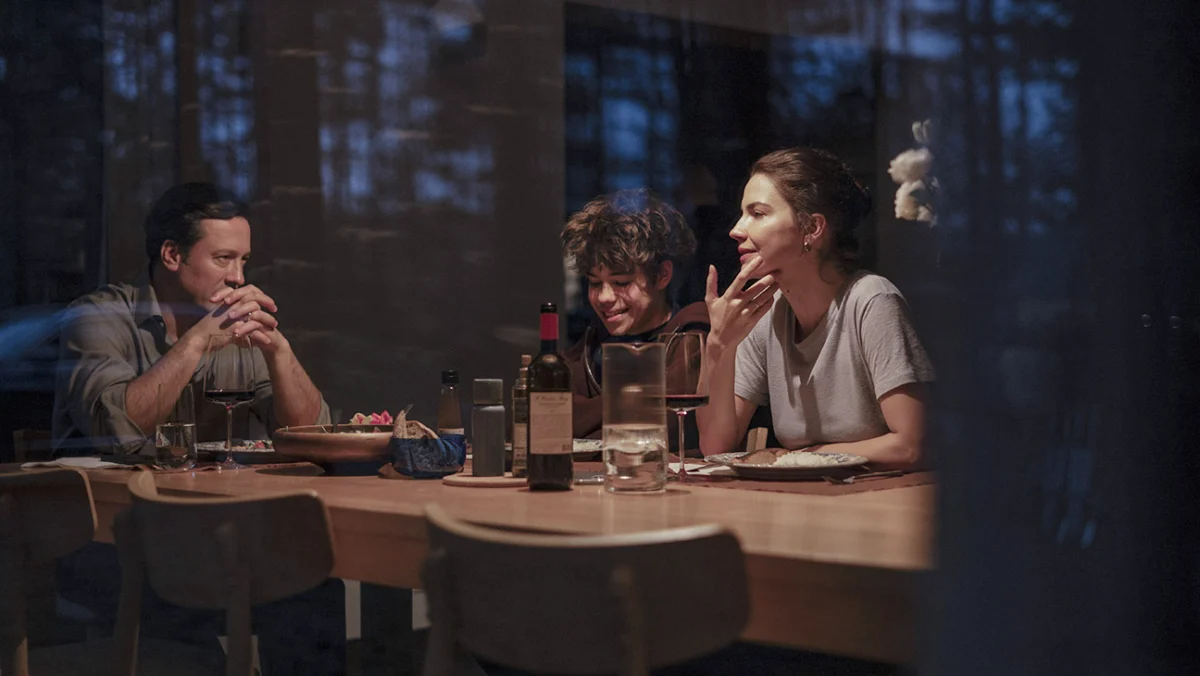
Amidst this national tragedy, Gleb Morozov grapples with a crisis much closer to home: his wife Galina (Iris Lebedeva) has become distant, her phone a source of secret smiles, her hairdresser visits yielding no noticeable change to her coif. Living in a luxurious, modern house in the rural outskirts – reminiscent of the opulent setting in Zvyagintsev’s Elena – the couple’s veneer of domestic tranquility begins to crack. Gleb’s suspicions lead him to employ his head of security, Nikolai (Mikhail Samodakhov), to investigate. The evidence reveals Galina’s affair with a photographer residing in a rundown social housing estate, a stark contrast to Gleb’s affluent world.
This marital infidelity, a direct echo of Chabrol’s source material, serves as a powerful microcosm for the broader betrayals and moral decay depicted in the film. The "cheating side of town" – a neighborhood of hundreds of units overlooking a scruffy wasteland, devoid of neighborly curiosity – becomes a symbolic space where clandestine acts and sudden, brutal deaths (often by defenestration, a recurring motif of "high places and plummeting") can occur with chilling anonymity. Photographs, too, play a crucial role, capturing moments of lost happiness, erotic abandon, or younger, untransfigured selves, serving as both truth-exposing clues and totems of a vanished past.
The script, a collaboration between new collaborator Simon Lyashenko and Zvyagintsev, is lauded for its rigorous economy and granular detail. A 20-minute sequence in the film’s middle is singled out for its gruesome, comical, and crucial propulsion of the story, demonstrating the director’s refined narrative control. The film’s meticulous construction ensures that "nothing is random or accidental," every detail, from a throwaway comment about house cleaning to the background figures, contributes to the overarching critique.
Exile, Evolution, and Artistic Liberation
Zvyagintsev’s personal experiences – his brush with death and subsequent exile – appear to have liberated and refined his cinematic skills. While Minotaur is his first adaptation of pre-existing material, the reworking is described as akin to a jazz virtuoso covering another artist’s tune, tweaking rhythms and keys to find new feelings within the melody. This approach allows the film to resonate deeply with contemporary anxieties while honoring its thematic origins.
Unlike some of his earlier, lengthier works like The Banishment or even Loveless, Minotaur, despite its 141-minute runtime, never feels "dragged out or bloated." Critics suggest it is more dramatically concise than Loveless and, for all its profound Russian sensibility, more accessible than Leviathan, positioning it to potentially reach a wider international audience. This accessibility, however, does not diminish its thematic depth or critical bite. Instead, it amplifies Zvyagintsev’s message, making his critique of state authority, personal compromise, and the devastation of war resonate beyond niche art-house circles.
The Broader Implications: A Voice from Exile
The context of Minotaur within the larger landscape of Russian cinema and global geopolitics cannot be overstated. Prior to 2022, films addressing Russia’s various military interventions were rare, particularly those produced within Russia itself. Sergey Loznitsa’s 2018 drama Donbass, which also played in competition at Cannes, required Western audiences to be educated on the presence of "little green men" – Russian military invaders – in Ukraine, a conflict few outside the region were tracking. Minotaur arrives at a time when the world’s awareness of the war in Ukraine is dramatically different, even if the conflict has been edged off the front pages. It is the "unignorable entity" that shapes any discussion of Russia.
Zvyagintsev’s decision to make such an openly critical film from exile represents a potent act of artistic defiance. In an environment where independent media and artistic expression are increasingly suppressed within Russia, exiled artists like Zvyagintsev become crucial voices. Their work serves as a powerful counter-narrative to state propaganda, offering perspectives that are otherwise silenced. The "safety fears" for Zvyagintsev and his collaborators are not mere speculation; Russia’s history of persecuting critics and dissidents, both at home and abroad, lends a chilling reality to these concerns.
Minotaur explores the many shades of toska, from the devastation of personal loss to the profound powerlessness in the face of state authority. A brilliant near-final scene, depicting soldiers being shipped out, encapsulates this despair. The film leaves the audience with a foreboding sense that things, as dire as they may seem, are poised to become even worse, a feeling perfectly captured in an airplane scene far above fluffy, photogenic clouds. It is a testament to Zvyagintsev’s enduring vision and courage, offering a mirror to a nation grappling with its identity and its actions, while reminding the world of the profound human cost of conflict and control.