Che Guevara: The Last Companions, a documentary directed by Christophe Dimitri Réveille and narrated by the acclaimed French actor Vincent Lindon, debuted at the Cannes Film Festival, offering a granular look at the final months of Ernesto "Che" Guevara’s life through the eyes of those who survived his ill-fated Bolivian campaign. The film, which runs for 98 minutes, attempts to bridge the gap between the mythic status of the Argentine revolutionary and the harsh, grounded reality of his final insurgency. By blending rare archival footage, animated reconstructions, and contemporary interviews with the last living witnesses of the 1967 conflict, Réveille seeks to document a 2,400-kilometer survival trek that followed the execution of Guevara. However, the production has sparked significant debate regarding its stylistic choices, its focus on specific European geopolitical connections, and its overall contribution to the extensive body of work surrounding the Cold War icon.
Historical Background: The Bolivian Campaign of 1967
To understand the narrative of the film, one must look back at the geopolitical climate of the mid-1960s. After the success of the Cuban Revolution in 1959, Ernesto "Che" Guevara became a central figure in the new government but eventually grew restless with administrative duties. Driven by the "foco" theory of revolution—the belief that small, fast-moving paramilitary groups could provide the spark for a general uprising—Guevara left Cuba in 1965. After a failed attempt to export revolution to the Congo, he turned his sights toward Bolivia in 1966.
The Bolivian campaign was intended to create a "second or third Vietnam" in South America, drawing the United States into a multi-front conflict. Guevara arrived in the remote Ñancahuazú region under a pseudonym, leading the National Liberation Army of Bolivia (ELN). The group consisted of approximately 50 guerrillas, including several veteran Cuban officers and local Bolivian recruits. Unlike the Cuban experience, the Bolivian insurgency struggled from the outset. The local peasantry remained largely indifferent or hostile, and the Bolivian military, supported by U.S. Special Forces and CIA advisors, proved more resilient and organized than anticipated.
Chronology of the Final Stand and the Great Escape
The documentary focuses heavily on the endgame of this campaign, which culminated in the Battle of Yuro Ravine in October 1967. The following timeline outlines the pivotal moments that the film and historical records identify:
- October 8, 1967: The guerrilla group is cornered in the Quebrada del Yuro. During a fierce firefight, Guevara is wounded in the leg and his pistol is rendered inoperable. He is captured by the Bolivian Army’s 2nd Ranger Battalion.
- October 9, 1967: Following orders from the highest levels of the Bolivian government, and after consultation with intelligence agencies, Guevara is executed in the village schoolhouse of La Higuera.
- The Aftermath (October 1967 – February 1968): While the world focused on Guevara’s death, a small remnant of his force remained at large. Three Cuban survivors—Harry Villegas (known as "Pombo"), Dariel Alarcón Ramírez ("Benigno"), and Leonardo Tamayo Núñez ("Urbano")—began a harrowing journey to escape the country.
The film details how these "shadow warriors" navigated 2,400 kilometers of treacherous terrain, ranging from dense jungles to the high Andean plateaus. Pursued by approximately 4,000 Bolivian soldiers, the survivors relied on survivalist tactics and the loyalty they held for their fallen leader. Their journey eventually led them across the border into Chile, where they were granted asylum by then-Senator Salvador Allende, eventually returning to Cuba as heroes.
Production Elements and Narrative Technique
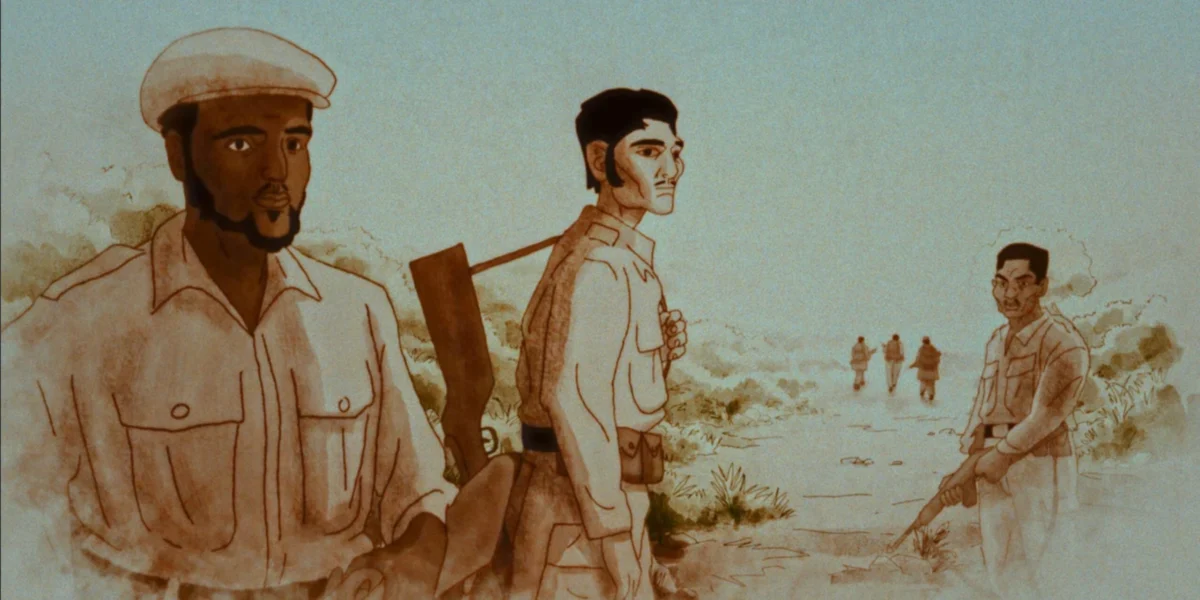
Christophe Dimitri Réveille utilizes a multi-disciplinary approach to tell this story. Because the actual 1967 footage of the retreat is non-existent, the film employs stylized animation to recreate the tension of the jungle pursuit. These sequences are intended to provide a visual rhythm to the narrative, breaking up the "talking head" interviews that form the backbone of the documentary.
The inclusion of Vincent Lindon as the narrator was a deliberate choice by the production team. Lindon, a heavyweight of French cinema and winner of the Best Actor award at Cannes for The Measure of a Man, brings a somber, gravelly tone to the proceedings. His narration is designed to reflect the gravity of the historical events, though some critics have noted that his delivery borders on the detached, perhaps reflecting the film’s overall clinical approach to the subject matter.
The interviews themselves feature the last surviving members of Guevara’s inner circle. These men, now in their eighties and nineties, offer reflections that oscillate between ideological fervor and the weary nostalgia of soldiers who have outlived their cause. The film also grants screen time to those on the other side of the conflict—the former soldiers and officials who hunted the guerrillas—providing a rare, albeit brief, look at the perspectives of the Bolivian military.
Critical Analysis and Thematic Reception
Since its screening at Cannes, Che Guevara: The Last Companions has faced a mixed reception from historians and film critics. While the film is praised for its archival discoveries—some of which have rarely been seen in a high-definition format—it has been criticized for its aesthetic and structural choices.
One primary point of contention is the film’s production value. Some reviewers have described the interview segments as lacking cinematic depth, comparing the visual style to low-budget television documentaries of the late 20th century. The lighting and set design of the contemporary interviews have been characterized as sparse, failing to capture the epic scale of the story being told.
Furthermore, the documentary has been scrutinized for its perceived "French-centric" lens. Despite the events taking place in the heart of South America and involving Cuban and Bolivian nationals, the film places a significant emphasis on French connections. This likely refers to the involvement of French intellectual Régis Debray, who was captured and imprisoned in Bolivia during the campaign, and the broader fascination the French left held for Guevara during the 1960s. Critics argue that this focus occasionally distracts from the local geopolitical realities of the Cold War, such as the direct influence of the Soviet Union and the United States’ "Operation Condor" framework.
The Iconography vs. The Reality
A central theme of the documentary is the tension between the "Che" of pop culture and the "Che" of history. The film opens with reflections on how Guevara’s image—specifically the "Guerrillero Heroico" photograph taken by Alberto Korda—has been commodified into a fashion statement, often divorced from the violent and complex reality of his life.
By focusing on the "Last Companions," Réveille attempts to strip away the t-shirt iconography. The men interviewed do not speak of a saint, but of a demanding commander who led them into a tactical nightmare. The documentary highlights the contradictions of the Bolivian mission: a quest that was theoretically noble in its pursuit of liberation but practically flawed by a lack of local support and a misunderstanding of the Bolivian social fabric.
The film explores the increasingly strained relationship between Guevara and Fidel Castro’s regime in Havana. Historical data suggests that by 1967, Guevara felt isolated, and some historians argue that the support he expected from Cuba was withheld as the island moved closer to the Soviet orbit. The testimony of the survivors in the film touches upon these feelings of abandonment, adding a layer of tragedy to their 2,400-kilometer trek.
Broader Impact and Historical Implications
As a historical document, Che Guevara: The Last Companions serves as a reminder of the human cost of the Cold War’s "proxy" conflicts in Latin America. The 1960s were a decade of intense revolutionary fervor, and Guevara’s death marked the end of an era for the armed left in the region.
The film’s release comes at a time when Latin American history is being reassessed through new lenses. For younger audiences, the documentary provides a necessary, if flawed, primer on the stakes of the 1967 campaign. For historians, the value lies in the first-hand accounts of the survivors, whose deaths will eventually close the door on living memory of the event.
In terms of cinematic impact, the film highlights the difficulty of capturing "revolutionary" history on film without falling into the traps of hagiography or dismissive criticism. By attempting to tell the story of the survivors rather than the martyr, Réveille tries to find a middle ground. Whether the film succeeds in its mission is a matter of debate; while it brings new voices to the table, its presentation has left some viewers wishing for a more robust and cinematically ambitious treatment of such a significant historical epoch.
Conclusion
Che Guevara: The Last Companions remains a polarizing addition to the canon of revolutionary cinema. It is a film that demands an interest in the minutiae of military history and the psychological toll of long-term insurgency. While it may not satisfy those looking for a high-octane thriller or a definitive political analysis, it offers a somber look at the men who were left behind when the flashbulbs of history moved on. As the final survivors of the Yuro Ravine fade from the stage, this documentary stands as one of the final attempts to record their voices before the jungle of time swallows their story entirely.