Yu Murai’s audacious theatrical production, "HAMLET | TOILET," staged by KPR/Kaimaku Pennant Race at the Craiova International Shakespeare Festival, has ignited discussions and provoked audiences with its unapologetically raw and deeply unconventional reimagining of Shakespeare’s classic tragedy. Founded in Tokyo in 2006 by Murai, KPR (Kaimaku Pennant Race) is renowned for its contemporary Japanese theatre that fearlessly deconstructs canonical works, injecting them with elements of kabuki, noh, anime, manga, and modern pop culture. This latest offering is no exception, pulling "Hamlet" from the hallowed halls of Elsinore into the most private, vulnerable, and often ridiculous of human spaces: the toilet. The result is a performance described as deliberately vulgar, visually extreme, physically demanding, frequently hilarious, and surprisingly profound in its exploration of how basic bodily functions connect to themes of cowardice, sanity, revenge, grief, and the struggle to move forward from paralyzing trauma.
KPR: A Legacy of Radical Reinterpretation
KPR/Kaimaku Pennant Race has established itself as a significant voice in international experimental theatre, carving out a unique identity through its theatrical collisions. The company’s artistic philosophy, spearheaded by Yu Murai, centers on challenging conventional interpretations and pushing the boundaries of what theatre can be. Murai’s vision involves stripping away pretension and confronting audiences with visceral, immediate experiences that resonate with contemporary anxieties. This approach was evident early in their trajectory with "ROMEO and TOILET," which garnered international attention during its run in New York in 2009. The success of this early work paved the way for further international tours, including "1969: A Space Odyssey? Oddity!", which traveled to prestigious festivals in Tunisia, Romania, Thailand, and South Korea, solidifying KPR’s reputation for innovative and boundary-pushing productions. The company’s consistent engagement with global audiences and its critical acclaim underline its commitment to fostering dialogue between Japanese aesthetics and universal themes, often filtered through a distinctly absurdist and physical lens. Their return to Romania with "HAMLET | TOILET" at the Craiova International Shakespeare Festival underscores their ongoing influence and the festival’s dedication to showcasing diverse and challenging theatrical forms.
The Craiova International Shakespeare Festival: A Hub for Global Theatre
The Craiova International Shakespeare Festival, a biennial event, is recognized globally as a premier platform for Shakespearean performance and scholarship. Established in 1994, the festival has grown to host some of the world’s most innovative directors and companies, presenting a wide spectrum of interpretations, from traditional to avant-garde. Its mission extends beyond mere performance, aiming to foster international cultural exchange and stimulate critical discourse on Shakespeare’s enduring relevance in a constantly evolving world. The inclusion of "HAMLET | TOILET" in its program for 2026 (as suggested by the image timestamp) reflects the festival’s openness to radical interpretations and its commitment to presenting works that challenge conventional theatrical norms. Festival organizers often seek productions that provoke thought and push artistic boundaries, making KPR’s work a fitting, albeit controversial, choice. The festival’s reputation for showcasing groundbreaking theatre ensures that such a provocative piece receives a significant international platform, inviting both praise and debate.
"HAMLET | TOILET": An Unflinching Premise
The core concept of "HAMLET | TOILET" is deceptively simple yet profoundly unsettling: Hamlet is depicted reading Shakespeare’s tragedy while engaged in the most mundane and private of human acts – defecating. From this seemingly absurd image, Murai constructs an entire theatrical universe where the quintessential existential question, "To be or not to be," is recontextualized within the realm of digestion, excretion, blockage, release, and relentless repetition. Elsinore, traditionally a court of political intrigue and moral decay, is transformed into a symbolic bathroom, a liminal space where the protagonist finds himself trapped between thought and action, between the urgent desire to expel something and the agonizing inability to do so.
The production deliberately eschews a conventional linear synopsis of Shakespeare’s tragedy. Instead, it fragments "Hamlet" into a series of highly stylized, often grotesque, and frequently hilarious vignettes. The narrative is driven by a constant stream of narration delivered in the toilet, punctuated by graphic fart jokes, dynamic hip-hop dance sequences, and pervasive repetition. This relentless barrage of language and imagery rarely allows the audience a moment of repose, mirroring Hamlet’s own tormented mind and his inability to escape his internal turmoil. The performance is designed to be an assault on the senses, forcing viewers to confront the play’s themes through an entirely new, visceral, and often uncomfortable lens.
The Unabashed Theatrical Language of the Grotesque
While "HAMLET | TOILET" revels in its own excessiveness, its provocative nature is far from a mere gimmick. The humor is loud, aggressively physical, and deeply scatological, often intentionally pushed beyond the limits of conventional taste. Farts are elevated to theatrical punctuation, serving as sonic underscores to moments of existential crisis or absurd relief. A particularly striking example of the production’s commitment to the grotesque is the "tube scene," which pushes absurdity to an almost unbearable degree, leaving audiences oscillating between laughter and discomfort.
The repeated phrase, "you don’t know unless you wipe and see," transcends its initial function as a crude toilet joke. It evolves into a profound philosophical statement, suggesting that truth is not an abstract concept to be intellectually apprehended but something tangible, discovered through direct, often messy, contact with the body and its inherent dirtiness. In Murai’s vision, Shakespeare is not diminished by this embrace of vulgarity; rather, the director posits that "Hamlet" has always been as much about the body as it is about the mind. It is a body that hesitates, decays, leaks, suffers, and stubbornly refuses to obey rational control, a body deeply implicated in the tragedy’s unfolding. This subversion of the dignified intellectual pursuit of truth into a bodily, excretory act highlights Murai’s radical approach to engaging with classic texts, making them relevant and resonant in a contemporary, often uncomfortable, context.
A Tapestry of Trauma and Repetition: Japan’s Lingering Wounds
Beneath the layers of laughter and scatological humor lies a darker, more profound cultural context. As Yu Murai elucidated during a post-performance discussion, the pervasive theme of repetition within the production is intrinsically linked to fear, pain, sorrow, and the cyclical patterns through which individuals and societies attempt to survive profound trauma. Murai specifically connected this idea to the devastating Great East Japan Earthquake of March 11, 2011, and the subsequent Fukushima Daiichi nuclear disaster. This catastrophic event, followed by widespread misinformation and allegations of falsified documents, left a generation grappling with an enduring sense of unease and a society forced to continue living amidst official obfuscation and unresolved wounds.
This background imbues the repeated scenes, phrases, and physical actions with a weight that far transcends mere comedic effect. The performance repeats because trauma repeats. The characters are stuck in a loop, their bodies returning to the same positions, their narratives echoing the unresolved societal wounds that persist. The inability to move forward, to find release, to fully comprehend or escape the consequences of disaster, is powerfully embodied in the play’s structure. The sense of being trapped, both physically within the toilet space and psychologically within cycles of memory and pain, becomes a metaphor for the collective experience of a nation grappling with its recent history. This deep contextualization elevates the play beyond mere shock value, transforming it into a poignant commentary on collective memory, resilience, and the difficult process of healing.
The Toilet as a Confessional and Subversive Space
In "HAMLET | TOILET," the toilet setting is not merely a stage; it transforms into a potent symbol, functioning as a confessional booth, a site of vulnerability, and a locus of subversive truth-telling. Private bodily acts, typically concealed, are overtly connected to broader societal anxieties: radiation, illness, shame, familial bonds, and the hidden, often insidious, effects of contamination. The toilet, in this sense, transcends its roles as merely funny or disgusting. It becomes one of the few spaces where individuals are truly alone with themselves, stripped bare of public performance, social masks, and external pressures.
Murai’s bold deployment of scatological imagery, therefore, possesses a genuinely subversive edge. It democratizes Shakespeare, bringing the elevated discourse of the royal chamber and existential philosophy down to the level of the cubicle. Here, monumental questions of life and death, morality, and justice are not nobly declaimed but are instead pushed through the raw, unfiltered experiences of physical pain, constipation, embarrassment, and the fundamental realities of human biology. This act of artistic degradation serves to highlight the inherent human frailty that underlies even the grandest narratives, arguing that our most private, undignified moments often reveal the most profound truths about our existence. By placing the tragedy in this most intimate and unglamorous of settings, Murai forces the audience to reconsider the very nature of human dignity and vulnerability.
The Ensemble’s Demanding Performance: A Study in Endurance
Central to the profound impact of "HAMLET | TOILET" is the extraordinary commitment and physical endurance of its acting ensemble. Takuro Takasaki, G.K. Masayuki, and Atsuyuki Tanaka deliver performances that demand both relentless verbal speed and grueling physical stamina. The delivery of lines is almost nonstop, creating an oppressive sense of pressure that mirrors the protagonist’s inability to release himself from the relentless grip of thought, memory, and bodily discomfort.
The performers are engaged in a constant cycle of running, squatting, sweating, and dancing, repeating movements with an intensity that often appears almost sadomasochistic in its demands. This is particularly evident in extended scenes, such as those where two actors successively sit underneath a tube that pours a continuous stream of stones upon them for a significant duration. During the post-performance discussion, Murai clarified that the company does not embrace sadomasochism as an artistic principle. Instead, he explained that the extreme intensity and physical strain are directly connected to the play’s overarching focus on pain and sorrow, on the inescapable weight of trauma. Nevertheless, the physical exertion is palpable and impossible to ignore, becoming an integral part of the piece’s meaning, embodying the characters’ psychological and emotional torment through sheer corporeal suffering. The actors’ unwavering commitment transforms their bodies into instruments of both comedy and profound anguish, making the audience keenly aware of the physical toll of existential crisis.
Minimalist Design, Maximalist Impact: A Sensory Assault
Visually, "HAMLET | TOILET" adopts a minimalist aesthetic, yet its impact is maximalist and immersive. Natsuko Takebe’s set design is sparse but highly symbolic, utilizing basic elements such as toilet paper, pipe-like structures, and a limited array of objects to evoke a bathroom space rather than realistically depict it. This deliberate absence of conventional props is ingeniously compensated by a sophisticated integration of sound and video, which become crucial components of the stage language, complementing the necessary subtitles for international audiences.
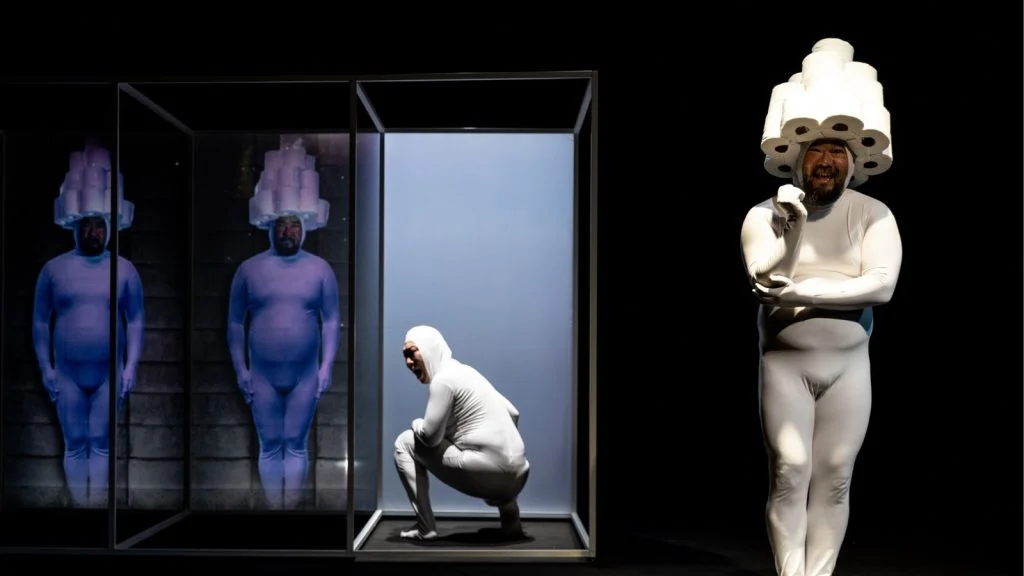
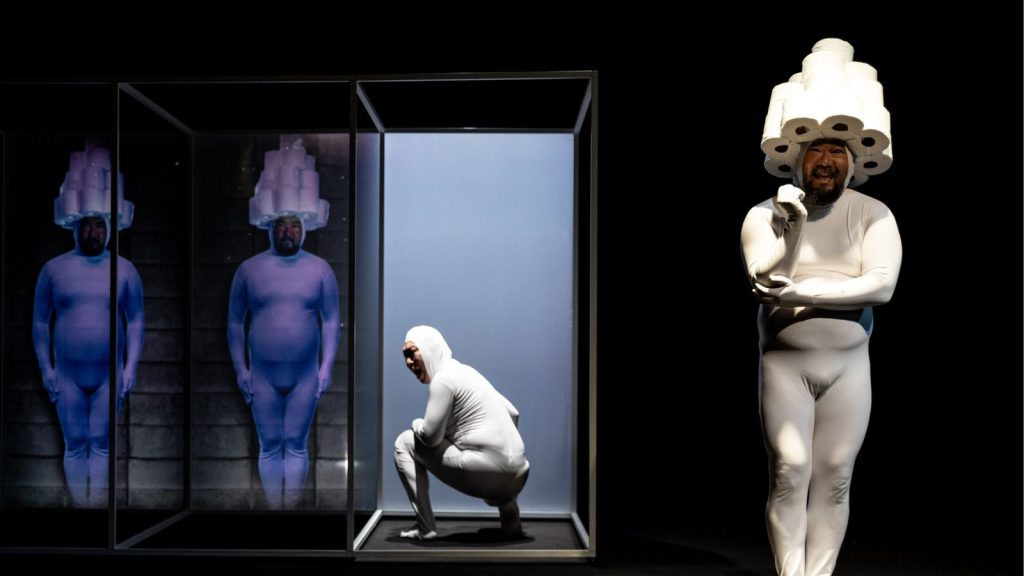
Takashi Kawasaki’s video design and Tsutchie’s intricate sound and music design collaboratively create a multi-layered world where media culture, primal bodily functions, and the gravitas of Shakespearean tragedy constantly interrupt, juxtapose, and inform one another. Ryuichi Okino’s dynamic lighting design deftly supports the rapid shifts in mood, transitioning seamlessly between moments of broad comedy, profound discomfort, ritualistic action, and nightmarish sequences. Akane Sato’s costume design further amplifies the play’s unique aesthetic. The performers are clad in white full-body suits and toilet-paper-like hats, transforming them into enigmatic figures that hover somewhere between clowns, hospital patients, ghosts, and abstract representations of human waste, blurring the lines between the absurd and the tragic.
Sound, in particular, plays a pivotal role in the production’s sensory assault. The auditory landscape is rich and varied, incorporating elements of rap and hip-hop rhythms, exaggerated fart noises, repetitive musical motifs, and the unsettling sound of falling pebble-like objects. This cacophony contributes to the overall immersive and often overwhelming experience. Shinnosuke Motoyama’s choreography further reinforces this energy, especially during the high-octane hip-hop sections, where the performers’ bodies become both comic instruments and suffering machines. The cumulative effect is a performance that transcends traditional theatrical categorization, feeling closer to a theatrical installation or a visceral bodily concert than to a conventional adaptation of Shakespeare.
Audience Reception and the Challenge of Excess
"HAMLET | TOILET" is undeniably a challenging work, and its reception at the Craiova International Shakespeare Festival underscored its polarizing nature. The production’s inherent excessiveness is both its core artistic statement and its primary challenge for viewers. Some sequences deliberately stretch their jokes and conceptual repetitions to the point of exhaustion, while the constant barrage of scatological imagery and sound can easily alienate audiences accustomed to a more conventional or decorous relationship between Shakespeare and theatrical interpretation. Indeed, reports from the Craiova performance indicated that a number of attendees chose to leave before the play concluded.
Yet, this very discomfort is precisely what Murai intends and what makes the production so memorable and impactful. Murai’s objective is not simply to adorn Shakespeare with contemporary Japanese pop culture references. His aim is far more radical: to compel the audience to sit within a space where thinking, defecating, remembering, laughing, and suffering become inextricably intertwined. The intentional provocation serves to dismantle the audience’s preconceived notions of theatre, dignity, and even Hamlet himself, forcing a confrontation with raw, unfiltered humanity.
Broader Implications for Contemporary Theatre
"HAMLET | TOILET" stands as a genuinely radical interpretation of Shakespeare’s enduring tragedy, turning the conventional narrative upside down and inviting audiences to glimpse profound truths from this undignified, yet revelatory, angle. It is a work that is crude, intelligent, excessive, physically demanding, and often uproariously hilarious. However, beneath the graphic farts and symbolic toilet paper lies a serious and urgent meditation on trauma, the cyclical nature of repetition, the paralysis of inaction, and the body’s stubborn, undeniable refusal to be ignored.
The production’s success, despite its challenging nature, lies in its ability to provoke critical thought and emotional response. It demands from its audience a certain openness to its particular brand of humor and an appreciation for intense, sometimes discomforting, repetition. In an era where classical texts are constantly being re-evaluated, KPR’s "HAMLET | TOILET" offers a compelling case for the enduring power of radical adaptation to unlock new meanings and connect ancient narratives to contemporary anxieties. It asserts the continued relevance of experimental theatre in pushing artistic boundaries and challenging societal norms. Ultimately, "HAMLET | TOILET" is a performance that, regardless of individual taste or comfort level, cannot be ignored, solidifying its place as a significant, albeit controversial, contribution to the global theatrical landscape.