In the rugged landscape of northeastern France, a region defined by its dense forests and sprawling agricultural plains, a simmering conflict between two distinct social classes has reached a violent breaking point. Directed and written by Sarah Arnold in her feature debut, the film Too Many Beasts presents a multi-layered narrative that functions simultaneously as a rural whodunnit, a dark comedy, and a poignant social commentary on the state of modern provincial life. The story centers on a devastating ecological and economic crisis: an overpopulation of wild boars that has turned the countryside into a literal and figurative battlefield.
The narrative begins by establishing the high stakes of this agrarian struggle. On one side are the local farmers, represented by Brun, a grain producer whose livelihood is being systematically dismantled by the encroaching wildlife. On the other are the wealthy landowners and hunting associations who have a vested interest in maintaining a high population of boars for sport. These "beasts," kept well-fed and numerous to provide trophies for the affluent, have become an existential threat to the working-class residents of the region. When the pressure becomes unbearable, Brun suffers a psychological breakdown and vanishes, leaving a void that remains unfilled for a year.
Chronology of an Investigation
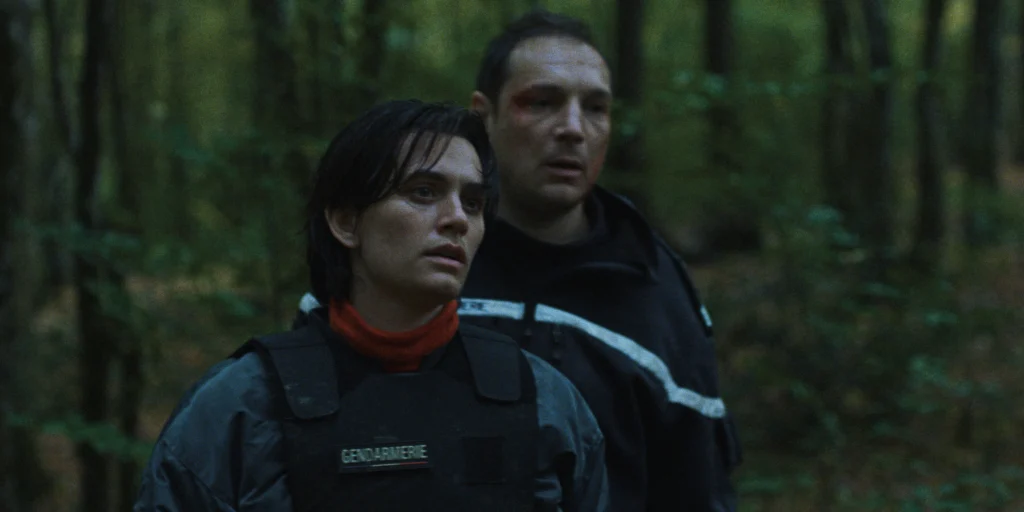
The timeline of Too Many Beasts is split by a twelve-month hiatus that shifts the film from a survivalist drama into a procedural of a different sort. Following the prologue detailing the farmers’ grievances and Brun’s disappearance, the narrative resumes with the arrival of Sergeant Orsino. A Corsican police officer played by Alexis Manenti, Orsino is a man in the midst of a personal and professional collapse. Exiled from the mainland’s more prestigious jurisdictions to this rural outpost, his transfer is revealed to be a consequence of a psychological breakdown.
The investigation into the "cold case" of Brun’s disappearance and the suspected murder that followed is not a matter of high-stakes detective work initially, but rather a pursuit born of professional boredom and a refusal to yield to his own mental instability. Orsino’s progress is tracked through his interactions with Stéphane, portrayed by Ella Rumpf. Stéphane is a police therapist tasked with evaluating Orsino’s fitness for duty, though she admits her own limitations within the bureaucratic system. Together, this unlikely duo—a disgraced cop and a therapist harboring her own secrets—navigates a web of local corruption, class resentment, and environmental mismanagement.
Socio-Economic Context: The Real-World Boar Crisis
While Too Many Beasts is a work of fiction, its premise is rooted in a very real and escalating crisis within the European agricultural sector. The "war" between farmers and hunters in France is a documented phenomenon. Data from the French National Federation of Hunters (FNC) and agricultural unions indicate that wild boar populations have surged over the last two decades. This growth is attributed to a combination of milder winters, changes in agricultural practices—specifically the increased cultivation of maize—and historical breeding practices intended to maximize hunting yields.
In France, the financial implications are significant. Under current regulations, hunting federations are legally required to compensate farmers for crop damage caused by big game. In recent years, these compensation payments have exceeded €30 million annually, a figure that has placed immense financial strain on both the hunting associations and the farmers who feel the payouts are insufficient to cover their total losses. This economic tension creates a volatile social environment, mirrored in the film’s depiction of "deep-rooted animus" and "tempers rising to a boiling point."
Character Analysis and Performance
The strength of the film lies in its unconventional leads. Alexis Manenti, known for his gritty performance in Ladj Ly’s Les Misérables, brings a "manic joy" to the role of Orsino. His character is defined by a sense of liberation that comes from having hit rock bottom. This is exemplified in a scene where he drives his vehicle into a road barrier simply to witness the "fireworks of sparks" produced by the impact—a visual metaphor for his internal chaos.
Ella Rumpf, who garnered international acclaim for her role in Julia Ducournau’s Raw, provides a necessary counterpoint as Stéphane. Her character subverts the trope of the stoic, all-knowing therapist. Instead, she is presented as a flawed professional who finds a strange kinship with the man she is supposed to be "fixing." The chemistry between Manenti and Rumpf elevates the film from a standard genre piece into a character-driven study of isolation and resilience. The supporting cast, featuring veteran actors such as Bernard Blancan and Thierry Godard, rounds out a "deep bench" of character performers who lend authenticity to the provincial setting.
Genre Fluidity and Directorial Vision
Sarah Arnold’s direction refuses to be pinned down to a single category. The film has been described as a "punkish farce" and an "agrarian whodunnit," yet it evades these definitions by blending elements of French "polar" (crime fiction) with absurdist humor. Arnold, along with a writing team including Jérémie Dubois and Olivier Seror, utilizes a "writer’s room" approach to dialogue that results in sharp, well-timed comedic sequences. One notable highlight involves the protagonists accidentally consuming narcotics before embarking on a "quixotic investigation," a scene that highlights the film’s willingness to embrace the surreal.
The visual language of the film contrasts the natural beauty of the French countryside with the "mess" created by both the humans and the animals. The cinematography captures the forest not as a serene escape, but as a site of conflict and hidden violence. This aesthetic choice aligns with the film’s broader themes of environmental degradation and the breakdown of social order.
Official Responses and Internal Power Dynamics
Within the world of the film, the institutional response to the crisis is portrayed as indifferent or actively obstructive. The police captain at Orsino’s station characterizes his subordinates as "losers" foisted upon him by a system that prioritizes optics over justice. This cynical view of authority suggests that the legal and social structures intended to mediate the farmer-hunter conflict are themselves broken.
The arbitrary exercise of power by the captain and the local landowners reflects a broader suspicion of institutions. As Orsino’s "incisive detection" begins to uncover uncomfortable truths, the reaction from those in power is one of suppression rather than support. This dynamic serves as a microcosm for the larger political themes of the film, where the marginalized—whether they be ruined farmers or exiled police officers—are left to navigate a system that views them as expendable.
Broader Impact and Implications
Set in the near future of 2026, Too Many Beasts carries a distinct political resonance. The film explores the "shadow of populism," a movement often fueled by the perceived abandonment of rural populations by urban elites. The conflict between the local farmers (the proletariat) and the wealthy hunting association members (the bourgeoisie) is a classic class struggle reimagined through an ecological lens.
The title itself, Too Many Beasts, serves as a double entendre. While it refers to the literal overpopulation of boars, it also points toward the "beast" within human nature—the capacity for violence, greed, and the "beast in me" that Stéphane and Orsino both recognize in themselves. The film suggests that the chaos in the countryside is merely a reflection of the internal chaos of its inhabitants.
As a debut feature, Sarah Arnold’s work is a significant entry into the tradition of atypical French comedies, drawing comparisons to Jean-Pierre Jeunet’s Delicatessen. While it maintains its own unique identity, it operates within a lineage of films that use absurdity to critique social norms. The "punkish energy" and the refusal to offer easy resolutions make it a standout piece of contemporary European cinema.
In conclusion, Too Many Beasts is more than a simple rural mystery. It is a dense, intellectually stimulating exploration of the friction between man and nature, class tensions in provincial France, and the thin line between sanity and collapse. By grounding its narrative in the very real agricultural crises of the 21st century, the film provides a factual and emotional resonance that lingers long after the credits roll. The humans and the boars may create an equal amount of mess, but as the film poignantly illustrates, only one of those species has the capacity to understand the consequences of the destruction they leave behind.