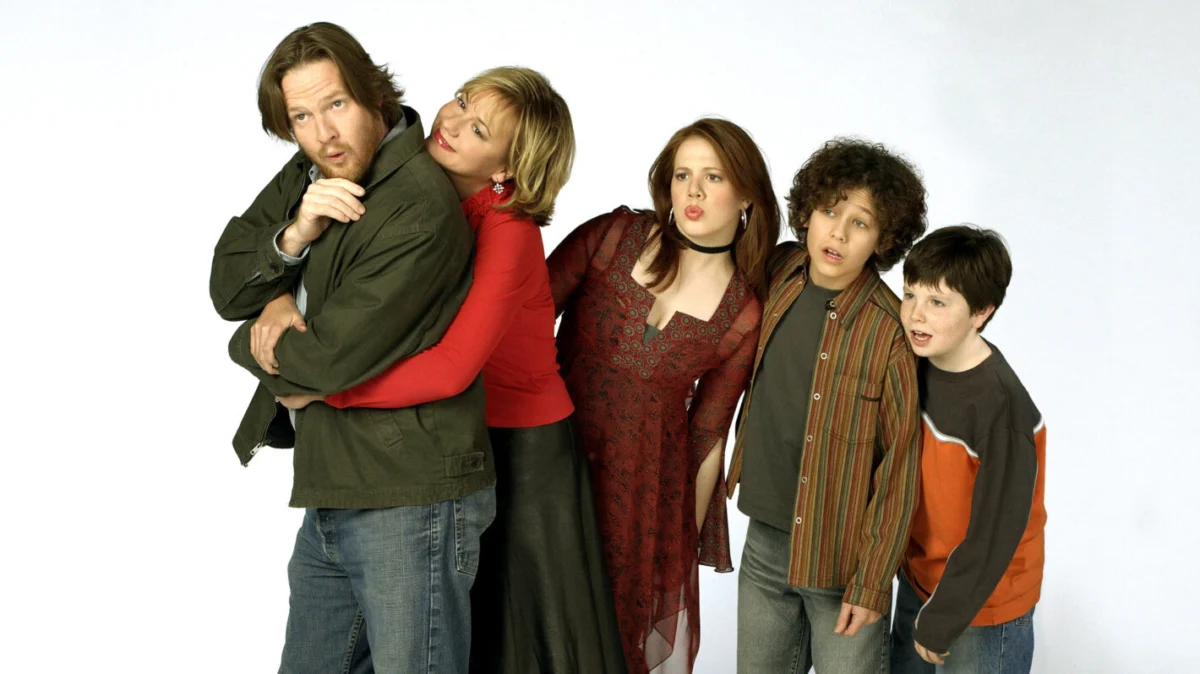
The series premiered on January 10, 2001, on the Fox Broadcasting Company, introducing a distinctive narrative style to the American family sitcom genre. Created by Bill Martin and Mike Schiff, both alumni of the critically acclaimed series 3rd Rock from the Sun, the show diverged from the traditional "perfect parent" archetype that dominated 1980s and 1990s television. Instead, it centered on Sean and Claudia Finnerty, a young couple living in the blue-collar neighborhood of Staten Island, New York. Having married and started their family while still in their teens, the Finnertys were portrayed as parents who were still navigating the complexities of adulthood alongside their three—and later four—children. This foundational premise provided a platform for a more grounded, albeit comedic, exploration of generational conflicts and the realities of working-class family life.
The Evolution of the Finnerty Family Narrative
The core of the series was built around the chemistry of its lead actors, Donal Logue and Megyn Price. Logue, portraying Sean Finnerty, brought a frantic yet relatable energy to the role of a father trying to balance his responsibilities at an underground utility company with his own lingering youthful impulses. Megyn Price, as Claudia, served as the pragmatic yet equally overwhelmed matriarch. The show’s primary conflict often stemmed from the fact that the parents were not much more mature than their oldest daughter, Lily, played by Lynsey Bartilson.
Throughout its five-season run, the series expanded its scope to include a robust supporting cast that added layers to the Staten Island setting. Kevin Corrigan’s portrayal of Eddie Finnerty, Sean’s eccentric and perpetually scheming brother, became a fan favorite, often serving as the catalyst for the family’s more absurd predicaments. Richard Riehle played Walt Finnerty, the stern, traditionalist grandfather whose disapproval of his son’s parenting style provided a consistent source of tension and humor. The younger children, Jimmy (Griffin Frazen) and Henry (Jake Burbage), rounded out the household, representing the chaotic middle-child and youngest-child dynamics respectively.
Chronological History: From Fox to The WB
The production history of the series is marked by a significant transition between major networks, a move that was relatively uncommon for successful sitcoms at the turn of the millennium.
- The Fox Era (2001–2002): The series launched as a mid-season replacement on Fox, where it initially benefited from a strong lead-in and the network’s reputation for edgy, counter-cultural programming. During its first two seasons, the show established its unique "Rashomon-style" storytelling technique, frequently using non-linear structures and flashbacks to reveal how the characters ended up in their current predicaments.
- The Cancellation and Pickup (2002–2003): Despite a loyal following and respectable ratings for its time slot, Fox canceled the series during its third season. Industry analysts at the time attributed the move to the network’s shifting focus toward reality television and high-concept dramas. However, the show’s production company, Carsey-Werner (the powerhouse behind The Cosby Show and Roseanne), successfully negotiated a move to The WB.
- The WB Era (2003–2005): On The WB, the series found a second life, anchoring the network’s comedy block. The move allowed the show to lean further into its coming-of-age themes, aligning with The WB’s younger demographic. It continued for an additional two and a half seasons before ultimately concluding in 2005.
- The Legacy of Syndication (2005–Present): Following its finale, the series entered off-network syndication, airing on various cable networks including ABC Family (now Freeform) and MTV2. In recent years, its acquisition by LAFF TV has introduced the Finnertys to a new generation of viewers, while its presence on streaming platforms has solidified its status as a cult classic of the early 2000s.
Structural Innovation and the "Rashomon" Effect
One of the most significant contributions of the series to the sitcom format was its innovative use of non-linear narrative structures. While most multi-camera sitcoms of the era followed a chronological "A-story/B-story" format, this show frequently began in media res. Episodes often opened with the parents discovering a disaster—such as a hole in the wall, a missing car, or a child in police custody—and then spent the remainder of the half-hour piecing together the events leading up to that moment through a series of interlocking flashbacks.
This technique allowed the writers to play with perspective. A single event would be shown multiple times from the differing viewpoints of Sean, Claudia, or the children, revealing discrepancies in their stories. This approach not only heightened the comedic tension but also mirrored the chaotic, often confusing nature of parenting and family communication. Critics at the time noted that this structure made the show feel more cinematic and intellectually engaging than its contemporaries.
Supporting Data: Ratings and Industry Impact
At its peak on Fox, the series reached an average of approximately 7.5 million viewers per episode, a figure that would be considered a major hit by modern broadcast standards. Its move to The WB saw a dip in total viewership to roughly 3 million, though it remained one of the network’s highest-rated comedies among the 18–34 demographic.
The series was also a critical success within the industry, earning an Emmy Award nomination for Outstanding Art Direction for a Multi-Camera Series and several Teen Choice Award nominations. Its production by Carsey-Werner is also a point of historical significance. As one of the last major independent production companies in Hollywood not owned by a conglomerate, Carsey-Werner’s ability to keep the show running across two different networks demonstrated the enduring power of the independent sitcom model.
Statements and Reactions: Behind the Scenes
While formal statements from the cast during the show’s initial run focused on the camaraderie of the set, later reflections by the creators and actors have shed light on the show’s creative philosophy. In various retrospective interviews, Bill Martin and Mike Schiff emphasized that the show was "an ode to the imperfect parent." They noted that their goal was to validate the experiences of parents who didn’t have all the answers and who occasionally made mistakes as large as those of their children.
Donal Logue has frequently spoken about the show with fondness, noting that the Staten Island setting was crucial to the show’s identity. He observed that the Finnertys represented a specific type of New York family—fiercely loyal, culturally Catholic, and unapologetically loud—that had rarely been depicted with such nuance on television. Megyn Price similarly praised the show for its refusal to sanitize the stresses of marriage, noting that Sean and Claudia’s relationship was built on a foundation of genuine friendship and shared struggle rather than the stereotypical "nagging wife/bumbling husband" trope.
Broader Impact and Cultural Implications
The series arrived at a pivotal moment in the evolution of the American family. By the early 2000s, the "nuclear family" model was being redefined, and the show was among the first to acknowledge the reality of "accidental" young parenthood without treating it as a tragedy or a moral failing. The Finnertys were competent, loving parents, even if they were still learning how to pay their bills on time or manage their own tempers.
Furthermore, the show’s portrayal of the working class was distinct. Unlike many sitcoms that use poverty as a punchline or ignore financial stress entirely, the series often touched upon the realities of Sean’s blue-collar job and the family’s constant efforts to make ends meet. This socioeconomic honesty, paired with its Staten Island roots, gave the show a sense of place that remains rare in the genre.
The show also served as a precursor to the "single-camera revolution" that would follow in the mid-2000s. While it was filmed in front of a live studio audience, its rapid-fire editing and non-linear jumps paved the way for shows like Arrested Development and Modern Family, which would later push the boundaries of sitcom structure even further.
Conclusion: The Finnerty Legacy in the Streaming Age
As the series continues its run on LAFF TV and remains a staple of digital libraries, its relevance persists. In an era where "prestige" television often focuses on dark, complex anti-heroes, the Finnertys offer a different kind of complexity: the messy, joyful, and often frustrating reality of a family that is simply trying to get through the week.
The 91-episode catalog stands as a testament to a specific era of television—one that was transitioning from the rigid structures of the 20th century to the more experimental and character-driven narratives of the 21st. For fans of the series and new viewers alike, the Finnertys remain a reminder that while parents might not always have the answers, the bond of family is often enough to weather the most chaotic of storms. The show’s enduring popularity in syndication suggests that its themes of youthful parenthood and working-class resilience are as universal today as they were when the show first aired on a cold January night in 2001.