The automobile, arguably the most transformative invention of the 20th century, has irrevocably shaped economies and societies worldwide. Its ubiquitous presence has naturally placed it at the forefront of public policy discussions. However, real-world policymakers often grapple with the pragmatic constraints of feasibility and political viability. For truly groundbreaking and visionary solutions to the complex challenges posed by automotive technology, one must often turn to the imaginative realms of science fiction. This article explores five persistent traffic issues and the prescient, albeit sometimes fantastical, solutions proposed by science fiction authors.
Navigating the Labyrinth: Tackling Traffic Congestion
The modern commuter’s bane, the traffic jam, is a phenomenon that has plagued roadways for over a century. The sheer scale of modern gridlock can be staggering. For instance, on November 11, 1921, an Armistice Day parade in New York City led to an unprecedented traffic jam involving an estimated 3,000 vehicles, bringing the city to a standstill. More recently, in August 2010, China experienced a colossal traffic jam that stretched over 100 kilometers on the Beijing-Tibet Expressway, lasting for nearly two weeks. This event highlighted the vulnerability of even modern infrastructure to overwhelming traffic volume, with reports of drivers resorting to makeshift markets and sleeping in their vehicles.
Science fiction has long offered unique perspectives on this persistent problem. James D. Houston’s 1964 short story, "Gas Mask," presents a surprisingly pragmatic, albeit bleak, approach. The protagonist, Charlie Bates, finds himself trapped in an endless traffic jam. As air quality deteriorates and basic necessities become scarce, Bates’s epiphany is not to find an escape route, but to fully accept the reality of the perpetual gridlock. His solution is to adapt his lifestyle to this immobile existence, suggesting that sometimes the most effective strategy is to cease struggling against the inevitable and find a way to live within it. This narrative serves as a thought experiment on the psychological and societal implications of extreme, seemingly unsolvable, infrastructure failures.
Enhancing Safety: Beyond the Crumple Zone
While advancements in automotive safety have been monumental, the fundamental reality is that as the number of vehicles on the road increases, so does the probability of unforeseen incidents. Even with the most rigorous safety engineering, the number of accidents can never be reduced to absolute zero. Car design must therefore account for the inherent risks associated with human error and unpredictable events.
The science fiction series Captain Scarlet and the Mysterons (1967-1968), created by Gerry and Sylvia Anderson, provides a compelling, albeit dramatic, illustration of a future where traffic safety is paramount, particularly in the face of extraterrestrial sabotage. The Mysterons, an alien force with a penchant for engineering disasters, constantly targeted transportation infrastructure. In response, the Spectrum Pursuit Vehicle (SPV) was designed with an innovative approach to crash safety. Drivers were positioned in rearward-facing seats, navigating the windowless vehicles via telescreen images. This design mitigated the immediate physical effects of sudden deceleration on the driver. While this innovation was primarily focused on protecting the occupant, it implicitly acknowledges the need for vehicle designs that can withstand extreme forces, even if the immediate impact on external factors like pedestrians remains a separate, and in the fictional context, often tragic, consideration. The series underscored the idea that safety design must be proactive and consider worst-case scenarios, even those orchestrated by malevolent forces.
The Tyranny of Distance and Time: Accelerating Journeys
The adage "time is money" holds particular resonance for transportation. Simple logic dictates that reducing the time spent on the road inherently minimizes opportunities for mishaps. This time is determined by two primary factors: speed and the distance between origin and destination. Science fiction authors have explored both avenues with remarkable creativity.
Rick Raphael’s 1963 novel, Code Three, envisioned a North America equipped with an advanced road system capable of accommodating speeds up to 400 miles per hour. This radical increase in speed, however, was not matched by a commensurate improvement in driver proficiency or adherence to regulations. Consequently, the burden of maintaining order and preventing carnage fell upon the brave, and often short-lived, North American Thruway Patrol officers. The narrative highlights a critical societal challenge: the mismatch between technological advancement and human capacity to manage it responsibly, leading to a perpetual state of high-speed, high-risk transportation.
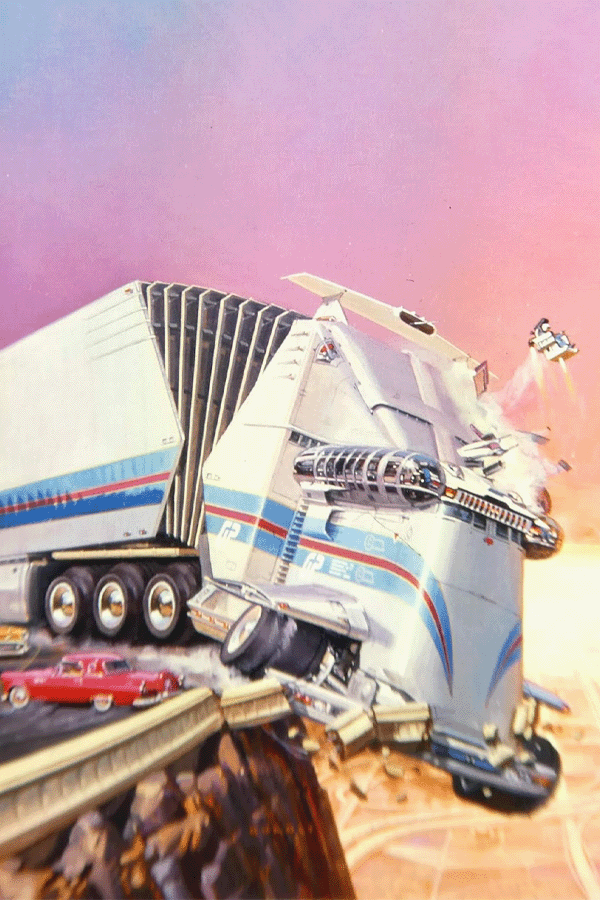
For a more profound redefinition of speed and distance, John DeChancie’s 1983 novel, Starrigger, offers an interstellar solution. The "starrigger" routes traverse vast cosmic distances, rendering conventional notions of travel obsolete. The ingenious solution lies in "Kerr-Tipler objects," colossal structures left by a precursor civilization, functioning as interstellar tollbooths. By utilizing these warped spacetime conduits, interstellar trucks could effectively drive from one planet to another, akin to terrestrial travel between cities. This concept eradicates the limitations of physical distance by manipulating the fabric of spacetime itself, showcasing a future where the journey is not about traversing space, but about navigating cosmic shortcuts.
The Rise of the Machines: Autonomous Vehicles and Error Reduction
The inherent fallibility of human drivers is a primary contributor to traffic accidents. Human error, whether due to inattention, distraction, or impaired judgment, leads to a significant percentage of road incidents. The logical conclusion, as often drawn by artificial intelligence in science fiction, is that removing humans from the driving equation is the most effective way to eliminate human error.
Daniel Keys Moran’s 1989 novel, The Long Run, presents a society under the governance of the Unification Council, which implements Automated Traffic Control. This system promises unprecedented safety, with all trips meticulously documented by the world government. The narrative depicts a scenario where the efficiency and safety of automated travel are so overwhelmingly evident that objections come only from a small faction of "speedfreaks." The tragic demise of a million-car convoy of manually-driven hovercars attempting a circumnavigation of the Earth, which flies into a storm and perishes, serves as a stark, fictional cautionary tale, reinforcing the perceived superiority of automated systems over human control in hazardous conditions. This scenario taps into the public discourse surrounding the development of autonomous vehicles and the ongoing debate about their safety and societal implications.
Clear Communication: The Violent Language of the Road
The current communication systems in automobiles are rudimentary at best, relying on blinkers, horns, and a limited range of visual cues. While these methods convey basic intent, their inherent ambiguity can lead to misunderstandings and conflict. Science fiction has explored more direct, and often more aggressive, forms of communication.
Alan Dean Foster’s 1971 short story, "Why Johnny Can’t Speed," paints a dystopian vision of North America where drivers navigate the streets in heavily armed and armored vehicles. In this world, the right to road usage is asserted through lethal force. The narrative centers on Frank Merwin, who seeks violent retribution against the driver responsible for his son Robert’s death. Robert, it is revealed, had prioritized maneuverability over the defensive and offensive capabilities of his vehicle, a choice that proved fatal. This story explores a chilling extreme of vehicular interaction, where communication is reduced to a violent assertion of dominance, highlighting the potential for escalated conflict when technological capabilities outstrip social norms and regulatory frameworks. The narrative serves as a stark reminder of the potential consequences of unchecked vehicular power and the breakdown of civil discourse on the roadways.
The exploration of these science fiction narratives offers a unique lens through which to examine the enduring challenges of automotive transportation. While the solutions proposed may range from the psychologically profound to the technologically fantastical, they all serve to illuminate the complexities of human behavior, societal development, and the unceasing quest for safer, more efficient, and perhaps even more imaginative ways to navigate our world. The continued evolution of automotive technology, from electric vehicles and advanced driver-assistance systems to the eventual widespread adoption of fully autonomous driving, will undoubtedly continue to be a fertile ground for future speculative fiction and, perhaps, for the practical innovations that shape our roads.