The month of May, often a harbinger of warmer days and shifting seasons, also delivered a compelling collection of short speculative fiction, offering readers brief yet potent explorations of science fiction, fantasy, and horror. While longer narratives can immerse audiences in intricate worlds, these ten shorter pieces provide concentrated bursts of imagination, serving as potent literary "treats" to usher in the summer reading season. From the dusty plains of Mars to the unsettling depths of human memory and the chilling realities of an undead epidemic, these stories showcase the genre’s enduring power to provoke thought and ignite the imagination.
Martian Exploration and Colonial Echoes
One standout piece, "1,001 Best Hikes on Mars: The Peterson Historic Trail (‘Peterson’s Folly’)" by Ron Fein, published in Small Wonders (Issue 35, May 2026), reimagines the classic Mars colonization narrative through the lens of a travel guide. The story immerses readers in the rugged terrain of the Phoenicis Lacus quadrangle, specifically within the labyrinthine canyons of Noctis Labyrinthus. Fein meticulously details the geological features, the historical context provided at a Visitor Center, and the perilous journey along the trail itself. The narrative subtly weaves in the fate of an ill-fated expedition, leaving the reader to uncover the poignant irony behind the trail’s moniker, "Peterson’s Folly." This approach offers a refreshing departure from conventional Mars exploration tropes, framing the challenges and tragedies of colonization within an accessible, almost mundane, format. The story implicitly highlights the human drive for exploration and settlement, while simultaneously underscoring the inherent dangers and the potential for hubris in such ambitious endeavors. The implication of "Peterson’s Folly" suggests a cautionary tale about overconfidence or miscalculation in the face of an unforgiving environment, a recurring theme in human history’s grandest ventures.
The Allure of Flight and Hidden Magic
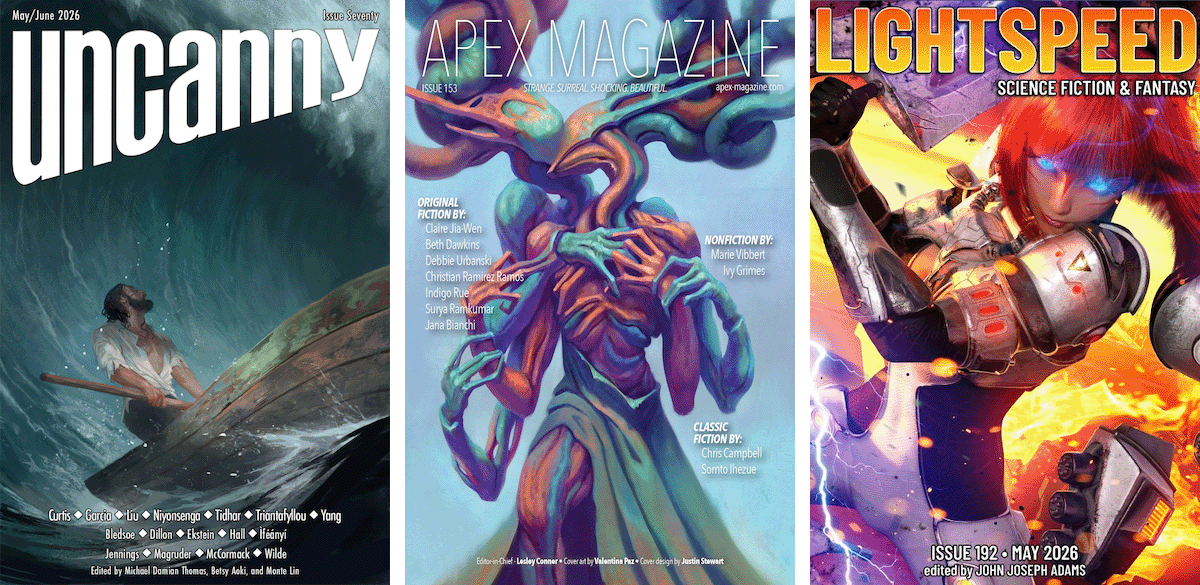
In "The Aerialist" by Yoon Ha Lee, featured in Lightspeed Magazine (Issue 192, May 2026), the protagonist Kallista yearns for a bygone era of aerial acrobatics aboard a plane powered by "intoxicating faerie fuel." Dismissed from service in disgrace, she finds herself in possession of a stolen typewriter, an object that transcends its historical appearance. This typewriter, it turns out, is not merely an artifact but a conduit to flight, offering Kallista a means to recapture her lost passion. Lee’s narrative masterfully blends gaslamp aesthetics with an undercurrent of fairy magic, creating a story with both whimsical charm and profound emotional depth. The story can be interpreted as a metaphor for reclaiming lost dreams or finding unconventional paths to personal fulfillment. The "faerie fuel" hints at a world where natural or mystical energies were once harnessed, contrasting with the more mechanical or perhaps corrupted forms of power present in Kallista’s current reality. The act of stealing the typewriter suggests a desperation to recapture a former glory, and the story’s hidden depths likely explore themes of artistic expression, the nature of inspiration, and the consequences of disgrace.
Planetary Metaphors for Real-World Conflicts
Yasmeen Amro’s "Dark, Where the Sun Never Sets," published in Phano (Issue 16, April 2026), offers a potent science fiction allegory for geopolitical realities. The story centers on Khadija, an American-raised visitor to her relatives on Trappist-1d, a planet where language and cultural barriers are significant. Her relatives recount the history of a fallen American space station that created a massive crater. This narrative serves as a stark commentary on Israeli and American military aggression towards Palestine. The choice of Trappist-1d, a planet with an atmosphere conducive to life, adds a layer of irony to the destruction wrought by external forces. Amro’s research into "Nabati," the local name for the planet, which refers to a vernacular form of Arabic poetry practiced by Bedouin communities, further enriches the story’s allegorical weight. This connection highlights the deep cultural roots and enduring spirit of the land and its people, even in the face of profound disruption. The "darkness" where the sun never sets can symbolize the perpetual shadow of conflict and oppression. The story’s metaphorical power lies in its ability to distill complex political issues into a science fiction framework, allowing for reflection on themes of displacement, historical trauma, and the lasting impact of colonial and military actions.
The Power of Flash Fiction
R. F. Daniels’ "Excrescence," featured in Quotidian Bagatelle (Issue 5, May 2026), stands as a testament to the impactful brevity of flash fiction. The story, beginning with the evocative line, "It began as an itch in the back of my throat," is too concise for a traditional synopsis. However, its strength lies in its ability to convey a complete narrative arc and emotional resonance within a remarkably small word count. Daniels masterfully demonstrates how this format, often perceived as ephemeral, can carry significant thematic weight and deliver a powerful punch. The story’s effectiveness suggests that a more expansive telling would dilute its impact, making its punchiness a deliberate and successful artistic choice. This piece serves as an excellent example of how concise storytelling can be just as, if not more, effective than lengthier works, forcing the reader to engage actively with the implied narrative and unspoken implications. The "excrescence" itself, a growing or emerging abnormality, could symbolize any number of things – a physical ailment, a psychological manifestation, or even a societal ill.
Memory, Colonialism, and Identity
Aline-Mwezi Niyonsenga’s "Extracted from an Unravelled Braid," published in Uncanny Magazine (Issue 70, May/June 2026), delves into the complex themes of memory, identity, and post-colonial extraction. Memoire, a Rwandan immigrant residing in what is presumed to be Canada, undergoes a procedure that braids memory fibers into her hair, connecting to her brain through her scalp. Initially envisioned as a way to honor her ancestors and reconnect with her homeland, the technology, owned by Western entities, reveals its true purpose: colonial extraction. Niyonsenga’s subtle yet powerful storytelling highlights the insidious nature of cultural appropriation and the commodification of personal history. The story is lauded for its well-crafted prose and its ability to convey its message with profound nuance. The "unravelled braid" can be seen as a metaphor for fragmented identity or the unraveling of cultural heritage under external pressures. The narrative implicitly critiques how technologies designed for connection can be repurposed for exploitation, particularly in contexts shaped by colonial legacies. The story’s subtle approach underscores the idea that the most impactful critiques often emerge not from overt declarations but from carefully constructed narratives that allow the reader to draw their own conclusions about the injustices at play.
Southern Gothic and Faded Glory
Marsden Lyonwahl’s "Me, Myself, and I," featured in Perseid Prophecies (Issue 9, Spring 2026), transports readers to the atmospheric setting of an old plantation house in Attakapas Parish, Louisiana. John Broussard returns to his ancestral home after a prolonged absence, finding the once-influential and wealthy Broussard family name faded, the town having forgotten them, and the plantation house in ruins. John is presented as the key to restoring their former prominence, whether he desires it or not. This Southern Gothic tale is noted for its evocative atmosphere and an unexpected, impactful ending. The story taps into the rich tradition of Southern Gothic literature, which often explores themes of decay, inherited sin, and the haunting presence of the past. The dilapidated plantation house serves as a potent symbol of the decline of a particular socio-economic order and the lingering shadows of its history, including the complex and often painful legacy of slavery. The narrative’s focus on John’s unwilling role in restoring the family’s influence suggests a critique of inherited burdens and the pressure to conform to past expectations, even when those expectations are rooted in problematic histories. The "unexpected ending" likely subverts genre conventions or offers a surprising resolution to John’s predicament, leaving a lasting impression on the reader.
A Modern Plague Narrative with Corporate Chill
Grace Crouthamel’s "Not Hunger, Not Feeling," published in Allegory (Issue 76, Spring/Summer 2026), offers a chilling take on the zombie apocalypse, resonating with recent global experiences. The protagonist, Gretchen, is compelled to go to work during a plague outbreak, a scenario that echoes the surreal realities faced by many during the COVID-19 pandemic. The story vividly captures the unsettling experience of a world shutting down while essential workers continue their duties. In Gretchen’s world, a strain of HSV transforms victims into "brainless killer zombies." Trapped in a corporate office security room with a colleague from HR, Gretchen faces not only the undead but also the implicit threats posed by their corporate environment. The narrative’s relevance is heightened by its direct engagement with the anxieties of mass societal disruption and the psychological toll of navigating such crises. The mention of California’s lockdown and the protagonist’s own experience of being sent home mid-shift during the pandemic grounds the fictional horror in a relatable contemporary context. The added threat from within the corporate structure suggests that human institutions and internal dynamics can be as dangerous as external monstrous forces, adding a layer of social commentary to the horror.
Transformation and Hope in Cosmic Scales
Aegor ray’s "Senescence," featured in Strange Horizons (May 4, 2026), presents a beautifully written and profoundly hopeful exploration of a being in constant flux. The story begins with a fragmented entity, "scattered at the base of a tree," resting in pieces for sixty years before embarking on a journey of transformation. The being shifts through genders and states of existence, evolving from "forty-nine sticky droplets of impulse and intelligence" to a pregnant entity that "flies through galaxies and deep, sick quiet." The story’s power lies in its poetic language and its hopeful conclusion, which evokes a sense of profound optimism. This marks aegor ray’s debut in fiction publication, and the piece suggests a promising future for the author. The concept of "senescence," typically referring to biological aging and deterioration, is here recontextualized as a process of continuous change and evolution, perhaps even rejuvenation on a cosmic scale. The narrative’s emphasis on transformation rather than decay offers a refreshing perspective on existence, suggesting that change, even if initially disorienting, can lead to new forms of being and profound connection. The story’s cyclical nature and its focus on the vastness of existence can be interpreted as a meditation on the interconnectedness of all things.
Desire, Caution, and the Price of Fulfillment
Rae Zalopany’s "The Trident-Tailed Water Monster," published in The Future Fire (Issue 2026.76, May 2026), examines themes of desire, caution, and the potential costs of achieving one’s wants. Natalie visits a resort near Little Lake Kerr in Central Florida, drawn there by a dream about a deity. Her inherent caution, particularly around men, is highlighted, with the narrative suggesting that her level of wariness is justified for those who often face the brunt of patriarchal structures. When a man who has been harassing her also appears at the springs, Natalie’s craving for safety is presented in a dangerous package. The story is described as a thoughtful piece about the consequences of getting what you want, regardless of the cost. The "trident-tailed water monster" could be a literal entity, a metaphor for primal desires, or even the embodiment of the dangerous allure of the unknown. The story implicitly explores the complexities of female agency and vulnerability in environments where harassment is present. The allure of the "dangerous package" offering safety suggests a Faustian bargain, where a perceived solution comes with unforeseen and potentially devastating repercussions. The narrative’s thoughtfulness lies in its refusal to offer easy answers, instead posing questions about the nature of safety, desire, and the sacrifices individuals might make to attain them.
Diaspora, Assimilation, and Bittersweet Remembrance
Surya Ramkumar’s "The Vigil of the Tenth Air," featured in Apex Magazine (Issue 153, May 2026), delivers a breathtaking and bittersweet narrative about a son’s incomplete funeral ritual and its profound consequences. Following Hindu tradition, a deceased father is cremated, but his son fails to perform the kapala-kriya ritual. This oversight results in the father’s life force, or prana, becoming attached to his son. The spectral father accompanies his son to their home in an unnamed Western country, observing the son’s struggles with assimilation. The story poignantly illustrates the challenges of living in the diaspora, where cultural identity is often tested against the pressures of societal integration. The "vigil of the tenth air" likely refers to this lingering spiritual presence and the son’s extended period of unspoken mourning and cultural negotiation. The narrative masterfully captures the emotional weight of displacement and the complex dance between maintaining ancestral traditions and adapting to a new environment. The story implicitly critiques the concept of forced assimilation and the potential for cultural erosion when individuals are distanced from their heritage. The "bittersweet" nature of the tale suggests that while there may be moments of connection or understanding, the underlying sorrow of separation and loss remains a pervasive element.