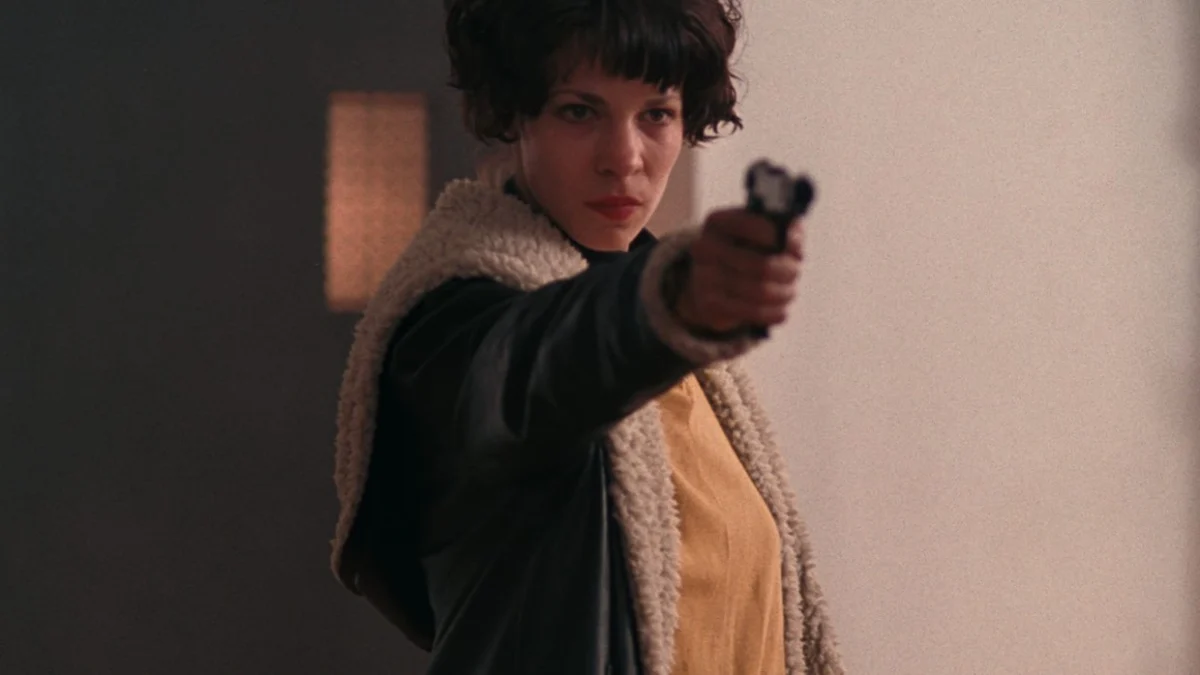
Mary Harron’s seminal 1996 debut feature, I Shot Andy Warhol, is returning to screens in a new 4K restoration, reigniting critical discussion around its provocative subject matter and enduring relevance. Before captivating audiences with the chillingly charismatic Patrick Bateman in American Psycho (2000), Harron meticulously crafted a portrait of another form of New York pathology, delving into the complex figure of Valerie Solanas, the radical feminist who shot pop artist Andy Warhol in 1968. The film, starring Lili Taylor as Solanas, has long been a touchstone for independent cinema and continues to challenge viewers with its nuanced exploration of gender, power, and artistic ambition.
The Genesis of a Provocative Vision
Harron’s journey to bring Solanas’s story to the screen was a lengthy one, spanning five years of development. Her initial fascination stemmed from an obsession with Warhol, The Factory, and The Velvet Underground, encountering Solanas’s SCUM Manifesto (Society for Cutting Up Men) initially as a "darkly comic" curiosity. Solanas, the sole member of her self-proclaimed organization, published the manifesto in 1967. This document, a scathing indictment of patriarchal society and a call for its dismantling, outlines a world liberated from male influence. Its radical propositions and confrontational tone set it apart from other feminist texts of the era.
Harron recounted discovering the manifesto in a left-wing bookstore while researching a Warhol documentary. She was "completely stunned by how brilliant it was," particularly by its opening line: "Life in this society being, at best, an utter bore…" The writing style, marked by sophisticated irony and elegant prose, struck Harron as akin to Evelyn Waugh. Beyond its stylistic flair, Solanas’s sharp dissection of societal absurdity and injustice, rooted in the assumption of female inferiority, resonated deeply with Harron, who confessed to struggling against condescension even in the 1980s.
At the time of its initial circulation in the late 1960s and early 1970s, the SCUM Manifesto was known primarily within a small circle of radical feminists and was largely considered an "outlier" compared to more widely recognized works like Shulamith Firestone’s The Dialectic of Sex. Its broader cultural life and wider recognition, Harron notes, came much later, spurred by reprints and even a graphic novel adaptation, proving its enduring, "lightning bolt" impact on readers.
Bringing 1960s New York to Life: Aesthetic and Production
I Shot Andy Warhol immerses viewers in the gritty, vibrant, and often chaotic downtown art world of 1960s New York through Solanas’s perspective. The film follows Valerie (Lili Taylor) as she attempts to sell copies of her manifesto (famously priced at "Two dollars for men, one dollar for women"), struggles to find a producer for her play Up Your Ass, and ultimately drifts into the magnetic, yet ultimately dismissive, orbit of Warhol’s Factory.
Lili Taylor, a revered figure in 1990s indie cinema, delivers a performance that imbues Solanas with a "deadpan swagger," portraying her as an uncontainable and undeniable outsider. The supporting cast, featuring talents like Martha Plimpton, Michael Imperioli, and Stephen Dorff as the iconic Candy Darling, masterfully captures the spirit of the independent arts scene of the era.
The film’s aesthetic was carefully crafted to evoke a sense of "poetic realism" and naturalism, drawing inspiration from contemporary documentary sources rather than stylized dramatic films. Harron and cinematographer Ellen Kuras, who recently supervised the 4K restoration, aimed for a look that was both "gritty and beautiful, but not too beautiful." Harron cited Larry Clark’s 1995 film Kids as a visual reference point, appreciating its use of available light. For interior scenes, particularly the starkness of hotel rooms, Harron looked to the work of photographer Diane Arbus, incorporating elements of negative space and sparse details. This commitment to authenticity extended to renting photographs from Magnum archives to inform the shooting style, aiming for an "energetic, naturalistic" feel.
The soundtrack further grounds the film in its specific time and place. While Lou Reed famously denied permission for The Velvet Underground’s music, Harron enlisted John Cale, a co-founder of the band, to compose the score. This creative pivot resulted in a score that, alongside tracks from bands like Yo La Tengo and Pavement, contributes to the film feeling less like a rigid period reconstruction and more like a "living document of New York at a particular moment." The recent 4K restoration, overseen by Kuras, has highlighted the beauty of the original lighting and color palette, revealing the intentionality behind the film’s "slightly magical world while keeping its grunginess."
Valerie Solanas: An Uncontainable Outsider
The film’s strength lies in its refusal to simplify Solanas into a mere caricature or a villain. Harron’s portrayal, enhanced by Taylor’s performance, presents Solanas as a brilliant, frustrated, and deeply troubled individual whose actions were rooted in a profound sense of injustice and a desperate longing for recognition. Solanas’s struggles to get her play produced and her manifesto published reflect a broader systemic issue: the control exerted by men over creative and intellectual output, particularly in a patriarchal society. As Harron observes, Solanas was "not wrong" about figures like Maurice Girodias, the publisher who distributed her manifesto but was notorious for not paying royalties.
However, Solanas’s "despair and outsiderdom" meant she was often "too much trouble in the end," even for those who initially supported her. Her intense personality and confrontational nature alienated potential allies, leading to cycles of hope and rejection. The film skillfully navigates this complexity, allowing the audience to empathize with her frustrations while acknowledging the difficult nature of her character.
Andy Warhol: Fragile Icon, Flawed Human
The Factory, Warhol’s iconic studio and cultural hub, has been thoroughly mythologized over the decades. Harron consciously chose to present Warhol through Solanas’s eyes, portraying him in a "strangely passive position," an elusive figure who both attracted and repelled Solanas. Harron, who had met Warhol twice, noted his "incredible fragility and elusiveness." Warhol’s dynamic involved an intense, albeit often fleeting, interest in people, leading many "hungry-for-attention" individuals to "blossom" under his gaze before he inevitably turned away. This withdrawal of attention, Harron suggests, could be devastating, pushing some, including Solanas, "off the deep end."
Jared Harris’s portrayal of Warhol captures this vulnerability, allowing Harron to present him not as a clear-cut villain but as a "great artist and a flawed human being who could be cruel and cold but was also kind and sensitive." Harron intentionally avoided creating a narrative of "heroes and villains," preferring instead to provoke thought and allow audience sympathies to "ping-pong around," ultimately yielding a more "real" understanding of the situation. This refusal to provide a simplistic moral framework was criticized at the time of the film’s release but remains central to its provocative power.
The Factory itself operated with a "ruthlessness of a Hollywood studio," as Harron describes it. Individuals like Edie Sedgwick were celebrated and then discarded when they became "too difficult." Yet, Harron also acknowledges Warhol’s groundbreaking role in elevating marginalized voices, particularly drag queens and trans women, providing them with a platform and a form of stardom. While Warhol "changed America" by subtly integrating a gay sensibility into the mainstream, Harron notes a potential source of rage for Solanas: Warhol often found trans men "easier to deal with than biological women," a dynamic that underscored the gendered economy of the Factory and the broader art world.
The SCUM Manifesto in Flux: Interpretation and Legacy
The SCUM Manifesto remains a document of significant cultural and political contention. Its deliberately provocative nature raises questions about its intent: Is it satire? Is it a serious call to action? Is it the rantings of a "crazy" woman or the profound insight of a "sane" one? Harron’s intention was always to leave these questions "productively open," recognizing that the manifesto "shares elements with [Jonathan Swift’s] A Modest Proposal, but it’s not a completely self-contained work of satire with a specific political goal."
Categorizing it solely as satire, Harron argues, "keeps it in a safe place it doesn’t really belong in." The manifesto is both "brilliant and fantastically well-written" and "disturbing and awful at moments." Its nihilistic undertones, particularly the questioning of humanity’s purpose and reproduction, coexist with its incisive analysis of politics and power.
The text has been "claimed and reclaimed" by various feminist and radical groups, and even by those identifying as TERFs (Trans-Exclusionary Radical Feminists). Harron acknowledges that "people get what they need from a text like that, and interpret it the way they need to for now." She discusses Solanas’s essentialist philosophy, rooted in a biological understanding of chromosomes, which led her to believe "men cannot be women." While this perspective clashes with contemporary understandings of gender and identity, Harron cautions against imposing current ideologies onto historical figures: "If you’re going to understand somebody in 1968, you have to go back and think about how people then thought and talked." She finds Solanas’s analysis of power and conformity to absurd stereotypes far more compelling than her biological theories. Despite some contemporary critics arguing for the manifesto’s trans-affirming qualities, Harron considers this a "stretch" but remains "open to it."
A Director’s Instincts: Crafting a Non-Biopic
Harron’s approach to I Shot Andy Warhol defies traditional biopic conventions. Drawing from her extensive background researching documentaries and directing short films and satires for the BBC, she developed a unique aesthetic. Her seven years of directing experience before her feature debut instilled in her the crucial ability to "trust my instincts against opposition." This conviction allowed her to create a film that prioritizes thematic depth and psychological nuance over a linear, fact-heavy biography.
Harron considers many of her films, despite their often dark subject matter, as "comedies in a weird way." Her consistent attraction to "loners, outsiders, people who have been disregarded or despised" stems from a personal identification with feeling like an outsider herself. This empathetic lens allows her to explore complex characters without assigning easy labels or moral judgments, a hallmark of her distinctive directorial voice.
Relevance in a New Millennium
The re-release of I Shot Andy Warhol arrives at a moment when discussions around feminist rage, its acceptable forms, and the broader backlash against feminist progress are particularly acute. Harron notes the cyclical nature of feminist discourse, from the "Backlash" era of the early 90s to a period of wider acceptance, and now to an "extraordinary, brutal, clumsy backlash that’s almost beyond parody." This current climate, marked by rapid societal shifts and a feeling of being in a "different world," makes the film’s re-examination timely.
Harron speculates that Valerie Solanas might have "thrived" in today’s internet culture, where individuals can "make your own fame" and find an audience for radical ideas in ways unimaginable in the 1960s. While acknowledging the "terrible side" of this phenomenon, the opportunity for creative expression and audience connection resonates with Harron’s own past frustrations. Before becoming a director, she "totally related to [Solanas’s] longing to make something" and her struggle to express herself.
The film’s conclusion, which emphasizes the SCUM Manifesto becoming a classic radical feminist text rather than Solanas’s bleak biographical end in a welfare hotel, was a deliberate choice. While Harron admits a part of her still appreciates the "bleakness" of the original ending, she believes the current ending "makes more sense" given the manifesto’s increased circulation and discussion over the past three decades. This shift reflects the film’s ultimate focus: not just on the tragedy of Valerie Solanas, but on the enduring, often uncomfortable, power of her ideas.
The Enduring Power of Ambiguity
I Shot Andy Warhol continues to resonate because it resists easy answers. It explores the intersections of mental health, radical politics, artistic expression, and gender dynamics without succumbing to didacticism. Harron’s daughters, upon seeing the film in their late teens/early twenties, praised her handling of gender politics, a testament to the film’s nuanced approach.
The film serves as a crucial document, not only of a specific historical moment in the New York art scene but also of the complex, often contradictory, nature of radical thought and the enduring struggle for women’s voices to be heard and valued. As I Shot Andy Warhol returns to screens, its sharp insights into power, alienation, and the uncomfortable truths of societal structures remain as provocative and alive as ever, inviting new generations to grapple with its challenging legacy.