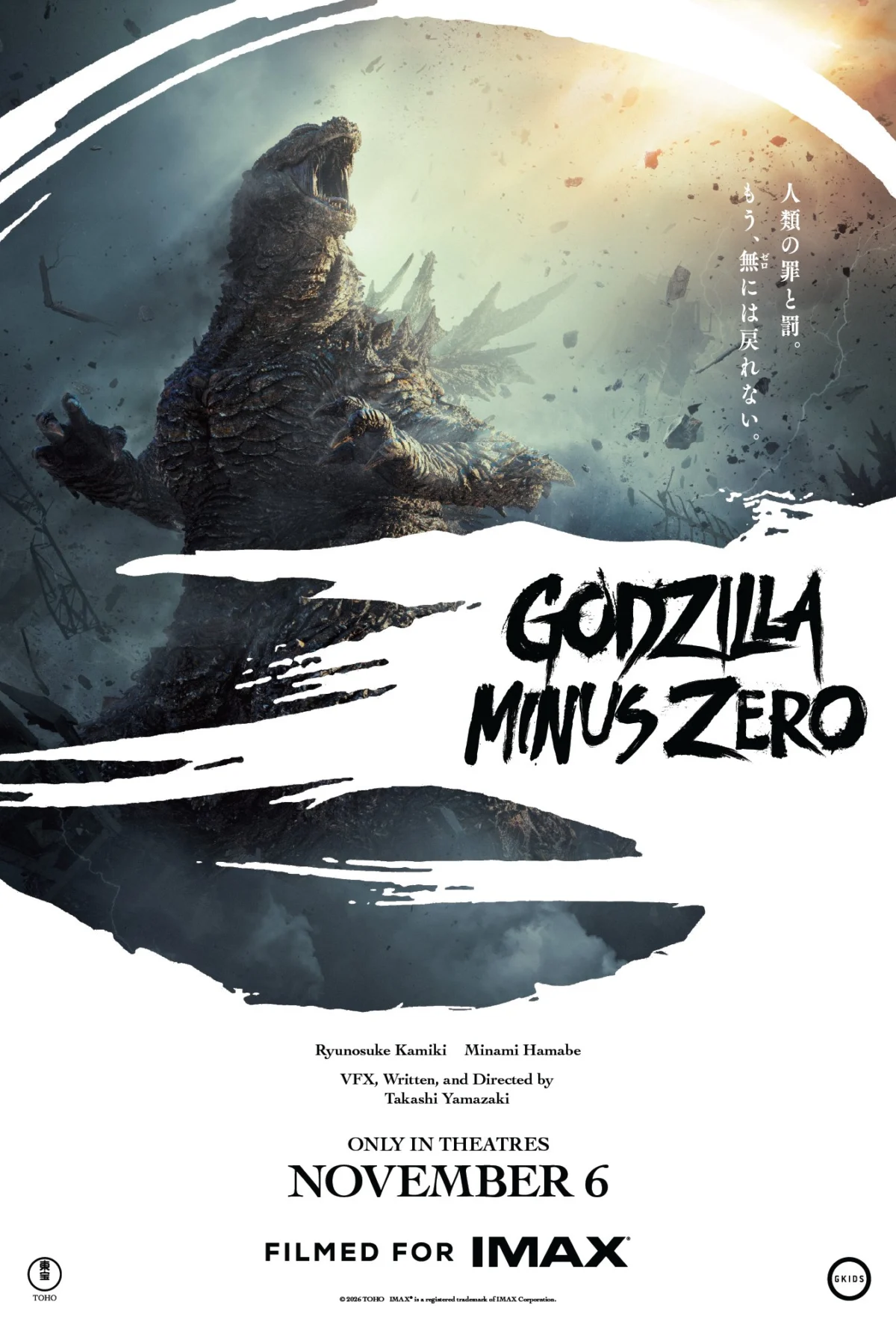
TOHO and GKIDS have officially unveiled the first teaser trailer for Godzilla Minus Zero, the highly anticipated sequel to the Academy Award-winning global phenomenon Godzilla Minus One. Directed, written, and overseen by visual effects lead Takashi Yamazaki, the new film is scheduled to arrive in Japanese theaters on November 3, 2026—a date that coincides with the annual celebration of Godzilla Day—before making its North American debut on November 6, 2026. This announcement marks a significant milestone for TOHO Studios, as it seeks to build upon the unprecedented critical and commercial success of its predecessor, which redefined the international standing of the long-running kaiju franchise.
The teaser trailer offers a haunting glimpse into a Japan still grappling with the physical and psychological scars of World War II and the initial devastation wrought by Godzilla. Set in 1949, the narrative picks up two years after the events of the previous film, centering on the Shikishima family as they attempt to forge a life in a country struggling to transition from total ruin toward a tenuous recovery. The film’s tagline, "War reduced Japan to zero, and Godzilla plunged it into minus," serves as the foundational premise for this new chapter, suggesting an even deeper descent into national and personal crisis.
Narrative Continuity and the Evolution of the Shikishima Story
Godzilla Minus Zero continues the harrowing journey of Koichi Shikishima, portrayed by Ryunosuke Kamiki. In the first film, Shikishima was a failed kamikaze pilot burdened by survivor’s guilt, whose personal redemption arc was intrinsically tied to his stand against the King of the Monsters. Kamiki’s return signals a continuation of this grounded, human-centric approach to the monster genre, focusing on the trauma of the post-war era. Joining him is Minami Hamabe, reprising her role as Noriko Shikishima. Her character’s miraculous survival at the conclusion of the previous installment was a major talking point among fans, and her return suggests that the lingering effects of Godzilla’s radiation and the mystery of her survival will play a central role in the upcoming plot.
The story transitions from the immediate aftermath of the war in 1945–1947 to 1949, a period historically characterized by the Allied occupation and the beginning of the Japanese economic miracle. However, in this alternate timeline, the recovery is interrupted by a "new threat" that promises to crush the hard-won peace. The synopsis warns that "there is no third time," implying a finality to the conflict that threatens to erase the progress made by the survivors.
A Cast of Returning Veterans and New Perspectives
TOHO has confirmed the return of several key cast members who formed the emotional core of the first film. Hidetaka Yoshioka returns as Kenji Noda, the former naval engineer who now leads the Disaster Response Bureau, a government entity presumably formed to handle the ongoing threat of giant monster attacks. Yuki Yamada reprises his role as Shiro Mizushima, the spirited young crewman of the mine-sweeping vessel Shinseimaru, alongside Kuranosuke Sasaki as the ship’s veteran captain, Seiji Akitsu.
The ensemble is further bolstered by Sakura Ando as Sumiko Ota, the neighbor who provided a moral compass and maternal support in the first film, now shown running a local orphanage. Miou Tanaka also returns as Tatsuo Hotta, the former captain of the destroyer Yukikaze.
In addition to the returning cast, the production has announced the inclusion of legendary actor Min Tanaka. Tanaka, who recently garnered acclaim for his performance in the 2025 blockbuster Kokuho, will portray Kanji Murakami. Described as a biologist carrying deep psychological scars from the war, Murakami is expected to provide the scientific and philosophical framework for understanding the new threat, potentially filling a role similar to the classic scientist figures in the original 1954 production.
Technical Milestones: Filmed For IMAX
Godzilla Minus Zero distinguishes itself as a technical pioneer in the franchise’s 72-year history. It is the first-ever Japanese production to be officially "Filmed For IMAX." This designation means the film was shot using high-definition digital cameras certified by IMAX and underwent the proprietary IMAX DMR (Digital Media Remastering) process. This ensures that the scale of Godzilla and the destruction of post-war Tokyo are presented with unparalleled clarity and immersive sound design.
Takashi Yamazaki, fresh off his historic Oscar win, once again leads the visual effects team at SHIROGUMI Inc. The production is a collaborative effort between Toho Studios and ROBOT, the same production house behind the visual triumphs of the previous film. By utilizing IMAX technology, Yamazaki aims to elevate the "theatrical event" nature of the film, encouraging audiences to experience the scale of the monster in a format that mirrors the creature’s own gargantuan proportions.

The Financial and Critical Legacy of the "Minus" Series
The pressure on Godzilla Minus Zero is bolstered by the massive success of Godzilla Minus One. Released in late 2023, the previous film grossed over $116 million at the global box office, a staggering figure for a non-English language film in the genre. It became the highest-grossing Japanese-produced Godzilla film of all time, surpassing the $78 million record held by Hideaki Anno’s Shin Godzilla (2016).
More importantly, Godzilla Minus One achieved a historic milestone at the 96th Academy Awards, winning the Oscar for Best Visual Effects. It was the first time an Asian production had won in that category and the first time a Godzilla film had even been nominated. The win was widely celebrated as a victory for high-quality, mid-budget filmmaking, proving that creative ingenuity and meticulous direction could rival the visual spectacles of much larger Hollywood productions.
Global Distribution and the TOHO-GKIDS Synergy
The international rollout of Godzilla Minus Zero reflects a new era for TOHO’s global strategy. Following TOHO’s acquisition of the North American distributor GKIDS in 2024, the company now possesses a direct pipeline to the Western market. GKIDS, primarily known for its stewardship of Studio Ghibli titles, will handle the wide theatrical release across North America starting November 6, 2026.
In Canada, the release will be supported by Cineplex Pictures. TOHO has also coordinated a simultaneous international launch during the same week across Latin America, Europe, Asia, the Middle East, Australia, and New Zealand. This synchronized global release is a departure from older distribution models where Japanese films often faced months of delay before reaching international audiences. It highlights TOHO’s commitment to treating the Godzilla franchise as a top-tier global intellectual property.
Historical Context and the Significance of Godzilla Day
The release date of November 3 is deeply symbolic. On November 3, 1954, Ishirō Honda’s original Godzilla premiered in Japan, introducing the monster as a metaphor for the nuclear trauma of Hiroshima and Nagasaki. By scheduling Godzilla Minus Zero for the same date in 2026, TOHO is aligning the new film with the 72nd anniversary of the franchise.
Furthermore, the "Minus" timeline serves as a direct spiritual successor to the themes of the 1954 original. While the Hollywood "MonsterVerse" films (produced by Legendary Entertainment) tend to focus on Godzilla as a heroic or neutral force of nature in a modern setting, Yamazaki’s "Minus" series returns the creature to its roots as a terrifying personification of national tragedy and divine retribution.
Chronology of the Modern Godzilla Era
To understand the positioning of Godzilla Minus Zero, it is helpful to look at the recent timeline of the franchise:
- 2016: Shin Godzilla is released, offering a satirical, dialogue-heavy look at modern Japanese bureaucracy in the face of a crisis. It becomes a domestic hit and revitalizes Japanese interest in the series.
- 2023: Godzilla Minus One is released to commemorate the 70th anniversary, taking the story back to the post-war era. It becomes a global sensation.
- 2024: TOHO acquires GKIDS, consolidating its distribution power in North America.
- 2025: Pre-production and filming for the sequel take place under the working title "Godzilla Minus Zero," utilizing IMAX-certified equipment.
- 2026: The official teaser is released, confirming the return of the original creative team and setting the stage for a November global launch.
Analysis of Implications for the Film Industry
The production of Godzilla Minus Zero carries significant implications for the Japanese film industry. By adopting the "Filmed For IMAX" standard, TOHO is signaling its intent to compete directly with Hollywood blockbusters on a technical level. This move may encourage other Japanese studios to invest in high-end format certifications, potentially increasing the exportability of Japanese live-action cinema.
Additionally, the continuation of a serious, period-accurate drama within the monster genre suggests that audiences have a strong appetite for "prestige" kaiju films. The success of this model—focused on character development and historical weight rather than just spectacle—provides a blueprint for how long-standing franchises can be reinvented for modern, discerning audiences without losing their cultural identity.
As the production enters its final stages, the global film community remains focused on whether Takashi Yamazaki can capture lightning in a bottle for a second time. With the return of a beloved cast and the backing of a newly integrated global distribution network, Godzilla Minus Zero is positioned to be one of the most significant cinematic events of 2026, continuing the legacy of a monster that has captivated the world for over seven decades.