In an era defined by the insatiable demand for compelling serialized storytelling, television showrunners are increasingly venturing beyond the established narratives of beloved literary and cinematic properties, crafting expansive new chapters that resonate with contemporary audiences. This trend is exemplified by upcoming series like The Testaments, It: Welcome to Derry, and Alien: Earth, each seeking to enrich existing lore while maintaining the core essence of their acclaimed predecessors. The challenge lies in balancing fidelity to the source material with the creative freedom necessary to evolve narratives for a new medium and a new generation of viewers.
The Handmaid’s Tale and The Testaments: A Dystopian Saga Evolves
The journey of Margaret Atwood’s seminal dystopian novel, The Handmaid’s Tale, from a celebrated literary work to a critically lauded television series, and now to a highly anticipated sequel, The Testaments, offers a compelling case study in this narrative expansion. Showrunner Bruce Miller, who helmed the initial Hulu adaptation, recounts his initial reaction to Atwood’s original novel: "I was like, ‘Well, I hope there’s a sequel!’" This sentiment, shared by many readers, foreshadowed the profound impact the story would have for decades.
Background and Cultural Resonance:
The Handmaid’s Tale, first published in 1985, presented a chilling vision of a totalitarian, theocratic society called Gilead, where fertile women, known as Handmaids, are enslaved for reproductive purposes. Atwood’s novel quickly became a cornerstone of feminist literature and dystopian fiction, praised for its prescient themes and powerful prose. Its initial adaptation into a 1990 film, though notable, did not achieve the widespread cultural penetration that the 2017 Hulu series would.
The Hulu series premiered during a politically charged period in the United States—the first Trump administration—which amplified its themes of reproductive rights, authoritarianism, and female subjugation. The visual iconography of the Handmaids’ red capes and white bonnets transcended the screen, becoming a potent symbol of both oppression and resistance at protests and rallies worldwide. The show’s critical success was immediate and undeniable; it made history as the first streaming offering to win an Emmy for Best Drama Series, ultimately collecting 13 more Emmys over its subsequent five seasons, cementing its status as a cultural phenomenon. Elisabeth Moss’s portrayal of Offred (June Osborne) became iconic, embodying the struggle for survival and defiance.
The Genesis of the Sequel:
As The Handmaid’s Tale series progressed, Miller found himself contemplating the narrative possibilities beyond Atwood’s original ending, which famously concludes with Offred’s uncertain fate. Unbeknownst to him, Atwood herself was grappling with similar questions, leading her to embark on writing The Testaments. Miller notes, "I’m sure it had been suggested a zillion times before," regarding a sequel, but credits the show’s success and Atwood’s personal connections with the cast for demonstrating "the fun of television in terms of expanding stories."
By the time production began on the second season of The Handmaid’s Tale, Atwood had already begun writing The Testaments. She shared details of her expanded vision with Miller, providing a crucial directive for the series: preserve Aunt Lydia. The menacing figure, brilliantly portrayed by Emmy winner Ann Dowd, was central to Atwood’s sequel, preventing Miller from killing her off as he might have otherwise considered.
Narrative Divergences and Creative Freedom:
The Testaments novel, published in 2019, is set 15 years after the events of The Handmaid’s Tale. It follows three narrators: Aunt Lydia, Agnes Jemima (a young woman growing up in Gilead), and Daisy (a young woman living in Canada). A key divergence between Atwood’s original novel and Miller’s series adaptation lies in June’s fate. In the novel, Offred’s account is a historical document discovered much later, implying her demise in anonymity. Miller’s series, however, allows June to escape Gilead for Canada, leaving one daughter behind, setting the stage for a more active and triumphant role. This departure, while significant, was informed by Atwood’s comfort with expanding the universe. Miller explains, "The sequel made me realize that Margaret was comfortable with expanding the world… It really encouraged me [to consider] some victories for June."
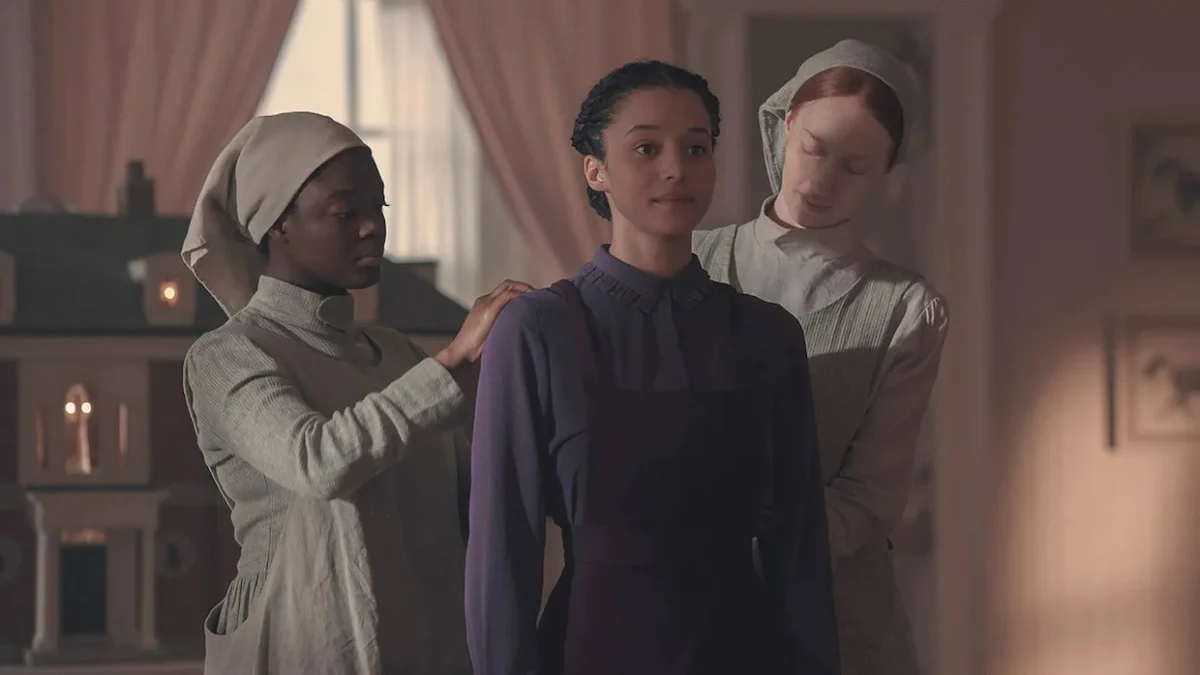
Miller’s approach involved close collaboration with Atwood. Halfway through the writing of each season of Handmaid’s, the pair would meet, and Miller would share his ideas for her input. This synergy allowed Miller the freedom to "fill in the gaps between Atwood’s first novel and his eventual sequel," ensuring that while specific plot details might deviate, the larger story and its prescient themes remained intact. The television adaptation of The Testaments, starring Chase Infiniti as Agnes (June’s daughter, unaware of her true parentage, who becomes a Handmaid-in-training), already garnered early acclaim, with Infiniti winning a Gotham Award for her lead performance, bolstering its Emmy prospects.
It: Welcome to Derry – Unpacking the Origins of Pure Evil
Another iconic literary creation undergoing a profound television expansion is Stephen King’s terrifying entity, Pennywise the Dancing Clown, in HBO’s prequel series, It: Welcome to Derry. Following the immense box office and critical success of Andy Muschietti’s two-part film adaptation, the decision to delve deeper into the origins of this cosmic horror was a natural progression, driven by the very creators who brought the recent cinematic vision to life.
Stephen King’s Legacy and Previous Adaptations:
Stephen King’s 1986 novel It is a sprawling epic of horror, friendship, and trauma, spanning decades as it chronicles a group of outcast children, the "Losers’ Club," battling an ancient, malevolent entity in Derry, Maine. The novel’s intricate structure and psychological depth made it a landmark in horror fiction. It was famously adapted into a two-part miniseries in 1990, with Tim Curry’s portrayal of Pennywise becoming legendary. However, the miniseries, constrained by broadcast television limitations, couldn’t fully capture the novel’s intensity.
Muschietti’s cinematic adaptations, It: Chapter One (2017) and It: Chapter Two (2019), were critical and commercial triumphs, collectively grossing over $1.1 billion worldwide. Bill Skarsgård’s chilling performance as Pennywise redefined the character for a new generation. It was during the production of these films that the idea for Welcome to Derry began to take shape. Muschietti, along with Skarsgård, engaged in deep discussions about Pennywise’s motivations and backstory, realizing the untapped potential for further exploration. Muschietti recalls, "When you’re close to your actor and talking about character a lot, you go into depths that transcend the story you’re telling… Soon we were very excited about the potential exploration of Pennywise’s origins—when did the monster become the clown? It’s very enigmatic in the book, but intentionally cryptic."
Crafting a Prequel with Historical Depth:
Andy Muschietti and his producing partner and sister, Barbara Muschietti, serve as executive producers on It: Welcome to Derry, which is set 27 years before the events of It: Chapter One. The films themselves shifted the timeline of King’s novel: Chapter One took place in the late 1980s (rather than the late 1950s), with Chapter Two set in the present day. This temporal flexibility allowed the Muschiettis to set their prequel in the early 1960s, a period that holds personal significance for them and offers rich historical context. Barbara Muschietti notes, "That was our childhood," referring to the era they first encountered King’s writing.
This early 1960s setting allows the series to weave in significant historical backdrops, such as the Cold War and the burgeoning Civil Rights Movement, creating a thematic resonance with the original novel’s exploration of societal evils mirroring supernatural ones. The show introduces a new group of young outcasts, reminiscent of the "Losers’ Club," who grapple with both the supernatural terror of Derry and the turbulent social currents of their time.
The Muschiettis are staging an origin story for Pennywise’s human alter ego, Bob Gray, tracing his roots to the end of the Great Depression. He is depicted as a dancing clown on the carnival circuit with his young daughter, eventually lured away by the unnamed cosmic entity that later assumes his persona to attract victims. This "evocative use of vaudevillian imagery" not only provides a fresh aesthetic but also lays the groundwork for future seasons to explore other historically significant periods, promising a multi-generational saga of horror.
Collaboration and Expanding the Mythology:
The Muschiettis maintain close communication with Stephen King regarding any narrative changes or expansions. Barbara Muschietti describes King as the "mastermind behind the whole enterprise," stating, "Whenever we want to test the waters, we let him know immediately." The creative team acknowledges the delicate balance required to explain an iconic horror villain’s motivations without diminishing the sense of mystery that makes Pennywise so terrifying. Andy Muschietti reassures fans that the series will offer compelling answers: "Over the three seasons that we’re planning, we’re hitting the character’s motivation right in the face… It’s not something that people necessarily will expect, but it’s very exciting." This approach aims to provide depth without demystifying the horror, enhancing the lore rather than dissecting it.
Alien: Earth – Redefining Sci-Fi Horror for a New Generation
The Alien franchise, a cornerstone of science fiction horror, is receiving its own television expansion with FX’s Alien: Earth. Unlike Bruce Miller or the Muschiettis, showrunner Noah Hawley, celebrated for his Emmy-winning anthology series adaptation of Fargo, is a newcomer to the Alien cinematic universe. However, his established track record for sophisticated storytelling suggests a fresh yet reverent approach to the iconic saga.
The Legacy of the Alien Franchise:
Ridley Scott’s original Alien (1979) redefined sci-fi horror, blending terrifying creature design, claustrophobic tension, and compelling character development. It launched the career of Sigourney Weaver as Ellen Ripley, one of cinema’s most enduring heroes, and spawned a highly influential franchise encompassing sequels (Aliens, Alien 3, Alien Resurrection), prequels (Prometheus, Alien: Covenant), video games, and comic books. The xenomorph, H.R. Giger’s biomechanical creation, became an instant horror icon.
The core themes of the Alien films often delve into corporate greed, exploitation, the perils of unchecked technology, and the primal fear of the unknown. Hawley recognized this thematic depth as the foundation for a television series. "What is [the original] movie at its core?" Hawley asks. "If it had just been a monster movie, I don’t know if there would be a television series there."
A Prequel with Contemporary Resonance:
Alien: Earth is set just before the events of Scott’s 1979 film, placing it chronologically at the very beginning of the known cinematic timeline. The series introduces Sydney Chandler as Wendy, a human-cyborg hybrid—the first of her kind—who leads a team of fellow hybrids to investigate a research vessel’s crash landing. Predictably, a xenomorph is running rampant, having decimated the crew.
Hawley utilizes the expanded canvas of a 10-episode series to bring the franchise’s larger themes into sharp focus for a contemporary audience. Wendy’s predicament encapsulates a central conflict of the Alien universe: she is caught between two powerful corporations. Weyland-Yutani, the omnipresent and notoriously ruthless conglomerate from the films, claims ownership of the crashed vessel and the alien specimen. Opposing them is Prodigy, the tech company responsible for the hybrid program. This corporate rivalry amplifies a dynamic present in Scott’s original film, where Ian Holm’s android, Ash, prioritizes Weyland-Yutani’s assets (the xenomorph) over human lives. Hawley observes, "You realize she’s trapped between nature and technology, and they’re both trying to kill her. That seems pretty on point with our moment on Earth right now." This analysis highlights the series’ potential to explore modern anxieties about AI, corporate power, and environmental threats through the lens of classic sci-fi horror.
Expanding the Alien Pantheon:
One of Hawley’s most intriguing creative liberties is the introduction of new extraterrestrial creatures. While some are predictably deadly to humans, others are "surprisingly friendly." This move challenges the audience’s preconceived notions about the franchise. Hawley clarifies his reasoning: "It’s called Alien. It’s not called Xenomorph, right? That allows me to introduce a bunch of new characters, basically, where you don’t know what they eat or how they reproduce. We get to make it fresh again for the audience." This innovative approach suggests a broadening of the Alien universe’s biological scope, moving beyond the singular terror of the xenomorph to explore a more complex ecosystem of extraterrestrial life.
Hawley articulates his overarching goal for the series: "If you say, ‘Here’s the world of Alien, here’s the creatures and premise that you love, and let me see if I can do something additive to it,’ the hope is that people will feel happy about that." This statement encapsulates the delicate balance inherent in expanding beloved intellectual properties—to honor the past while boldly forging new paths.
The Broader Implications of Narrative Expansion
The development of The Testaments, It: Welcome to Derry, and Alien: Earth reflects a significant trend in the entertainment industry: the strategic expansion of successful intellectual properties (IPs) into serialized television formats. This phenomenon is driven by several factors: the immense commercial value of established fan bases, the increasing demand for high-quality streaming content, and the creative opportunities presented by longer narrative arcs.
These projects highlight the critical importance of collaboration between original creators and new showrunners. Whether it’s Margaret Atwood’s direct input with Bruce Miller, Stephen King’s oversight with the Muschiettis, or Noah Hawley’s independent but reverent approach to the Alien canon, success often hinges on a shared understanding of the source material’s essence. The challenge lies in navigating the tension between fan expectations for faithfulness and the creative imperative to innovate and surprise.
Furthermore, these series demonstrate the power of television as a medium for exploring complex themes and expanding intricate mythologies. The longer runtimes of episodic television allow for deeper character development, more nuanced thematic exploration, and the gradual unfolding of intricate backstories that might be condensed or omitted in feature films. By setting these expansions as prequels or sequels, creators can revisit familiar worlds from fresh perspectives, introducing new characters, timelines, and conflicts that resonate with contemporary societal concerns.
Ultimately, the goal of these ambitious television projects is not merely to capitalize on existing fame but to genuinely enrich and deepen the narratives that have captivated audiences for decades. As these new chapters unfold, they promise to offer both familiar thrills and unexpected insights, proving that even the most iconic stories still have new tales to tell.