Trương Minh Quý’s 2024 cinematic offering, "Việt and Nam" (original Vietnamese "Trong Lòng Đất"), emerges as a profound exploration of love, loss, and the enduring legacies of conflict within the intimate landscape of northern Vietnam. Building upon themes previously touched upon in films like Leon Quang Lê’s "Song Lang" (2018), which depicted desires invested in fantastical stage worlds, "Việt and Nam" grounds its narrative in a far earthier, more visceral reality, where protagonists Việt and Nam consummate their complex relationship amidst the shadows of a coal-mining town. The film, which garnered significant critical attention upon its release, distinguishes itself through a meticulous visual language and a deeply allegorical narrative structure, examining how personal grief and national history intertwine within the fabric of human connection.
Thematic Core: Love and Loss in Northern Vietnam’s Coal Mines
Set against the rugged backdrop of a northern Vietnamese coal-mining community, the film introduces Việt (portrayed by Đào Duy Bảo Đình) and Nam (played by Phạm Thanh Hải), two men whose romance unfolds under the pervasive shadow of unresolved grief and impending separation. Nam’s father, a casualty of the Vietnam War, remains an unmourned presence, his memory a silent burden. Compounding this, Nam’s decision to seek fortune abroad casts an anticipatory pall of mourning over the couple, their love suspended between a past trauma and a future uncertainty. This dual state of mourning—for a departed father and a soon-to-be-absent lover—forms the emotional bedrock of the film, anchoring its exploration of human resilience and vulnerability.
The coal mine itself transcends its literal function, evolving into a potent metaphor that guides the film’s visual and thematic trajectory. Its deep, shadowed tunnels become a symbolic representation of the human psyche, luring the eye into regions of darkness and introspection. This metaphor is immediately established in the film’s opening sequence, which commences in pitch black, with only the ambient sound of dripping water indicating the beginning of the cinematic experience. The gradual, almost imperceptible illumination of a small area on the screen mirrors the human eye’s strenuous adjustment to profound darkness, subtly drawing the viewer into the film’s immersive, often challenging visual world. An indistinct figure, later resolved as a person carrying another unconscious individual, moves through water, their progress audible over the opening credits, setting a tone of mystery, burden, and a journey into the unknown.
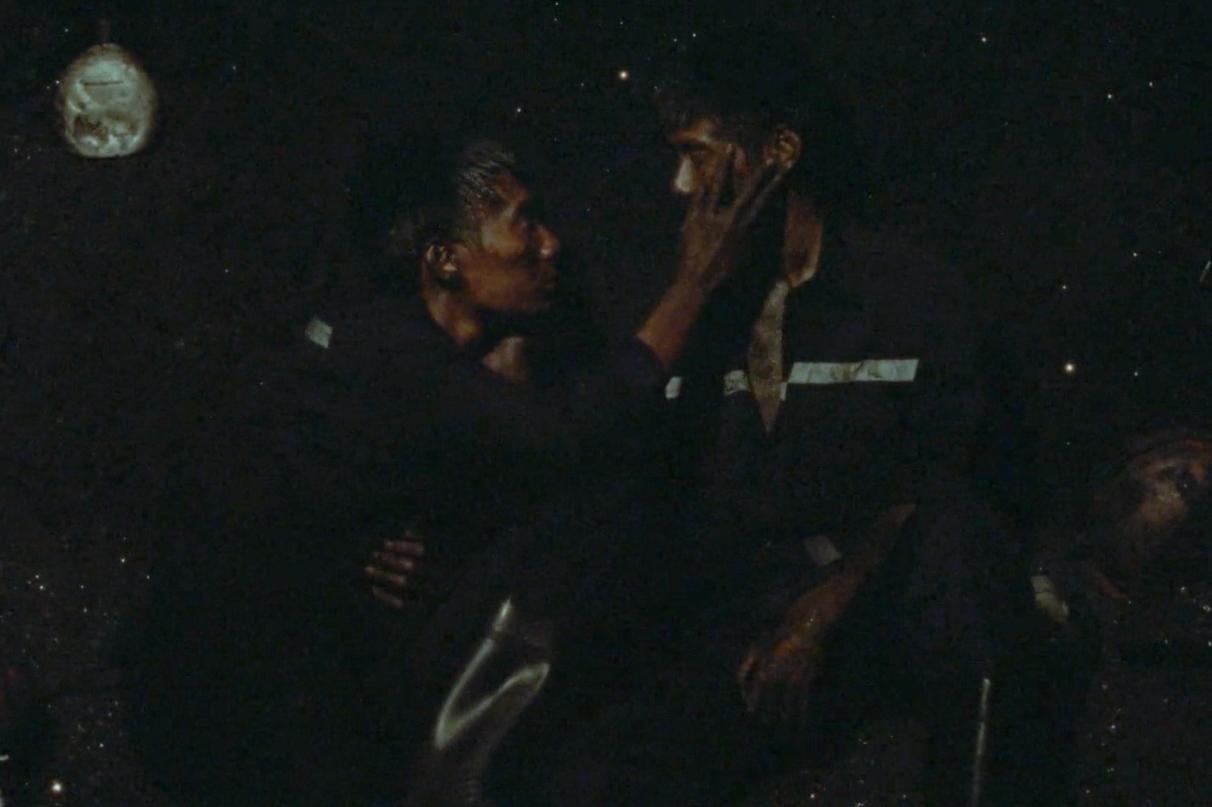
The film then transitions to a black screen, punctuated by Nam’s voice recounting what appears to be a dream: "I had trouble breathing in the bag." As he describes being pushed across a river in a giant transparent bag by a swimmer, the scene shifts to Việt and Nam seated within the coal mine. Việt, attentive, takes a canteen from his satchel and affixes it to a niche in the wall. For the remainder of this pivotal scene, the light reflecting off the canteen transforms it into a luminous, moon-like orb against the dark, twinkling expanse of the coal mine walls, which resemble a starry field. This visual transformation underscores the film’s capacity to infuse mundane objects with profound symbolic resonance, creating moments of poetic beauty amidst harsh realities. When the men share an intimate caress, their soot-covered arms add another layer to the visual tapestry, deepening the chiaroscuro effect and challenging the spectator’s eye to discern form and emotion within the enveloping darkness.
Cinematic Craft: A Visceral Journey into Darkness
Trương Minh Quý’s directorial vision is powerfully realized through the film’s exceptional cinematography and production design. The decision to shoot on 16mm film imbues "Việt and Nam" with a distinct texture and grain, lending a visceral quality to its portrayal of the Vietnamese landscape. Cinematographer Son Doan, lauded for his ability to capture the "poetics and coded integrity of exotic landscapes"—a talent previously demonstrated in Meryem Benm’Barek’s "Derrière les Palmiers" (2025), set in Morocco—excels in rendering Vietnam as a world both fluid and flinty. The film’s visual palette is characterized by light that feels as palpable as Van Gogh’s paint strokes, creating a world perpetually beset by penumbra. These encroaching shadows simultaneously threaten and invite the eye inward, crafting mise-en-scènes that are at once stark in their depiction of reality and speculative in their evocation of inner worlds.
The interplay of light and shadow is a recurring motif, not merely for aesthetic effect but as a narrative device that trains the spectator’s vision to accommodate ambiguity and delve deeper into the film’s layered meanings. The opening sequence, with its gradual illumination, serves as a primer for the visual demands the film places on its audience, preparing them for a journey through scenes where clarity is often elusive, and meaning must be actively sought in the depths of the frame. This artistic choice contributes significantly to the film’s immersive quality, pulling viewers into the characters’ subjective experiences and the ambiguous spaces they inhabit.
Dreams, Reality, and the Weight of History
"Việt and Nam" skillfully blurs the lines between social reality and psychical landscapes, allowing the drama to unfold within the contiguous realms of waking life and dream. The early dream sequences, particularly Nam’s account of being in a bag in a river, are not mere flights of fancy but premonitions and allegories of real-world events. Shortly after Nam shares his dream, Việt narrates a scene where he observes Nam from a hill, being pushed in a bag by a swimmer across a river. While the use of voiceover initially lends a dream-like quality to Việt’s narration, it is later revealed to be a clandestine training session for Nam. This training is a grim preparation for his illegal migration to another country, a journey that involves being hidden in a shipping container and navigating treacherous waters, echoing the initial dream’s imagery with chilling accuracy. This narrative technique highlights the desperate measures individuals are forced to take in pursuit of better economic opportunities, a poignant commentary on contemporary socio-economic pressures in Vietnam.
The film further explores the interplay of the oneiric and the mnemic through the characters of Hoa (Nguyễn Thị Nga), Nam’s mother, and Ba (Lê Viết Tùng), a one-armed veteran who fought alongside Hoa’s late husband. Hoa is haunted by dreams of her husband’s ghost guiding her to his resting place, while Ba, drawing on his wartime memories, endeavors to pinpoint the makeshift grave. Ba’s recollection of soldiers’ graves being "very shallow – 90cm [35 inches] because they needed to bury them quickly and move on" vividly illustrates how the war dead lie just beneath the surface of everyday life, both physically and psychologically. This psychological impact is brutally brought home during a dinner scene when Ba, unable to eat a served frog, recounts a horrifying memory of a forest path lined with corpses covered in "frogs as large as sewer rats," before he retreats outside to vomit. This disturbing anecdote will later be woven into another crucial sequence involving Việt and Nam, demonstrating the persistent, often visceral, haunting of war.
A Nation’s Unresolved Grief: The Journey South
Hoa’s unwavering determination to locate her husband’s grave serves as a powerful symbol of a nation’s collective yearning for closure. Her quest draws parallels to the Russian woman in Ali Khamraev’s 1985 Soviet/Uzbeki film "I Remember You" ("Ya Tebya Pomnyu"), who sends her son to Moscow to retrieve soil from her soldier husband’s grave. While that film’s journey across the tundra triggers an epic expansion of personal and national memories, encompassing vestiges of the Silk Road and the winter-ravaged regions of the Soviet Union, the journey undertaken by Hoa, Ba, Việt, and Nam in "Việt and Nam" remains intensely local. As they travel south, reaching as far as the Cambodian border in their search for Nam’s father, their northern accent immediately identifies them to fellow northerners, emphasizing the deep-seated regional identities within Vietnam even decades after national unification.
Their odyssey leads them through various institutions and practices that have evolved from the widespread longing for closure. They encounter a shaman, standing defiantly in the road, demanding professions of belief from clients before proceeding with divination for their lost loved ones’ remains. This scene highlights the blend of spiritual practices and desperation that often characterizes the search for the missing.
The Ba Chúc Tomb House: A Confrontation with Collective Trauma
In a particularly poignant interlude from their personal search, Hoa and her companions visit the Ba Chúc Tomb House, a memorial dedicated to the 3,157 villagers who were brutally tortured and massacred by the Khmer Rouge between April 18 and April 30, 1978. This tragic event was part of a series of border incursions and atrocities committed by the Khmer Rouge against Vietnam, preceding the Vietnamese invasion of Cambodia that ultimately toppled Pol Pot’s regime.
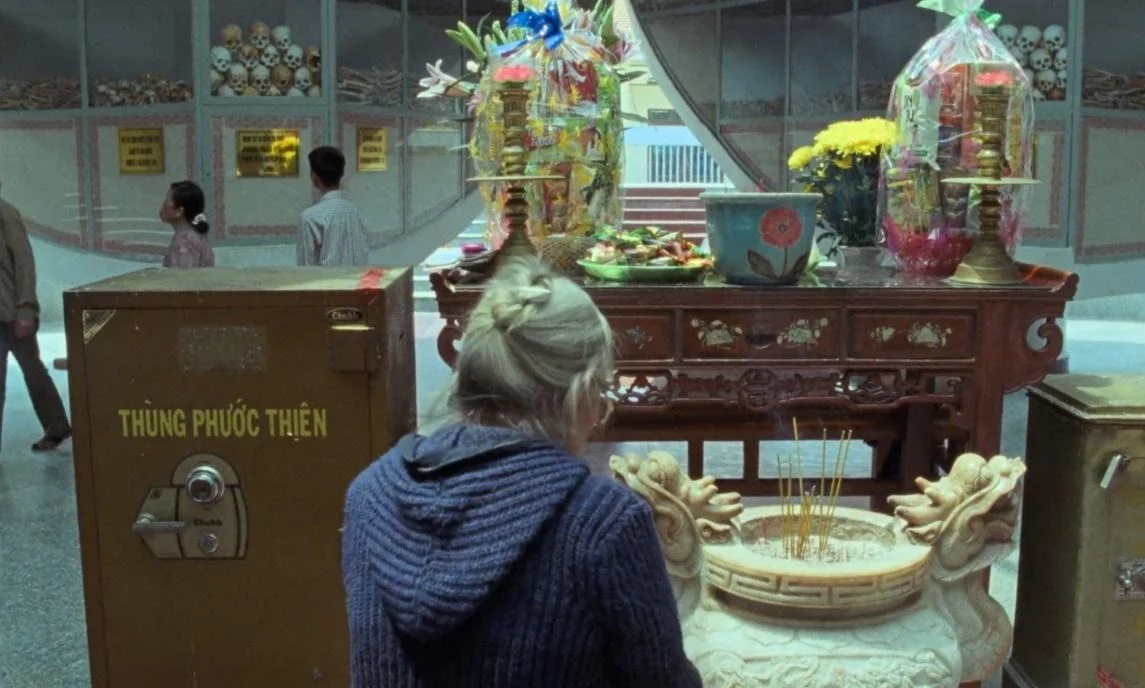
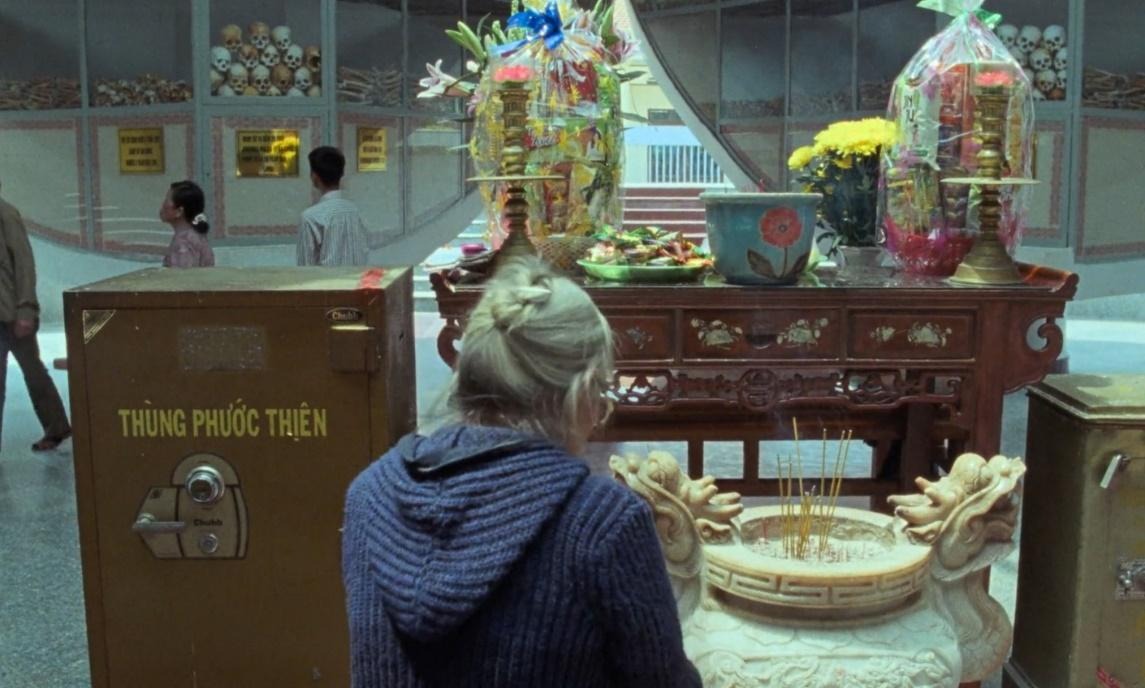
The characters enter a pristine building shaped like an inverted lotus blossom, a symbol of purity and rebirth in Vietnamese culture. Inside, the curved interior is lined with glass enclosures, chillingly filled with the skulls and skeletons of the victims. The scene presents a stark juxtaposition: the brutal facticity of the human remains—a tangible testament to unspeakable violence—is encased within the euphemistic architectural fantasia of the memorial. In the center of the floor, they observe an elderly woman making an offering to a relative interred and on display, her altar flanked by a large safe conspicuously marked "Charity Box." This image serves as a powerful, albeit unsettling, commentary on the commodification of grief and the institutionalization of remembrance, raising questions about how societies process and preserve the memory of mass trauma. The Ba Chúc Tomb House scene underscores the film’s broader engagement with national memory, demonstrating how collective suffering is enshrined and presented, both for public remembrance and, implicitly, for ongoing societal discourse.
The Abyss and Allegory: Searching for Closure
The journey culminates in a sequence of profound allegorical depth. Ba eventually finds a tree he believes he remembers, and Hoa, seeing it, believes it is the one from her dream. The four begin to dig feverishly around its roots, their hope tinged with desperation. The film then introduces a moment of terror when one of Nam’s pickaxe strokes hits something that reverberates with a metallic din, which they identify as an unexploded MK-82 bomb—a lingering, deadly artifact of war. Exhausted, the four seek rest among the giant roots of the tree.
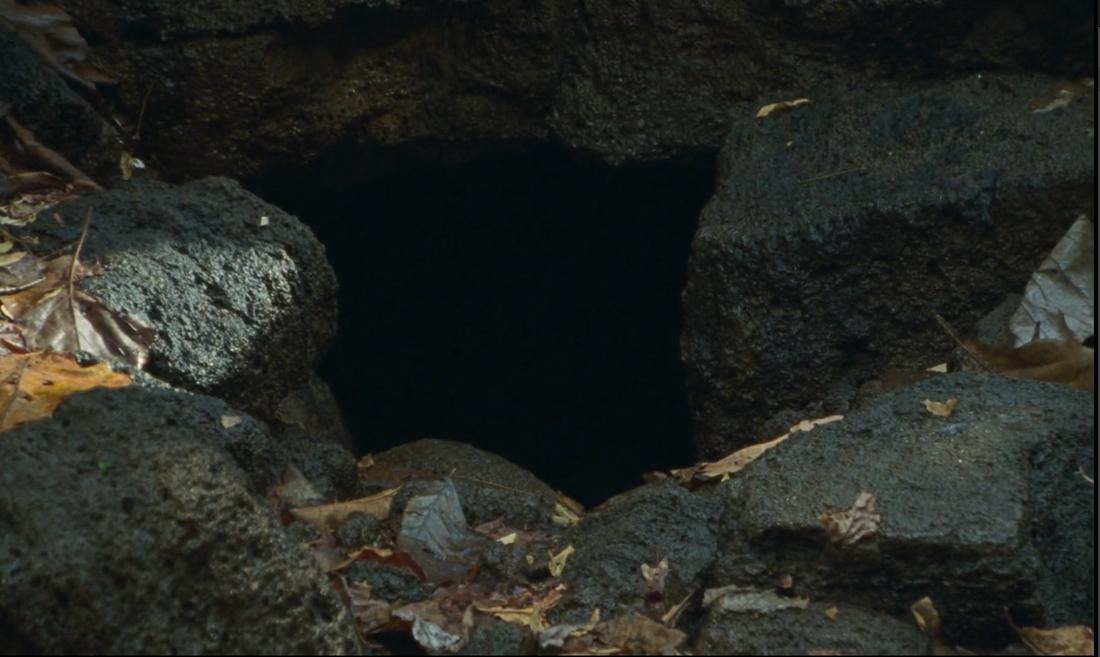
What follows is a sequence that masterfully blurs the distinction between dream and reality. A shot of a frog in the rain is immediately followed by a reverse shot of the sleepers, who remain perfectly dry. Nam wakes, also dry, but then steps into the rain to follow the frog through the forest. His pursuit is crosscut with shots of the other sleepers still perfectly dry under the tree, intensifying the ambiguity. When Việt wakes to see Nam gradually disappearing into the rain-drenched forest, the scene abruptly cuts to Nam standing in a now perfectly dry forest, shovel in hand, watching the frog disappear into an opening in an ancient stone wall. In a voiceover, he narrates imagining his father returning home when he is alone, as the frog vanishes into the jet-black hole.
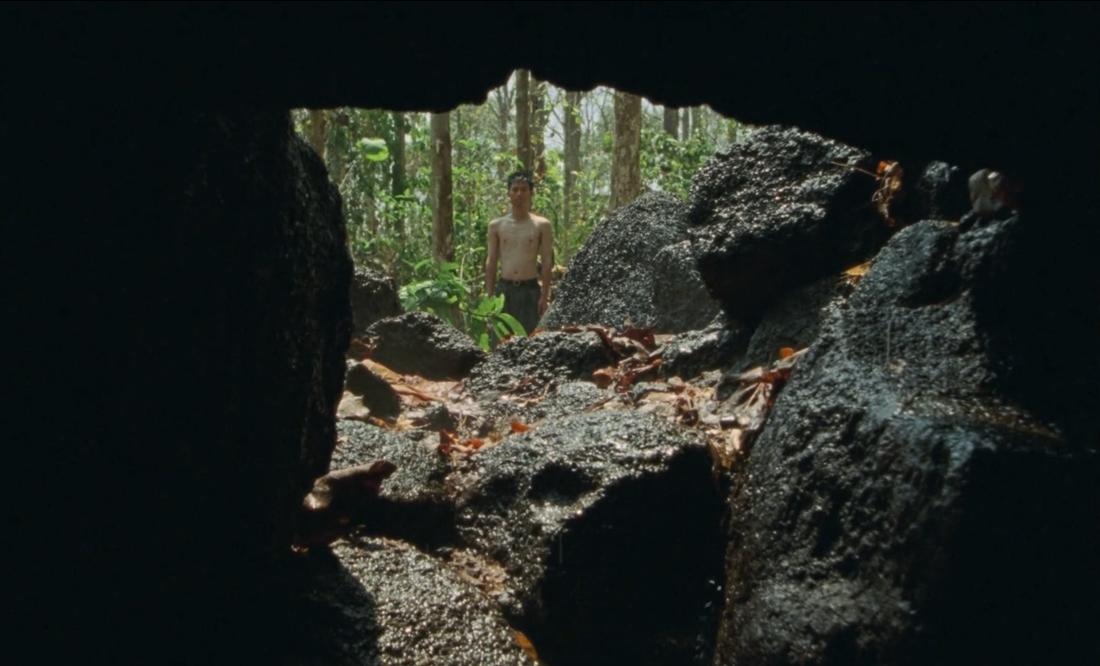
The camera then zooms slowly towards this enigmatic hole from a greater distance, as Nam’s voice wonders aloud what he would say to his father’s ghost. This leads to a sudden and astonishing shot-reverse shot: now from inside the hole, looking out at Nam. This visual echoes Nietzsche’s Aphorism 146 from Beyond Good and Evil: "Und wenn du lange in einen Abgrund blickst, blickt der Abgrund auch in dich hinein" ("When you gaze long into an Abyss, the Abyss will also gaze into you"). This philosophical resonance transforms the physical hole into a metaphorical abyss of memory, grief, and the unknown, suggesting that the act of seeking answers often leads to a confrontation with one’s own existential depths.
Suddenly, a gunshot rings out, and Nam falls. Lying on the ground, he asks, "Is this what it is like to be dead?" This question is immediately followed by a cut to a swimmer pushing Nam in a giant bag across the river. This shot is presented from Việt’s perspective, yet with a level of detail and proximity that Việt could not have physically observed in the earlier scene. This narrative slippage underscores the film’s increasingly interfused visions of dream and reality, event and allegory, personal perception and shared experience, solidifying the idea that the internal and external worlds are inseparable.
Beyond Narrative: Allegorizing Location and Identity
The film’s narrative evolution into metaphor finds an illustrious precedent in Apichatpong Weerasethakul’s 2004 film "Tropical Malady" ("Satpralat"). Set in rural Thailand, the first half of "Tropical Malady" traces the developing romance between soldier Keng and villager Tong, a story that abruptly concludes with Tong’s disappearance into a forest. The second half adapts a legend, with the same actors portraying new figures: a soldier (played by Banlop Lomnoi) tasked with defeating a shaman (played by Sakda Kaewbuadee) capable of transforming into a tiger. Their battle becomes a psychodramatic expression of the lust and desire circulating between them, culminating in the soldier’s ecstatic absorption into the tiger spirit, infusing the myth with the pleasure principle of the earthly lovers from the first story.
"Việt and Nam," however, departs from this pattern. Rather than allegorizing the lovers themselves, the film allegorizes the location of love and loss. This brings the focus back to the "other scene" of the central fantasy—the coal mine—where the protagonists consummate their relationship, including an explicit post-coital scene. This strategic choice highlights the centrality and significance of the physical space in shaping and containing the characters’ emotional and historical experiences.
"Trong Lòng Đất": A Multilayered Title
The original Vietnamese title, "Trong Lòng Đất," reflects the profound significance of this allegorized location more vividly than its English counterpart. While the term can be directly translated as "underground"—an evocative descriptor for the clandestine nature of the sexual relationship and the hidden aspects of history—it carries far richer poetic connotations than other Vietnamese words for "underground."
According to film scholar and performance artist Phạm Đức Minh, the title is "quite nuanced and can mean different things." He elaborated, "It can definitely carry the meaning you mentioned. At the same time, if you look at each of the words individually, it also opens up other interpretations. In Vietnamese, đất nước means country or nation. So đất (earth, land, soil) can also carry part of that association. In Vietnamese, lòng can mean heart, inside, or even womb in certain contexts. At the same time, the earth is often associated with parenthood and ancestry. Therefore, trong lòng đất can also be understood as being embraced by one’s ancestors, or returning to them."
This multifaceted interpretation reveals the depth of the film’s title. The lovers’ secret rendezvous point is not merely "underground" in a literal or social sense; it is also the source of their livelihood, the energy for their community, and symbolically, a womb-like space, a metaphorical embrace by their ancestors, and a return to the very heart of their nation. Visually, within the film, this space functions as both a microcosm of their world and a theater for the fulfillment of desire and the solace of seclusion. Crucially, these scenes were not filmed in an actual coal mine but in a meticulously crafted stage-set placed inside a natural cave, a deliberate choice that fuses the material reality of the site with the fantastical, almost dreamlike, inner world where Việt and Nam find precarious satisfaction and chiaroscuro comfort.
Implications and Legacy in Vietnamese Cinema
"Việt and Nam" stands as a significant contribution to contemporary Vietnamese cinema, pushing boundaries in narrative, visual storytelling, and thematic exploration. Its unique approach to historical trauma, particularly the lingering impact of the Vietnam War and the Cambodian-Vietnamese conflict, offers a contemplative and deeply personal lens through which to examine national memory. The film’s portrayal of a gay relationship, while not explicitly foregrounded as a political statement in the analysis, implicitly contributes to the evolving landscape of LGBTQ+ representation in Vietnamese film, presenting a tender and complex bond within a challenging societal context.
Trương Minh Quý’s work challenges conventional storytelling by prioritizing atmosphere, symbolism, and subjective experience over linear plot progression. This experimental approach, coupled with Son Doan’s evocative cinematography and the use of 16mm film, positions "Việt and Nam" as a work of profound artistic integrity. The film’s critical reception, particularly its inclusion in international film festivals and the detailed analyses it has inspired, suggests its growing influence on how Vietnamese stories can be told and received globally. It contributes to a broader cinematic dialogue about national identity, the processing of historical wounds, and the universal search for connection and meaning amidst adversity.
Conclusion
"Việt and Nam" masterfully weaves together individual desire with collective memory, crafting a cinematic experience that is both deeply personal and universally resonant. The film’s increasingly allegorical motifs coalesce into a visual stream-of-consciousness, where the impossible sparkling darkness of the coal mine embraces and stains Việt and Nam. This evocative imagery comprehends the joy of love and the anticipation of loss, a profound togetherness within an impending separation. It is a separation that will forever harbor the memory of a union, offering both consolation and torment.
Like "Song Lang" before it, "Việt and Nam" enacts a powerful investment into a fantasy space—an "other scene"—where the inherent impossibility of desire becomes heartbreakingly possible. This space is imbued with attendant mysteries, tentative resolutions, and clandestine revelations, offering viewers a profound meditation on the enduring power of human connection against the backdrop of history and an ever-changing landscape. Trương Minh Quý’s film ultimately provides a poignant and visually stunning testament to the enduring human spirit, finding solace and meaning in the deepest recesses of the earth and the human heart.