When Christopher Nolan brought editor Jennifer Lame aboard for his 2020 science-fiction action thriller Tenet, the pairing represented a distinct pivot for both filmmaker and artisan. Lame had built her formidable reputation within the independent cinema landscape, cutting character-driven, intimately scaled dramas such as Noah Baumbach’s Frances Ha (2012), Mistress America (2015), and Marriage Story (2019), alongside Kenneth Lonergan’s Manchester by the Sea (2016) and Ari Aster’s psychological horror Hereditary (2018). Transitioning from emotionally resonant, low-budget talking pictures to a globally budgeted, reverse-chronology spectacle involving backward-moving car chases and large-scale combat required a fundamental paradigm shift. Lame has frequently recalled feeling deeply intimidated by the logistical and technical demands of Tenet during the early stages of production.
To bridge the gap between her human-centric background and Nolan’s mechanics-driven script, Lame devised a psychological strategy. She began treating the inanimate, reverse-moving vehicles in the film’s massive action set-pieces as living characters, assigning each machine a distinct personality and internal dialogue. By approaching action sequences with the same structural intensity and interpersonal tension typically reserved for dramatic dialogue scenes, Lame unlocked the editorial rhythm that would define the collaboration. The resulting film emerged as a masterclass in cinematic propulsion—a work where action is governed by a metered, relentless beat toward moments of high-impact collision. Dialogue scenes were similarly trimmed to the bone, frequently sacrificing traditional spatial continuity for sheer velocity, transforming standard conversations into tense, athletic sparring matches.
This stylistic trajectory represents the culmination of a two-decade editorial philosophy that Nolan began developing with his self-funded, micro-budget feature debut, Following (1998). Over the subsequent years, Nolan refined this aesthetic alongside veteran editors such as Dody Dorn and Lee Smith. However, his partnership with Lame, which officially solidified during their Oscar-winning work on the 2023 biographical drama Oppenheimer, marked a distinct structural evolution. Oppenheimer presented a notoriously complex, multi-layered narrative tracking J. Robert Oppenheimer and the development of the atomic bomb, jumping freely across decades through the subjective, dueling perspectives of different characters. The editorial approach relied heavily on Lame’s prior mastery of flashback architecture, a skill she initially honed while working on the grief-stricken, non-linear timeline of Manchester by the Sea.
Emotional Logic as the Foundation of Nolan’s Oeuvre
Despite the intricate, puzzle-box architecture that characterizes Christopher Nolan’s filmography—spanning from the psychological investigations of Memento (2000) to the interstellar physics of Interstellar (2014)—the operational core of his editing suite remains decidedly visceral and emotional. The intricate plotting and conceptual loops are consistently subordinated to the immediate, gut-level feeling of a single shot, a passing line of dialogue, or an abrupt cut. Nolan’s breakout feature, Memento, famously utilized a dual-track structure where one narrative unspooled in reverse chronological order while the other advanced forward, converging at the narrative center. Yet, the enduring success of the film relied less on its structural gimmick and more on the fact that its classical neo-noir tropes—the femme fatale, the betrayal, and the tragic realization—retained their emotional momentum.

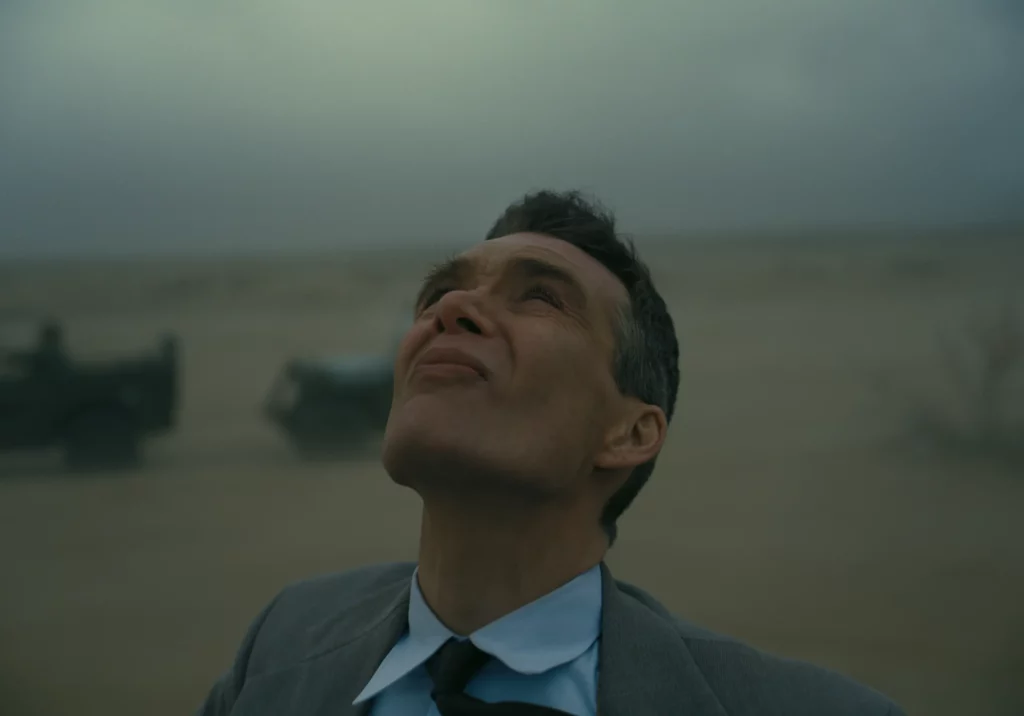
Over successive projects, including the opening sequences of Batman Begins (2005) and The Prestige (2006), Nolan and his editorial teams pushed further toward intuitive, abstracted cutting. By the time Lame entered the fold on Tenet and subsequently Oppenheimer, this methodology had matured into a system of impressionistic association. Discussing the rigorous demands of editing Oppenheimer, Lame noted that she and Nolan frequently executed multiple editorial passes tailored explicitly to individual supporting characters. By compiling targeted sequences focused on specific historical figures—such as Robert Serber or George Kistiakowsky—the filmmakers ensured that even brief, fleeting on-screen appearances carried immediate cognitive and emotional weight. This meticulous atomization of character allowed quick historical flashes, visions of quantum mechanics, and the surreal pacing of the Trinity test sequence to register with maximum theatrical impact.
The Chronological Dissolution of The Odyssey
With their third major collaboration, The Odyssey (2026), Nolan and Lame have pushed this impressionistic editing style to its structural limits, adapting Homer’s foundational epic into a film that exists largely outside of conventional linear time. Homer’s original text is itself famous for its non-linear construction, utilizing media res openings, embedded retrospective narratives, shifting perspectives, and digressions. Rather than flattening this complexity into a straightforward historical adventure, Nolan embraces the structural fragmentation of the source material, crafting a narrative that mirrors the synaptic logic of human memory.
The film establishes its complex temporal architecture in its opening sequence, featuring musician Travis Scott appearing as an ancient bard recounting the myth of the Trojan Horse. Within these opening moments, the audience is thrust simultaneously into three distinct timelines. Odysseus, portrayed by Matt Damon, is glimpsed briefly alongside Sinon, played by Elliot Page. The wooden horse juts awkwardly from a stark, sun-bleached beach, while Penelope, played by Anne Hathaway, screams from behind an industrial metal screen, demanding that the bard cease his oft-repeated retelling of the war.
Following this disorienting prologue, the main narrative proceeds along two loosely concurrent timelines, yet the overarching editorial rhythm actively disregards the traditional establishment of physical space and geography. Individual shots are deliberately brief, rarely lingering for more than a few seconds, creating a breathless momentum as Odysseus sorts through the fractured components of his own history. The vast majority of his legendary decade-long voyage is revealed to the nymph Calypso via extended flashbacks, emerging in jagged fragments as the protagonist struggles to recover his identity from a prolonged, drug-induced stupor.
Rethinking the Scale of the Classical Epic

Historically, Hollywood cinematic epics set in antiquity—ranging from mid-century spectacles like The Robe (1953) to Ridley Scott’s large-scale historical dramas such as Kingdom of Heaven (2005)—have relied on opulent theatricality, extended widescreen cinematography, and a leisurely, immersive sense of physical scale. The Odyssey deliberately subverts this tradition. While exterior establishing shots of the Mediterranean Sea and rugged Greek islands are undeniably grand, the camera rarely lingers on these vistas. The editorial strategy dictates that visual grandeur must be subordinated to the psychological reality of the characters.
In stark contrast to the rapid-fire cutting of the action sequences, select intimate moments are granted expansive, unbroken screen time. A notable sequence features Penelope standing behind a strung loom while her persistent suitor, Antinous, played by Robert Pattinson, attempts to court her. This extended long take mirrors an earlier intimate conversation between Penelope and Odysseus before his departure for Troy. By slowing the editorial pace during this interaction, the filmmakers capture the delicate frisson of human connection, underscoring the central thematic tension of the epic: the gradual fraying of interpersonal bonds and the unreliability of memory over years of separation.
These quiet dramatic islands are punctuated by abrupt, decontextualized flash-cuts back to the visceral violence of the sacking of Troy. By repeatedly juxtaposing these memories of loss and wartime horror against the domestic struggle in Ithaca, the editing establishes a thematic bridge between disparate traumas. It is only in the film’s final sequence that these fractured narrative threads converge, tying the disparate memories of war and homecoming into a unified cinematic statement.
Implications and Industry Reception
The release of The Odyssey marks a significant milestone in the ongoing creative partnership between Christopher Nolan and Jennifer Lame, further solidifying their shared methodology as a defining force in contemporary studio filmmaking. By applying the rhythmic intensity and psychological fragmentation typically reserved for experimental cinema or internal thrillers to a foundational classical text, the filmmakers have challenged conventional expectations of the Hollywood epic.
Industry analysts and film scholars have noted that the film’s commercial and critical reception will likely reinforce the viability of complex, non-linear storytelling within large-budget studio tentpoles. As blockbuster filmmaking increasingly leans toward standardized narrative frameworks, Nolan and Lame’s insistence on treating chronology as a fluid, emotional construct demonstrates that audiences remain receptive to cognitively demanding cinema. Through its fusion of classical mythology and hyper-modern editorial technique, The Odyssey stands as a testament to the evolving potential of the cinematic cut as the primary engine of dramatic expression.