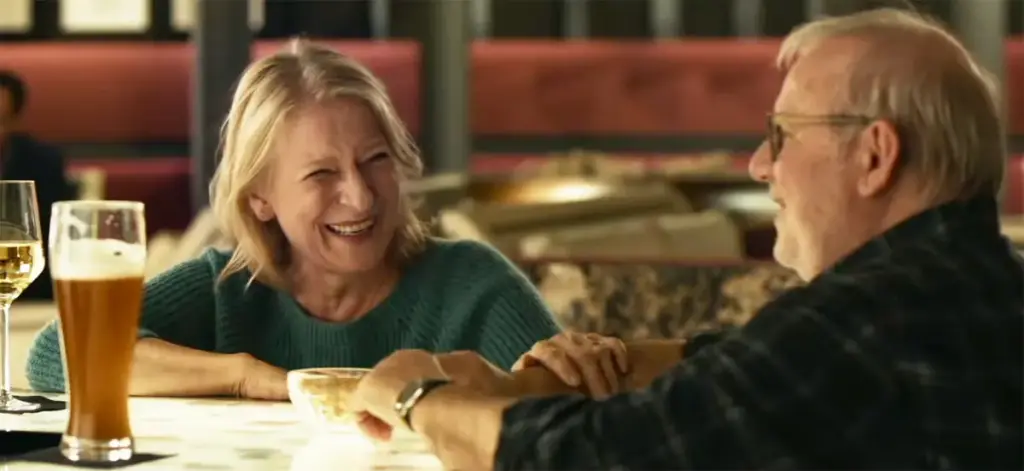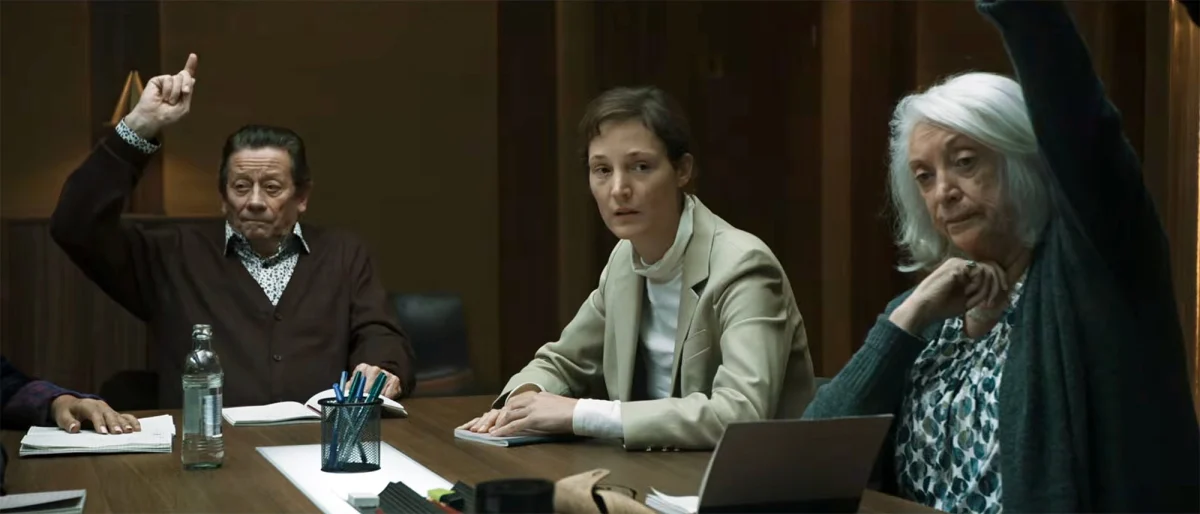
Kino Lorber has officially released the trailer and promotional poster for Re-Creation, a compelling and unconventional courtroom thriller co-directed by Academy Award nominee Jim Sheridan and filmmaker David Merriman. Billed as a modern-day conceptual update to Sidney Lumet’s seminal 1957 classic 12 Angry Men, the film transports the psychological weight of the jury deliberation room into the contentious arena of true-crime re-investigation. Following its world premiere at the 2025 Tribeca Film Festival, the feature bypassed a traditional theatrical window, arriving directly on Video-on-Demand (VOD) platforms via Kino Lorber.
The film operates as a fictionalized examination of a real-life tragedy that has haunted Ireland and France for nearly three decades: the 1996 murder of French television producer Sophie Toscan du Plantier. Rather than offering a traditional linear narrative of the crime, Re-Creation constructs a dramatic thought experiment. It imagines a jury deliberation concerning the guilt or innocence of English journalist and primary suspect Ian Bailey—a figure who was infamously convicted in absentia by a French court in 2019, though he was never extradited from Ireland and consistently maintained his innocence until his death in early 2024.
The Main Facts and Narrative Premise
At its core, Re-Creation explores the fragile nature of justice, circumstantial evidence, and public perception. The narrative centers on twelve fictionalized jurors tasked with weighing the complex, often contradictory evidence surrounding the brutal killing of Toscan du Plantier, whose battered body was discovered near her holiday home in Schull, County Cork, just days before Christmas in 1996.
Leading the ensemble cast is internationally acclaimed actress Vicky Krieps (Phantom Thread, Corsage), who anchors the film as Juror #8—the character spiritual equivalent to Henry Fonda’s dissenting voice in 12 Angry Men. Krieps’s character pushes her fellow jurors to look past media sensationalism and peer pressure to re-examine the facts of the case critically. The impressive supporting ensemble features a roster of notable Irish talent, including Aidan Gillen, Colm Meaney, John Connors, and even co-director Jim Sheridan himself, blending dramatic performance with meta-theatrical commentary on storytelling and guilt.

By staging a trial that never actually took place in a standard courtroom, the filmmakers intentionally blur the lines between reality, dramatic representation, and societal judgment. The film invites viewers to participate actively in the jury process, questioning how cultural biases, police procedures, and media narratives shape our collective understanding of guilt and innocence.
Historical Background and the Sophie Toscan du Plantier Case
To fully understand the gravity and ambition of Re-Creation, one must examine the real-world history that inspired it. On the night of December 23, 1996, Sophie Toscan du Plantier, a 39-year-old French film and television producer, was brutally murdered outside her isolated rural retreat in West Cork. Her body was found the following morning by a neighbor, half-hidden in a briar patch near a laneway.
The subsequent Garda Síochána (Irish police) investigation quickly zeroed in on Ian Bailey, an English journalist living nearby who had been among the first reporters to arrive at the scene. Despite local suspicion and intense media scrutiny, the Director of Public Prosecutions in Ireland repeatedly declined to charge Bailey, citing a lack of sufficient, admissible evidence.
However, the case took an extraordinary international turn when French authorities launched their own parallel investigation under French extraterritorial laws, which allow prosecution for crimes committed against French citizens abroad. In May 2019, a French court found Bailey guilty in absentia of voluntary homicide and sentenced him to 25 years in prison. France subsequently sought his extradition from Ireland. The Irish High Court and Supreme Court ultimately blocked the extradition, ruling that surrendering Bailey would violate his constitutional rights because he had never been charged by Irish authorities and would face a trial dependent on preliminary dossiers rather than standard Irish evidentiary standards.
Ian Bailey lived out the remainder of his life in Ireland as a free man, vehemently protesting his innocence until he suffered a fatal heart attack in Bantry, County Cork, in January 2024. The case remains officially unsolved in the eyes of Irish jurisdiction, leaving a lingering cultural wound and a legacy of legal controversy that Re-Creation seeks to interrogate.

Chronology and Production Development
The genesis of Re-Creation traces back to an original concept conceived by Jim Sheridan, a towering figure in Irish cinema whose career boasts six Academy Award nominations, including nods for My Left Foot (1989), In the Name of the Father (1993), and In America (2002). Sheridan partnered with co-director and co-writer David Merriman, known for his work on the documentary-driven project Rock Against Homelessness.
The collaboration represents Merriman’s feature-length narrative debut alongside a master filmmaker, blending seasoned cinematic craftsmanship with an investigative, docudrama-adjacent sensibility. The production was steered by producers Fabrizio Maltese and Tina O’Reilly, who faced the delicate task of balancing dramatic tension with respect for the real-life sensitivities surrounding a high-profile, unsolved homicide.
Following its selection for the 2025 Tribeca Film Festival, where it drew curiosity and critical discussion for its unique structural premise, the film secured distribution through Kino Lorber. Rather than pursuing a traditional theatrical rollout—a strategy increasingly challenging for mid-budget, dialogue-heavy psychological dramas—the studio opted for a direct-to-VOD release strategy, making the film immediately accessible to home audiences seeking intellectually stimulating cinema.
Comparative Analysis: The Modern Jury Room Subgenre
Re-Creation arrives during a notable resurgence of the courtroom thriller and, more specifically, the jury-room subgenre. Its release echoes conversations surrounding Clint Eastwood’s 2024 psychological drama Juror #2, starring Nicholas Hoult, which similarly explored the ethical dilemmas and personal guilt of an individual serving on a murder trial jury.
However, where Eastwood’s film utilized a fictionalized murder plot to examine internal morality, Sheridan and Merriman anchor their project in the chilling reality of a real international tragedy. By casting actors alongside real dramatic recreations of arguments, Re-Creation functions almost as a cinematic essay. It challenges the conventions of the true-crime genre, which has exploded in popularity across streaming platforms in recent years. While true-crime docuseries often lean toward sensationalism or definitive conclusions, Re-Creation deliberately subverts this by refusing to offer tidy answers, instead forcing the audience to grapple with the inherent limitations of judicial certainty.

Broader Impact and Implications
The release of Re-Creation carries significant implications for how modern filmmakers engage with historical trauma and open legal wounds. In communities like West Cork, the ghost of Sophie Toscan du Plantier’s murder still resonates deeply, and artistic interpretations of the tragedy have frequently sparked intense public debate regarding ethics, respect for the victim’s family, and the ethics of true-crime adaptation.
By framing the narrative around a fictionalized jury room rather than directly dramatizing the crime itself, the filmmakers attempt an ethical pivot. They shift the focus away from the gruesome mechanics of the murder and onto the machinery of justice, public opinion, and the burden of proof.
For Jim Sheridan, the film represents a thematic continuation of his lifelong cinematic exploration of miscarriage of justice, state power, and human fallibility—themes that previously defined masterpieces like In the Name of the Father and The Field. Paired with David Merriman’s contemporary vision, Re-Creation stands as a haunting, cerebral exercise in civic responsibility.
As the film becomes available to global audiences via Kino Lorber’s VOD platforms, it invites viewers to step into the jury box, weigh the shadows of circumstantial evidence, and confront an unsettling cinematic question: when the legal system reaches an impasse, how do we decide who is guilty?