Prime Video’s newly released adaptation of Stephen King’s seminal 1974 horror novel Carrie, helmed by acclaimed genre architect Mike Flanagan, has reignited critical and public debate over the boundaries of literary translation. For over half a century, King’s narrative detailing telekinetic terror, religious fanaticism, and high school cruelty has occupied a towering position in American popular culture, largely anchored by Brian De Palma’s legendary 1976 feature film. Repeated attempts to revisit the Carrie mythos—including a 1999 theatrical sequel, a 2002 television film, and a 2013 cinematic remake—frequently struggled to justify their existence, often treading the exact thematic and narrative footprints of their predecessors. Flanagan’s serialized adaptation, however, abandons straightforward replication in favor of expansive restructuring. Now that all episodes are available to stream, a thorough examination of the Prime Video series reveals a radical overhaul of the source material, transforming a localized tragedy of isolation into a sprawling exploration of systemic institutional control, genetic inheritance, and a clandestine network of psychic phenomena.
Chronology and Environmental Shifts: Relocating Telekinesis to 2026
The original literary text anchors its chilling events in the late 1970s, precisely 1979, mirroring the sociopolitical anxieties of the decade immediately following its publication. Flanagan’s adaptation deliberately shifts the temporal baseline to the year 2026. While maintaining a contemporary high school landscape, this chronological leap allows the series to directly confront the technological and psychological landscape of modern adolescence, specifically the pervasive, digitized cruelty of cyberbullying.
In promotional interviews surrounding the series premiere, Flanagan noted that contemporary secondary education is defined by an unprecedented level of constant connectivity that renders harassment inescapable. Within the narrative, this is exemplified by the establishment of a malicious social media page titled Carrie Red, operated by Carrie’s primary antagonist, Chris Hargensen. Beyond its immediate function as a digital pillory designed to systematically humiliate Carrie White, the account serves as an ambient hub for rumor dissemination, targeting various students and faculty members alike. This integration of modern high school security architecture—such as ubiquitous metal detectors—alongside digital harassment reflects a deliberate effort to update the existential dread of the youth experience for a 21st-century viewing audience.
The Academic Milestone: Carrie’s First Incursion into Public Education
A foundational narrative divergence occurs in the framing of Carrie White’s socialization. In both King’s novel and previous adaptations, Carrie has endured years of systemic marginalization and bullying within the public school system, establishing a lifelong baseline of torment. The Prime Video series, conversely, introduces Carrie as a teenager who has spent the entirety of her formative years isolated through rigorous homeschooling under the watchful eye of her fundamentalist mother, Margaret.
According to the series narrative, local authorities mandate Carrie’s enrollment in public school following a tragic domestic turning point: the sudden death of her father. This late-stage introduction to a conventional educational institution alters the psychological trajectory of the character. Rather than enduring a lifelong escalation of localized abuse, Carrie enters a volatile, high-tech social ecosystem completely unequipped for its tribal dynamics. This structural choice provides the creative team with a narrative vehicle to examine the insular cultural and sociological dynamics of extreme homeschooling, though it introduces a significant departure from the localized, insular abuse pattern established in the original text.
Paternal Dynamics and the Spectral Presence of Ralph White
In Stephen King’s original narrative, Carrie’s father, Ralph White, is deceased prior to the protagonist’s birth, existing merely as a distant, fundamentalist specter invoked by Margaret to justify their austere, punishing lifestyle. The Prime Video series expands this familial background significantly. In this version, Ralph White survives until Carrie is well into her teenage years, ultimately perishing in a fatal workplace accident that serves as the catalyst for Carrie’s sudden entry into public school.
Furthermore, Ralph’s presence remains active throughout the series via a recurring apparition witnessed obsessively by Carrie. Through these spectral interactions, the narrative paints a more complex portrait of the White household’s origins. Ralph is retroactively established as a military veteran whose rigorous, survivalist discipline contributed heavily to the fiercely guarded, isolated environment in which Carrie was raised. This addition recontextualizes the family’s foundational trauma, positioning Ralph not merely as a historical footnote, but as an active, haunting architect of Carrie’s psychological conditioning.
Nuance and Isolation: Reimagining Chris Hargensen
Chris Hargensen, universally recognized as the quintessential high school antagonist of the original text, undergoes a calculated softening in Flanagan’s adaptation. In the 1974 novel and De Palma’s film, Chris’s animosity toward Carrie is driven by a visceral, unabashed hatred for anyone who deviates from social norms, compounded by disciplinary action stemming from her initial mistreatment of Carrie in the showers.
The Prime Video series incorporates extensive backstory to contextualize Chris’s behavior, revealing a young woman navigating the isolating fallout of a broken home. Her father—a character possessing considerable socio-legal influence in the literary canon—is depicted as mired in severe financial and legal turmoil. These revisions are engineered to render Chris a multi-dimensional, psychologically grounded figure rather than a traditional literary villain. By framing Chris’s cruelty as a misguided displacement of her own domestic insecurity and adolescent alienation, the series aligns with its broader thesis regarding the immense pressures bearing down on contemporary teenagers, a creative choice that has nonetheless divided purists.
Hereditary Power and the Re-characterization of Margaret White
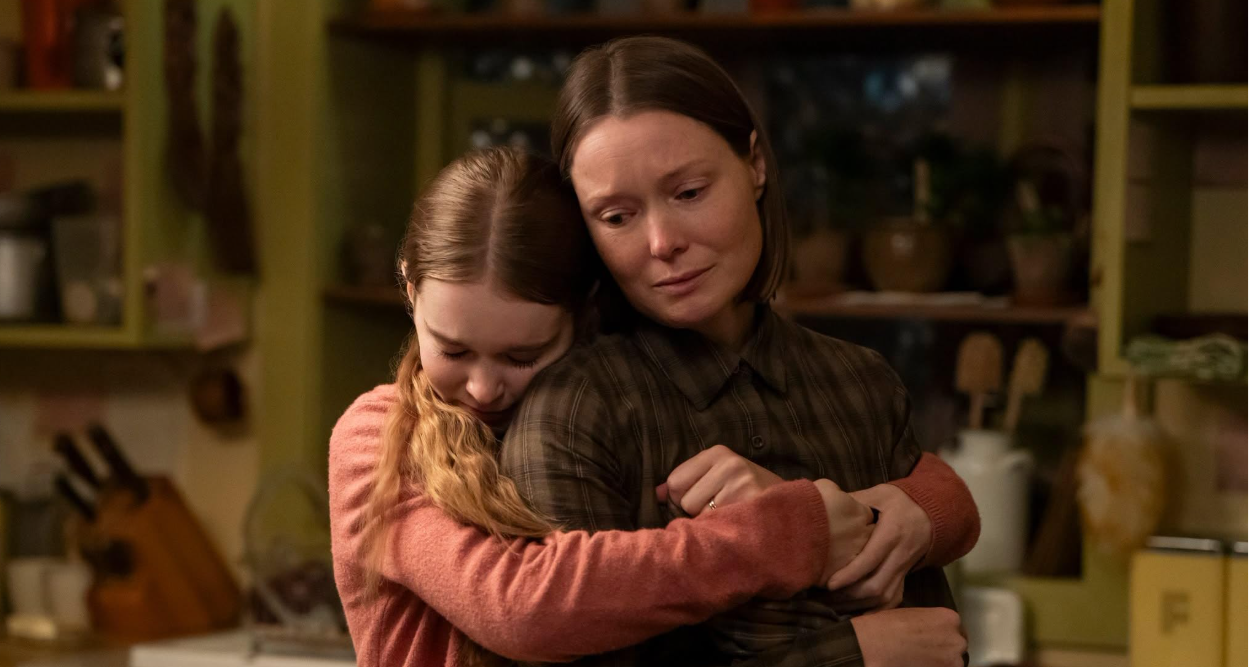
Without question, the most seismically controversial alterations within the Prime Video adaptation center on Margaret White, brilliantly embodied by Samantha Sloyan, and the expansion of the universe’s psychic taxonomy. Traditionally portrayed as a monolith of fanatical religious zealotry and unyielding sadism, Margaret is re-envisioned by Flanagan and Sloyan as a fundamentally protective, albeit profoundly damaged, figure. While her methods remain horrifyingly abusive, the series frames her actions through the lens of a deep, cynical awareness of the world’s cruelty and a desperate desire to shield her daughter from a fate she intimately understands.
The foundational shift, however, lies in the revelation that Margaret possesses latent telekinetic and psychic abilities comparable to Carrie’s. While King’s novel briefly hints at ancestral lineage by noting that Margaret’s grandmother exhibited similar capabilities, the source material keeps these talents dormant or anecdotal. In contrast, the Prime Video series depicts Margaret actively utilizing her powers—most notably as a desperate defense mechanism during the catastrophic structural collapse of the White homestead.
Thematically, this hereditary expansion addresses contemporary anxieties surrounding genetic determinism and the psychological baggage passed down across generations. By establishing that telekinesis is an inherited trait rather than an isolated supernatural anomaly, the narrative validates Margaret’s extreme paranoia: she recognized the latent power in Carrie because she recognized it within herself. This foundational pivot represents the most heavily debated creative choice of the adaptation, fundamentally altering the mythological rules established by the source text.
Collective Telekinesis: Emaline and the Telekinetic Network
Expanding far beyond the isolated tragedy of a single troubled girl, the Prime Video series populates its narrative universe with other individuals possessing psychic gifts. Among them is Emaline, a student who befriends Carrie at public school. Initially structured to appear as a psychological projection or a figment of Carrie’s overstimulated imagination, Emaline is eventually revealed to be a fellow psychic capable of astral projection. Throughout the series, Emaline acts as a mentor, guiding Carrie to accept and wield her extraordinary capabilities before finally meeting her in the physical world.
While the original novel briefly references isolated accounts of psychics across the globe, it firmly positions Carrie’s experience as a singular, tragic occurrence. Flanagan’s series dismantles this isolation, integrating Carrie into a broader, interconnected network of telekinetic individuals. This collective framework directly impacts the climax of the story during the infamous prom sequence.
During the catastrophic prom massacre, while Carrie’s humiliation via porcine blood still triggers the bloodshed, the violence is no longer solely her responsibility. As Carrie begins wreaking havoc—shattering mobile devices, collapsing catwalks, and sealing exits—Emaline’s voice is heard offering direct intervention: "Let me help… let me take the wheel, ok?" The narrative strongly implies that Emaline actively influences or temporarily controls Carrie, orchestrating the most lethal manifestations of the massacre.
Industry analysts and critics have identified two primary interpretations for this narrative choice. First, it functions as a deliberate attempt to mitigate Carrie’s direct culpability in mass school violence—a sensitive cultural touchstone carefully addressed throughout the series. Second, it serves to subordinate Carrie’s individual narrative arc to a much larger mythological framework involving an organized network of psychic individuals.
Shadow Organizations and the Survival of Carrie White
The culmination of this expanded universe theory arrives in the final episodes, which introduce a clandestine government or private organization dedicated to hunting down and neutralizing individuals with psychic abilities. Operating initially under the guise of an ordinary documentary film crew recording the high-stakes events surrounding Carrie, this shadow syndicate’s true, predatory intentions are unmasked late in the series.
This secretive faction steps into the foreground when one of its operatives assassinates Margaret White, subverting the traditional narrative where Margaret perishes alongside her daughter in the collapsing home. This assassination sets the stage for the most radical departure from King’s text: Carrie White survives.
Rather than succumbing to her wounds amid the burning wreckage of her hometown, as immortalized in both the 1974 novel and subsequent cinematic adaptations, Carrie escapes alongside Emaline. Together, they embark on an uncertain future, evading the pursuit of the mysterious shadow organization.
Showrunner Mike Flanagan has expressed clear ambitions to develop multiple seasons of the series, projecting the narrative far beyond the established boundaries of Stephen King’s original book. Consequently, Carrie’s survival ensures that the Prime Video adaptation functions less as a faithful recreation of a standalone tragedy and more as an open-ended gateway into a sprawling, sci-fi/horror universe. While purists may mourn the loss of the original story’s inevitable, Greek-tragedy conclusion, Flanagan’s bold deconstruction ensures that Carrie continues to provoke, challenge, and terrify audiences half a century after its initial creation.