After nearly 70 years of cinematic evolution, the search for the quintessential James Bond has taken an unexpected turn back to the source material. While the role of 007 has been defined by the distinctive charisma of actors like Sean Connery, Roger Moore, and Daniel Craig, a closer examination of author Ian Fleming’s original creative vision reveals that the character’s literary blueprint has remained largely untapped until recently. Analysis of Fleming’s archived correspondence and his commissioned artistic renderings suggests that the specific physiological traits he envisioned—a long, angular face, sharp cheekbones, and a precise jawline—find their most accurate modern-day match in actor Robert Pattinson, marking a potential shift in how casting directors and fans view the archetype of the British secret agent.
The Literary Blueprint: Fleming’s Rigid Specifications
Ian Fleming was notoriously specific about the physical attributes of his protagonist. Throughout the 14 original Bond novels, beginning with the 1953 release of Casino Royale, Fleming provided granular details regarding 007’s appearance. According to the internal dossier referenced within the narrative, the quintessential Bond stood approximately six feet tall, weighed 168 pounds, possessed jet-black hair, and featured striking blue eyes.
Fleming’s preoccupation with these details was not merely aesthetic; it was an exercise in world-building that allowed him to anchor his fictional spy in a hyper-realistic setting. He viewed Bond as a functional tool of the state—a man whose physical appearance was meant to be unremarkable enough to blend into the high-society environments of Cold War-era espionage, yet striking enough to command attention. For decades, the casting of 007 has struggled to perfectly align with these constraints. Connery, the franchise’s inaugural cinematic Bond, famously lacked the requested blue eyes, and Daniel Craig, despite his physical commitment to the role, was frequently critiqued by purists for his fair hair, leading to the infamous tabloid headline: "No Mr. Blonde, They Expect You To Dye."
A Chronology of Cinematic Departures
The evolution of James Bond’s appearance on screen has functioned as a reflection of the changing definitions of masculinity in British cinema. A review of the franchise’s history reveals a deliberate departure from Fleming’s "lean and angular" description:
- 1962–1971 (Sean Connery & George Lazenby): Both actors provided a more robust, athletic, and arguably "rugged" physique. Connery’s broad-shouldered presence favored the "tough guy" aesthetic over the refined, razor-sharp look Fleming preferred.
- 1973–1985 (Roger Moore): Moore brought a sophisticated, suave temperament, yet his coloring and build shifted the character toward a more accessible, quintessentially British gentleman aesthetic.
- 1987–1989 (Timothy Dalton): Dalton offered a darker, more brooding interpretation, arguably closer to the literary "coldness" of the character, but his facial structure remained distinct from the narrow, sharp-featured profile described in the original texts.
- 1995–2002 (Pierce Brosnan): Brosnan is widely considered the closest visual match among the "classic" era actors. His black hair and blue eyes adhered to the color palette dictated by Fleming, though his softer facial features lacked the "angular" sharpness Fleming specifically requested.
- 2006–2021 (Daniel Craig): Craig’s tenure prioritized physical grit and vulnerability, intentionally eschewing the "dandy" nature of previous iterations in favor of a modern, tactical operative.
The Lost Portrait: Fleming’s Visionary Commission
The discrepancy between Fleming’s prose and the cinematic depiction of Bond can be traced back to the mid-1950s, when the Daily Express sought to serialize the novels as a newspaper comic strip. Recognizing that his readers would need a visual anchor for the character, Fleming commissioned an unknown artist to capture the essence of 007.
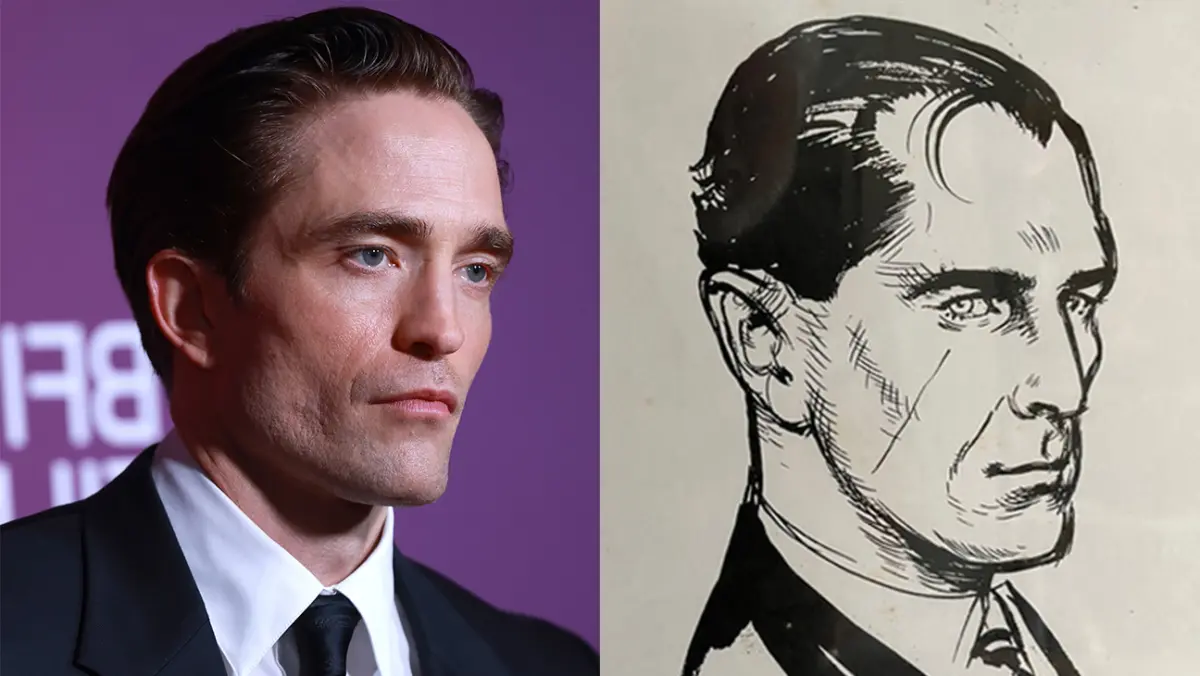
The instructions provided by Fleming were remarkably prescriptive. He explicitly warned against the "American-shaped head" and the "duck’s haircut" that were popular at the time, opting instead for a profile defined by a narrow nose, thin lips, and a firm, squared-off chin. The resulting sketch, which has recently resurfaced in historical analysis, depicts a figure with a sharp, skeletal intensity.

However, the illustrator hired for the project, John McLusky, opted to take creative liberties. McLusky’s Bond was broader, more muscular, and possessed a cleft chin—a design that bore a striking, perhaps prophetic, resemblance to Sean Connery. By favoring a more "traditionally masculine" look, McLusky inadvertently set the visual standard for the next half-century of Bond films, essentially burying the "true" version of the character that Fleming had envisioned.
Comparative Analysis: The Pattinson Connection
When comparing the original 1950s commission with modern screen stars, the alignment with Robert Pattinson is statistically and aesthetically significant. Pattinson’s facial geometry—characterized by a high-definition jawline, prominent brow, and narrow nasal bridge—mirrors the specific "angular" requirements outlined in Fleming’s notes.
While casting discussions for the next iteration of the franchise remain speculative, the identification of these shared traits has sparked a debate among film historians and industry experts. The implication is not necessarily that Pattinson is the "correct" choice, but rather that the industry’s perception of "what a Bond looks like" has been influenced by a deviation from the source material for nearly 70 years. If the producers of the franchise were to prioritize "literary accuracy" over "cinematic tradition," the casting process would naturally shift toward performers who possess the sharp, minimalist features that Fleming prioritized.
Industry Implications and the Future of 007
The revelation that the "ideal" Bond has been hidden in plain sight—or rather, obscured by the iconic performances of the past—poses an interesting dilemma for Eon Productions. The franchise has always balanced the need for fidelity to Ian Fleming’s work with the necessity of evolving for a modern audience.
Industry analysts suggest that this historical context provides a "creative mandate" for future casting. As the franchise prepares for its next chapter, the emphasis on a specific physical aesthetic may serve as a differentiator. "The visual shorthand for Bond has become so entrenched in the public consciousness that it is almost impossible to divorce the character from the actors who played him," says a veteran casting consultant. "However, returning to the source—the actual descriptions in the novels and the original sketches—offers a way to ‘reboot’ the character in a manner that feels both nostalgic and distinctly fresh."
Conclusion: The Synthesis of Fiction and Reality
The search for James Bond is, at its heart, a search for the perfect vessel for a mythic archetype. For decades, the film franchise succeeded by creating its own version of that myth, one that often diverged from the creator’s original instructions. Yet, the existence of Fleming’s commissioned sketch serves as a reminder that the author’s intent remains a primary document for the franchise.
Whether or not the cinematic Bond eventually moves toward the sharper, more angular features that Fleming favored, the discovery of this visual disconnect provides valuable insight into the creative process. It highlights how the translation of literature into film is never a direct path; it is a negotiation between the author’s internal imagination and the external limitations of the era. As the Bond franchise looks toward its next 70 years, the ghost of the original 1950s sketch continues to serve as a silent benchmark, proving that even the most enduring characters are still subject to the enduring power of the creator’s original intent.