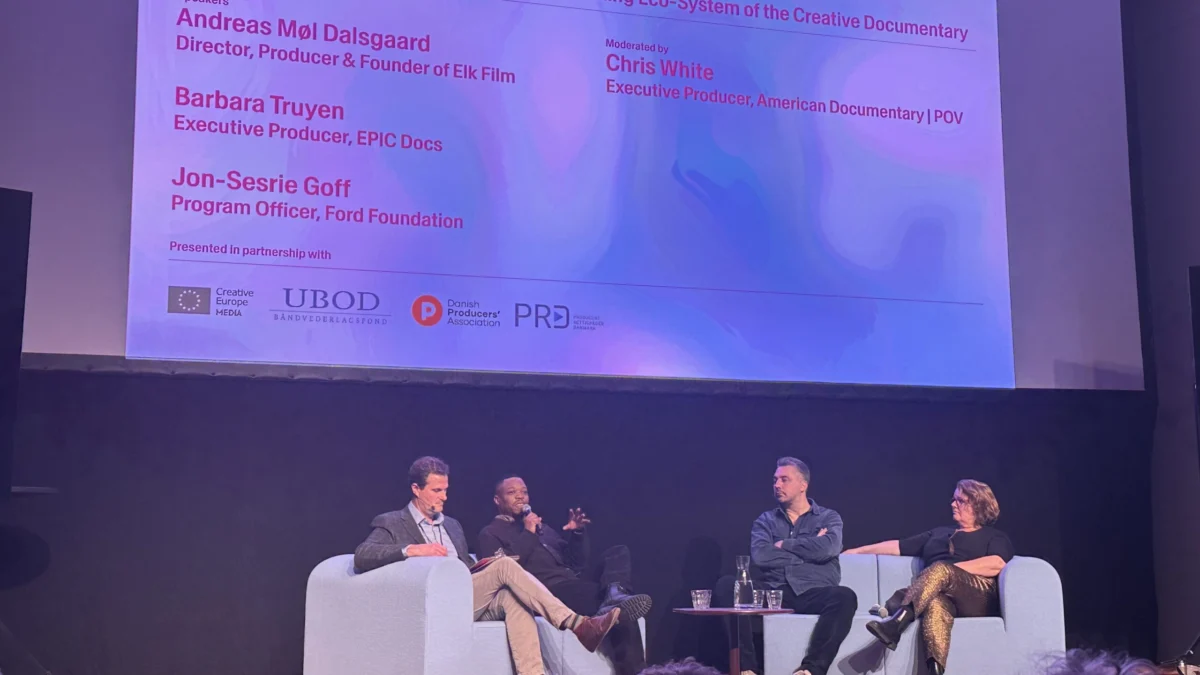
The global documentary film industry finds itself at a pivotal juncture, grappling with a complex array of challenges ranging from significant funding cuts across North America and Europe to evolving political landscapes and rapid technological shifts. These pressing issues and potential opportunities were brought into sharp focus during a Wednesday afternoon session at the Copenhagen International Documentary Festival (CPH:DOX), a globally recognized platform for creative documentary and industry discourse. As part of its extensive CPH:Conference industry program, a panel titled "Future Perspectives on the Shifting Eco-System of the Creative Documentary" convened leading figures to dissect the current state and future trajectory of the field.
CPH:DOX, established in 2003, has grown to become one of the most respected documentary film festivals globally, celebrated for its adventurous programming and its role as a crucial meeting point for filmmakers, producers, distributors, and funders. Its CPH:Conference arm is particularly vital, offering a dedicated forum for industry professionals to engage with critical topics shaping the non-fiction landscape. The decision to dedicate a high-profile panel to the "shifting eco-system" underscores the urgency felt across the sector.
The esteemed panel featured Andreas Dalsgaard, a distinguished Danish documentary director and producer and founder of Elk Film; Barbara Truyen, formerly the head of documentaries and commissioning editor for the Dutch public broadcaster VPRO, now an executive producer at her company EPIC-docs; and Jon-Sesrie Goff, a key member of the Creativity and Free Expression team at the Ford Foundation, a philanthropic organization with a long history of supporting independent media. Moderating the discussion was Chris White, executive producer at American Documentary | POV, who oversees the production of the renowned PBS documentary series POV and POV Shorts. Their collective expertise provided a panoramic view of the challenges and resilience within the documentary world.
The Erosion of Public Broadcasting Support
A central theme that emerged from the discussion was the alarming decline in public broadcasting funding, a traditional bedrock for independent documentary production, particularly in Europe. Barbara Truyen offered a candid and somewhat sobering assessment of the situation among European public broadcasters. "There are 27 public broadcasters that are all members of the EBU [European Broadcasting Union, the alliance that produces the likes of the Eurovision Song Contest], and if we see each other in the documentary group, now we do group therapy," Truyen shared, illustrating the shared anxiety. "We put down our phone, set down our laptop and really talk about what’s going on, and what we would need to do. We had never really felt the need to do that before, and now we do."
This newfound necessity for collective introspection stems directly from severe financial pressures. Truyen detailed the grim reality facing many European public broadcasters: "If you go around Europe, for example, in the Netherlands, 20 percent of the budget is cut." The implications of such a substantial reduction are far-reaching. "So that means one out of five people lose their jobs, and one of five programs is not being made anymore. That’s huge, and that’s happening all around," she emphasized. These cuts translate not only to job losses and reduced output but also to a potential chilling effect on ambitious, risk-taking documentary projects that often rely on the stable, mission-driven funding models of public service media. The absence of these projects can lead to a less diverse media landscape and fewer opportunities for critical investigative journalism or nuanced cultural explorations.
The situation is mirrored across the Atlantic. Chris White underscored the impact of U.S. funding cuts, specifically referencing reductions under former President Donald Trump that significantly impacted public broadcasters like PBS and NPR. Jon-Sesrie Goff quantified the philanthropic void created by these cuts, stating, "In terms of the dollars that have left the field of independent documentary makers in the U.S., it’s around $40 million, and philanthropy can’t replace that." Goff articulated a crucial distinction, asserting that the problem extends beyond mere financial loss. "What has happened is not a budgetary loss, it’s a structural loss. A lot of us have oriented our careers and our practices around a model that no longer exists, and so we have to envision a new way of making and thinking about media and the public interest."
This "structural loss" signifies a fundamental shift in the ecosystem. Historically, public broadcasters like PBS, through series such as POV and Independent Lens, provided consistent commissioning opportunities, distribution pathways, and a crucial imprimatur of quality and public service. Their funding often served as seed money, leveraging additional support from foundations and private investors. With this foundational pillar weakened, filmmakers accustomed to a specific funding pipeline and production methodology are forced to adapt to a fragmented and less predictable landscape, prompting an urgent need for innovative financing and distribution strategies.
Navigating Political Scrutiny and Geopolitical Realities
Beyond financial austerity, the documentary field is also contending with an increasingly complex political environment. Andreas Dalsgaard highlighted the new political hurdles his team has encountered, citing an instance where ARTE Deutschland, a prominent European public service channel, "doesn’t accept the Danish foreign ministry as a funder." This case exemplifies a broader trend. Dalsgaard elaborated, "There is a tendency in public broadcasting to start looking very carefully where the funding is coming from. That is the case even if strict journalistic standards are being adhered to."
This heightened scrutiny of funding sources, even for projects maintaining rigorous journalistic integrity, presents significant challenges for international co-productions and projects tackling politically sensitive subjects. In an era of geopolitical tensions and increasing concerns about foreign influence, documentary filmmakers must navigate a complex web of perceptions and regulations. The implication is that even well-intentioned funding from a national government, designed to promote cultural exchange or address global issues, can be viewed with suspicion, potentially limiting the scope and reach of documentary projects and fostering a climate of self-censorship or avoidance of topics that might be deemed controversial by potential funders.
The incident with ARTE Deutschland points to a broader tightening of controls and a more cautious approach within public broadcasting, which traditionally has been a bastion of independent thought and critical inquiry. This could lead to a preference for less politically charged content, potentially diminishing the documentary’s capacity to engage with pressing global issues and hold power to account.
The Rise of Streaming and Technological Disruption
While not explicitly detailed in the original text, the panel’s focus on a "shifting eco-system" inherently encompasses the profound impact of technological changes and the ascendancy of streaming platforms. The last decade has witnessed a dramatic shift from linear television to on-demand digital consumption, with behemoths like Netflix, Amazon Prime Video, Hulu, and HBO Max investing heavily in original content, including documentaries. This has created new avenues for distribution and, for a period, seemed to offer a new funding lifeline.
However, the streaming landscape presents its own set of challenges. While streamers offer unprecedented global reach, their commissioning models often differ significantly from traditional public broadcasters. They typically demand global rights, offer less creative control, and prioritize content that aligns with their subscriber acquisition and retention strategies, which may not always align with the public interest or the nuanced storytelling often associated with independent documentaries. Furthermore, the sheer volume of content produced means that individual films can easily get lost in vast digital libraries, making discoverability a constant struggle.
The "death by algorithm" panel, referenced in a related CPH:DOX discussion, further points to the growing influence of artificial intelligence in content curation and audience engagement. While AI can personalize viewing experiences, it also raises concerns about filter bubbles, algorithmic bias, and the potential for certain types of stories or voices to be marginalized if they don’t fit predictive models of commercial success. This technological layer adds another dimension of complexity for filmmakers seeking to connect with audiences and ensure their work has an impact.
Forging New Pathways: Collaboration, Sharing, and Advocacy
Despite the formidable obstacles, the CPH:DOX panel also illuminated potential opportunities and strategies for resilience and growth within the documentary field. Barbara Truyen emphasized the critical importance of broad-based European funding partnerships and networks of financing institutions. She pointed to the recent success of Navalny (often referred to as Mr. Nobody Against Putin in early coverage), which won the Oscar for Best Documentary Feature in 2023, as a prime example. "Mr. Nobody Against Putin winning the Oscar is amazing, but that’s really based on this European network," Truyen noted. This highlights the power of international co-production models, where multiple countries pool resources to finance ambitious projects that would be impossible for any single entity to fund alone. Such collaborations not only secure funding but also foster diverse perspectives and broader distribution.
Truyen also offered a more radical idea to address current challenges: a fundamental rethinking of release windows and exclusivity models. "It should be more about sharing, not so much about owning," she suggested. This concept challenges the traditional proprietary approach to content distribution, advocating for models that prioritize broader access and dissemination over strict rights control. This could manifest in various ways, from hybrid distribution strategies combining theatrical releases with free online access after a certain period, to adopting more open-source approaches for certain types of documentary content, particularly those with a strong public interest or educational mission. Such a shift would require significant cooperation across the industry, but it holds the promise of increasing the impact and reach of documentary films in an increasingly fragmented media landscape.
Jon-Sesrie Goff underscored the imperative for the documentary community to actively champion its own value and relevance. "We as a field should be making a case for documentary," he urged, connecting this call to action with the historical roots of the form. He reminded the audience that 2026 marks the centennial of the term "documentary," coined in 1926 by Scottish filmmaker and critic John Grierson, often considered the father of British and Canadian documentary film. "This is the centennial of documentary, and no one talks about it. It’s 100 years of documentary!" Goff exclaimed, advocating for a renewed sense of pride and celebration.
This historical context is crucial for understanding the enduring power and purpose of documentary. Grierson famously defined documentary as "the creative treatment of actuality," emphasizing its potential for social commentary, education, and fostering civic engagement. Celebrating this centennial would provide a powerful platform to reassert the unique role of documentary in informing public discourse, preserving history, and promoting empathy. Goff further challenged prevailing perceptions with a touch of humor: "I heard someone recently say [that] documentary isn’t sexy because it’s a tool, and tools aren’t sexy. Well, I think tools are sexy." This statement encapsulates the idea that documentary, as a powerful instrument for revealing truth and shaping understanding, possesses an inherent and often underestimated allure and utility.
Broader Impact and Future Implications
The discussions at CPH:DOX paint a picture of an industry in flux, facing an existential threat to its traditional models but also ripe with opportunities for innovation. The "structural loss" identified by Goff has profound implications for the diversity of voices and stories reaching audiences. If independent filmmakers, particularly those from underrepresented communities, lose access to stable funding, the media landscape risks becoming less inclusive and more homogenized. The increased scrutiny on funding sources could stifle investigative journalism and critical examinations of power, potentially eroding the documentary’s role as a watchdog and catalyst for social change.
However, the necessity to "envision a new way of making and thinking about media and the public interest" also forces a creative reckoning. This could lead to the development of more agile production models, direct-to-audience funding mechanisms like crowdfunding or membership programs, and enhanced community engagement strategies that deepen the impact of films beyond their initial release. The emphasis on "sharing, not owning" suggests a future where documentaries might become more collaborative cultural assets rather than strictly commercial products, aligning with their public service ethos.
Ultimately, the future of the documentary field hinges on its ability to adapt, innovate, and collectively advocate for its unique and indispensable value. As the industry navigates these turbulent waters, the insights shared at CPH:DOX underscore the need for sustained collaboration, flexible funding models, and a renewed commitment to the core mission of documentary: to illuminate, to challenge, and to connect audiences with the realities of the world. The next century of documentary will undoubtedly be defined by how the industry responds to these profound shifts, ensuring that this powerful tool for truth-telling continues to thrive and evolve.