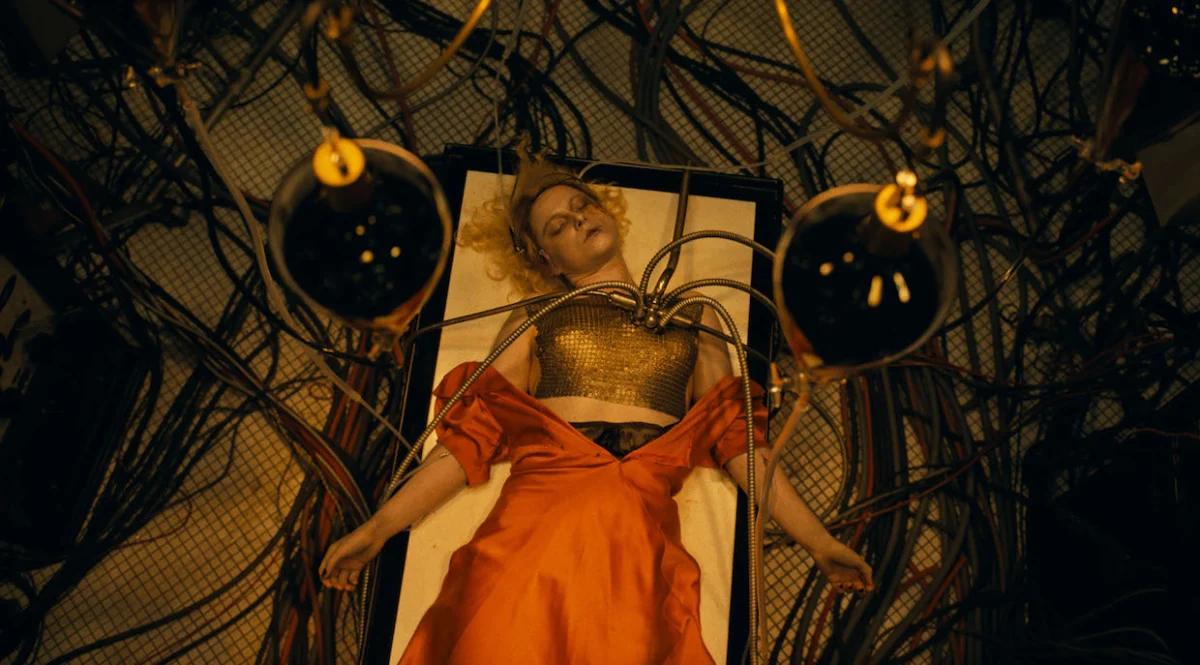
In the opening beats of The Bride!, the second feature written and directed by Maggie Gyllenhaal, the ghost of Mary Shelley, portrayed by Jessie Buckley, mutters to herself from some dark corner of the subconscious ether. She rasps about the sequel to her most iconic work, Frankenstein, that she never got to write before her death in 1851. What would this hypothetical book be, she wonders: "Is it a horror story, a ghost story, or, most frightening of all, a love story?" What follows is a cat-and-mouse road movie, a jewel-toned Jazz Age thriller, and a romantic caper charting the tumultuous journey of Frankenstein’s monster—who now goes by his maker’s name, Frank, or Frankie to those who know him intimately, played by Christian Bale—and the woman he painstakingly exhumed from a fresh grave to alleviate his century-long loneliness. This resurrected woman is also played by Buckley, embodying a character denied voice and agency in previous iterations. Shelley’s spectral presence appears periodically, cast in uplit shadows reminiscent of Boris Karloff’s iconic portrayal in the original Frankenstein film, prodding the "reinvigorated" corpse to act fearlessly and embrace a newfound purpose.
The Genesis of a Monstrous Love Story
Maggie Gyllenhaal’s latest directorial endeavor delves into a cinematic landscape both familiar and radically reimagined. The inspiration for The Bride! struck Gyllenhaal not from a deep dive into classic literature, but from a serendipitous encounter at a party where she spotted a forearm tattoo of the Bride of Frankenstein. This sparked her curiosity about a character so compelling, yet so minimally explored in her original source material. Gyllenhaal subsequently immersed herself in Mary Shelley’s 1818 novel, Frankenstein; or, The Modern Prometheus, a foundational text of gothic literature and science fiction. Upon finishing, a lingering question persisted in her mind: "Is this everything that Mary Shelley wanted to say?"
This query became the driving force behind The Bride! Gyllenhaal pondered the constraints placed upon a female author in the early 19th century. With perhaps only a handful of women being published at the time, how much did Shelley have to self-censor? What thoughts, deemed "unpublishable" or even "unthinkable" by the societal norms of her era, remained unexpressed? Gyllenhaal sought to unearth these unspoken narratives and infuse them into her film, giving voice to what Shelley might have envisioned for her creature’s longed-for companion.
Mary Shelley’s original novel famously depicts the Creature’s profound desire for a female companion, articulating his plea: "‘Shall each man,’ cried he, ‘find a wife for his bosom, and each beast have his mate, and I be alone?’" Tragically, Frankenstein ultimately denies his creation this solace, destroying the nascent female creature before she can be fully brought to life. Decades later, James Whale’s iconic 1935 film Bride of Frankenstein finally introduced the titular character, played by Elsa Lanchester. However, this cinematic Bride was granted a mere two minutes of non-speaking screen time, largely existing as a reaction to the Monster rather than a fully developed entity. Gyllenhaal’s The Bride! is a bold corrective, an ambitious attempt to fill this historical void, offering a narrative where the Bride not only exists but thrives, screams, and sparks a revolution.
Maggie Gyllenhaal’s Distinctive Vision and Thematic Depth
Calling from her home office the day after her London premiere, Gyllenhaal shared with Filmmaker her profound belief that while she appreciates the predictable rhythms of genre film—and relished the opportunity to craft one replete with IMAX-level guns and getaway cars for the first time—love ultimately triumphs as the most formidable fear. "I think connection is scary for people," she elaborated. "Real connection includes not just the parts of us that we’re proud of, but the parts of us that we’re terrified of and ashamed of—what I’ve been sort of calling the monstrous aspects. And to love someone or to connect to someone, including those aspects, takes real bravery." This philosophy underpins the entire film, elevating it beyond a mere monster flick to a profound exploration of vulnerability, acceptance, and the courage required for genuine intimacy.
Gyllenhaal’s directorial journey, which began to captivate audiences with her critically acclaimed debut, The Lost Daughter (2021), showcases a consistent thread of exploring "messy women," "bad" women, and those who steadfastly refuse to adhere to societal conventions. The Lost Daughter, an adaptation of Elena Ferrante’s novel, earned Gyllenhaal an Oscar nomination for Best Adapted Screenplay and critical accolades, including Best Screenplay at the Venice Film Festival. In that process, Gyllenhaal felt an "imaginary dialogue" with Ferrante, believing the author was "egging me on to be more and more truthful, more and more myself." She sees a similar dynamic at play with The Bride!, where Mary Shelley’s spirit actively encourages the resurrected Bride toward self-actualization. This artistic lineage demonstrates Gyllenhaal’s commitment to challenging traditional female archetypes and delving into the complex, often uncomfortable, truths of the female experience.
The scope of The Bride! also marks a significant step forward in Gyllenhaal’s filmmaking career in terms of resources. While The Lost Daughter was a more intimate production, made with limited equipment—Gyllenhaal recalled having "no dolly track and maybe four lenses to work with"—her latest feature benefited from a larger budget and access to advanced tools, including IMAX technology. This increased capacity allowed her to realize her grander vision for a period piece replete with action sequences, elaborate sets, and a distinctive visual style, pushing the boundaries of what a female director is typically afforded in the industry. This disparity in resources highlights a broader issue within Hollywood, where women directors historically receive fewer opportunities to helm large-scale productions.
A Feminist Roar in the Roaring Twenties
The tone of The Bride! is undeniably galvanizingly feminist in its anger. The Bride, brought back to life in a state of bewilderment and rage, screams in frustration at her own bewildering situation. This primal scream, delightfully and inexplicably, morphs into a battle cry that resonates with women from Chicago to New York in the vibrant, yet restrictive, year of 1936. Newspaper headlines, such as "Killer Bride Ignites A Revolution," encapsulate the unexpected societal ripple effect of her defiance.
This narrative arc is deeply intertwined with Gyllenhaal’s own active involvement in real-world movements like #MeToo and #TimesUp. The Bride’s mantras, "I would prefer not to," and "Me too," serve as deliberate anachronisms that jolt the audience out of the historical fiction and directly connect the film’s themes to contemporary issues of consent, agency, and female empowerment. Gyllenhaal’s past statements, such as her declaration to The Guardian in 2019 that "There have to be consequences for disrespecting women sexually, or at all," are explicitly enacted within her script. The Bride’s violent acts of self-defense—often triggered by unwanted advances or worse—are presented not as gratuitous aggression, but as justified retaliation against a patriarchal society that seeks to control and diminish women.

The character design of the Bride further emphasizes her defiance of conventional beauty standards. The result of being brought back to life by the eccentric Dr. Euphronious (Annette Bening), the Bride sports a frizzy bleached bob, a striking black tongue, and ink splatters that could be mistaken for expensive Berlin-style tattoos. This aesthetic choice subverts traditional notions of feminine allure, presenting a woman who is both monstrous and captivating, an embodiment of the "unthinkable" beauty Gyllenhaal sought to portray. In contrast, Frank, though stitched up and bolted together, retains a rugged handsomeness, accentuated by Bale’s intense eyes and a tenor of total devotion to his companion. "She’s too beautiful," he declares of the Bride after he and Dr. Euphronious clean her up, highlighting his profound, almost primal, admiration for her unique, unconventional existence.
Their journey is fraught with peril, as their murders in nightclub alleyways and on ballroom floors, though committed in self-defense, brand them as terrorists. A relentless detective and his assistant, played by Peter Sarsgaard and Penélope Cruz respectively, are hot on their trail. Adding another layer of danger, a mob boss’s henchman is also pursuing them, as the Bride, in her previous life as Ida, was thrown into a fresh grave for knowing too much—a detail that further contextualizes her righteous anger and quest for survival. Gyllenhaal notes that "Most of the things she’s saying are braver than even what people are able to say right now," underscoring the film’s audacious portrayal of female rebellion.
Crafting the Unthinkable: Production and Performances
The ensemble cast assembled for The Bride! is a testament to Gyllenhaal’s vision and her ability to attract top-tier talent. Christian Bale’s portrayal of Frank, the reanimated monster, promises a nuanced performance that transcends the archetypal horror figure. His interpretation brings a depth of emotion and a profound sense of devotion to the character, moving beyond the brute force often associated with Frankenstein’s creation. Jessie Buckley, in her dual role as Mary Shelley’s ghost and the Bride, delivers a captivating performance that grounds the film’s philosophical underpinnings while embodying the raw, untamed spirit of the resurrected woman. Her ability to convey both historical gravitas and nascent fury is central to the film’s impact.
Annette Bening’s turn as the mad scientist Dr. Euphronious adds another layer of eccentric genius to the narrative, providing the scientific impetus for the Bride’s existence. The film also marks a unique family collaboration for Gyllenhaal. While working with her husband, Peter Sarsgaard, who plays the pursuing detective, is not a new experience for the couple, this project saw her directing her brother, Jake Gyllenhaal, for the first time. Jake Gyllenhaal takes on the role of Ronnie Reed, a dapper and dashing Hollywood film star who serves as Frank’s initial inspiration for an ideal masculinity. This character’s eventual snubbing of Frank ignites another machine-gun showdown, highlighting the fragility of idealized male images when confronted with genuine vulnerability and monstrousness.
Gyllenhaal reflected on the dynamics of directing family members: "It’s scary to work with people if you’re not sure that they respect you. We don’t have that problem." She emphasizes the importance of a respectful and supportive set environment, a lesson learned from her own extensive career as an actress. "When you feel respected and seen, you feel free to push yourself to the edge and actually learn something on a film, as opposed to pretending to learn something. And that’s what I want all my actors to be doing." This philosophy fosters an atmosphere where creativity can flourish, allowing her cast to fully inhabit their complex roles and contribute authentically to the film’s bold narrative.
Historical and Cinematic Context: Reimagining a Legend
Mary Shelley’s Frankenstein; or, The Modern Prometheus, published in 1818, was revolutionary. Written by a woman in her late teens, it explored profound themes of creation, responsibility, loneliness, and the dangers of scientific hubris, establishing itself as a cornerstone of both gothic horror and science fiction. Shelley’s own life, marked by loss and intellectual curiosity, imbued the novel with a depth that resonated far beyond its initial reception. The monster’s poignant pleas for companionship and understanding have echoed through generations, making his yearning for a mate a particularly potent, yet unfulfilled, narrative thread.
The Universal Monsters cinematic universe, which gained prominence in the 1930s, immortalized Frankenstein on screen. James Whale’s 1935 sequel, Bride of Frankenstein, is widely regarded as a masterpiece, an iconic entry in horror cinema. Elsa Lanchester’s brief, electrifying performance as the Bride – with her distinctive shock of white hair and hissing rejection of the Monster – cemented her status as a horror icon despite her minimal presence. Gyllenhaal’s The Bride! directly confronts this legacy, questioning why such a pivotal character was given so little agency and screen time in her most famous cinematic depiction. By centering the narrative on the Bride, Gyllenhaal not only pays homage to the original material but also critically re-examines it through a modern, feminist lens, granting the character a voice, a purpose, and an entire revolution to ignite. This reinterpretation is not merely a remake but a profound conversation with the source material, an attempt to realize its full, suppressed potential.
Critical Reception and Industry Implications
Early reviews of The Bride! have presented a more divided landscape compared to the widespread acclaim and Oscar nominations garnered by The Lost Daughter. While The Lost Daughter resonated broadly with critics for its nuanced portrayal of motherhood and female identity, The Bride! appears to be a more polarizing work. The New York Post, for instance, delivered a sharp critique with the headline, "Leave her at the altar!" This reaction underscores that the film’s distinctive "punk sensibility" and its explicit feminist anger are not universally embraced. A challenging, unconventional film often finds its most ardent supporters among those who feel a deep need for its particular brand of defiance, while simultaneously alienating audiences accustomed to more traditional narratives.
Gyllenhaal herself acknowledges the potentially divisive nature of her work, particularly its perspective. "It is definitely a movie from a woman’s point of view. And I do believe that women have a different point of view, because we have such a different experience moving through the world." She rightly points out that "So much of cinematic language was created and invented by men, because women didn’t have access to the tools. We weren’t included." This observation highlights a critical imbalance in the film industry, where cinematic grammar and narrative conventions have historically been shaped by a male gaze.
Statistics consistently show a stark disparity in directorial opportunities. While the exact figures fluctuate year to year, typically only a small percentage—often hovering around 7% to 8%—of major studio films are directed by women. Yet, as Gyllenhaal notes, many of these female-helmed projects are the very films that generate significant cultural discourse and critical attention. This suggests a burgeoning "appetite for something new, in a new language, touching on new things—not just amongst women, but amongst everybody." The Bride! represents Gyllenhaal’s bold offering to this hunger for fresh perspectives, challenging audiences with the provocative question: "Everyone says they want something new. Well, alright. Can you take it?" This final query serves as both a statement of artistic intent and a challenge to the industry and its audiences, urging them to embrace narratives that dare to be different, messy, and authentically female.