The horror landscape has been profoundly shaken by undertone, the latest A24 release from writer-director Ian Tuason, a film that has rapidly transitioned from an indie darling on the festival circuit to a significant commercial success. Tuason, a veteran innovator in immersive virtual reality horror, brings a uniquely sound-driven vision to the screen, drawing from both his technical prowess and deeply personal experiences. The film’s compelling blend of "found audio" terror, occult lore, and raw emotional undercurrents has resonated with audiences and critics alike, marking a new chapter for the genre and solidifying Tuason’s position as a distinctive voice in contemporary cinema.
From Virtual Realms to Theatrical Triumph: Tuason’s Pioneering Journey
Ian Tuason’s path to directing a major A24 horror feature is anything but conventional, rooted in the nascent days of immersive digital experiences. Before undertone garnered widespread attention, Tuason was a recognized pioneer in 360-degree VR horror shorts. His early works, Continuity Problems (released in 2009) and Close Up (from 2011), achieved considerable success on platforms like YouTube, demonstrating an early understanding of how to leverage immersive technology for fright. These short-form experiments weren’t confined to online platforms; their innovative approach earned them screenings at prestigious events such as the Marché du Film’s NEXT Pavilion in Cannes, signaling their artistic merit and potential beyond niche digital communities. The breakthrough moment arrived with his 360-degree live-action short, 3:00am, which amassed a staggering 9 million viewers on YouTube. This digital acclaim underscored Tuason’s innate ability to craft compelling, fear-inducing narratives within immersive environments, even if those environments were initially confined to a viewer’s headset or desktop. His early career laid the groundwork for a directorial style heavily reliant on auditory cues and spatial manipulation, lessons he would meticulously translate to the cinematic experience of undertone. This background provided him with an unparalleled understanding of how to guide an audience’s attention and evoke visceral reactions through carefully constructed soundscapes, a skill that would prove instrumental in undertone‘s distinct horror identity. The transition from designing 360-degree sound for individual VR experiences to crafting a surround sound experience for a theatrical audience was a natural evolution for Tuason, allowing him to scale his innovative techniques to a broader, communal viewing format.
The Genesis of undertone: A Symphony of Found Sound and the Occult
undertone emerged from Tuason’s desire to merge his expertise in immersive sound design with established horror tropes, particularly the "found footage" subgenre. The concept evolved into a "found audio" film, a unique spin that capitalizes on the power of suggestion and the audience’s imagination. "I always felt like surround sound in the theater would be a great opportunity to take what I learned and play around with it—to create a 3D soundscape and guide the viewer’s attention to different spaces around them," Tuason explained. This commitment to an auditory-first approach allowed him to explore new dimensions of horror, where unseen threats are conjured through whispers, distorted sounds, and reverse speech, emphasizing the psychological impact over overt visual gore.
Intriguingly, Tuason admits his initial disinterest in the occult before embarking on the film. "I was never really into the occult before making this movie," he stated. However, extensive research for the project ignited a deeper fascination. "After doing research, I started getting into it more. That manifested weird things into existence." This personal dive into the supernatural realm infused the film with an unsettling authenticity, blurring the lines between fiction and the director’s own experiences. The narrative centers on the ancient demon Abyzou, a mythological figure often associated with stillbirths and infant mortality in ancient Near Eastern and European folklore. This specific choice of antagonist grounds the film’s horror in a rich, albeit dark, cultural history, moving beyond generic demonic possession to a more nuanced and psychologically resonant threat. The integration of scripted podcasts and found footage elements further distinguishes undertone, offering a modern, relatable framework for its supernatural narrative, which taps into contemporary media consumption habits.
A Box Office Sensation: Festival Buzz to Commercial Success
undertone has rapidly ascended the ranks of financially successful horror films, particularly notable given its modest budget and independent production roots. Produced for an estimated $500,000, the film defied expectations by grossing double that amount—$1 million—from Thursday box office previews alone. This strong opening suggested significant audience interest and word-of-mouth momentum, indicative of a potent marketing strategy and critical anticipation. The film has since continued its impressive theatrical run, accumulating a total gross of $9 million to date, a remarkable 18-fold return on its initial investment. This performance positions undertone as a significant theatrical smash, demonstrating a remarkable return on investment (ROI) that is increasingly rare for mid-budget features in the current cinematic landscape. For comparison, many Hollywood blockbusters struggle to achieve even a 2-3x ROI.
The film’s commercial triumph was preceded by a robust reception on the international festival circuit. It premiered to considerable buzz at the Fantasia International Film Festival in Montreal in July 2025, a prestigious event known for showcasing cutting-edge genre cinema and often serving as a launchpad for breakout horror films. Following its strong showing at Fantasia, undertone further solidified its critical standing and generated additional industry excitement at the Sundance Film Festival in January 2026. The journey from these esteemed festivals to a wide theatrical release, particularly under the A24 banner, highlights the film’s broad appeal and its ability to captivate both genre enthusiasts and broader audiences. For A24, a studio renowned for its distinctive and often unconventional horror offerings—including critical darlings like Hereditary and The Witch—undertone‘s success further validates their curatorial strategy and their willingness to champion unique directorial voices. Industry analysts view the film’s performance as a positive indicator for original, concept-driven horror, proving that compelling storytelling and innovative techniques can still draw significant crowds to theaters, even in a competitive streaming-dominant era.
Narrative Deep Dive: Evy’s Descent into an Audio Nightmare
The narrative core of undertone follows Evy (portrayed with compelling vulnerability by Nina Kiri), who co-hosts "The Undertone" podcast. Evy serves as the skeptical counterpoint to her best friend and co-host, Justin (played by Adam DiMarco), whose sensibilities lean towards an "Agent Mulder-adjacent" fascination with the paranormal. The logistical challenges of their podcast—specifically a significant time difference—force Evy to record her segments during the eerie "witching hour," a period traditionally associated with supernatural activity. This timing is particularly poignant as Evy has recently returned home to care for her comatose mother, a situation that casts a pall of grief and emotional exhaustion over her daily life. The podcast, initially, provides Evy with a crucial escape from the demanding and depressing reality of administering palliative care, offering a semblance of normalcy and intellectual engagement amidst her personal turmoil.
The story takes a chilling turn when a fan-submitted email arrives, containing an unsettling audio recording. The files purport to chronicle the paranormal encounter of a couple, Jessa and Mike, with Abyzou—the aforementioned female demon rumored to possess mothers and tragically claim their children. Justin, ever cautious, is wary of playing these potentially dangerous files, sensing an inherent malevolence. However, Evy, convinced it’s merely a hoax and driven by a desire for compelling podcast content, insists on recording their real-time reactions to the audio’s purported horrors. This decision acts as the catalyst for her gradual immersion into a genuine nightmare. Soon after engaging with the demonic audio, Evy begins to experience increasingly bizarre and inexplicable phenomena within her own home. Her unconscious mother’s body inexplicably shifts out of bed, lights flicker erratically, and a statue of the Virgin Mary mysteriously reappears on a bedside table despite Evy’s repeated attempts to store it away in a closet. "She’s slowly entering this audio nightmare until she’s entirely in it," Tuason describes Evy’s harrowing arc, highlighting her slow, inexorable descent into a reality consumed by the supernatural. The film expertly uses these subtle, escalating incidents to build a pervasive sense of dread, mirroring Evy’s own psychological unraveling and the insidious nature of the demonic presence.

The Haunting Production: Personal Trauma and Authentic Locations
Perhaps the most profoundly unsettling aspect of undertone‘s production lies in its choice of primary filming location and the deeply personal connection it holds for Ian Tuason. The film was shot entirely in the house where Tuason’s parents had both passed away from cancer, a revelation that imbues the onscreen horror with a palpable, heartbreaking authenticity. "We filmed in the house my parents died in," Tuason revealed. "You tell people that and they go, oh. Then there’s a moment of consoling, and then there’s a moment of, ‘Wait a minute, we’re filming in the same bedroom, right?’" This decision was not merely practical but served as a raw, emotional anchor for the film’s themes of grief, caregiving, and the vulnerability of the domestic space, making the horror intimately tied to real-world pain.
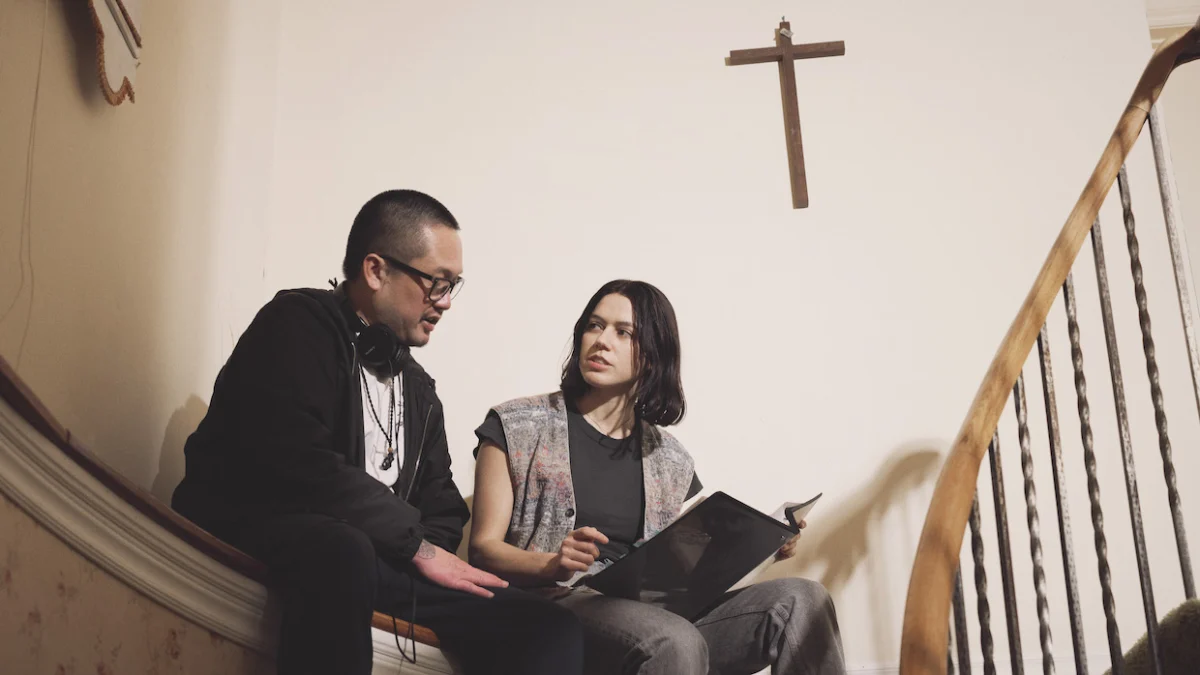
Production designer Mercedes Coyle meticulously refitted the house, incorporating overtly Catholic flourishes, including a significant number of crucifixes. These additions were not simply aesthetic choices; they served to amplify the film’s exploration of faith, fear, and the attempt to ward off malevolent forces, mirroring Evy’s own struggles with an unseen evil in a deeply personal environment. During the transformation of his childhood home into a horror set, Tuason moved back in to prepare for production—the first time he had resided there since his parents’ passing. This period of pre-production was, by his own account, not without its eerie occurrences. "I could say that the set was haunted," he recounted with a wry laugh, citing instances of lights flickering, much like they do in the film. While he remained tight-lipped about the full extent of the alleged supernatural activity, claiming it was "too long of a story," his composure in discussing these events speaks volumes about his desensitization to fear. "I kind of got desensitized after the whole caregiving experience—how dark it was," he reflected. "I used to be really scared of ghosts. If I saw a ghost now, I would just go back to sleep." This profound personal journey through grief and caregiving, culminating in the creation of undertone within the very walls where his trauma unfolded, offers a unique lens through which to view the film. Tuason’s decision to continue living in the house post-shoot, with Coyle’s atmospheric touches still intact, further blurs the lines between his personal reality and the fictional horror he meticulously crafted, suggesting a profound artistic and psychological processing of his grief.
The Power of Sound: Tuason’s Artistic Philosophy
Central to Tuason’s filmmaking philosophy, and arguably the most distinctive element of undertone, is his unwavering conviction in the supremacy of sound in horror. "I think audio is the most important element of a horror film—more important than picture," he asserts. "Whatever you can imagine is always going to be scarier than what I can show you." This principle is not merely theoretical; it is rigorously applied throughout undertone, where the unseen and unheard often prove more terrifying than any visual spectacle. The film’s preoccupation with nursery rhymes revealing sinister messages when played backward—such as "Baa Baa Black Sheep" allegedly containing the lyric "lick the blood off"—exemplifies this auditory manipulation, tapping into primal fears and distorting childhood innocence into something deeply sinister. The subtle shifts in room tone, the distant, indistinguishable whispers, and the expertly crafted sound effects combine to create an enveloping sense of dread that is both intimate and expansive.
Tuason’s reverence for sound design echoes through cinematic history, finding its roots in films that masterfully exploited the power of suggestion. When asked to name a film that perfectly embodies this principle, he responded without hesitation: Paranormal Activity. This choice is particularly significant given his recent appointment as the director for Paranormal Activity 8, announced in December 2025. His deep appreciation for the found-footage franchise’s ability to generate immense fear through subtle creaks, whispers, and unexplained noises aligns perfectly with his own artistic inclinations. The success of undertone and his subsequent role in a major franchise reboot signal a potential resurgence in sound-driven, psychological horror, moving away from reliance on jump scares and overt gore to more insidious forms of terror. This approach challenges audiences to actively engage their imaginations, making the horror a deeply personal and internal experience that lingers long after the credits roll.
Future Horizons: Beyond the Confines of Horror
While undertone has cemented Ian Tuason’s reputation within the horror genre, his ambitions extend far beyond its boundaries. His involvement with the Paranormal Activity franchise, a series that has grossed over $890 million worldwide across its seven installments, provides a significant platform to further explore and refine his unique horror sensibilities on a larger scale. However, Tuason is clear that horror is not his final destination. "I’m gonna come out with a couple more horror films," he teased, indicating a strategic, yet temporary, commitment to the genre that has launched his feature career. "After that, I’ll transition into sci-fi-horror. Then after that, sci-fi." This progressive trajectory reveals a meticulously planned artistic evolution, moving from the visceral scares of pure horror to the intellectual and existential anxieties often found in science fiction, potentially blending the two before fully embracing speculative fiction.
This creative ambition is a defining characteristic of Tuason, suggesting a director who is not content to be pigeonholed. His journey from an early pioneer in VR horror to a commercially successful feature film director, now tasked with revitalizing a beloved franchise, speaks volumes about his innovative spirit and adaptability. The industry will undoubtedly watch with keen interest as Tuason navigates these transitions, eager to see how his mastery of immersive sound and his deeply personal approach to storytelling will manifest in new genres. His strategic approach to his career, leveraging current success to build towards broader artistic goals, positions him as a filmmaker to watch. If there is one thing Tuason is undeniably possessed by, it is this relentless drive for creative exploration and artistic growth, promising a diverse and impactful body of work in the years to come.
Broader Implications for the Genre and Industry
The success of undertone carries significant implications for the horror genre and the independent film industry. For A24, it reinforces their reputation as a studio willing to invest in distinctive, director-driven projects that often defy conventional genre expectations. The film’s impressive ROI validates a model where compelling concepts, executed with artistic integrity, can yield substantial financial rewards, even on relatively modest budgets. This success could encourage other studios to take similar risks on original horror concepts that prioritize atmosphere and psychological dread over overt spectacle, potentially fostering a more diverse and innovative horror landscape.
Moreover, undertone highlights the enduring power of sound design as a primary tool for fear. In an era often dominated by elaborate visual effects and CGI, Tuason’s film serves as a potent reminder that the most terrifying experiences can be those that tap into our auditory imagination, making the audience an active participant in constructing their own horrors. This could inspire a new wave of filmmakers to experiment with soundscapes and alternative narrative delivery methods, moving beyond traditional found footage to "found audio" or other sensory-focused experiences. The film also underscores the therapeutic potential of art, as Tuason channeled profound personal grief into a creative endeavor. This aspect adds another layer of resonance, reminding audiences and creators alike that vulnerability and authentic experience can be powerful catalysts for artistic expression, transforming personal trauma into universally relatable narratives of fear and resilience. As Ian Tuason steps into the director’s chair for Paranormal Activity 8 and outlines his future trajectory into sci-fi, his work on undertone stands as a testament to the enduring power of innovative storytelling, personal conviction, and the terrifying whispers that linger in the dark.