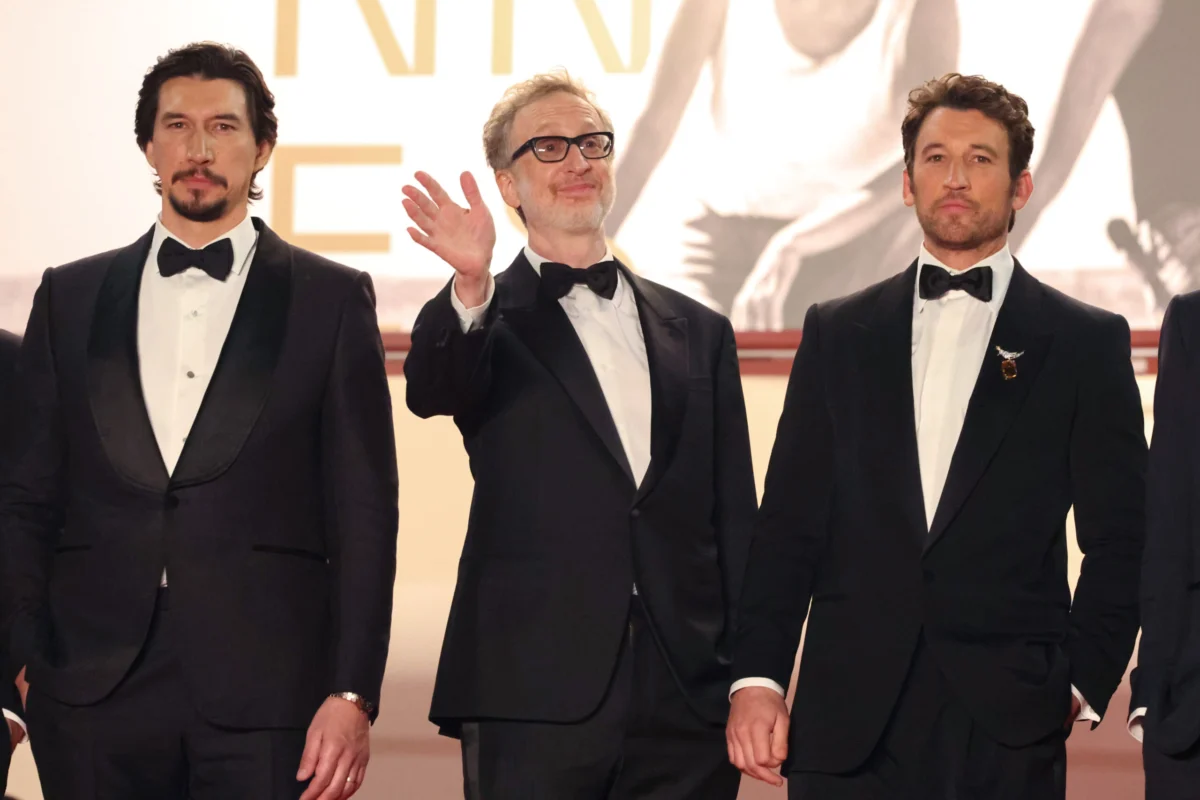
The 77th Cannes Film Festival, a beacon of global cinematic artistry, witnessed a powerful and emotional debut on Saturday night with James Gray’s latest directorial offering, Paper Tiger. Hailed as the most significant American film featured in what some have termed a "Hollywood-lite" edition of the prestigious festival, the drama garnered a resounding six-minute standing ovation, signaling early critical acclaim and generating substantial industry buzz. The premiere, attended by a captivated audience including cinematic luminaries, marked a triumphant moment for Gray and his star-studded cast, even as one of its lead actors, Scarlett Johansson, was notably absent due to other production commitments.
The Grand Unveiling at the Croisette
The Lumière Grand Theatre, the heart of the Cannes experience, was alight with anticipation for Paper Tiger. The screening concluded to an immediate and sustained roar of applause, a tradition at Cannes that often serves as an unofficial barometer of a film’s immediate impact. The six-minute ovation, characterized by spirited cheers and genuine enthusiasm, saw director James Gray visibly moved, albeit with his characteristic self-deprecating humor. Flanked by his stars, Miles Teller and Adam Driver, Gray initially attempted to playfully extend the adulation, pointing to his watch in a gesture of mock impatience before ultimately bringing the prolonged applause to an end by addressing the appreciative crowd. Among those seen applauding with fervor were acclaimed director Pawel Pawlikowski, known for his Oscar-winning film Ida, and acting icons Cate Blanchett and Julianne Moore, underscoring the film’s immediate resonance within the artistic community and its ability to captivate seasoned industry professionals.
A Deep Dive into Paper Tiger‘s Narrative
Paper Tiger transports audiences to the gritty, authentic landscape of 1980s Queens, New York, a setting Gray has masterfully explored in previous works such as Two Lovers (2008) and We Own the Night (2007). The film centers on Hester and Irwin, portrayed by the formidable Scarlett Johansson and Miles Teller, a couple navigating the complexities of raising a family amidst the socio-economic pressures of the era. Their lives take a perilous turn when Irwin’s charismatic yet unscrupulous brother, brought to life by the intense Adam Driver, entices him into a get-rich-quick scheme. This seemingly opportunistic venture quickly spirals into a nightmare, thrusting the family into the dangerous crosshairs of the Russian mob, a criminal element that adds a layer of visceral tension and high stakes to the narrative. Gray’s choice of the 1980s is not merely aesthetic; it’s a deliberate backdrop to explore themes of ambition, family loyalty, the American Dream’s darker underbelly, and the desperate measures individuals might take when faced with limited options in a rapidly changing urban environment. The film promises a character-driven thriller, steeped in the kind of moral ambiguity and emotional depth that has become a hallmark of Gray’s storytelling.
James Gray’s Vision: The Enduring Power of Classical Drama
For James Gray, Paper Tiger represents a deliberate artistic statement, a return to the foundational principles of cinematic storytelling. Ahead of the film’s premiere, Gray articulated his vision to The Hollywood Reporter, stating, "To be very pretentious about it, the intention was to try to make a very classical drama." He passionately defended the term "classical," clarifying that it should not be conflated with "old-fashioned." "People sometimes shit on that idea, ‘classical’ — they equate it with ‘old-fashioned,’ but the two are not the same thing. Internal conflict, struggle, love, emotion — that is never old-fashioned," Gray asserted. This philosophy underpins much of Gray’s filmography, which consistently delves into the intricate emotional landscapes of its characters, often within the confines of familial and societal pressures. His films are renowned for their meticulous craftsmanship, psychological depth, and a narrative elegance that eschews fleeting trends in favor of timeless themes. This approach aligns with his reputation as an auteur who prioritizes character development and emotional truth over superficial genre conventions, allowing him to craft stories that resonate universally.
The Stellar Ensemble: Performances Under the Microscope
The casting of Paper Tiger is a testament to Gray’s discerning eye for talent, bringing together a trio of actors known for their compelling and nuanced performances. The synergy between these acclaimed artists is expected to be a significant driving force behind the film’s emotional impact.
Scarlett Johansson as Hester: Johansson, one of Hollywood’s most versatile and bankable stars, takes on the role of Hester, a stay-at-home mother whose quiet strength is tested by unforeseen tragedy. Her character, as described by Johansson to The Hollywood Reporter, is a woman "determined to fight for more but faces fewer options when tragic news sets in." Johansson further elaborated on her character’s complexity, stating, "I liked the idea of Hester being feminine and soft and graceful because she has a lot of chutzpah inside her." This duality suggests a powerful internal struggle, a hallmark of Gray’s protagonists who often find themselves at a crossroads of resilience and vulnerability. Johansson’s recent work, spanning blockbuster franchises like Black Widow to critically acclaimed independent features such as Marriage Story and Jojo Rabbit, has solidified her status as an actress capable of immense range, making her a compelling choice for a character at the heart of the film’s emotional turmoil. Her absence at the premiere, though for a significant production, was a tangible missing piece from the celebratory event.
Miles Teller as Irwin: Miles Teller, who has steadily built a reputation for intense and authentic performances in films like Whiplash (2014) and the box-office phenomenon Top Gun: Maverick (2022), embodies Irwin, the family man drawn into his brother’s dangerous scheme. Teller’s capacity to portray characters grappling with moral dilemmas and profound personal stakes is well-suited to Gray’s dramatic landscape. His performance is expected to anchor the film’s exploration of desperation and the consequences of ill-fated choices, providing a grounded counterpoint to Driver’s more volatile character. His journey through the film promises to be one of profound internal and external conflict, a role perfectly aligned with his dramatic capabilities.
Adam Driver as the Flashy Brother: Adam Driver, known for his commanding screen presence and ability to inhabit complex, often morally ambiguous characters, steps into the role of Irwin’s flashy brother. Driver’s meteoric rise in Hollywood, marked by collaborations with esteemed directors like Noah Baumbach, Martin Scorsese, and Ridley Scott, and a string of critically acclaimed performances, makes his involvement a significant draw. His portrayal is anticipated to inject a volatile, unpredictable energy into the narrative, serving as the catalyst for the family’s descent into peril. The dynamic between Driver’s character and Teller’s Irwin is poised to be a central axis of the film’s dramatic tension, exploring themes of fraternal bonds, envy, and misguided ambition, a classic narrative trope that Gray is adept at dissecting.
The Premiere Night: A Mix of Celebration and Absence
While the red carpet buzzed with excitement, it also highlighted a notable absence. Scarlett Johansson, currently immersed in production for the highly anticipated Exorcist prequel for Universal, was unable to travel to Cannes. Her prior commitments underscore the demanding schedules of Hollywood’s top talent, even for a film as significant as Paper Tiger. Despite her physical absence, her presence was felt, particularly when James Gray attempted to call her during the rapturous standing ovation, a heartfelt gesture to share the moment of triumph with his lead actress. The cheers for Adam Driver and Miles Teller, who walked the red carpet alongside Gray, were nonetheless thunderous, acknowledging their compelling contributions to the film and its immediate impact.
Gray’s address to the audience following the ovation was marked by his characteristic blend of humility and profound passion for cinema. "I have to say, as you probably can tell, looking at my face, I’m more comfortable behind the camera than in front of it. So this is very agonizing for me," he confessed, eliciting sympathetic laughter from the crowd. His subsequent remarks transitioned into a deeply personal reflection on his enduring relationship with Cannes and the broader importance of the cinematic experience, delivered with a sincerity that resonated throughout the theater.
James Gray’s Enduring Affair with Cannes
Gray’s connection to the Cannes Film Festival is a storied one, extending over two decades. Paper Tiger marks his sixth film to debut on the illustrious Croisette, a remarkable testament to his consistent artistic output and the festival’s recognition of his unique voice. His previous Cannes entries include critically lauded films such as The Immigrant (2013), a poignant period drama starring Marion Cotillard and Joaquin Phoenix; We Own the Night (2007), a crime thriller featuring Mark Wahlberg and Joaquin Phoenix; Two Lovers (2008), a romantic drama with Joaquin Phoenix and Gwyneth Paltrow; the sci-fi epic Ad Astra (2019), starring Brad Pitt; and most recently, the deeply personal coming-of-age story Armageddon Time (2022), which starred Anne Hathaway and Jeremy Strong. This extensive history underscores Gray’s status as a Cannes darling, a director whose work is consistently sought after for its intellectual rigor and emotional resonance, often exploring themes of family, fate, and the immigrant experience in America.
During his post-screening speech, Gray reflected on this journey: "It’s not my first time here, you might know that. I will say that there’s much more gray now in the beard, not just the name but the beard. And I have learned finally to appreciate it, but more I appreciate you [the audience] because without you there is no cinema; cinema needs you. And cinema needs you guys more than ever. Really, this is a very important time, and Cannes is so important for that reason, and you are so important for that reason. So it always moves me greatly to see you here in this theater where I have very many great memories, and I love you all. What can I say? I’m going to leave soon so that I can hide.” This heartfelt plea for the enduring relevance of cinema, delivered in the hallowed halls of Cannes, resonated deeply, acknowledging the challenges faced by the film industry in an increasingly fragmented entertainment landscape. His words serve as a powerful reminder of the communal magic of the movie-going experience, a sentiment particularly poignant in an era dominated by streaming platforms and competing forms of digital media.
The "Hollywood-Lite" Cannes: A Festival in Transition
The descriptor "Hollywood-lite" for this year’s Cannes Film Festival reflects broader shifts within the global film industry. While Cannes traditionally attracts a robust contingent of major studio productions and star-studded blockbusters, recent years have seen a slight recalibration, partly influenced by the lingering effects of Hollywood strikes, changing distribution models, and an increased focus on international and independent cinema. The absence of several anticipated high-profile American studio films created a unique space for films like Paper Tiger to shine, emphasizing the festival’s dedication to showcasing diverse voices and quality storytelling, irrespective of massive budgets or studio backing. In this context, Paper Tiger‘s prominence as the "biggest American film" takes on added significance. It highlights the festival’s continued commitment to fostering cinematic art and the enduring appeal of auteur-driven American dramas on the world stage. The strong reception for Gray’s film serves as a potent reminder that compelling narratives and exceptional performances can still captivate international audiences and generate significant awards buzz, even in a more subdued Hollywood presence.
Broader Implications and Awards Season Outlook
The rapturous reception at Cannes positions Paper Tiger as an early contender for critical accolades and potential awards season recognition. The film’s distributor, Neon, is a significant player in this arena. Known for its astute acquisitions and successful awards campaigns for films like Bong Joon-ho’s Palme d’Or and Oscar-winning Parasite (2019), Julia Ducournau’s Palme d’Or winning Titane (2021), and Justine Triet’s Palme d’Or and Oscar-winning Anatomy of a Fall (2023), Neon’s backing immediately elevates Paper Tiger‘s profile. Their proven track record in navigating the awards landscape suggests a carefully planned release strategy designed to maximize the film’s impact and secure nominations.
The combination of Gray’s established auteur status, a compelling narrative set against a classic American backdrop, and a powerhouse cast could translate into nominations across various categories, including Best Picture, Best Director, and acting nods for Johansson, Teller, and Driver. The themes of family, crime, and the pursuit of the American Dream, often explored through a lens of moral complexity and human struggle, are perennially resonant with awards bodies. Moreover, a strong performance at Cannes often sets the stage for a film’s journey through other international festivals and into the broader awards circuit, building momentum and critical consensus. As Paper Tiger embarks on its global release, its Cannes debut has undeniably set a high bar, promising a significant cinematic event.
In conclusion, James Gray’s Paper Tiger has not only made a significant splash at the Cannes Film Festival but has also reaffirmed the timeless appeal of classical, character-driven drama. The six-minute standing ovation, the director’s heartfelt address, and the strong performances anticipated from its acclaimed cast collectively paint a picture of a film poised for both critical success and a profound connection with audiences worldwide. As Neon prepares for its release, the cinematic world watches eagerly to see how this "big story inside of a small story" will unfold beyond the Croisette, cementing its place in the annals of contemporary cinema.