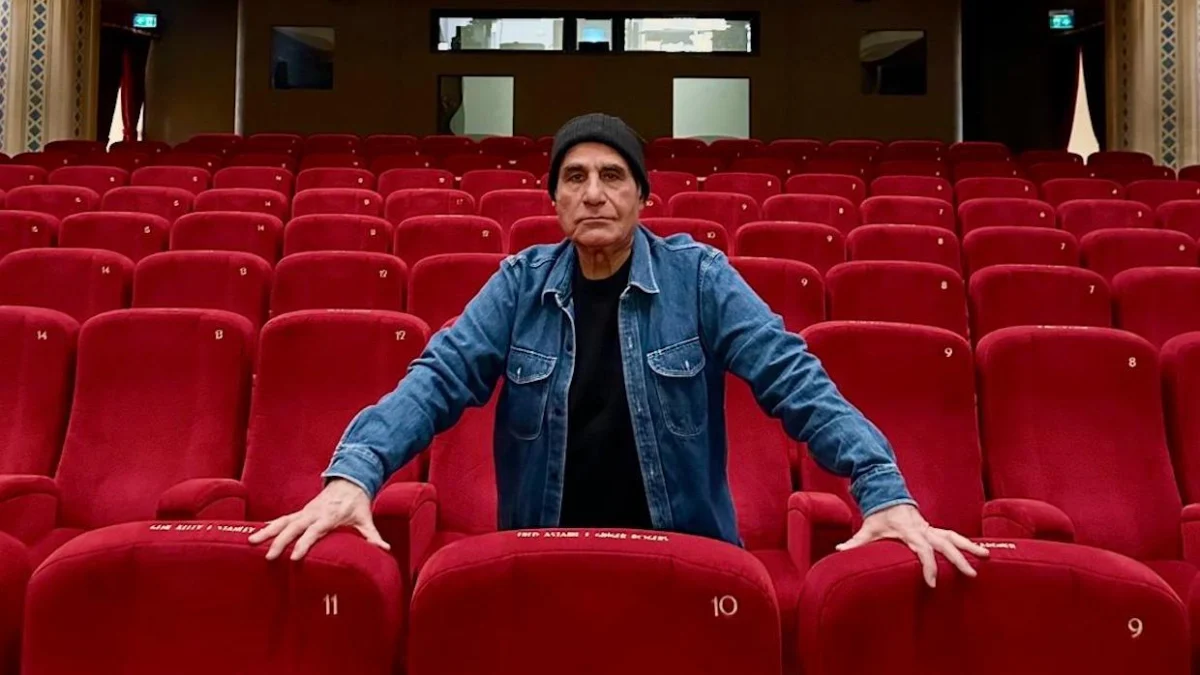
Iranian filmmaker Amir Naderi, a seminal figure in global cinema, is currently traversing Europe, sharing his profound insights on filmmaking through a series of masterclasses. Connecting via WhatsApp from Rome, the second stop on his pedagogical tour, Naderi’s dynamic approach to education mirrors his own cosmopolitan artistic journey: in each nation he visits, the curriculum is meticulously tailored to the specific cinema history of that country. This method is a fitting reflection of a filmmaker who has crafted narratives across the United States, Japan, and Italy, and who, with characteristic ambition, harbors aspirations of potentially making a film in Australia. "If I can do it," he muses, "If not, I keep going anyway." This statement encapsulates the relentless drive that has defined a career spanning over five decades, marking him as one of the most persistent and visionary voices in contemporary world cinema.
From Abadan’s Streets to Cinematic Dreams: Naderi’s Formative Years
Amir Naderi’s life story is one of profound resilience, a narrative that predates his celebrated cinematic achievements. Born in Abadan, Iran, in 1944, his early years were marked by hardship and self-reliance. His father passed before he knew him, and his mother succumbed when he was just five years old, leaving him an orphan in a bustling port city. To survive, Naderi undertook a series of arduous odd jobs, from selling ice blocks under the scorching sun – a harrowing experience vividly dramatized in his 1984 masterpiece The Runner (Devandeh) – to hawking soda at local cinemas. It was within the dim, cavernous spaces of these movie theaters that Naderi’s destiny irrevocably intertwined with the moving image. "I knew it from the beginning," he recalls, "my dream is in there, in that screen." This early exposure to the magic of cinema ignited an insatiable hunger, transforming a boy struggling for survival into a future auteur.
His self-education was rigorous and relentless. Lacking formal training, Naderi immersed himself in films, devouring every frame and story he could access. He became a self-taught cinephile, meticulously studying the works of revered masters like John Ford, John Huston, Kenji Mizoguchi, Max Ophüls, and Yasujirō Ozu. These titans of cinema, whose names Naderi still speaks of with hushed reverence, became his unwitting mentors, shaping his understanding of visual storytelling, narrative structure, and thematic depth. This foundational knowledge, acquired through sheer passion and dedication, would later inform his unique directorial voice, characterized by a blend of raw realism and poetic formalism.
The Iranian New Wave: A Pioneer’s Ascent
Naderi’s emergence coincided with the burgeoning Iranian New Wave, a transformative period in Iranian cinema that began in the late 1960s. This movement, characterized by a departure from commercial filmmaking towards more artistic, socially conscious, and often allegorical narratives, saw filmmakers exploring themes of identity, social injustice, and the human condition with a distinctive minimalist aesthetic. Naderi quickly became a pivotal figure within this vibrant artistic landscape.
After gaining experience as a still photographer and assistant director, Naderi made his directorial debut, initially working within the studio system. However, his artistic integrity soon compelled him to forge his own path. A moment of profound introspection arrived during the production of Tangsir (1974), his large-scale adaptation of Sadegh Chubak’s 1963 novel, a tale of vengeance and honor set in rural Iran. "One night, I was young, drunk, and in the rain, I said, ‘Amir, what do you want to do? You want to go this way? If you want to go this way, you’re not getting anything. What do you do?’ I said, ‘I want to do it my way.’" This defiant declaration marked a turning point, solidifying his commitment to an independent vision.
His 1974 diptych, Harmonica (Sazdahani) and Waiting (Entezar), showcased his burgeoning talent, delving into the poignant struggles of childhood and the complexities of human desire. These films, often featuring child protagonists navigating challenging circumstances, laid the groundwork for his distinctive style. However, it was The Runner (1984) that cemented his legend, not only within Iran but also on the international stage. Released in the tumultuous post-revolution era, the film became a landmark of Iranian cinema, garnering critical acclaim at festivals like Cannes and Venice. Its visceral portrayal of an orphaned boy, Amiro, struggling to survive amidst the war-torn landscape of Abadan, transcended its specific context to become a universal allegory of human perseverance against overwhelming odds. The film’s formalist expressionism and stark realism resonated deeply with international audiences and critics, establishing Naderi as a director of profound vision.
A significant figure in Naderi’s Iranian period was Bahram Beyzaie, a towering intellect of Iranian cinema, known for his masterful screenwriting, directing, and scholarly contributions. Beyzaie, who sadly passed away in December, edited The Runner and was honored alongside Naderi in a retrospective at Metrograph. Naderi speaks of Beyzaie with deep respect, recalling a shared kinship over cinema, exemplified by a conversation about Billy Wilder’s Sunset Boulevard shortly before Beyzaie’s passing. With reserved but visible sorrow, Naderi described Beyzaie as a "master" of language, whose "heart and his feeling and his brain" were inextricably linked to his Iranian identity. Beyzaie’s influence on the intellectual and artistic fabric of Iranian cinema is immeasurable, and his collaboration with Naderi underscored a period of intense creative synergy in a challenging political climate.
A Global Nomad: Expanding Horizons in the West
Despite his deep pride in his Iranian heritage and his indelible mark on its cinematic history, Naderi’s insatiable artistic ambition ultimately led him to seek new creative pastures. Having first visited New York City in the 1970s, he made the momentous decision to relocate there following the 1989 release of Water Wind Dust (Ab, Bhad, Khak), a film that continued his exploration of childhood, survival, and the indifference of nature. This move marked the beginning of his prolific international career, allowing him to explore diverse narratives and cinematic styles unfettered by the strictures of his homeland.

His American tetralogy began with 1993’s Manhattan by Numbers, a neo-realist exploration of artistic struggle in the relentless urban labyrinth of New York City. The film, which will screen at Film Forum as part of their "Tenement Stories" program, stands as an evergreen allegory for the challenges of maintaining artistic integrity amidst the rat race of the Big Apple. It also serves as a poignant snapshot of Manhattan on the cusp of the Giuliani-era gentrification, capturing a city in flux. Naderi’s subsequent American features, including A, B, C… Manhattan (1997), gradually narrowed in scope, culminating in his most claustrophobic and radical work, Sound Barrier (2005). This experimental film, about a deaf and mute boy desperately trying to recover the last known recording of his late mother, premiered at the Venice Film Festival, showcasing Naderi’s continued push against conventional narrative forms. If Manhattan by Numbers is a metaphor for the challenges of artistic integrity in a commercialized world, Sound Barrier frames the archive as a volatile, deeply personal space for the reconstruction of identity and memory. These films established Naderi as a unique voice in independent American cinema, bringing a distinctly international perspective to urban narratives.
While Naderi speaks with pride of his Iranian heritage and the indelible impact it has had on his work, he has never returned to his country since his departure. "I got too far from my past, geographically," he reflected, "But my heart is there." This sentiment encapsulates the complex identity of a filmmaker whose art transcends national borders while remaining deeply rooted in his personal history.
Critiquing the American Dream and Embracing Cinematic Transcendence
Naderi’s international work continued to grapple with profound societal issues, often through the lens of individual obsession and its destructive consequences. Though he explicitly refuses to discuss cinema in overtly political or didactic terms, his films frequently offer prescient social commentary. Vegas: A True Story (2008), for instance, stands as a blistering critique, not of Iran, but of America’s unvarnished pursuit of wealth. The film chronicles a family convinced by the former homeowner of their newly acquired property that untold riches may be buried beneath their lot. As this obsession curdles into self-destruction, the family’s patriarch literally eviscerates the land, refusing to believe the truth of his escalating squalor, which is ultimately exposed as the basis for a sick form of virtual gambling. In its scorching vision of white American patriarchy and the corrosive nature of unchecked greed, Vegas cuts deeply, offering a chillingly relevant commentary on an America often held captive by conmen and grifters profiting from the desecration of both land and values. The film’s reception, particularly in light of the 2008 financial crisis, underscored Naderi’s ability to capture the zeitgeist of a nation consumed by illusions.
Despite the bleakness that can pervade his studies of "obsession as hell," Naderi’s work consistently yields a possible form of transcendence. In his late period, this transcendence is largely found in an ascetic commitment to cinema itself. Films like 2011’s Cut, shot in Japan, and his last feature, Magic Lantern (2018), filmed in Italy, serve as passionate odes to the art form. Both films exhume the specters of the auteurs who expanded Naderi’s conceptions of the medium, creating meta-cinematic narratives that reflect on the power, history, and future of film. Cut follows a young cinephile who risks his life to save his grandfather’s film collection from debt collectors, a powerful allegory for the struggle to preserve artistic integrity in a commercialized world. Magic Lantern further explores the transformative power of cinema, acting as both a love letter and a cautionary tale. These works serve in tandem with his overriding desire to lead by example as a mentor for succeeding generations of cineastes and storytellers, embodying his belief that cinema is not merely entertainment but a profound cultural force.
A Mentor’s Mission: Cultivating Future Directors
Naderi’s global teaching tour is not merely a series of lectures; it is a mission to imbue aspiring filmmakers with the discipline and vision he believes are crucial for creating meaningful cinema. He is not content to simply exalt the established canon; instead, he guides his students toward foundational screenwriters and directors like Ben Hecht and Billy Wilder, whose unparalleled grasp of story structure and character development can prove invaluable. This pedagogical approach favors discipline, meticulous planning, and a deep understanding of craft over what Naderi critically describes as the "slipshod collation of footage" that, in his view, fuels the creative homogeneity prevalent in much of contemporary world cinema. From this rigorous approach, Naderi confidently asserts, "I can make, I think, at least 50 directors out of the world."
His teaching methodology is a direct extension of his own self-taught journey and his profound respect for the craft. He emphasizes that true originality stems from a deep understanding of fundamentals and a willingness to explore diverse cinematic traditions. By tailoring his curriculum to the specific cinematic history of each country, he encourages students to engage with their own cultural heritage while also drawing inspiration from global masters. This holistic approach aims to cultivate filmmakers who are not only technically proficient but also possess a unique voice and a profound appreciation for the art form.
Legacy and the Unyielding Faith in Cinema
Amir Naderi’s life and career stand as a testament to the power of unwavering conviction and artistic integrity. From his humble beginnings in Abadan to his status as a revered international filmmaker and educator, his journey is an epic narrative of perseverance. His films, whether depicting the harsh realities of post-revolution Iran, the gritty struggles of New York City, or the meta-cinematic explorations of his later works, consistently explore themes of human dignity, resilience, and the relentless pursuit of dreams.
"Cinema for me is like a religion," he proclaims, a statement that underscores the profound spiritual and existential meaning he derives from the art form. This faith, coupled with the cosmopolitan character of his vocation, defies nationalist constrictions and gives his belief in mankind’s propensity for creativity a stirring resonance in these often fraught and fragmented times. In a world grappling with uncertainty, Naderi’s message is one of enduring hope and the transformative power of art. Without a second thought, he articulates an unconditional truth that has guided his entire life: "I’ll never give up." This unyielding spirit, woven into the fabric of his films and his teaching, ensures that Amir Naderi’s legacy will continue to inspire generations of filmmakers and cinephiles across the globe, a beacon of artistic freedom and an enduring testament to the human spirit.