
The 1950s marked an era of profound transformation for Japan, emerging from the devastation of World War II to embark on an unprecedented period of high economic growth. This rapid economic ascent, often termed the "Japanese economic miracle," fueled widespread optimism and presented the nation with an opportunity to redefine its identity on the global stage. However, beneath the surface of prosperity and national reawakening, this era also fostered a pervasive drive for conformity, a societal inclination towards fitting in and belonging rather than embracing individuality. It was within this complex socio-economic landscape that visionary directors like Yuzo Kawashima identified and critiqued the inherent paradoxes. Throughout his prolific career, Kawashima consistently explored the tension between the earnest search for a new national and individual identity and the darker undercurrents of self-deception, manipulation, and mere survival. His 1962 feature film, Elegant Beast (originally titled Erejanto Kedamono), stands as a powerful thematic and aesthetic culmination of his cinematic vision, simultaneously bridging the stylistic sensibilities of 1950s Japanese cinema with the more radical, critical tendencies that would define the 1960s. More than just a significant work of its time, Elegant Beast remains a biting satire, offering incisive commentary on aspects of Japanese society that resonate with striking relevance even today.
The Economic Miracle and its Societal Undercurrents (1950s-1960s)
To fully appreciate the subversive power of Elegant Beast, one must understand the tumultuous backdrop against which it was created. The decade following the end of the Allied Occupation in 1952 saw Japan rebuild and industrialize at an astonishing pace. Fueled by significant investment, technological innovation, and a disciplined workforce, the nation experienced an average annual GDP growth rate exceeding 9% for nearly two decades. Key industries such as shipbuilding, steel, automobiles, and electronics became global powerhouses, transforming Japan from a war-torn nation into a leading economic force. This economic boom fundamentally reshaped Japanese society, leading to rapid urbanization, the rise of a substantial middle class, and a surge in consumerism. Department stores flourished, household appliances became commonplace, and the dream of "a car, a color TV, and an air conditioner" (the "three sacred treasures" of the era) became an attainable aspiration for many.
However, this period of prosperity was not without its shadows. The intense pressure to contribute to national recovery and maintain social harmony often translated into a powerful societal expectation for conformity. The concept of uchi-soto (in-group/out-group dynamics) and the desire to avoid standing out became deeply ingrained, influencing everything from corporate culture to family life. Traditional values, once rigidly defined, underwent significant reevaluation or outright erosion in the face of rapid Westernization and modernization. The collective trauma of defeat in World War II and the subsequent pursuit of economic success sometimes masked deeper anxieties about national identity and individual purpose. Many felt a disconnect between the outward appearance of progress and an internal sense of moral or spiritual vacuum. This fertile ground of contradiction and aspiration provided rich material for artists like Kawashima, who sought to peel back the layers of societal veneer.
Yuzo Kawashima: A Chronicler of Post-War Japan’s Soul
Yuzo Kawashima (1918-1963) was a prolific director whose career spanned the formative years of post-war Japanese cinema. Often overshadowed by his more internationally renowned contemporaries like Akira Kurosawa, Yasujiro Ozu, and Kenji Mizoguchi, Kawashima nevertheless carved out a distinctive niche, known for his keen observational eye, sharp wit, and willingness to tackle uncomfortable truths about society. He began his career in the late 1940s, working within the studio system, primarily at Nikkatsu and Daiei. His filmography, encompassing over 50 features, often explored themes of social hypocrisy, the struggles of the common person, and the tension between individual desires and societal expectations.
Kawashima’s style often blended elements of realism with theatricality, and his narratives frequently featured morally ambiguous characters navigating complex social landscapes. Unlike Ozu’s gentle, poignant family dramas or Kurosawa’s epic tales of samurai and justice, Kawashima’s films possessed a darker, more cynical edge, often employing satire and dark humor to expose societal flaws. His 1957 film Sun in the Last Days of the Shogunate (also known as Bakumatsu Taiyoden) is widely considered a masterpiece of comedic social commentary, demonstrating his ability to craft entertaining yet deeply critical narratives.
Elegant Beast, released just a year before his untimely death at the age of 45, represents a mature distillation of Kawashima’s recurring themes. It stands as a bridge between the more traditional, character-driven narratives of the 1950s and the burgeoning Japanese New Wave of the 1960s, which saw directors like Nagisa Oshima and Shohei Imamura challenge cinematic conventions and societal norms with increasing audacity. Kawashima’s film, while operating within a more conventional narrative framework, shares the New Wave’s critical spirit and its unflinching gaze at the darker corners of modern life.
The Maeda Family: A Microcosm of Deception
At the core of Elegant Beast is the Maeda family, seemingly a respectable middle-class household. However, Kawashima wastes no time in shattering this bourgeois façade, revealing a meticulously constructed illusion. The film introduces us to Tokizo and Yoshina Maeda (portrayed by Eiji Funakoshi and Haruko Sugimura, respectively), a seemingly conventional couple who, in reality, are living off the illicit gains of their adult children, Minoru (Hideo Takamatsu) and Tomoko (Ayako Wakao). Their existence is predicated on a web of exploitation, manipulation, and outright deception, making their "respectability" a carefully choreographed performance.
Minoru, the son, leverages his position at a talent and event agency, exploiting the goodwill and trust of his employer through embezzlement and other fraudulent schemes. Meanwhile, Tomoko, the daughter, cunningly manipulates a successful but mediocre writer who has fallen deeply in love with her, extracting financial support and lavish gifts. Together, the children’s illicit activities provide the luxurious lifestyle—fine furniture, gourmet food, and a comfortable apartment—that the parents openly enjoy, all while maintaining an outward appearance of innocence or even victimhood.
The precariousness of their existence is quickly revealed. Tomoko’s lover, the writer, demands the return of his money and threatens to end their relationship, exposing her scheme. Simultaneously, Minoru’s employer faces legal troubles and has finally uncovered the extent of his employee’s theft. The family’s carefully balanced house of cards is on the verge of collapse, forcing them into increasingly desperate and elaborate acts of deception.
Kaneto Shindo’s Screenplay: From Stage to Screen
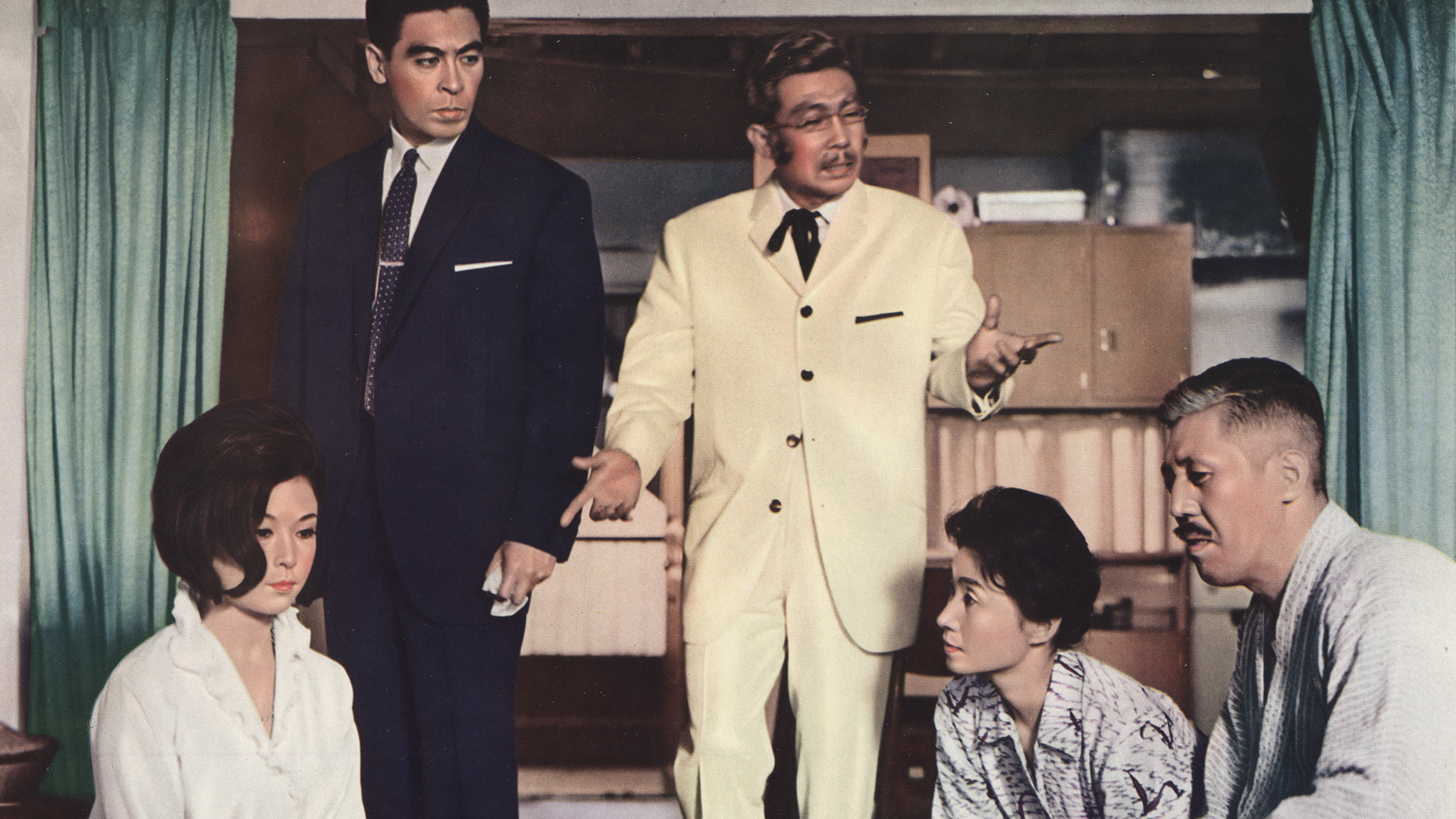
The narrative backbone of Elegant Beast originates from a stage play by Kaneto Shindo, a renowned director and screenwriter in his own right, known for his intense, often bleak explorations of human nature and survival (e.g., Onibaba, Naked Island). Shindo’s theatrical background is palpable in the film’s tightly constructed plot, sharp dialogue, and reliance on intense character interactions within a confined setting. He adapted his own play for the screen, a collaboration that brought a rare synergy between playwright and director.
The film’s opening scene is a masterclass in establishing its core premise with immediate impact. We witness Yoshina and Tokizo Maeda frantically hiding expensive furniture and replacing it with cheap, shabby items. This frantic charade is prompted by the imminent arrival of Minoru’s furious employer, whom they wish to convince that they are innocent, struggling parents, entirely unaware of their son’s malfeasance. This physical transformation of their living space is mirrored by a dramatic shift in their demeanor: their posture, speech, and expressions are meticulously altered to project an image of humble naivety and earnest concern. This initial sequence not only introduces the family’s deceit but also sets the satirical tone, demonstrating that performance is not merely a means to an end but a way of life for the Maedas.
The Anatomy of Satire: Humor as a Weapon
Elegant Beast employs a particularly sharp form of satire, where humor is not merely for comedic relief but serves as a cutting instrument to expose bitter social truths. The film argues, with ruthless precision, that in this specific societal context, cheating and lying have not only become viable but perhaps even necessary means of maintaining a stable, middle-class existence. The true luxuries, the film suggests, are dignity and genuine respectability – qualities the characters cannot afford, as adherence to them would significantly hinder their survival in a world that covertly rewards deceit.
Kawashima’s genius lies in his ability to maintain dramatic tension even after revealing the family’s core deception in the opening minutes. Once the entire family is introduced, a fascinating internal dynamic emerges: a constant, escalating battle of wits and attempted deceptions among themselves. Hideo Takamatsu’s Minoru embodies the cunning opportunist, perpetually seeking to secure advantages for himself, often at the expense of his sister or even his father. Eiji Funakoshi and Haruko Sugimura’s portrayals of Tokizo and Yoshina form an equally calculating duo, meticulously maintaining their illusion of respectability. Tokizo, in particular, clings to an outdated, almost performative version of Japanese identity, perhaps a lingering echo of national pride lost after the defeat in World War II, which he leverages to manipulate situations.
In this narrative, liars are pitted against liars, creating a claustrophobic atmosphere of mutual suspicion and betrayal. Each character is either on the verge of exposing another’s lies or is equally adept at perpetrating their own. This intricate dance of deceit transforms the film from a simple story of a dysfunctional family into a profound commentary on the moral compromises inherent in a society grappling with rapid change and superficial aspirations.
Aesthetic Bridge: Ozu, Kabuki, and the New Wave
Aesthetically, Elegant Beast draws upon and cleverly subverts two prominent traditions within Japanese cinema and culture. On one hand, Kawashima and cinematographer Nobuo Munekawa employ visual techniques reminiscent of the domestic dramas pioneered by filmmakers like Yasujiro Ozu. The focus on family interactions, often within the confines of a single apartment, and the meticulous framing of domestic scenes evoke the intimate, observational style associated with films like Late Spring or Tokyo Story. Even though the Maeda characters are fundamentally frauds and cheats, they remain a family unit, albeit a twisted one, attempting to navigate challenges that parallel those depicted in more conventional family narratives. This stylistic choice creates a disturbing juxtaposition: the familiar comfort of a domestic setting is rendered unsettling by the moral decay it houses.
On the other hand, the film incorporates explicit references to traditional Japanese theatre, particularly Kabuki. These theatrical allusions, visible in the characters’ exaggerated posturing, carefully constructed performances, and heightened dramatic exchanges, serve to underscore the story’s profound moral dimension. The Maedas’ lives are presented as a continuous performance, a dramatic play staged for external audiences and, often, for each other. While audiences may find themselves condemning the characters’ actions, these theatrical elements also subtly point to a larger societal context that enables, and perhaps even inadvertently encourages, such behavior. The film suggests that judging the Maedas becomes difficult when their deceit is a desperate response to the threat of social decline and financial ruin – a fate they are unwilling to accept in the fiercely competitive post-war landscape.
This blending of Ozu’s domestic realism with Kabuki’s theatricality, combined with Kawashima’s cynical outlook, positions Elegant Beast as a precursor to the Japanese New Wave. While not as overtly experimental as films by Oshima or Imamura, its willingness to dissect societal hypocrisy and challenge conventional notions of morality resonates with the New Wave’s spirit of rebellion and critical inquiry. It signifies a shift from the more humanistic concerns of earlier decades to a more cynical, analytical approach to the complexities of modern Japanese life.
Enduring Relevance and Legacy
Elegant Beast emerges as a ruthless, unflinching satire of a society where identity itself becomes a performance. Yuzo Kawashima masterfully exposes a world where respectability is no longer grounded in intrinsic values or ethical conduct but is meticulously staged through a constant cycle of deception and manipulation. Individuals are forced into an unending negotiation between maintaining appearances and ensuring their very survival. What begins as a confined family drama gradually expands into a broader, more profound critique of a societal system that, consciously or unconsciously, rewards illusion over integrity, where the distinction between authenticity and performance ultimately collapses.
The film’s themes resonate with striking clarity in contemporary society, both in Japan and globally. The pressure to present a flawless public image, the allure of superficial success, the struggles of economic precarity driving unethical choices, and the erosion of trust in institutions are all issues that continue to plague modern communities. Kawashima’s portrayal of the Maedas’ desperate charades offers a timeless warning about the corrosive effects of prioritizing outward appearance and material gain over genuine ethical foundations.
Today, Elegant Beast is increasingly recognized as a vital work within Japanese cinema, a testament to Kawashima’s unique voice and foresight. Its recent restorations and re-releases, such as the Blu-ray standard edition, signify a renewed appreciation for its artistic merit and its enduring social commentary. Film scholars and critics now view it not just as a product of its time but as a prescient examination of human nature under duress, a film that dared to expose the "elegant beast" lurking beneath the polished surface of a rapidly modernizing nation. Its legacy lies in its unyielding honesty, its sharp wit, and its chilling insight into the human capacity for deceit when survival and social standing are at stake.