The Genesis and Evolution of Beastars
The Beastars phenomenon began with Paru Itagaki’s original manga series, which commenced serialization in Akita Shoten’s Weekly Shōnen Champion in September 2016 and concluded in October 2020. The manga quickly garnered widespread critical acclaim for its unique premise, complex character dynamics, and profound exploration of societal issues through the lens of an anthropomorphic world. Itagaki’s work distinguished itself by using the inherent predator-prey dynamic to metaphorically represent real-world themes such as prejudice, discrimination, class struggle, identity, and the conflict between instinct and civilization. Its accolades include the Manga Taishō award in 2018, the New Creator Prize at the Tezuka Osamu Cultural Prize in 2018, and the Best Shōnen Manga award at the 42nd Kodansha Manga Award in 2018, underscoring its significant impact on the manga landscape.
The announcement of an anime adaptation by Studio Orange, renowned for its expertise in full CGI animation, generated considerable excitement. Studio Orange had previously impressed audiences with titles like Land of the Lustrous, showcasing their ability to translate intricate 2D aesthetics into compelling 3D animation without sacrificing artistic nuance. The first season of Beastars premiered in Japan in October 2019, quickly gaining a global audience through its exclusive streaming deal with Netflix, which released the series internationally in March 2020. The anime successfully brought Itagaki’s distinct art style and complex narrative to life, demonstrating that full CGI could be a powerful tool for expressive character animation and world-building, defying previous skepticism about the medium in anime. Subsequent seasons continued to build on this foundation, deepening the narrative and expanding the cast of characters while maintaining high production values.
A World on the Brink: Unraveling Societal Collapse
The narrative thrust of Beastars Final Season Part 2 is rooted in a world where the fragile coexistence between herbivores and carnivores has reached a critical breaking point. Zebuth City, once a tenuous model of interspecies harmony, is steadily collapsing under the weight of escalating distrust and a series of violent incidents. The meticulously constructed social order, enforced by strict dietary laws and cultural norms, proves increasingly inadequate in containing the primal instincts and deep-seated prejudices that lie beneath the surface.
At the epicenter of this brewing chaos is Melon, the series’ primary antagonist, whose insidious schemes and unpredictable actions push the city toward utter pandemonium. Melon, a hybrid of gazelle and leopard, embodies the profound anxieties and identity crises inherent in a society that struggles to categorize and accept individuals born from mixed-species relationships. His personal trauma and rejection fuel his desire to dismantle the existing order, making him a formidable and psychologically complex threat. His actions, including inciting unrest within the criminal underworld and manipulating public sentiment, intensify the divide between species, leading to a surge in hate crimes and murders explicitly linked to interspecies relationships. This narrative thread serves as a potent metaphor for real-world issues of systemic discrimination and the societal pressures placed upon marginalized groups.
Legoshi and Haru: A Relationship Defined by Instinct and Affection
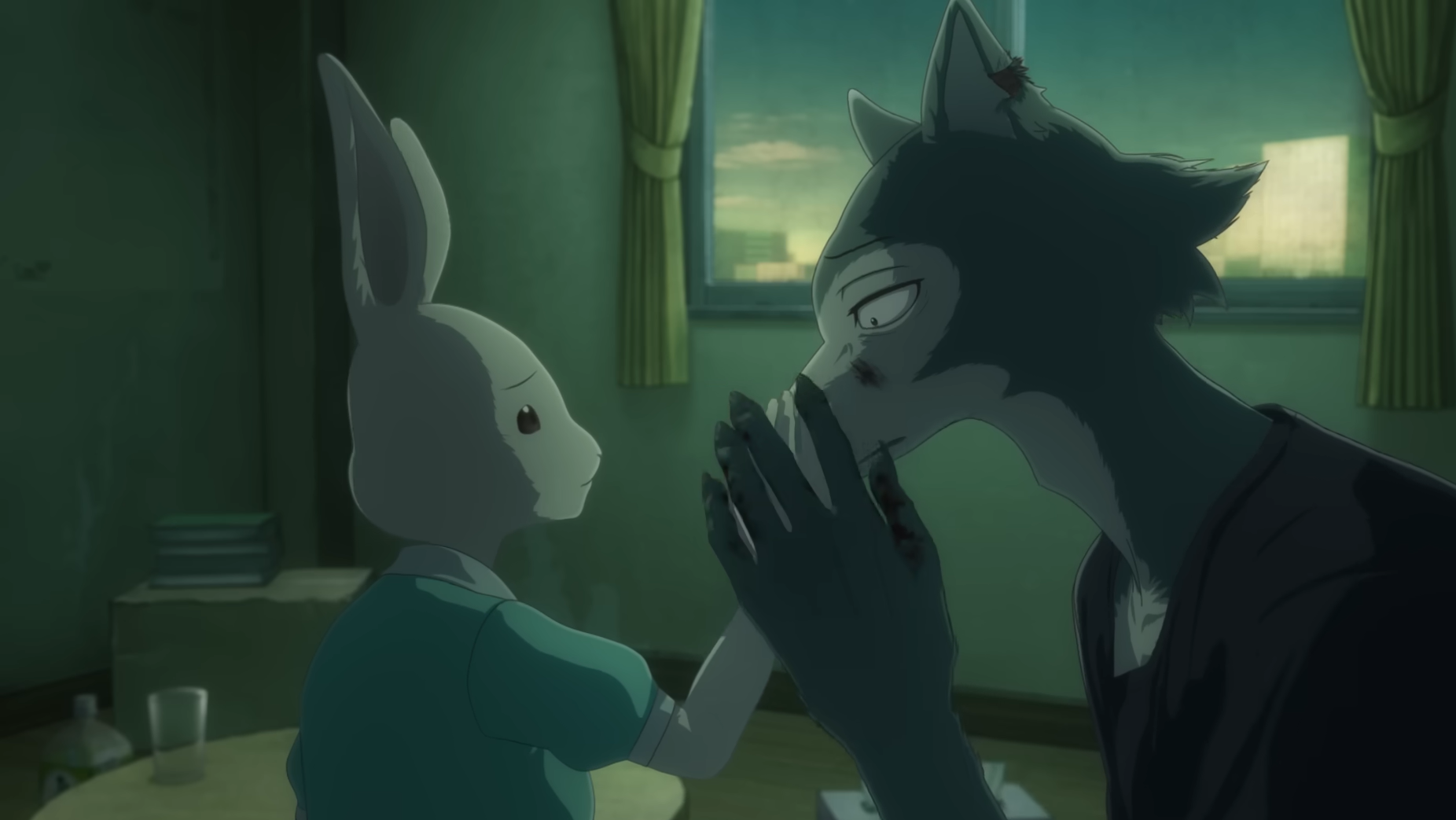
Central to the series’ emotional core is the evolving relationship between Legoshi, a gentle gray wolf, and Haru, a tenacious dwarf rabbit. Their unconventional romance, fraught with the inherent predator-prey dynamic, has always been a powerful vehicle for exploring themes of love, acceptance, and overcoming instinctual urges. In Beastars Final Season Part 2, their bond continues to strengthen, yet it remains hindered by Legoshi’s profound fear of inadvertently devouring Haru against her will. This fear, while seemingly primal, is deeply rooted in his desire to protect her and respect her autonomy, reflecting a mature understanding of consent and mutual respect that transcends his carnivorous nature.
Haru, on the other hand, exhibits a remarkable lack of fear regarding Legoshi’s predatory instincts. Her insistence on physical contact and her unwavering trust in him challenge Legoshi to confront his deepest anxieties. Her character arc highlights agency and resilience, subverting the typical damsel-in-distress trope. However, Haru’s entanglement in Melon’s dangerous obsession adds another layer of vulnerability and urgency to Legoshi’s quest, pushing him deeper into the underworld of the Black Market, where he must confront his own predatory nature to protect the one he loves. The Black Market, a clandestine society where carnivores can indulge their forbidden desires, serves as a grim reflection of the societal repression and hypocrisy that Beastars consistently critiques.
Louis’s Political Labyrinth and the Idealism of Art
Meanwhile, Louis, the red deer heir to the Horns Conglomerate, finds himself ensnared in a web of political pressure and personal dilemmas. His journey from a stoic, ambitious student to a pragmatic leader navigating the corrupt surface world has been one of the series’ most compelling character arcs. In the final season, his role becomes increasingly complicated as he struggles to reconcile his personal convictions with the expectations of his powerful father. This includes an arranged marriage with a formidable heiress, a strategic move designed to consolidate power and influence. The unexpected depth and intelligence of his fiancée further complicate his emotional landscape, forcing him to confront his preconceived notions and internal conflicts regarding duty, love, and self-determination. Louis’s arc serves as a commentary on the compromises inherent in leadership and the sacrifices often demanded by political expediency.
Concurrently, the theatre troupe, a recurring symbol of hope and unity, strives to prepare for a stage play intended to demonstrate the possibility of coexistence between herbivores and carnivores. This artistic endeavor represents an idealistic counterpoint to the city’s growing discord, advocating for understanding and empathy through shared experience. However, the troupe constantly encounters obstacles, including internal conflicts and the presence of a "true primadonna" whose ego threatens to derail their collaborative efforts. This sub-plot underscores the challenges of fostering unity even within a group committed to a common, noble goal, reflecting the difficulties of achieving social harmony in the face of individual egos and external pressures.
Thematic Depth and Narrative Nuances
Beastars has consistently excelled in its thematic exploration, and the final season is no exception. The concept of cohabitation, a cornerstone of the series, is implemented with remarkable nuance, serving as a powerful metaphor for complex real-world social dynamics. This season further enriches the discussion by introducing the idea of individuals born from mixed-species relationships, adding another layer to the existing discourse on discrimination, identity, and belonging. These "hybrids" often exist in a liminal space, ostracized by both parent species, highlighting the arbitrary nature of social boundaries and the psychological toll of not fitting in.
However, the narrative’s deep dive into Melon’s past, while providing context for his destructive motivations, has drawn some criticism. The revelation of his tragic background, while intended to humanize the antagonist, has been described by some as leaning towards a somewhat overused trope—the idea that every villain must have a sympathetic origin story. While this approach can deepen character complexity, it occasionally risks diluting the raw impact of pure malevolence, leading to varied audience interpretations regarding its effectiveness.
Beyond its core themes, Beastars meticulously integrates elements such as organized crime, rampant corruption at all levels of governance, the pervasive influence of illicit drugs, and the critical role of public opinion and the press. These elements add considerable depth to an already layered narrative, grounding the fantastical anthropomorphic setting in recognizable societal ills. The escalating murders, fueled by Melon’s machinations and the societal breakdown, contribute to a palpable tension that builds inexorably towards the inevitable final confrontations: Legoshi versus Melon, and Louis versus his father. The series masterfully employs thriller elements, gradually building suspense and urgency that culminate in a truly climactic finale.
Audiovisual Mastery and Climax
Studio Orange’s CGI animation remains a standout feature throughout the series, and in the final season, it reaches new heights of technical and artistic achievement. The animation quality is consistently among the best seen in any animated series, demonstrating the studio’s mastery of 3D modeling, texturing, rigging, and motion capture. The ability to convey nuanced emotions through anthropomorphic characters, despite the inherent challenges of CGI, is a testament to their animators’ skill.
The finale, in particular, showcases exceptional audiovisual direction. Highlights include a highly surreal quiz game presented in a television style, which transitions seamlessly into a delirious and brutally bloody confrontation involving multiple characters as the Black Market descends into utter chaos. This sequence is a technical marvel, utilizing advanced animation techniques to convey the raw intensity of the battle. The strategic use of rotoscope, a technique that traces over live-action footage, adds a unique fluidity and realism to certain movements and expressions, enhancing the emotional impact. The drum-driven score, a distinctive characteristic of the series’ soundtrack, perfectly punctuates the escalating tension and action, amplifying the visceral experience. Furthermore, the montage intercutting Louis’s arc during these intense moments provides a parallel emotional and narrative climax, resulting in what many consider to be the strongest and most extended sequence of the entire season. This creative integration of different narrative threads through visual and auditory cues exemplifies the sophisticated storytelling prevalent in Beastars.
The character designs by Takuma Norita and Nao Otsu continue to be of a very high caliber. Their anthropomorphic rendering of the diverse cast of characters not only makes them instantly recognizable but also allows for subtle shifts in appearance that convey emotional states and the toll of events. The expressive eyes, posture, and even the texture of fur or skin are meticulously crafted to reflect the characters’ inner turmoil and external struggles. Lastly, the series tastefully introduces a slight erotic element, which, rather than being gratuitous, is organically integrated into the narrative, serving to deepen the exploration of instinct, desire, and intimacy in a world grappling with primal urges.
Broader Impact and Enduring Legacy
The conclusion of Beastars marks a significant moment for both Studio Orange and Netflix, solidifying their reputations for delivering ambitious and high-quality animated content to a global audience. The series has not only pushed the boundaries of full CGI animation in anime but has also demonstrated the commercial viability and critical acceptance of mature, thematically complex narratives within the medium. Its success has likely inspired other studios to explore similar techniques and storytelling approaches, contributing to a more diverse and innovative animation landscape.
From a cultural standpoint, Beastars has sparked extensive discussions across various platforms, engaging fans and critics alike in debates about its allegories, character motivations, and social commentary. Its unique premise and compelling characters have resonated deeply, creating a passionate fanbase that has consistently celebrated its originality and daring thematic explorations. Creator Paru Itagaki’s original vision, faithfully adapted and visually enhanced by Studio Orange, has left an indelible mark on contemporary pop culture.
While the very ending, described by some as "somewhat vanilla" in its final resolutions, might not have delivered the visceral shock or unconventional twist some viewers might have expected, Beastars Final Season Part 2 undeniably provides a rewarding conclusion to an excellent series. It successfully brings closure to its myriad plotlines and character arcs, ultimately cementing its legacy as a seminal work that masterfully blended complex social commentary with gripping drama and groundbreaking animation. The series will be remembered not only for its technical prowess but for its courageous and nuanced exploration of what it means to be an individual, a predator, a prey, and ultimately, a member of a deeply flawed yet striving society.