The 2026 edition of CPH:DOX, the Copenhagen International Documentary Film Festival, reaffirmed its position as a preeminent global platform for documentary cinema, presenting a program that masterfully intertwined aesthetic innovation with pressing geopolitical and social commentary. Building on a tradition of opening films that address critical international events, the festival’s 2025 iteration notably commenced with Facing War, a documentary chronicling the final year of NATO Secretary General Jens Stoltenberg’s tenure against the backdrop of the ongoing Russo-Ukrainian conflict. While some critics observed a degree of caution in its portrayal of political lobbying, its premiere proved remarkably prescient, coinciding with former U.S. President Donald Trump’s resurgence in the political arena and escalating anxieties surrounding the stability of European alliances and collective security frameworks. This thematic resonance underscored CPH:DOX’s enduring commitment to showcasing works that not only reflect but also actively engage with the complex realities of a world grappling with multiplying conflicts and profound societal shifts.
CPH:DOX: A Beacon for Contemporary Documentary Storytelling
Established in 2003, CPH:DOX has rapidly ascended to become one of the world’s most respected documentary festivals, celebrated for its bold programming, interdisciplinary approach, and willingness to challenge conventional documentary forms. It consistently curates a selection that pushes cinematic boundaries while maintaining a sharp focus on social justice, human rights, and geopolitical issues. The festival serves as a vital meeting point for filmmakers, industry professionals, and a diverse international audience, fostering dialogue and critical engagement with the most urgent topics of our time. Its strategic location in Copenhagen, a city known for its progressive values and strong cultural scene, further amplifies its role as a hub for thought-provoking cinema that seeks to inform, inspire, and provoke change. In 2026, against a global backdrop of heightened tensions, the festival’s curated selection offered a powerful testament to the documentary medium’s capacity to mediate political complexities and illuminate the human condition.
Chronicling Conflict: From Geopolitical Chessboards to Frontline Realities
The festival’s opening film in 2025, Facing War, set a high bar for geopolitical relevance. The documentary offered an intimate, albeit perhaps guarded, look into the intricate world of international diplomacy and military strategy through the lens of Jens Stoltenberg’s leadership at NATO. Stoltenberg, a former Prime Minister of Norway, served as NATO Secretary General from 2014 to 2024, a period marked by significant challenges including Russia’s annexation of Crimea and the full-scale invasion of Ukraine. The film’s examination of the delicate balance between deterrence and de-escalation, and the constant navigation of diverse member state interests, provided timely insights into the mechanisms attempting to preserve peace in a volatile continent. Its critical reception, acknowledging its cautious approach to political lobbying, nevertheless highlighted its crucial timing, offering a lens through which to understand the vulnerabilities of international alliances in an era of resurgent nationalism and shifting global power dynamics.
Continuing CPH:DOX’s dedicated focus on the Ukraine conflict, a tradition rooted in the festival’s commitment to current events, Pieter-Jan De Pue’s Mariinka emerged as a work striking a rare and powerful balance between artfulness and urgent reportage. De Pue, known for his 2016 Sundance-winning film The Land of the Enlightened—which spent years alongside orphaned child soldiers in Afghanistan, crafting a celluloid dreamlike fable to counter reductive portrayals of the country—once again turned his gaze to the profound human cost of war. For over a decade, De Pue meticulously filmed in and around Mariinka, a small city in the Donbas region situated along the Russia-Ukraine border, prior to its full-blown occupation by Russian forces in 2024. The Donbas, an industrial heartland in eastern Ukraine, has been a flashpoint since 2014, witnessing protracted conflict that has devastated communities and displaced millions.
In Mariinka, De Pue follows orphaned children whose formative years have been tragically consumed by the conflict, including brothers tragically finding themselves on opposing sides of the battlefield. The narrative is further enriched by the lyrical narration of Natascha, a young paramedic whose voice imbues the film with an emotional depth. Composed from footage gathered in the desolate trenches, across contested international borders, and during reflective intervals away from the immediate chaos, Mariinka delivers a profoundly poetic portrait of a deeply wounded Donbas. Unlike many contemporary war documentaries defined by the rough, immediate digital imagery of austerity, De Pue, armed with a 16mm camera, intentionally sacrifices mobility for a more elevated visual register. The warmth and texture of celluloid lend an extraordinary dignity to the protagonists’ close-ups and the vast, star-filled skies, while providing a visceral force to harrowing images, such as an artery pulsing blood after a near-fatal shot or the perspective from atop a tank in active combat. This choice exposes the unique, almost bipolar yet undeniably powerful, nature of war cinema—its ability to be visually immaculate and emotionally tender, yet relentlessly graphic, achieving an artful expression of war’s surreal reality. The film’s deep dive into the human impact of the Donbas conflict offers a crucial counter-narrative to the often-abstract geopolitical discussions, forcing viewers to confront the deeply personal tragedies unfolding daily.
Journeys of Self-Discovery: Navigating Social Pressures in Rural China
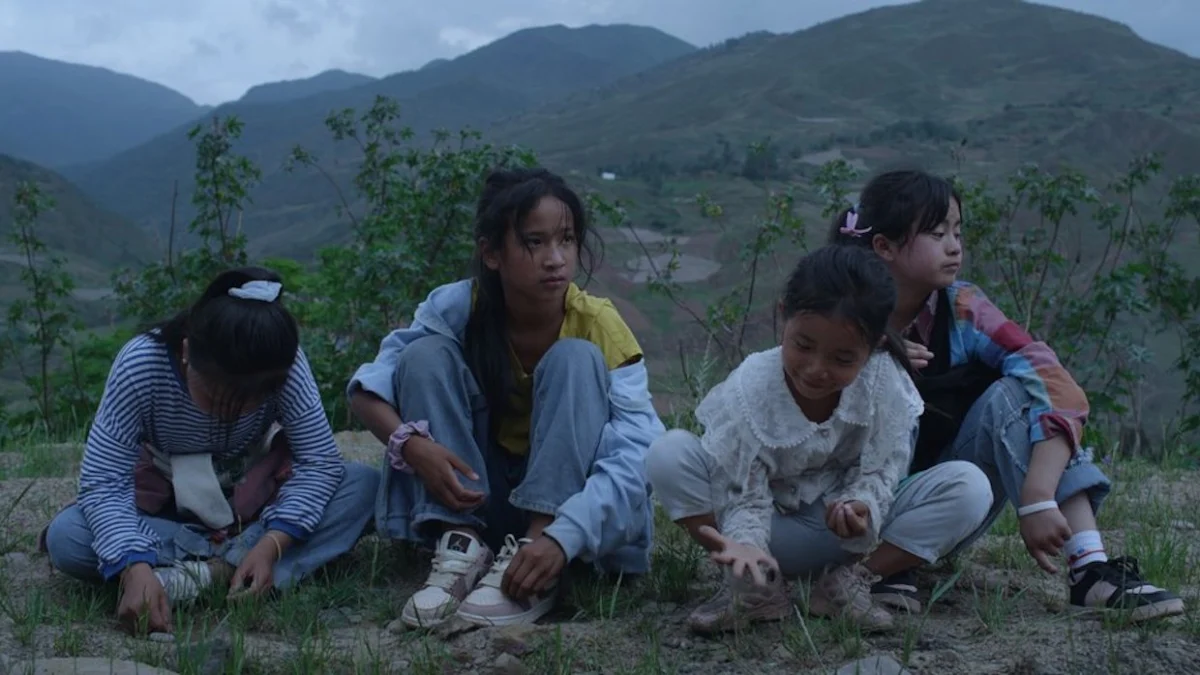
Shifting from the ravages of war to the intimate battles of adolescence, Dongnan Chen’s Whispers in May captivated audiences and critics alike, ultimately receiving the competition’s top award. This Chinese production unfolds as a poignant coming-of-age road-trip fable, meticulously anchored in sensitive documentary observation. The film introduces Qihuo, a lonely fourteen-year-old protagonist whose life is shaped by the pervasive realities of rural Chinese society. She frequently skips school, parented largely over the phone by a mother working as a migrant laborer in a distant city. This maternal relationship is fraught with the economic pressures of their circumstances, oscillating between pushing Qihuo towards factory work—a common trajectory for young people in China’s vast internal migration system—and pragmatically considering the transactional benefits of an arranged marriage, reflecting deep-seated societal norms and economic survival strategies.
The narrative takes a pivotal turn when Qihuo confides in two friends about her first menstruation, a secret that becomes a catalyst for a collective journey. The trio embarks on a quest through the breathtaking Liangshan Mountains, a region known for its rich cultural heritage and distinct Yi ethnic minority, in search of the traditional skirt that signifies this crucial rite of passage into womanhood. Chen describes her unique methodology as "improvised fiction," a technique that allows her to honor both the fearless spontaneity of the young girls and the profound, folk-imprinted beauty of the picturesque landscape. This approach grants the film an authentic, almost vérité quality, capturing unscripted moments of vulnerability and resilience.
Throughout their journey, the film intercuts the live-action footage with still illustrations accompanied by a voiceover narrating the oral myth of Coqotamat. This ancient tale, at once comic and threatening, frequently resonates with the girls’ own prolonged and often challenging voyage, adding layers of cultural depth and symbolic meaning. The camerawork in Whispers in May is remarkably persistent, following the heroines into potentially suspicious houses at night or through torrential rain in their search for shelter. Yet, it also demonstrates a profound understanding of when to grant them distance, allowing for quiet, intimate conversations about their hopes and fears for the future. Through these moments of attentive observation and sensitive portrayal, Whispers in May evolves into a lyrical celebration of innocence, precariously set against the backdrop of majestic mountains that, in their vastness, seem capable of swallowing it whole. The film’s recognition at CPH:DOX highlights the festival’s appreciation for narratives that explore personal journeys within complex social landscapes, particularly those shedding light on the often-unseen lives of young women in marginalized communities.
The Unseen Borders: Global Surveillance and the Migrant Experience

In stark contrast to the intimate journey of self-discovery, Kenya-Jade Pinto’s debut, The Sandbox, plunges into a sweeping exposition of the global surveillance machine, a technological apparatus under which migrants of every kind are often the first to fall victim. This ambitious film examines the unprecedented deployment of drones, robots, CCTV, and artificial intelligence (AI) to control migration at the borders of privileged states, effectively transforming these zones of patrol into profitable trial grounds for advanced technologies. Pinto adopts an almost ruthlessly global perspective, with the narrative traversing continents—from North America to Europe and Africa—to meticulously trace both the engineers who fine-tune these invasive technologies and the migrants whose lives are tragically reduced to mere test cases in this escalating digital frontier.
The film’s formal structure mirrors the bleak divide it diagnoses, oscillating between the inhuman gaze of thermal imaging and drone footage and the ground-level intimacy of survivor testimonies and volunteers diligently searching for human remains. This stylistic juxtaposition powerfully underscores the dehumanizing nature of surveillance technology versus the visceral reality of human suffering. However, in its expansive crossing of so many geographies and migratory flashpoints, The Sandbox occasionally risks only skimming the deeper historical, economic, and political contexts of each region, sometimes losing hold of the humanist impulse it strives to restore. Yet, what the film might concede in individual depth, it profoundly recovers in its sheer scope, rendering a borderless observation with harrowing unease. It presents a chilling vision where, as governments increasingly perfect their borders through technological means, humanity appears to be forfeiting its own fundamental empathy and interconnectedness. The film serves as a crucial, if unsettling, wake-up call to the ethical dilemmas posed by the rapid advancement of surveillance technologies in the context of one of the 21st century’s most defining humanitarian crises.
Unearthing History: Forensic Truth-Telling in Atlas of Disappearance
Manuel Correa, a multimedia artist and researcher, brings a unique perspective to CPH:DOX with Atlas of Disappearance, a film that skillfully foregrounds the humane within the inhumane. This eight-year-long project meticulously confronts the lingering traces of Franco’s dictatorship in Spain by excavating its buried truths through cutting-edge technology. The legacy of General Francisco Franco’s authoritarian rule (1939-1975) continues to cast a long shadow over Spain, marked by mass executions, disappearances, and a subsequent "pact of forgetting" that hindered accountability for decades. Correa’s film centers on three relatives of disappeared citizens as they navigate an exhausting and often deliberately obstructive bureaucratic maze in their relentless pursuit of justice and closure.
Correa counters this gubernatorial obstruction with innovative digital mapping of sealed mausoleums and sophisticated 3D reconstructions that virtually exhume human remains, thereby offering these families a crucial avenue for mourning and legal recourse. His work is deeply informed by his membership in Forensic Architecture, a renowned research agency based at Goldsmiths, University of London. This interdisciplinary group brings together specialists—including architects, filmmakers, software developers, and investigative journalists—to make evidence public across various multimedia formats, particularly in cases where physical evidence is absent, suppressed, or difficult to access. Their pioneering work expands the very definition of what constitutes legal proof, allowing evidence to transcend the courtroom and enter broader cultural and public institutions.
In Atlas of Disappearance, bones serve as the central symbolic and material subject, carrying a particular weight within forensic aesthetics: a substance from which truth, however long suppressed, cannot be fully erased. Where legal actors strive to make evidence speak before a court, Correa assumes a comparable role as director, with the CPH:DOX festival serving as his forum. Weaving together situated testimonies, fragmented archival materials, and state-of-the-art computer technologies beneath a somnambulistic voiceover, Atlas of Disappearance stands as a striking example of how rigorously forensic documentaries can achieve a delicate and powerful balance between legal rigor and artistic expression. It highlights the profound potential of documentary cinema to contribute to historical memory, accountability, and the ongoing struggle for justice against systemic obfuscation.
Utopian Echoes and Dystopian Warnings: The Enduring Legacy of Christiania
Against the backdrop of so many sharply political and emotionally charged films, Karl Friis Forchhammer’s Christiania offered a seemingly comforting, yet ultimately concordant, exploration of a unique social experiment. The film is a smart and nuanced ode to the eponymous Danish freetown, Christiania, a self-proclaimed autonomous neighborhood in Copenhagen. Founded in 1971 by young anarchist-idealists who squatted in former military barracks, Christiania set out to build an alternative paradise, governed by its own rules and a commitment to communal living, environmentalism, and radical democracy.
Forchhammer, however, treats Christiania less as an idealized utopia and more as a lived contradiction. While he genuinely celebrates the romantic force of its radical democratic vision and the enduring spirit of its founders, he is ultimately more interested in exposing the inconvenient cracks in that history. The film candidly addresses the challenges that have plagued Christiania over its five-decade existence: issues of drug use, internal and external violence, persistent political pressure from the Danish state, and the double-edged sword of a booming tourism industry that often clashes with its anti-commercial ethos.
Despite the wealth of exciting, rarely seen archival footage, the film skillfully avoids lapsing into a didactically nostalgic slideshow. Forchhammer expertly calibrates the viewer’s expectations, regaling them with vivid passages of local legend and essential lore, including figures as improbable and memorable as Rikke, the community’s alcoholic black bear. Christiania further surprises with occasional animated sequences that tip into overgrown fantasy, giving its stories and figures a form they could not otherwise assume on camera, adding a layer of myth-making to its historical account. By unsettling the freetown’s crystalline utopian image, the film offers a serious and timely reflection on consensual democracy, questioning the practical limits of total tolerance and humanity’s recurring problem with open dialogue and collective governance. Thus, even if Christiania can no longer fully uphold its initial utopian promise, the film can be read, within the broader context of CPH:DOX 2026’s selection, as a nuanced warning about the increasing challenges facing such ideals in what are often perceived as increasingly dystopian times. It serves as a microcosm for the broader societal struggles to balance freedom with responsibility, and idealism with reality.
The Enduring Power of Documentary: CPH:DOX’s Legacy
The 2026 edition of CPH:DOX once again demonstrated the unparalleled power of documentary cinema to illuminate, challenge, and connect. From the geopolitical complexities of Facing War and the raw, artistic portrayal of conflict in Mariinka, to the tender coming-of-age narrative in Whispers in May, the stark realities of surveillance in The Sandbox, the historical reckoning of Atlas of Disappearance, and the bittersweet legacy of idealism in Christiania, the festival presented a comprehensive, multifaceted portrait of the contemporary world. Each film, in its unique cinematic language, contributed to a larger conversation about human resilience, the pursuit of justice, the struggle for identity, and the ongoing quest for meaningful existence in an ever-changing global landscape. CPH:DOX continues to be a crucial platform for filmmakers to amplify urgent voices and for audiences to engage deeply with the pressing issues that define our shared future, solidifying its legacy as a vital institution in the global documentary ecosystem.