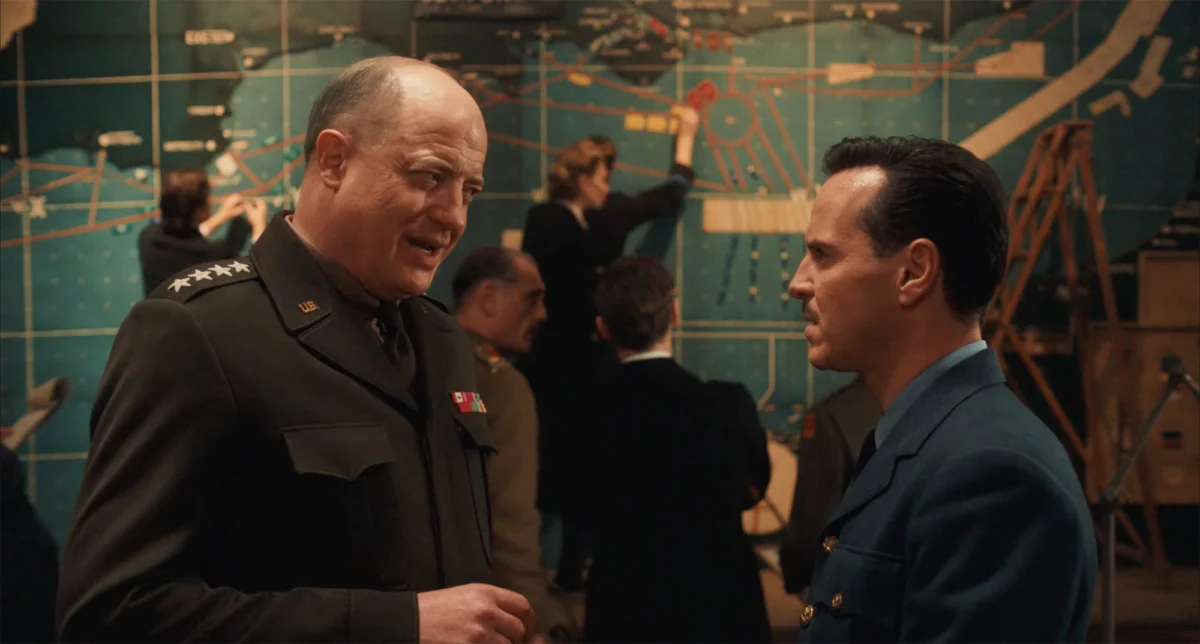
The cinematic landscape of 2026 is set to be anchored by a profound exploration of one of the most pivotal yet overlooked facets of military history: the meteorological forecast that determined the success of the Normandy landings. Studiocanal has officially unveiled a new international trailer for Pressure, a high-stakes historical thriller directed by Anthony Maras. The film, which features Academy Award winner Brendan Fraser as General Dwight D. Eisenhower and Andrew Scott as Captain James Stagg, shifts the focus from the front lines of the battlefield to the claustrophobic tension of the command centers where the decision to launch Operation Overlord was made. Scheduled for a United States theatrical release on May 29, 2026, through Focus Features, the film will subsequently debut in United Kingdom cinemas on September 9, 2026. This new footage offers a more granular look at the friction between scientific certainty and military necessity, emphasizing the immense burden placed upon a single Scottish meteorologist in the 72 hours preceding June 6, 1944.
Narrative Focus and Historical Framework
Pressure is adapted from the critically acclaimed 2014 stage play of the same name by David Haig, who also co-wrote the screenplay alongside Maras. The narrative centers on the true story of Captain James Stagg, the Chief Meteorological Officer to the Supreme Headquarters Allied Expeditionary Force (SHAEF). As the Allied forces prepared the largest seaborne invasion in history, the success of the mission hinged entirely on a narrow window of viable weather.

The film depicts the intense atmosphere within the Southwick House headquarters, where Stagg was tasked with reconciling conflicting weather reports. While his American counterpart, Irving P. Krick—portrayed in the film by Chris Messina—predicted a period of calm and clear skies, Stagg identified a massive storm system approaching the English Channel. The film’s primary conflict arises from Stagg’s attempt to convince General Eisenhower to postpone the invasion, despite the massive logistical and political pressures to proceed. The trailer highlights this tension with the evocative line, "If we delay, we will lose this war," juxtaposed against the scientific reality that a premature launch into a storm would result in catastrophic casualties and a failed campaign.
The Strategic Importance of the June 1944 Forecast
To understand the stakes depicted in Pressure, one must examine the historical data governing the D-Day operations. In June 1944, the Allied command required three specific conditions: a late-rising moon for paratrooper visibility, a low tide at dawn to expose German beach obstacles, and relatively calm winds and clear skies for naval and aerial bombardment. These conditions only converged during a three-day window: June 5, 6, and 7.
History records that the invasion was originally scheduled for June 5. However, Stagg’s forecast of a severe gale forced a 24-hour postponement. On the evening of June 4, Stagg identified a brief "lull" in the storm—a narrow window of improving weather that would allow for the invasion on June 6. This decision is widely regarded by military historians as one of the most courageous and accurate scientific calls in human history. Had Eisenhower followed Krick’s optimistic advice and launched on June 5, the Allied fleet would have been caught in the peak of the gale. Conversely, had they waited for the next lunar cycle two weeks later, they would have encountered the "Great Storm" of June 19, the worst storm to hit the Channel in decades, which likely would have ended the invasion before it began.

Production Details and Creative Direction
Director Anthony Maras, known for his visceral and high-tension work on the 2018 film Hotel Mumbai, brings a similar sense of urgency to the boardrooms of WWII. Maras has stated in various production notes that the film aims to capture the "psychological warfare" of decision-making. The production is a collaboration between Studiocanal, Focus Features, and Working Title Films, the latter of which has a long history of producing high-caliber historical dramas such as Darkest Hour.
The casting of Brendan Fraser as Dwight D. Eisenhower marks another significant step in the actor’s professional resurgence. Following his Academy Award-winning performance in The Whale, Fraser’s portrayal of "Ike" is expected to focus on the human vulnerability and the crushing weight of leadership. Andrew Scott, fresh from the critical success of All of Us Strangers, portrays James Stagg as a man of rigorous science standing firm against the tide of military impatience. The supporting cast is equally robust, featuring Kerry Condon as Captain Kay Summersby, Eisenhower’s personal driver and confidante, and Damian Lewis as Field Marshal Bernard Montgomery.
Chronology of Events: The 72-Hour Countdown
The film’s structure follows a strict chronological progression, mirroring the real-time pressure of the meteorological countdown:

- June 2, 1944: Captain James Stagg and Irving P. Krick begin their final analysis of the Atlantic weather systems. Initial reports are contradictory, creating immediate friction within SHAEF.
- June 3, 1944: Stagg identifies a deep low-pressure system moving toward the English Channel. He advises Eisenhower that the planned June 5 invasion is at risk.
- June 4, 1944 (04:00 hours): Eisenhower officially postpones the invasion by 24 hours based on Stagg’s warnings of high winds and low cloud cover.
- June 4, 1944 (21:30 hours): Stagg identifies a temporary break in the weather—a "quiet spell" expected to last from the evening of June 5 through the morning of June 6.
- June 5, 1944 (04:15 hours): In a final, tense meeting, Eisenhower utters the famous words, "Okay, let’s go," confirming the June 6 launch.
- June 6, 1944: The invasion commences. While conditions are difficult, the "lull" identified by Stagg allows the troops to land, effectively changing the course of the war.
Industry Implications and Genre Analysis
Pressure joins a growing sub-genre of historical cinema that prioritizes intellectual and logistical conflict over traditional combat sequences. Much like Christopher Nolan’s Oppenheimer or Morten Tyldum’s The Imitation Game, Pressure seeks to highlight the "unseen" heroes of the war—those whose contributions were made in laboratories, offices, and weather stations rather than on the front lines.
The film’s focus on meteorology is particularly relevant in the modern era, where data science and predictive modeling have become central to global security. By dramatizing the birth of modern synoptic forecasting under the most extreme conditions imaginable, Maras and Haig offer a commentary on the necessity of expertise and the dangers of ignoring scientific data for the sake of political or military expediency.
Industry analysts suggest that the decision to release the film in May in the US and September in the UK is a strategic move to capitalize on different market dynamics. The May release in the US aligns with the Memorial Day holiday and the anniversary of D-Day itself (June 6), providing a thematic resonance for American audiences. The September release in the UK may be positioned to leverage the start of the autumn awards season, where historical dramas often find significant traction.

Statements and Reactions
While official press junkets are ongoing, sources close to the production indicate that the filmmakers worked closely with historical consultants and meteorological societies to ensure technical accuracy. In preliminary discussions regarding the adaptation of his play, David Haig emphasized that the heart of the story is the "clash of temperaments"—the cool, calculated Scottish pragmatism of Stagg versus the aggressive, optimistic Americanism of Krick, with Eisenhower caught in the middle.
Meteorological experts have also expressed interest in the film’s portrayal of their profession. Representatives from the Royal Meteorological Society have noted in historical retrospectives that James Stagg’s work in 1944 was a masterclass in risk management, and its portrayal on the big screen serves as a tribute to the rigorous standards of the field.
Conclusion
Pressure promises to be a definitive look at the intersection of science and history. By focusing on the invisible forces of nature and the men who dared to predict them, the film offers a fresh perspective on the most documented war in human history. As the international trailer suggests, the true enemy in early June 1944 was not just the Atlantic Wall, but the Atlantic weather—and the victory of D-Day was as much a triumph of science as it was a triumph of arms. With a powerhouse cast and a script rooted in historical tension, Pressure is positioned to be a significant cinematic event in the summer of 2026.