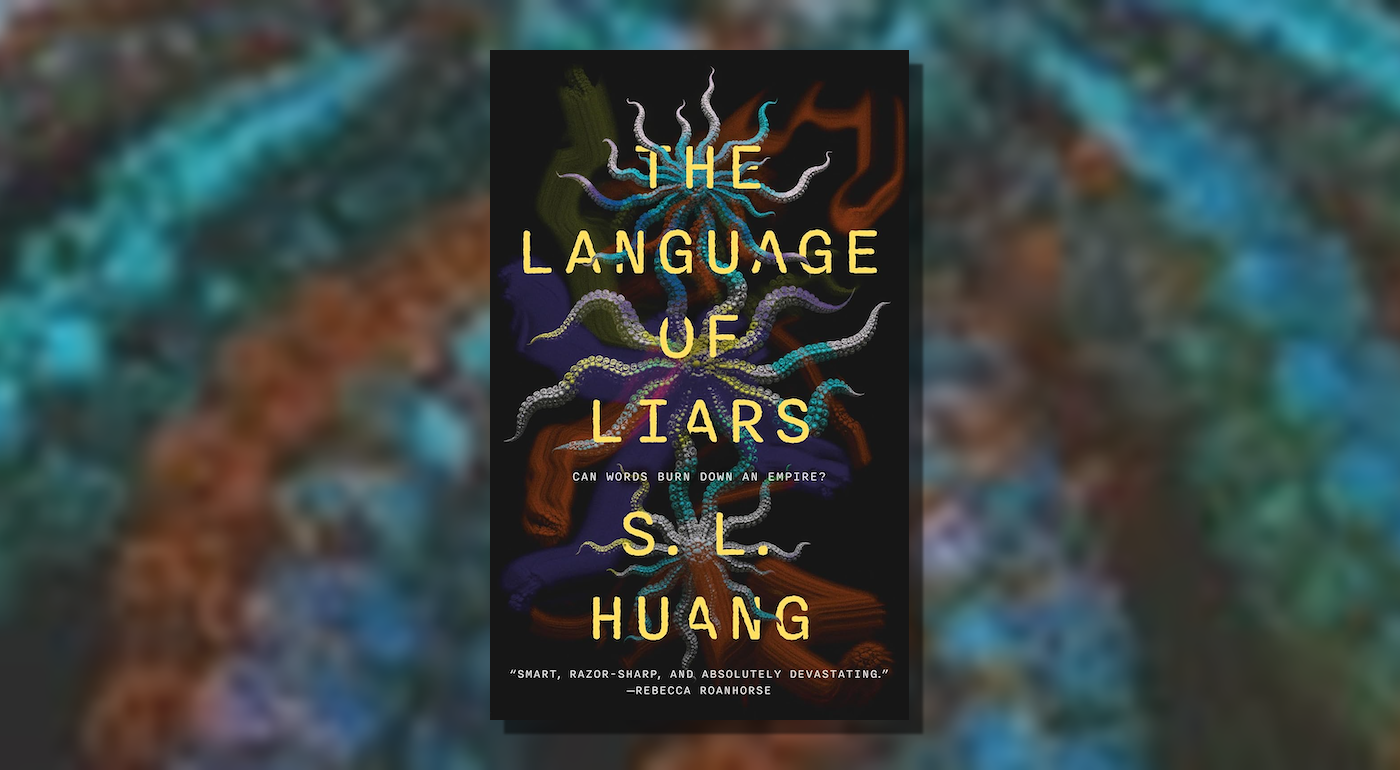
Tordotcom Publishing unveils a compelling science fiction novella, "The Language of Liars" by S.L. Huang, offering readers a profound exploration of communication, identity, and the very nature of understanding. The novella, released on April 21st, delves into the intricate world of Ro, a young Ponto linguist tasked with a monumental mission: to bridge the communication chasm between his civilization and the enigmatic Star Eaters. This excerpt provides a tantalizing glimpse into Ro’s arduous training and the complex philosophical questions that lie at the heart of his quest.
The Weight of Understanding: Ro’s Mission and the Star Eaters
At the core of "The Language of Liars" is Ro’s immersion in the rigorous training of a spy and linguist, a path fraught with the inherent paradox of deception. His mission is not merely academic; it is a desperate necessity for his home civilization, Orro, which faces dwindling resources and a precarious future. The Star Eaters, beings of nebula and vacuum, are the sole possessors of an element crucial for faster-than-light travel, a resource coveted by all galactic civilizations. Yet, their language and culture remain largely impenetrable, their sharing of knowledge notoriously sparse.
Ro’s elders impress upon him the fundamental truth of his training: "you will always be living a lie." The act of entering a Star Eater’s mind requires a perfect psychic connection, a feat achieved through years of dedicated study to comprehend their alien species. Ro’s reverence for the Star Eaters is palpable; he admires, respects, and is almost awestruck by their very existence and their vital role in interstellar commerce. He harbors a deep-seated belief that he can transcend the role of an imposter, that his heart can truly become one with the Star Eaters, making him genuinely "one of them." However, the novella hints at a darker truth: "To understand is to become. It never occurs to him that the mere act of understanding can destroy." This foreshadows the profound personal and existential costs of Ro’s ambition.
The Orro Primaries and the Genesis of Espionage Through Language
The historical context of Ro’s training is illuminated by fragments from the "Orro Internal Records, Dissolution Era," revealing a pivotal moment in Orro’s history. The Orro Primaries, the governing body, were initially skeptical of the concept that language could induce mental transference. Their question, "Language causes the mind to jump?" highlights a fundamental resistance to the abstract power of communication.
The Master Linguist, however, articulated the true potential: "No. Understanding causes the jump. Language is the tool." This insight transformed the understanding of linguistics from a purely academic pursuit into a strategic asset. The Primaries’ apprehension that this ability would make them "feared" and lead to "trouble from the conglomerate" was met with the chillingly pragmatic response: "No, it will give us spies." This reveals that the Ponto, Ro’s species, have weaponized language and understanding for intelligence and infiltration, a practice that has shaped their civilization and its place within the galactic community.
A Lexicon of Doubt: Navigating the Nuances of Communication
The novella masterfully explores the multifaceted nature of "doubt" across various alien languages, demonstrating how cultural context shapes even the most fundamental human, or rather, Ponto, concepts. Ro’s own people, the Ponto, define doubt as "uncertainty, apprehension, a lack of confidence or conviction," a visceral feeling described as "the feeling of a squiggle in his third and fourth stomachs."
In contrast, the Birjivina, the trade language of the Andu-Erjians, frames doubt as a direct question, used in phrases like "Ask your doubts" or "We have seventeen doubts to settle." The Gendamese, with their twenty-two common languages across three species, offer even more varied interpretations. One Gendamese tongue allows for "minus doubt," signifying self-assurance, while another uses "doubt" as a casual slang question tag, as in "You get me, doubt?"
The Koi people, with their single, unnamed language, eschew abstract concepts for sensory metaphors. Happiness is "the sound of trilling," and love is "enveloped by warmth," with "warmth" being a precisely measured fraction above absolute zero, a concept alien to most conglomerate species but critical to the Star Eaters.
The most profound linguistic divergence lies with the Star Eaters themselves, who possess at least nineteen gestural words and phrases for variations of doubt, including "doubt of place," "doubt of identity," and "doubt of purpose." This vast semantic landscape underscores the difficulty Ro faces in truly comprehending their alien mindset. His own people, the Ponto, believe "Language is unpaired," meaning that words are not direct equivalents but rather "clouds of overlapping colored meaning." This philosophy underpins Ro’s struggle; he recognizes the inherent subjectivity of language and the near impossibility of perfect translation.
The Warren and Ro’s Unconventional Path
Ro’s personal journey unfolds within the prestigious Warren, an institution dedicated to training Linguists. The Warren’s philosophy, initially built on the premise that recruits are too "self-motivated to need rules," is challenged by Ro’s presence. He admits to struggling with schedules and meditation, often forgetting his intentions or practicing in unconventional dialects, such as Haazgi, a common trade record language he assumes his Senior Linguists would comprehend. This deviation from protocol, while unintentional, marks him as an outlier.
The Seniors at the Warren perceive Ro’s actions as a lack of discipline, their emotions casting a "looming shadow" over his empathic sense, signaling an impending "serious talk." Ro, a Ponto with a species that possesses a complex system of emotional expression through auras, finds himself in the familiar position of unintentionally disrupting expectations. The Ponto, despite an early foreign researcher’s claim that their language lacks a word for lying due to the transparency of their empathic auras, possess a nuanced understanding of falsehood. Their native tongue differentiates between "socially kind, harmless untruth" and "intentional, targeted untruth meant to distort what is felt or real," with the latter being a serious offense. Ro’s innate ability to manage his aura, while not a perfect shield, allows him to conceal his emotional reactions, including his apprehension about his academic shortcomings.

The Burden of Potential and the Shadow of Failure
Ro’s acceptance into the Warren was meant to be his ultimate validation, a chance to prove his worth after a childhood often characterized by his elders’ affectionate yet telling nickname, "cheerful disaster." His early aptitude for languages was undeniable, his eagerness to absorb new words and tongues a beacon of potential. However, his struggles with practical tasks, like basic navigation or maintaining his fur, cast a shadow over his promise. The opportunity at the Warren, and the subsequent focus on the secret art of "Jumping," represented his chance to overcome these perceived deficiencies.
The act of "Jumping" is Orro’s most guarded secret and its most bewitching aspiration. It involves a linguist achieving a momentary, perfect psychic alignment with a Star Eater, allowing their consciousness to inhabit the alien being’s body. This profound connection is the ultimate goal of Ro’s training, a testament to the Ponto’s belief that "to understand is to become." The success rate for Jumping is exceptionally low, with historically few Linguists achieving it in any generation. For many cycles, no one has succeeded, making Ro’s ambition all the more daunting.
The Lure of the Star Eaters and the Weight of "Keykka"
Ro’s dedication to understanding the Star Eaters is fueled by their unique biology and their crucial role in interstellar travel. Their ability to harness the "meridian element," essential for lightyear-spanning space travel, makes them indispensable. Ro is driven by a desire to unravel their complex, full-body communication and their "tragedy-soaked history and culture." He believes that only through Jumping can he achieve a level of understanding that no outsider could ever attain.
His peers at the Warren, initially envious of his rapid progress, begin to interpret his enthusiasm and sharing of linguistic insights as arrogance. This growing friction mirrors his earlier experiences, reinforcing Ro’s sense of being an outsider, even within a place meant for him to belong. He grapples with the nagging thought that his Seniors might doubt his ability to handle the practical challenges of Jumping, despite his linguistic prowess. He clings to the hope that his success in Jumping will eclipse any other perceived shortcomings, a testament to his service to Orro.
The Whispers of Doubt and a Glimmer of Hope
The "miasma" of Ro’s persistent struggles begins to weigh heavily on him. While most Linguists achieve Jumping at a younger age, Ro, not yet at his second molt, feels his mental flexibility waning. The fear of failure gnaws at him, prompting him to seek solace in his family hive. His return home is met with the effusive affection of his litter-sisters, Lalo, Coro, and Sa, whose familial warmth momentarily lifts his spirits.
However, the encounter with his childhood mentor, Mother Hobi, proves to be a turning point. Mother Hobi, a respected Orro Linguist, reveals herself to be an "unsuccessful one," a fact Ro had never considered. Her gentle questioning, phrased in the Oltasol language’s "undeniable phrase" of "Share with me," prompts Ro to confess his deepest fear: "What if I can’t?"
Mother Hobi’s response is unexpected: "I hope you never make the jump." She shares her own past ambition and the profound contentment she found in her life within the hive, emphasizing the value of human connection and building a vibrant life. She introduces the concept of "keykka," a Nahonic word signifying a "chance" but also imbued with the gravity of "incalculable loss." She argues that the choice to Jump involves sacrificing not only the potential of a life within the hive but also the "theft of another’s self." Ro’s fervent insistence that the potential for understanding and connection outweighs these sacrifices, that it is "incalculable," is met with Mother Hobi’s quiet proverb: "The young are able to believe."
A Leap of Faith, or a Step into the Unknown?
Reinvigorated by his conversation with Mother Hobi, Ro returns to the Warren with a renewed, albeit conflicted, determination. He enters a practice cocoon, designed to simulate the experience of being a Star Eater. As the simulation takes hold, he finds himself in a body of "twisting sinew and sensitive cilia," adrift in space alongside other simulated Star Eaters. He attempts to internalize the Star Eater’s way of being, reciting their rote phrases: "work is life, work is work. baseline, baseline. unbothered."
But the memory of Lalo’s scent, an olfactory sensation impossible for Star Eaters, shatters the illusion. For the first time, Ro experiences genuine doubt. The weight of what he might miss, the imagined loneliness, the loss of self, and the fundamental question of the ethics of "borrowing" another’s existence, all converge. The adventure he envisioned begins to feel hollow.
As he grapples with this profound uncertainty, the Star Eater’s own concepts of doubt—"doubt of place, doubt of identity, doubt of purpose"—resonate within him. He questions not only his ability but also his desire. In this moment of existential crisis, as he confronts the true cost of his ambition and the potential for devastating self-deception, Ro jumps. Whether this is a leap towards ultimate understanding or a tragic descent into the unknown remains the central, compelling question of "The Language of Liars." The novella promises to explore the profound consequences of this act, pushing the boundaries of identity and the very definition of what it means to truly connect.