The chilling sound of audience whimpers is a reliable indicator that a horror film has truly transcended its genre and burrowed under the skin of its viewers. Damian McCarthy’s latest offering, Hokum, has proven to be such a film, eliciting this visceral response in packed theaters on multiple occasions. This review aims to provide a comprehensive, fact-based analysis of Hokum, delving into its thematic depth, technical achievements, and its place within the burgeoning landscape of contemporary folk horror, while carefully avoiding plot-altering spoilers.
Setting the Stage: The Premise of Hokum
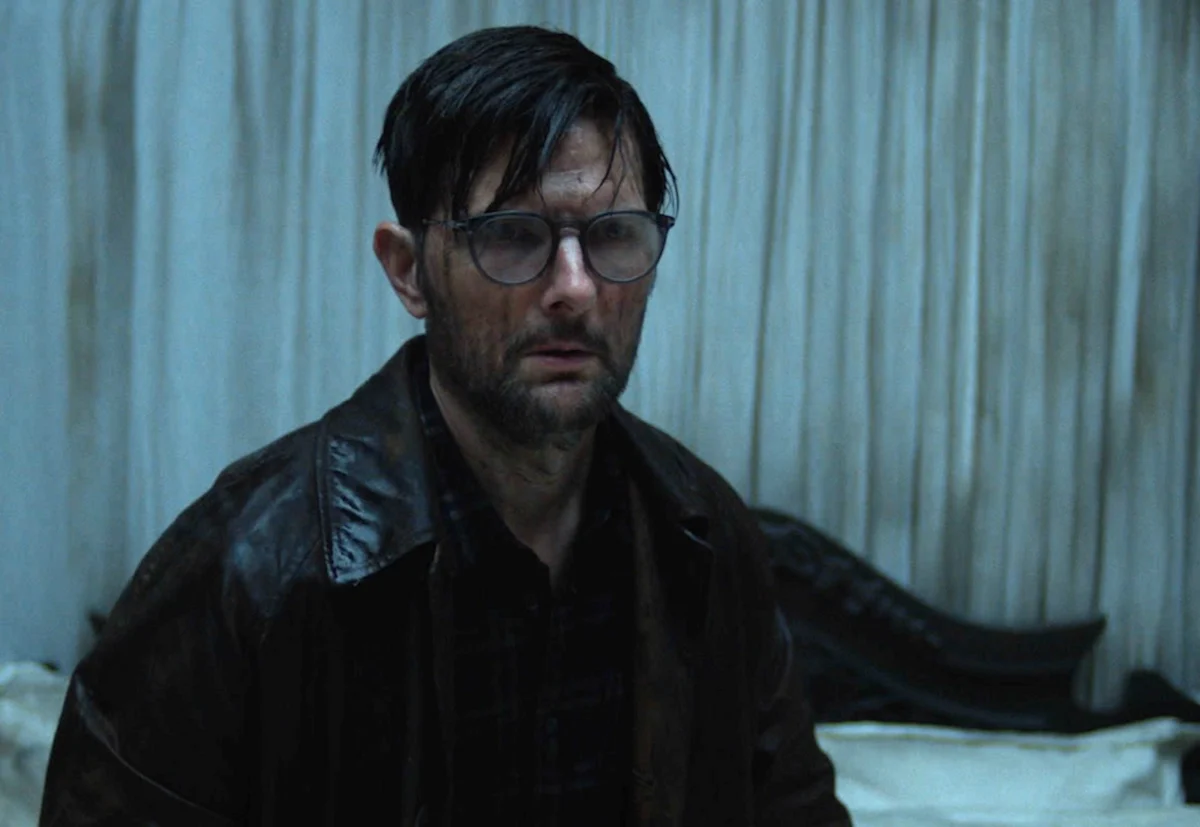
At its core, Hokum presents a seemingly straightforward, yet ultimately deceptive, premise. Adam Scott stars as Ohm Bauman, a celebrated bestselling author grappling with the creative paralysis that has stalled the conclusion of his highly successful book trilogy. Seeking refuge from his professional anxieties and personal demons, Ohm retreats to the picturesque Bilberry Woods Hotel in Ireland, a location steeped in personal history as it was the site of his parents’ honeymoon. His initial intentions are to scatter their ashes in a place they cherished, to find solace, and to escape the pressures of his literary career through the time-honored writer’s methods of procrastination and alcohol.
This initial setup, however, serves as a mere prologue, efficiently dispensed within the first eight minutes of the film. The true narrative engine of Hokum ignites when Ohm discovers that the seemingly tranquil Bilberry Woods Hotel harbors a profound and unsettling secret, pulling him into a vortex of escalating dread and psychological terror.
Damian McCarthy: A Consistent Vision in Irish Horror
Hokum marks director Damian McCarthy’s third feature film, following the critically acclaimed Caveat (2020) and Oddity (2024). Both of his previous works have been lauded for their unique atmospheric qualities and their ability to craft deeply unsettling experiences through subtle yet potent means. For fans of Caveat and Oddity, Hokum will undoubtedly resonate with its familiar thematic preoccupations and stylistic hallmarks. However, the film also stands as an excellent entry point for newcomers to McCarthy’s distinctive cinematic universe.

McCarthy has cultivated a reputation for building a cohesive artistic world characterized by recurring themes and visual motifs, a stark contrast to the often-fragmented and commercially driven approaches seen in some larger cinematic universes. While Hokum benefits from the presence of a recognizable Hollywood star in Adam Scott and wider distribution through Neon, its artistic soul remains firmly rooted in the director’s established oeuvre. Elements and objects that have appeared in his prior films are woven into the fabric of Hokum not as gratuitous callbacks, but as integral components that enhance the narrative and thematic resonance of this specific story.
Adam Scott’s Transformative Performance
The casting of Adam Scott as Ohm Bauman is a significant asset to Hokum. While Scott is consistently praised for his versatile acting abilities, Ohm provides him with an opportunity to explore new dimensions of his performance. The character’s journey is portrayed with a compelling arc, and Scott inhabits the role with a nuanced depth that anchors the film’s escalating horror. McCarthy’s directorial choice for Ohm’s character development is expertly realized through Scott’s performance, demonstrating a profound understanding of psychological disintegration.
A Claustrophobic World: The Bilberry Woods Hotel
The Bilberry Woods Hotel itself is a character in Hokum, meticulously designed to foster an atmosphere of dread and isolation. Production Designer Til Frohlich has crafted a setting that is both visually striking and deeply unnerving. From the exterior, the hotel appears as a rambling structure nestled within the dense Irish woodland. Upon entering, the sense of faded grandeur is palpable, a pervasive weariness that suggests a place long past its prime. The longer Ohm remains, the more the hotel feels alive, imbued with a palpable sense of being watched from the encroaching shadows.
The film’s cinematography, expertly handled by Colm Hogan, further amplifies this unsettling atmosphere. Hogan’s masterful use of light and shadow creates a tangible sense of unease. Shadows do not merely obscure; they writhe and seethe, with isolated lamps and flickering torches creating pockets of illumination that are often more terrifying than the darkness itself. The isolation of the hotel is emphasized by its remote location in West Cork, Ireland, near the remnants of the region’s temperate rainforest. When darkness falls, the environment becomes utterly impenetrable, reinforcing the protagonist’s profound solitude. This potent sense of isolation is a key element in Hokum‘s successful evocation of folk horror, a genre that often thrives on the disconnect between civilization and ancient, untamed forces.
Technical Prowess: Editing and Score

The film’s editor, Brian Philip Davis, deserves significant recognition for the tightly controlled pacing of Hokum. Despite its relatively short runtime, the film masterfully orchestrates well-timed jump scares that serve a narrative purpose rather than acting as mere cheap shocks. The breathing room provided around these moments is crucial, allowing the audience to anticipate and experience the escalating tension.
The atmospheric dread is further amplified by the score of Joseph Bishara, whose work creates a pervasive sense of unease that is likely to become a benchmark for similar horror soundtracks. Bishara’s compositions eschew overt bombast in favor of a creeping, insidious tone that perfectly complements the film’s visual and narrative style.
Thematic Depth and Recurring Motifs (Light Spoilers Ahead)
For those who have experienced McCarthy’s previous films, Hokum offers a rewarding return to familiar thematic territory, albeit explored through new and horrifying lenses. A significant element of Hokum‘s thematic richness lies in its use of resonant objects, a technique also employed effectively in Caveat and Oddity. The film prominently features a desk bell, a crossbow, ropes, chains, unsettling bunny figurines, and the recurring "See/Hear/Speak No Evil" motif. Of particular note is a book whose author appears to be credited as "D. Odello," a subtle nod to McCarthy’s previous work. These objects, as the narrative unfolds, gradually accrue symbolic weight and emotional resonance, becoming integral to the unfolding mystery.
McCarthy also revisits one of his most potent themes in Hokum, exploring it in a way that is both fresh and deeply disturbing. To elaborate further on this particular thematic exploration would venture too deeply into spoiler territory, but it is a testament to McCarthy’s skill that he can revisit and innovate upon his core ideas with such success.
A Tapestry of Influences: Homages and Originality
Hokum masterfully blends atmospheric tension with subtle homages to classic horror cinema. The film relies more on shadows, creaking sounds, and psychological dread than on explicit gore or violence. The Bilberry Woods Hotel itself evokes comparisons to iconic haunted locations such as those found in The Haunting of Hill House and The Innocents. The film also draws inspiration from Dorothy McArdle’s The Uninvited, a significant work in Irish gothic literature.

The narrative setup, featuring a writer struggling with his art in an isolated, potentially haunted hotel, inevitably invites comparisons to Stephen King’s The Shining and 1408. Ohm Bauman’s status as a bestselling author of a book series that echoes King’s The Dark Tower further solidifies this connection. However, McCarthy navigates these influences with a discerning touch. The allusions are present as a "side conversation," enriching the film’s texture without ever overwhelming the unique narrative McCarthy is weaving. Hokum stands firmly on its own merits, utilizing these touchstones to enhance its own distinctive storytelling.
Beyond Kitsch: An Authentic Irish Experience
A notable aspect of Hokum is its deliberate avoidance of Irish kitsch. While the hotel itself plays into tourist tropes with a boisterous Halloween party and ubiquitous carved turnips, the film’s perspective is not defined by these superficial elements. Instead, it drops Adam Scott’s character into this world, offering minimal exposition beyond the colloquial understanding of "craic" as "fun." Ohm encounters local customs, folklore, and even distinct beverages like poitín, and the film’s narrative does not offer him any easy explanations or concessions. This grounded approach to cultural representation lends an authenticity to the film’s setting and its unfolding horror.
The brief inclusion of ogham script, an ancient Irish alphabet, and the celebration of poitín, a potent distilled spirit, add layers of cultural authenticity that resonate with a deeper understanding of Irish heritage. These elements are not mere window dressing but are woven into the fabric of the story, contributing to the film’s immersive quality.
Thematic Resonance: Guilt, Forgiveness, and Liminal Spaces
As with McCarthy’s earlier works, Hokum delves into profound thematic explorations of guilt, forgiveness, and the concept of purgatorial in-between spaces. In this instance, the hotel itself becomes a claustrophobic manifestation of these themes. Once the layout of the main hotel suite is revealed, akin to the narrative progression in 1408, the sheer impossibility of escape becomes chillingly apparent.
The title, Hokum, itself is a thematic cornerstone. McCarthy consistently explores the archetype of the skeptical outsider who dismisses folklore and superstition. In Hokum, this archetype is embodied by a protagonist from the United States, a creator of horror fiction, who initially views Irish culture and its traditions with a detached, analytical eye. His profession as a horror writer ironically positions him as someone who believes he understands the mechanics of a spooky story, only to find himself trapped within a reality far more potent and inescapable than any fiction he could conceive. The film poignantly suggests that the true horror lies not in fictional constructs, but in the tangible, often terrifying, realities that lie beyond our comprehension.

The Cultural Landscape of Irish Horror
The prominence of Irish filmmakers in the horror genre is a phenomenon worth examining. Ireland’s rich history, marked by periods of trauma and resilience, provides fertile ground for narratives exploring the uncanny and the supernatural. This cultural heritage, combined with a strong tradition of storytelling, song, and literature, has consistently mined deep veins of folklore, superstition, and the spectral.
McCarthy’s own trajectory, along with that of other notable Irish horror directors, illustrates this trend. Aislinn Clarke’s films, such as The Devil’s Doorway and Fréwaka, delve into intergenerational trauma and historical injustices like the Magdalene Laundries. Paul Duane’s All You Need Is Death explores themes of desperation and authenticity within marginalized communities. These films, while diverse in their specific subject matter, share a common thread of engaging with the complexities of Irish identity and history through the lens of genre.
What distinguishes many of these works, and Hokum in particular, is their refusal to reduce complex narratives to simplistic causalities, such as a villain’s tragic backstory or a generalized societal ill. Instead, they allow for nuance, mystery, and the genuinely uncanny. The film suggests that sometimes, monsters simply are, and that what appears monstrous to human eyes may possess an inherent, albeit terrifying, beauty. Whether the supernatural elements are objectively "real" or merely manifestations of psychological turmoil becomes secondary to the power of the narrative itself. Hokum offers a story that, by embracing ambiguity and foregoing easy answers, solidifies its position as a standout horror film of the year.