The highly anticipated season finale of Daredevil: Born Again, titled "The Southern Cross," penned by Dario Scardapane and Jesse Wigutow and directed by Iain B. MacDonald, has successfully concluded its second season, weaving together intricate plotlines and delivering a powerful conclusion that simultaneously tees up a compelling trajectory for the already-filming third season. Despite the season’s earlier narrative complexities, the finale provided a much-needed sense of resolution and forward momentum, solidifying its place in the Marvel Cinematic Universe’s evolving landscape.

A Courtroom Showdown and Unexpected Alliances
The episode opens amidst the tense atmosphere of a courthouse, where proceedings are set to commence despite the conspicuous absence of Matt Murdock. Karen Page, visibly bearing the marks of a recent altercation with Heather Glenn, underscores the immediate stakes. Meanwhile, a battered Matt Murdock is receiving aid from Jessica Jones, a moment that appears to spark a crucial realization for the titular hero regarding his entanglement with Wilson Fisk’s machinations.
Across town, at Gracie Mansion, Fisk receives grim news regarding Daniel’s demise, delivered with a stoic, albeit somber, demeanor by Buck. This revelation prompts Fisk to engage in a moment of philosophical reflection, musing on the "responsibility of someone who’s elected by millions—chosen by millions of New Yorkers." This statement, however, serves as a stark reminder of the disconnect between Fisk’s self-perception and his actions, a point the narrative implicitly critiques, referencing the character’s prior machinations revealed in the Echo post-credits scene.

Back in the courtroom, Heather Glenn, taking the stand, presents a psychological assessment of Karen Page, labeling her with "antisocial personality disorder," a term Hochberg clarifies as a more colloquial "sociopath." The trial’s proceedings are dramatically interrupted by Matt Murdock’s limping, bruised arrival. His declaration of being "outstanding," despite admitting to being "shot in the leg," signals his unwavering commitment to the case.
The Unveiling of Daredevil and Fisk’s Calculated Gambit
As the trial progresses, the narrative introduces a parallel thread of escalating tension outside the courthouse. Masked figures ascend stairs in an adjacent building, foreshadowing an imminent threat. Within the courtroom, Heather Glenn’s testimony, drawn from her book on vigilantism, is met with sharp criticism for its lack of insight, with the reviewer noting its superficial engagement with themes long explored in literature. Matt Murdock, seizing an opportunity, questions Glenn, subtly introducing the possibility of Karen’s assault and implicating those who had sole access to her.

The prosecution’s relentless "Objection!" from Hochberg, consistently sustained by the judge, attempts to stifle the defense’s momentum. Simultaneously, across the street, a man in a blue mask, later revealed to be Bullseye, meticulously sets up a sniper rifle, poised for a calculated strike.
The pivotal moment arrives as Matt Murdock, with a barely concealed glee, pivots the defense’s strategy by calling a new witness: Mayor Wilson Fisk. The dramatic entrance of Fisk, accompanied by an Omen-esque soundtrack and the resounding thud of his footsteps, commands the courtroom’s attention. His solemn oath, punctuated by the steady, booming beat of his heart audible to Matt, signifies the beginning of a complex legal battle. The presence of the AVTF (Anti-Vigilante Task Force) lining the back of the room adds an ominous layer to the proceedings.

Fisk, taking the stand, begins his defense with a seemingly paternalistic anecdote about childhood lessons of overcoming challenges, before pivoting to an address on the sanctity of the "institution" of the courthouse. However, the external threat escalates as another masked assailant infiltrates the building across the street, neutralizing the sniper and other threats before Bullseye claims his vantage point.
Fisk’s Downfall and the People’s Uprising
Fisk’s testimony, focused on his "Safer Streets Initiative," allows him to speak himself out of the immediate legal trap, a testament to his perceived invincibility. The introduction of testimony from the late Christofi Savva shifts the trial’s focus. While sequestered in the judges’ chambers, Matt detects Fisk’s veiled threats, to which he subtly retorts, seemingly forgetting Fisk’s lack of enhanced hearing. This exchange, overheard by the judges, allows Matt to frame Fisk’s outburst as a commentary on Hochberg and the case’s integrity. Hochberg’s panicked exclamation, "There’s not going to be an appeal!" becomes a critical turning point, signaling Matt’s strategic victory.

The court’s decision to play Savva’s testimony unleashes Matt’s offensive. He systematically grills Fisk about his criminal dealings, including weapon smuggling through the freeport and the scuttling of the Northern Star. Hochberg’s desperate attempts to halt Fisk’s testimony highlight his complete lack of control. Fisk’s eventual meltdown, screaming, "You don’t get to know what comes through our port!" confirms his culpability. Matt’s strategic revelation that Daredevil was present on the boat, corroborated by Savva’s testimony, leads Fisk to a moment of grudging admiration, masked by fury. Matt’s defiant declaration, "I am Daredevil," ignites the courtroom.
The judge, recognizing the validity of Matt’s argument that the court is compromised by Fisk’s admitted crimes, dismisses the case against Karen. The ensuing emotional reunion between Matt and Karen is shattered by the escalating chaos outside. As the Governor demands Fisk’s resignation, a sudden, coordinated attack erupts. Bullseye’s sniper shot injures Buck, leading to a lockdown of the building.

Trapped inside, the good guys witness Fisk manipulate the narrative via a televised address, framing himself as a victim and rallying support against masked assailants. This propaganda is swiftly countered by the emergence of a mysterious figure, later revealed to be BB, who broadcasts her face and a powerful message of empowerment: "It’s our City not his. It’s time to take it back."
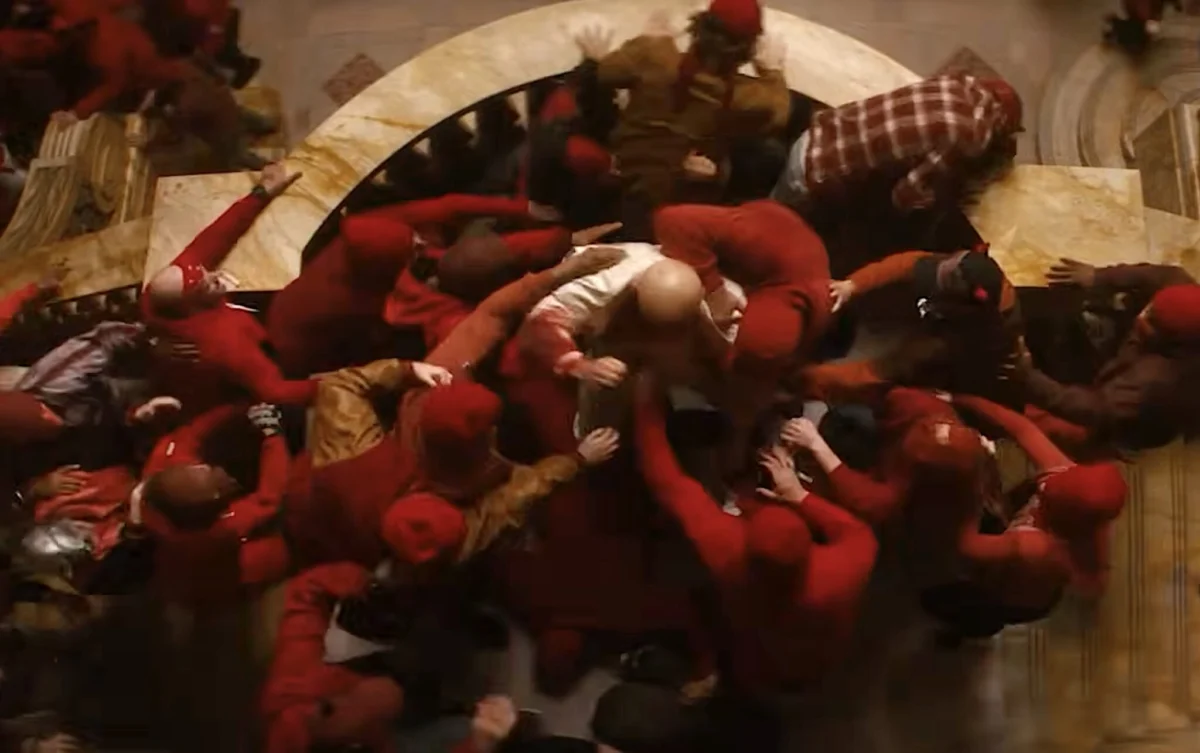
This call to action galvanizes the citizens of New York, who march towards the courthouse, many donning Daredevil masks. The AVTF’s violent confrontation with the protesters is met with defiance, culminating in Norton’s decisive action against Powell, opening the doors for the crowd to surge into the building.

The Kingpin’s Fall and Daredevil’s Surrender
The climax sees Fisk, a blood-soaked figure of rage, engage in a brutal rampage through the courthouse, decimating protesters. Matt and Jessica fight their way through parallel corridors, converging on the scene. As Fisk, standing on a balcony, rails against the city he claims to have protected, the narrative emphasizes the public’s turn against him, mirroring a scene from MacGyver. Matt, intervening, urges both Fisk and the crowd to stand down, advocating for a plea deal to achieve peace. Fisk, after a moment of contemplation, accepts, his declaration, "I… accept. You’ll understand if I don’t shake your hand," marking a significant shift.
The season concludes with a montage of desolate locations, hinting at a changed New York. Matt and Karen share a quiet moment of reflection at an Indian restaurant, grappling with the idea of a normal life. Their heartfelt exchange is interrupted by the arrival of law enforcement, leading to Matt’s surrender. He waives his rights, a poignant acknowledgment of his past as a lawyer.

Meanwhile, Jessica and Luke are reunited with their daughter, hinting at a return to a semblance of family life, though Luke’s prior government employment raises questions. BB secures a position at the Bulletin, and Mr. Charles, now using a new alias, is seen with Bullseye, foreshadowing future threats. Jessica closes the door on Alias Investigations, suggesting the end of one chapter and the potential beginning of another. The final scenes depict Matt in prison, Heather embracing her "Muse" persona, Fisk in exile, and Bullseye in transit, all underscored by the melancholic strains of "Pyramid Song," setting a somber tone for the future.
Analysis of Key Themes and Narrative Arcs
The season finale of Daredevil: Born Again successfully addressed several critical thematic elements: the nature of justice, the corrupting influence of power, and the cyclical battle for the soul of New York City. Fisk’s fall from grace, while visually dramatic, underscores the consequences of unchecked ambition and the eventual triumph of the rule of law, even in a city often teetering on the brink of anarchy. Matt Murdock’s ultimate surrender to the authorities, despite his vigilantism, serves as a powerful statement on the necessity of due process and accountability.

The narrative’s exploration of the public’s fickle allegiance—from electing Fisk to ultimately turning on him—highlights the fragility of political support and the power of collective action. BB’s emergence as a symbol of hope and resistance, directly challenging Fisk’s narrative, is a crucial development, signifying the rise of new heroes and the continuation of the fight against corruption.
Unanswered Questions and Future Implications
The season’s conclusion leaves several threads for Daredevil: Born Again Season Three to explore. The true extent of the AVTF’s influence and their future role remains uncertain. The motivations and allegiances of characters like Mr. Charles and Bullseye, particularly their association, pose a significant threat. Luke Cage’s brief appearance and his past government work suggest potential connections to larger MCU narratives. Jessica Jones’s return to Alias Investigations, coupled with her complicated relationship with Luke, offers a rich ground for character development.

The final moments, particularly Matt’s imprisonment, promise a stark exploration of his enduring commitment to justice and his personal sacrifices. The juxtaposition of Fisk’s exile, Bullseye’s continued machinations, and Matt’s confinement underscores the complex and often morally ambiguous nature of heroism within the MCU. The deliberate inclusion of "Pyramid Song" throughout these final scenes serves as a powerful emotional anchor, reinforcing the season’s exploration of loss, regret, and the search for redemption.
The season’s success in bringing together disparate plotlines, while leaving ample room for future storytelling, solidifies its impact. The finale’s ability to satisfy immediate narrative demands while expertly constructing a foundation for subsequent seasons marks a significant achievement for Daredevil: Born Again.