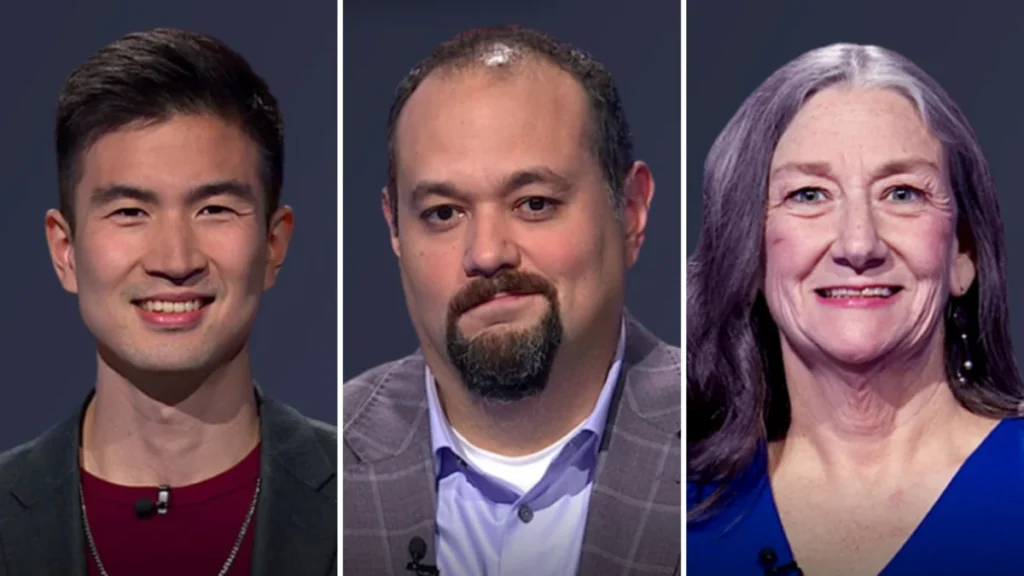
Greg Shahade, a professional chess master hailing from Philadelphia, Pennsylvania, successfully defended his title on the April 28 episode of Jeopardy!, following a historic performance the previous day in which he unseated one of the program’s most formidable competitors. Shahade’s initial rise to prominence occurred on April 27, when he ended the 31-game winning streak of Jamie Ding, a champion whose dominance had led many viewers to consider him nearly invincible. Entering his second match with a cumulative total of $33,000, Shahade faced a new set of challengers: Chris Argento, a high school teacher from Bayonne, New Jersey, and Alice Jiang, a student from Redwood City, California. The match served as a test of whether Shahade’s aggressive, strategy-heavy gameplay—a hallmark of his professional chess background—could withstand the pressure of being the target rather than the challenger.
Host Ken Jennings opened the program by acknowledging the magnitude of Shahade’s previous victory. Jennings noted that Shahade had earned the moniker of "giant-killer" by delivering a metaphorical checkmate to Ding. The host highlighted Shahade’s technical proficiency during his first game, specifically his ability to locate and correctly answer all three Daily Doubles. This feat allowed Shahade to add $16,800 to his score through those clues alone, resulting in a "runaway" victory—a scenario where the leader’s score is more than double that of the second-place contestant, making the Final Jeopardy round a formality rather than a competitive necessity. Jennings remarked on the unpredictability of the game, stating that while Ding had appeared unstoppable for weeks, the transition of power on the Alex Trebek Stage remains a constant possibility for any skilled contestant.
The Jeopardy! Round: Momentum and Precision
The first round of the April 28 match saw Shahade attempting to replicate the momentum that had carried him through his debut. By the 12th clue of the round, Shahade had established a lead of $2,200. It was at this juncture that he uncovered the first Daily Double of the game under the category "Repetitive Stress." Adhering to the bold wagering style he exhibited in his previous appearance, Shahade opted to "make it a true Daily Double," wagering his entire $2,200 bankroll.
The clue presented was: "Anaphora is the repetition of the start of a clause ending in different ways, like these 4 words in an Aug. 28, 1963 speech in D.C." Shahade, maintaining a composed demeanor, correctly identified the phrase: "What is I Have a Dream?" This correct response doubled his score to $4,400. The clue referenced the iconic speech delivered by Dr. Martin Luther King Jr. during the March on Washington for Jobs and Freedom, a pivotal moment in the American Civil Rights Movement.
Despite this early success, the round remained competitive. Unlike the previous day’s game, Shahade was unable to secure a dominant lead before the first commercial break. His opponents, Argento and Jiang, demonstrated quick reflexes on the signaling devices and a broad knowledge base. By the conclusion of the first round, Shahade held the lead with $7,600, but he was closely pursued by Argento, who finished with $3,600, and Jiang, who held $2,800. The narrow margins indicated that the second half of the game would require careful strategic navigation.
Double Jeopardy: Risks and Recoveries
As the game transitioned into the Double Jeopardy! round, the stakes increased significantly. Shahade found the second Daily Double almost immediately, on the second clue of the round. At this point, he had $8,200 in his bank and chose to wager $6,000, a move that could have either solidified his lead or decimated his standing. The category was "O Captain, My Captain," and the clue read: "A national hero as an Austrian sub captain during WWI, he’d later gain more fame after marrying a woman named Maria."
Shahade appeared to struggle with the prompt, failing to provide the correct response of Georg von Trapp, the real-life inspiration for the patriarch in the musical and film The Sound of Music. The incorrect guess resulted in a significant loss, dropping Shahade’s total to $2,200 and relegating him to third place. This moment represented the most vulnerable point in Shahade’s brief tenure as champion, as Argento and Jiang continued to accumulate funds.
However, the resilience often found in high-level chess players became evident as Shahade worked to rebuild his score. By the fifth clue of the round, he had managed to climb back to $4,200 and uncovered the final Daily Double in the "Business History" category. Recognizing the necessity of a bold move to regain control of the game, he again wagered his entire total. The clue stated: "This co. was born in 1911, after 4 years of talks among the Intl. Time Recording Co., Computing Scale Co. & Tabulating Machine Co."
After a moment of visible contemplation, Shahade correctly responded, "What is IBM?" (referring to International Business Machines). The successful wager brought his total to $8,400 and restored him to the lead. The historical context of the clue refers to the formation of the Computing-Tabulating-Recording Company (CTR), which was later renamed IBM in 1924 under the leadership of Thomas J. Watson.
Final Jeopardy and Strategic Wagering
The remainder of the Double Jeopardy! round was a tightly contested battle. Argento proved to be a persistent threat, at one point reaching over $10,000 while Shahade held a slim lead. By the time the round concluded, the scores stood at $12,400 for Shahade, $10,800 for Argento, and $6,000 for Jiang. Because Shahade did not have a "runaway" lead, the outcome of the match depended entirely on the Final Jeopardy! round and the mathematical precision of the contestants’ wagers.
The category for Final Jeopardy! was "Playwrights." The clue provided was: "When she was 7, her family moved to the mostly white Chicago neighborhood of Woodlawn, leading to attacks & a Supreme Court case." This clue required knowledge of both American literature and legal history, specifically referencing the life of Lorraine Hansberry. Hansberry’s family had challenged a restrictive covenant in the Woodlawn neighborhood, leading to the landmark Supreme Court case Hansberry v. Lee (1940), which helped pave the way for the Fair Housing Act. Her experiences later served as the inspiration for her acclaimed play, A Raisin in the Sun.
All three contestants correctly identified Lorraine Hansberry, shifting the focus to their respective wagers. Alice Jiang wagered $3,200, bringing her final total to $9,200. Chris Argento, perhaps anticipating a potential miss from Shahade or aiming to stay ahead of Jiang while hoping for a conservative wager from the leader, bet $1,601, finishing with $12,401.
Shahade, however, chose an aggressive wagering strategy. He bet $9,201, a figure designed to cover Argento’s potential maximum score while maximizing his own winnings should he answer correctly. This wager brought Shahade’s daily total to $21,601 and his two-day winnings to $54,601.
Analysis of the "Giant-Killer" Phenomenon
Shahade’s victory over Jamie Ding on April 27 is considered one of the most significant upsets of the current Jeopardy! season. Ding’s 31-game streak places him among the elite tier of contestants in the show’s history, alongside legendary names like Ken Jennings, Amy Schneider, and Matt Amodio. In the world of competitive trivia, defeating a long-term incumbent requires not only a vast breadth of knowledge but also the psychological fortitude to disrupt the champion’s established rhythm on the buzzer.
Data from previous seasons suggests that long-running champions often develop a "buzzer timing" advantage that is difficult for newcomers to overcome. Shahade’s success can be attributed in part to his professional background in chess. As an International Master and a prominent figure in the U.S. chess community, Shahade is accustomed to high-pressure environments where rapid decision-making and pattern recognition are essential. His willingness to make large wagers on Daily Doubles—a strategy often employed by high-level players like James Holzhauer—indicates a calculated approach to risk management.
The "Giant-Killer" narrative is a recurring theme in Jeopardy! lore. Often, the contestant who defeats a legendary champion finds it difficult to maintain that energy in subsequent games, frequently losing their very next match. Shahade’s ability to survive a "non-runaway" game against Argento and Jiang suggests that he possesses the stamina required for a multi-day run.
Broader Implications and Future Outlook
The transition from the Jamie Ding era to the Greg Shahade era marks a shift in the season’s competitive landscape. Ding’s departure leaves a vacuum that several players will seek to fill as the show approaches its annual Tournament of Champions. Shahade’s performance has already qualified him as a person of interest for future tournament play, should he continue to extend his streak.
For Jeopardy!, these moments of transition are vital for maintaining viewer engagement. While long streaks generate headlines and consistency, the "upset" provides the drama and unpredictability that have sustained the program for decades. Shahade’s background as a chess master adds an additional layer of interest for the audience, as it highlights the intersection of different types of intellectual competition.
Greg Shahade is scheduled to return to the Alex Trebek Stage on April 29 to face two new challengers. With a current total of $54,601 and a demonstrated mastery of both the clues and the game’s internal mechanics, he has transitioned from the role of challenger to the "giant" that others must now attempt to slay. The statistical likelihood of a new champion reaching a 30-plus game streak is low, but Shahade’s early performance indicates that he has the tools necessary to become a significant fixture in the show’s current season. As host Ken Jennings noted, "anything can happen," and the chess master from Philadelphia has proven that he is more than capable of navigating the complexities of the board.