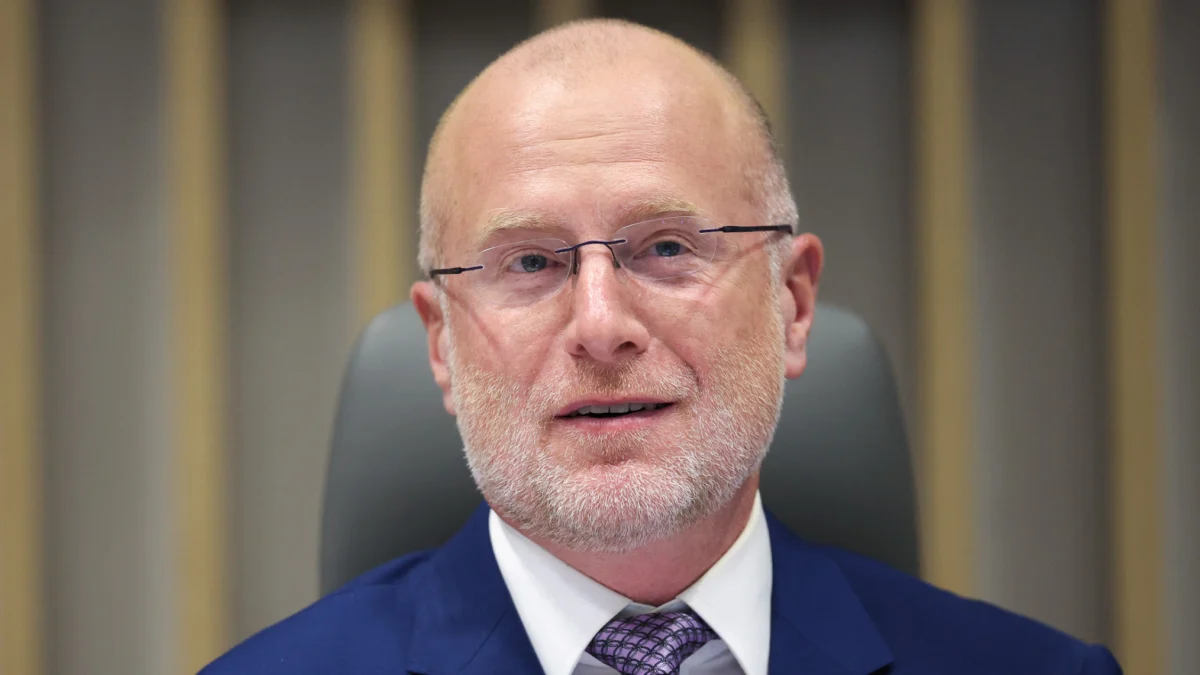
Federal Communications Commission (FCC) Chairman Brendan Carr delivered a pointed address at the Conservative Political Action Conference (CPAC) in Grapevine, Texas, on Friday, framing the current administration’s relationship with the American press as a decisive conflict that the executive branch is winning. Speaking to a crowd of conservative activists, Carr aligned himself closely with President Donald Trump’s long-standing grievances against mainstream journalism, asserting that the administration has successfully dismantled the "facade" of legacy media influence. The speech, which named specific journalists and networks as targets of a systemic overhaul, marks a significant departure from the traditionally neutral posture of the FCC, an independent agency tasked with regulating interstate and international communications.
During his remarks, which were captured in footage by PBS NewsHour, Carr characterized the President’s media strategy as a direct assault on what he termed "fake news." He argued that previous political figures had allowed established media outlets to dictate national narratives, a trend he claims has been reversed under the current administration. "President Trump, when he ran for office, he ran directly at the fake news media," Carr told the audience. "So many other politicians and Americans simply gave way to the legacy national media—they let the legacy media set the narrative. And President Trump smashed the facade. He said, ‘You don’t get to say what we say, what we think, how we’re gonna vote inside the voting booth.’ President Trump took on the fake news media, and President Trump is winning."
A Tally of Departures and Institutional Shifts
The centerpiece of Carr’s address was a celebratory list of recent changes within the media landscape, which he presented as evidence of the administration’s success in neutralizing adversarial journalism. Carr specifically cited the departures of high-profile news anchors and the defunding of public broadcasting as milestones in this effort. Among the names mentioned were MSNBC’s Joy Reid, NBC’s Chuck Todd, and CNN’s Jim Acosta, all of whom have been frequent targets of executive criticism.
"Look at the results, so far," Carr said to audible cheers from the CPAC audience. "PBS defunded. NPR defunded. Joy Reid gone from MSNBC. Sleepy-Eyed Chuck Todd gone. Jim Acosta gone. John Dickerson gone. [Stephen] Colbert is leaving. CBS is under new ownership, and soon enough CNN is gonna have new ownership as well."
Carr’s reference to CBS and CNN points to a broader trend of corporate consolidation and ownership shifts within the media industry. CBS’s parent company, Paramount Global, recently underwent a high-stakes merger with Skydance Media, a move that has led to significant internal restructuring and cost-cutting. Similarly, rumors regarding the potential sale or spin-off of CNN by Warner Bros. Discovery have circulated for months, fueled by declining ratings and shifting corporate priorities. Carr’s comments suggest that the FCC views these corporate transitions not merely as market movements, but as ideological victories that facilitate a more favorable media environment for the administration.
The Evolution of FCC Regulatory Policy
The rhetoric displayed at CPAC is the culmination of a months-long shift in FCC policy under Carr’s leadership. Historically, the FCC has operated with a degree of insulation from the White House to ensure that broadcast licenses and regulatory decisions are not used as political weapons. However, since his appointment to the chairmanship, Carr has aggressively utilized the commission’s oversight powers to challenge the content and status of various television programs.
A primary tool in this effort has been the reinterpretation of the "Equal Time" rule, formally known as Section 315 of the Communications Act of 1934. This rule requires radio and television stations to provide an equivalent amount of airtime to opposing political candidates. Crucially, "bona fide" news programs, including documentaries and news interviews, have traditionally been exempt from this requirement to protect journalistic independence.
In early 2026, the FCC issued new guidance that narrowed the definition of these exemptions. The commission stated that any program "motivated by partisan purposes" would no longer be entitled to a "bona fide" news exemption. This policy shift directly targeted daytime talk shows and late-night comedy programs, which often feature political commentary. Carr specifically questioned whether ABC’s The View should continue to receive an exemption, suggesting that its format was inherently partisan.
Chronology of Tensions Between Carr and the Media
The friction between Chairman Carr and the media industry has intensified through a series of public confrontations involving some of the most prominent figures in late-night television:
- The Jimmy Kimmel Controversy: In late 2025, Carr made headlines by appearing to threaten the broadcast status of Jimmy Kimmel Live! on ABC. The friction began after Kimmel made controversial remarks following the death of conservative activist Charlie Kirk. Carr’s public response suggested that such commentary could have regulatory repercussions for Nexstar and other ABC affiliates, a move critics described as an attempt to chill free speech.
- The Seth Meyers Incident: Carr amplified a social media post from President Trump calling for the firing of NBC’s Seth Meyers. Meyers, host of Late Night, had been a vocal critic of the administration’s policies. Carr’s endorsement of the President’s demand signaled a willingness to use his platform to pressure private media corporations regarding their talent choices.
- The Stephen Colbert Censorship Allegations: In early 2026, Stephen Colbert informed his Late Show audience that CBS lawyers had blocked an interview with Texas State Representative James Talarico, a Democrat. Colbert attributed this internal censorship to fears of FCC retaliation under Carr’s new guidelines. On air, Colbert addressed Carr directly, stating, "I think you are motivated by partisan purposes yourself. Sir, you smelt it because you dealt it." Colbert characterized the administration’s actions as an attempt to silence dissent from a president who "only watches TV."
Public Media and the Defunding Debate
Carr’s boast regarding the defunding of PBS and NPR touches on a perennial legislative battle. Public media in the United States is partially funded through the Corporation for Public Broadcasting (CPB), a private, non-profit corporation created by the Public Broadcasting Act of 1967. While federal funding typically accounts for about 15% of the budget for local public radio and television stations, it is vital for stations in rural and underserved areas.
The administration’s recent budget proposals have sought to eliminate federal appropriations for the CPB, arguing that public media should be entirely self-sufficient through private donations and sponsorships. While these efforts have faced bipartisan resistance in Congress in the past, Carr’s comments at CPAC suggest a renewed and more aggressive push to finalize the withdrawal of federal support, which he frames as a victory against "liberal bias" in the public square.
Legal and Ethical Implications of Regulatory Pressure
The Chairman’s remarks have sparked a firestorm of criticism from First Amendment advocates, legal scholars, and media ethics experts. The primary concern is the potential for "regulatory capture," where an agency designed to serve the public interest instead serves the political interests of the executive branch.
Critics on social media and in legal circles have argued that Carr’s open admission that the administration is "taking on" and "winning" against the media could be used in future litigation. Under the Administrative Procedure Act (APA), agency actions must not be "arbitrary, capricious, or an abuse of discretion." If the FCC’s regulatory decisions—such as denying a license renewal or changing equal-time rules—can be linked to a stated goal of punishing specific media outlets for their political content, those decisions may be vulnerable to being overturned in federal court.
"This is not a flex," wrote one critic on X (formerly Twitter). "You’re just admitting that the administration is going after the free press." Another user suggested that Carr’s rhetoric should disqualify him from his role, noting that the FCC is meant to protect a diverse and competitive media landscape, not curate it to suit the preferences of a single political leader.
Broader Impact on the American Media Landscape
The implications of Carr’s stance extend beyond individual late-night hosts or specific news anchors. By signaling that the FCC will scrutinize "partisan" content, the commission creates an environment of uncertainty for broadcasters. This "chilling effect" may lead networks to self-censor or avoid controversial political topics to ensure their broadcast licenses remain secure.
Furthermore, the emphasis on changing ownership at CBS and CNN suggests a desire for a more compliant corporate media structure. If major networks believe that their regulatory path will be smoother under ownership that is friendly to the administration, it could trigger a shift in editorial standards across the industry.
As the 2026 election cycle approaches, the role of the FCC will likely remain a focal point of national debate. Chairman Carr’s speech at CPAC has made it clear that he does not view the commission as a passive referee, but as an active participant in what the administration views as an existential struggle for control over the American narrative. While Carr stopped short of declaring "mission accomplished," his message to the conservative base was unequivocal: the era of the legacy media’s perceived dominance is over, and the regulatory tools of the state are being fully utilized to ensure it stays that way.