The stark, almost defiant closing lines of Albert Camus’s L’Étranger – "For it all to be consummated, to feel less alone, I had only to wish for a big crowd on the day of my execution, and for them to greet me with cries of hate" – resonate with a chilling finality. These are not the easily digestible aphorisms found adorning social media feeds, but rather the profound, unsettling core of existentialist thought. It is against this backdrop that François Ozon’s new film adaptation of the iconic 1942 novel emerges, a significant cinematic event eighty-four years after its literary debut. This unexpected revival raises pertinent questions: has existentialism experienced a resurgence in contemporary culture, or is this merely a cinematic revisiting of a text long favored by angst-ridden students seeking profound quotes?
Ozon’s Vision: A Departure from the Past
Ozon’s interpretation arrives as a notable improvement upon Luchino Visconti’s less successful 1967 attempt, Lo Straniero. Filmed in a deliberately aloof, silvery monochrome, Ozon’s L’Étranger offers a tasteful yet pointed cinematic rendering of Camus’s seminal work. Newcomer Benjamin Voisin delivers a compelling performance as Meursault, the novel’s infamous antihero, a man conspicuously unmoved by his mother’s death and whose fatal act of shooting an Arab is attributed to the blinding glare of the sun. Voisin’s portrayal imbues Meursault with a hard-edged nonconformism, at times drawing parallels to a sociopathic, colonial-era Patrick Bateman, a far cry from the more passively acquiescent figure in the original novel. Ozon strategically amplifies the political undercurrents, re-centering the narrative on colonial power dynamics from the outset. The film opens with a newsreel-style propaganda piece celebrating Algiers’s supposed "smooth blend of Occident and Orient," immediately establishing a critical lens on the colonial enterprise. This deliberate political framing suggests a contemporary re-evaluation of the novel’s setting and its inherent societal structures.
The Enduring Relevance of Existentialism?
The central question remains: is this renewed focus on L’Étranger sufficient to reignite interest in existentialism itself? This philosophy, which grappled with the value and purpose of life in the absence of divine guidance, emerged from a distinct mid-century intellectual milieu. The era of turtleneck-clad philosophers like Camus, Jean-Paul Sartre, and Simone de Beauvoir, associated with Paris’s Left Bank, now feels as distant and exotic as ancient Greece.

While Camus’s accessible prose made L’Étranger a staple of French language curricula, it also served as an entry point for deeper dives into existentialist and existentialist-adjacent literature, including works by Dostoyevsky, Kerouac, and Salinger, often read by adolescents grappling with feelings of alienation. For many adults today, the existential challenge of navigating a meaningless universe is less a philosophical pursuit and more a practical consequence of technological dependence – the frustration of losing GPS signal, for instance. The adage "God is dead" has been supplanted, for some, by the perceived eternity offered by technological advancement. This shift in societal focus raises doubts about whether existentialism, as a distinct philosophical movement, retains its contemporary relevance.
Existentialism and the Cinematic Landscape
Historically, existentialism has not deeply permeated the cinematic landscape, partly due to a scarcity of readily adaptable fictional works. While Sartre’s Nausea and his Roads to Freedom trilogy have never received feature-length adaptations, Camus’s The Plague was filmed in 1992 by Argentine director Luis Puenzo. Visconti’s 1967 adaptation of The Stranger is often criticized for its static portrayal, with Marcello Mastroianni’s Meursault perceived as more theatrical than truly embodying the novel’s radical alienation.
In contrast, the works of Franz Kafka, a writer often associated with existential themes of alienation and absurd bureaucracy, have seen more robust cinematic engagement. Multiple adaptations of The Metamorphosis and The Castle exist, with Orson Welles’s nightmarish 1962 interpretation of The Trial standing out as a particularly powerful cinematic exploration of an individual held captive by society’s arbitrary standards, a theme that resonates with Camus’s L’Étranger.
The French New Wave and the Echoes of Existentialism
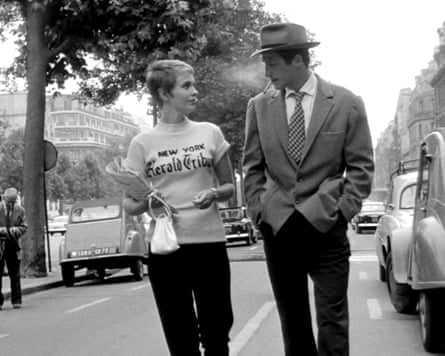
The filmmakers of the French New Wave, with their embrace of freedom and self-determination, might have been expected to champion existentialist ideals. Indeed, films like François Truffaut’s The 400 Blows, with its defiant young protagonist, Jean-Luc Godard’s Breathless, featuring a fast-talking, anti-establishment figure, and Agnès Varda’s Cléo from 5 to 7, depicting a singer confronting her mortality, can be seen as embodying existentialist heroes navigating an uncertain future. Godard, Truffaut, and Alain Resnais’s innovative cinematic techniques, breaking apart classical film grammar and engaging in what could be described as cinematic jazz, served as reflections of the fractured 20th-century psyche. However, at times, these cinematic experiments leaned more towards deconstructing film conventions than a radical outward-facing metaphysical exploration of life itself.
Film Noir: The Pop-Existentialist Counterpart
In the United States, émigré directors like Fritz Lang, Billy Wilder, and Robert Siodmak skillfully translated interwar European paranoia and the burgeoning nihilistic philosophies into the accessible idiom of film noir. This genre, characterized by its terse gumshoes, doomed schemers, and rootless drifters, may have lacked strict philosophical rigor, but its protagonists were perpetually entangled in the quagmire of a seemingly senseless universe. The archetypal Camus, famously photographed in a popped collar and smoking, evoked the image of a hardboiled detective interrogating a femme fatale.
The noir canon is replete with memorable one-liners that capture existential weariness. In the 1945 B-movie classic Detour, Ann Savage’s femme fatale chillingly advises, "Life’s like a ballgame. You gotta take a swing at whatever comes along before you find it’s the ninth inning." Emerging from this milieu is the figure of the existential hitman, a lineage that stretches from Alain Delon in Jean-Pierre Melville’s Le Samouraï to contemporary characters in films like Léon, Collateral, and David Fincher’s recent The Killer. These figures, perched on the precipice of life and death, often find themselves questioning their very purpose as they become targets themselves.
The Pervasive Influence of Existential Themes
The unstable foundations laid by film noir have permeated contemporary cinema, making existential heroism a familiar trope. This can be observed in the disaffected nocturnal journey of Travis Bickle in Martin Scorsese’s Taxi Driver, the replicants’ agonizing search for meaning in Blade Runner, Jim Carrey’s quest for authentic existence in The Truman Show, and the fragmented, labyrinthine narratives of Christopher Nolan’s films. Therefore, the cinematic re-emergence of The Stranger offers not merely a nostalgic throwback, but a vital cultural Rosetta Stone, providing a framework for understanding the origins of these persistent metaphysical quests in modern storytelling.
Ozon’s Political Reinterpretation: A Departure from Camus?
While Ozon’s film is politically charged, its strict adherence to existentialist doctrine is debatable. Camus’s original novel does not overtly critique colonialism. Instead, Meursault’s detached acceptance extends to racial disparities in colonial Algeria as it does to other absurdities of life. In the novel, upon his imprisonment, Meursault observes his fellow inmates: "They laughed when they saw me. Then they asked what I’d done. I told them that I’d killed an Arab and there was silence." Ozon’s adaptation, however, places anticolonialism at the forefront. This is evident in details such as a "No Natives" sign outside a cinema and the film’s closing moments, where the previously unnamed victim of Meursault’s act is finally identified on his headstone.

The political commentary in Ozon’s film is undeniable. However, this emphasis on moral rectitude arguably detracts from the novel’s core existentialist themes. Meursault, in both the courtroom and his encounter with the priest, resists attempts to "explain" his personality or to find solace through Christianity. Ozon’s directorial approach, while acknowledging the West’s colonial past, introduces a layer of moralizing that seems at odds with Meursault’s radical rejection of external judgment and his embrace of subjective truth. The film’s political urgency, while valid, may overshadow the exploration of individual purpose in a meaningless universe.
Existentialism’s Enduring Spark in a Chaotic World
The abstract philosophical concerns of existentialism were once dismissed as adolescent introspection. Sartre’s famous assertion, "existence precedes essence," might now sound like a tagline for a perfume advertisement. Yet, the fundamental spirit of existentialism remains potent. Its emphasis on austere individuality offers a compelling counterpoint to the homogenizing influence of algorithmically curated online personas. In an era marked by a seemingly inescapable capitalist dystopia and escalating geopolitical tensions, the existentialist call to forge authentic moral bearings amidst chaos resonates with profound urgency.
Sirat: Navigating the Existential Tightrope
Olivier Laxe’s Sirat, a recent film nominated for an Oscar, offers a compelling exploration of the existential tightrope, sharing thematic and geographical links with The Stranger. Set in the stark beauty of North Africa, a landscape that historically offered Europeans a sense of detachment and reinvention, Sirat opens with a hadith describing the bridge between heaven and hell as "thinner than a hair and sharper than a sword." This precarious path is traversed by a group of desert ravers, most notably Sergi López’s desperate father searching for his lost daughter. Following a catastrophic event on a mountain pass, he becomes utterly disoriented. The film’s climax hinges on a single, agonizing step, blurring the lines between life and death. The pervasive anxiety and nausea, two cornerstones of existentialist thought, are palpable throughout the narrative.
Sirat is implicitly set against the backdrop of a potential World War III, suggesting Laxe’s message: we are all navigating a minefield – geopolitically, technologically, economically, and emotionally. While Meursault in Camus’s novel chooses to embrace the absurdity of his predicament, Sirat proposes an alternative: finding a way to dance through the chaos, or at least to confront it with defiant energy. The proto-existentialist philosopher Friedrich Nietzsche, standing on the precipice of the abyss, understood the significance of movement and adaptation, famously stating, "I do not know what the spirit of a philosopher could more wish to be than a good dancer." This notion of finding one’s footing, of actively engaging with the uncertainties of existence, remains a powerful and relevant response to the human condition.