
Swayamvaram, the 1972 Malayalam drama, stands as a pivotal work in Indian cinematic history, marking the feature film directorial debut of Adoor Gopalakrishnan and initiating what is widely recognized as the Malayalam New Wave. Released on November 24, 1972, this critically acclaimed film transcended conventional Indian filmmaking, establishing a new paradigm for narrative depth, technical innovation, and social commentary. Its profound impact earned it four National Film Awards, including Best Feature Film and Best Director, and cemented its status as a cornerstone of parallel cinema in India.
The Dawn of a New Wave: Adoor Gopalakrishnan’s Vision
Adoor Gopalakrishnan, a graduate of the Film and Television Institute of India (FTII) in Pune, emerged as a transformative figure in Indian cinema. His debut with Swayamvaram was not merely a new film but a conscious rebellion against the prevailing commercial cinema landscape of the time, characterized by formulaic plots, song-and-dance routines, and melodramatic excesses. Gopalakrishnan, alongside a cohort of like-minded filmmakers, sought to create a cinema rooted in realism, exploring socio-political themes with artistic integrity and technical sophistication. This movement, often referred to as the Indian Parallel Cinema or New Wave, found a particularly fertile ground in Kerala, giving birth to the "Malayalam New Wave."
Gopalakrishnan’s artistic philosophy was deeply influenced by global cinematic movements, particularly Italian Neorealism and the French New Wave, which prioritized authentic storytelling, on-location shooting, and a focus on the struggles of ordinary people. He brought this sensibility to Swayamvaram, a film that deliberately eschewed the escapist fantasies of mainstream cinema to confront the harsh realities of life. His vision for Swayamvaram was clear: to craft a film that resonated with the lived experiences of its audience, eschewing the glamour and artifice that often defined popular narratives.
Production Challenges and Innovative Techniques
The journey to bring Swayamvaram to the screen was fraught with challenges, primarily financial. The film was produced on a modest budget of ₹250,000 (equivalent to approximately $3,300 USD at the time, or roughly ₹15 million in 2024 terms, considering inflation and purchasing power parity), a testament to the dedication of its creators. Adoor Gopalakrishnan and his co-writer K. P. Kumaran faced years of struggle to secure funding, a common hurdle for independent and art-house productions in India. Partial support eventually materialized from the Film Finance Corporation (FFC), a government-backed institution established in 1960 with the mandate to promote quality cinema and support films that might not find mainstream commercial backing. The FFC’s involvement was crucial, underscoring its role in fostering India’s parallel cinema movement by providing vital financial lifelines to projects that prioritized artistic merit over commercial viability.
The production itself was a pioneering effort, spearheaded by the Chitralekha Film Co-operative. Established in 1965 by Adoor Gopalakrishnan and Murali Nair, Chitralekha was India’s first film co-operative, designed to create an alternative production and distribution model for films that dared to deviate from commercial norms. This co-operative structure was instrumental in enabling Swayamvaram to be made, pooling resources and expertise outside the established studio system.
Technically, Swayamvaram was revolutionary for its time. It was one of the earliest Indian films to extensively use synchronized sound, a practice that was uncommon in an era where post-synchronization (dubbing) was the norm. This choice significantly enhanced the film’s realism, capturing the ambient sounds and authentic vocal performances directly on set. Furthermore, Gopalakrishnan’s decision to shoot in real locations, rather than elaborate studio sets, contributed immensely to the film’s documentary-like quality and immersive atmosphere. This approach allowed the narrative to unfold within genuine environments, reflecting the socio-economic fabric of Kerala with stark honesty. The film’s departure from mainstream Indian cinematic conventions was a deliberate artistic choice, signaling a commitment to a new form of storytelling that prioritized authenticity and thematic depth.
Narrative Core: Vishwam and Sita’s Struggle
At its heart, Swayamvaram is a poignant family drama that chronicles the arduous journey of Vishwam (Madhu) and Sita (Sharada), a young couple who choose to defy their families and societal expectations to marry and forge an independent life in a new city. Their initial optimism, born from deep love and shared dreams, soon confronts the relentless pressures of harsh economic realities.
The film opens with an intimate portrayal of their early days, capturing their profound affection through subtle gestures and shared glances. The sequence of them riding a bus and their first moments in a modest hotel effectively conveys their connection. An idyllic interlude on the beach initially appears to be a real moment of happiness, but its ethereal quality soon suggests it might be a dream or a fleeting memory, foreshadowing the challenges ahead.
Vishwam, an aspiring writer, struggles relentlessly to secure stable employment, a common predicament for educated but unprivileged youth in 1970s India. Sita’s earnest attempts to contribute financially are repeatedly thwarted by circumstances beyond her control, including societal norms that limited women’s roles in the workforce and the sheer scarcity of opportunities. The script, co-written by Gopalakrishnan and K. P. Kumaran, masterfully depicts their downward spiral as their meager savings dwindle. They are compelled to move from one impoverished living condition to another, each move signifying a deeper descent into destitution. This series of escalating obstacles, marked by a pervasive sense of powerlessness against systemic forces, has been aptly described as Kafkaesque, trapping the couple in a bureaucratic and socio-economic labyrinth from which there seems to be no escape. Their initial optimism gradually gives way to anxiety, despair, and a profound sense of disillusionment.
Thematic Depth and Social Commentary
Beyond the personal tragedy of Vishwam and Sita, Swayamvaram functions as a searing piece of social commentary, offering a critical lens on the society of 1970s India. Gopalakrishnan’s approach is distinctly realistic, avoiding excessive sentimentality even as the couple’s lives spiral downwards. The film’s melodrama remains grounded, often imbued with a documentary-like quality that lends credibility to its critique.
One notable sequence features a political speech, which serves as a powerful microcosm of the director’s broader commentary. This scene incisively critiques the political class and the bourgeoisie, portraying their combined authority as actively suppressing the working class. The trajectory of Vishwam and Sita’s lives directly reinforces this notion, illustrating how systemic inequalities trap individuals in cycles of poverty, regardless of their aspirations or efforts.
The film also delves into the plight of artists and intellectuals within such a system. Vishwam’s interactions with a publisher, to whom he submits his manuscript, highlight the stagnation and risk aversion prevalent in certain segments of the intellectual establishment. The publisher and his peers are depicted as individuals entrenched in the past, unwilling to embrace new ideas or take chances on emerging talent, preferring nostalgic discussions of earlier, established writers. This scene underscores the challenges faced by creative minds seeking to break new ground in a conservative environment.
Swayamvaram further explores other societal ills. The blights of excessive drinking are addressed, though the original article suggests this aspect might be portrayed with a somewhat sanctimonious tone. More significantly, the concept of patriarchy is woven into the thematic fabric, particularly through the exploitation of Kalyani, the prostitute next door. Her character, while offering a contrasting cheerfulness, serves to highlight the vulnerability of women caught in the socio-economic margins. Overall, the film’s critique extends across multiple facets of the existing social and economic system, with its commentary often becoming as prominent and impactful as the central family drama itself. This layered approach ensures that Swayamvaram is not just a story of individual suffering but a profound reflection on the systemic failures that perpetuate it.
Performances that Defined an Era
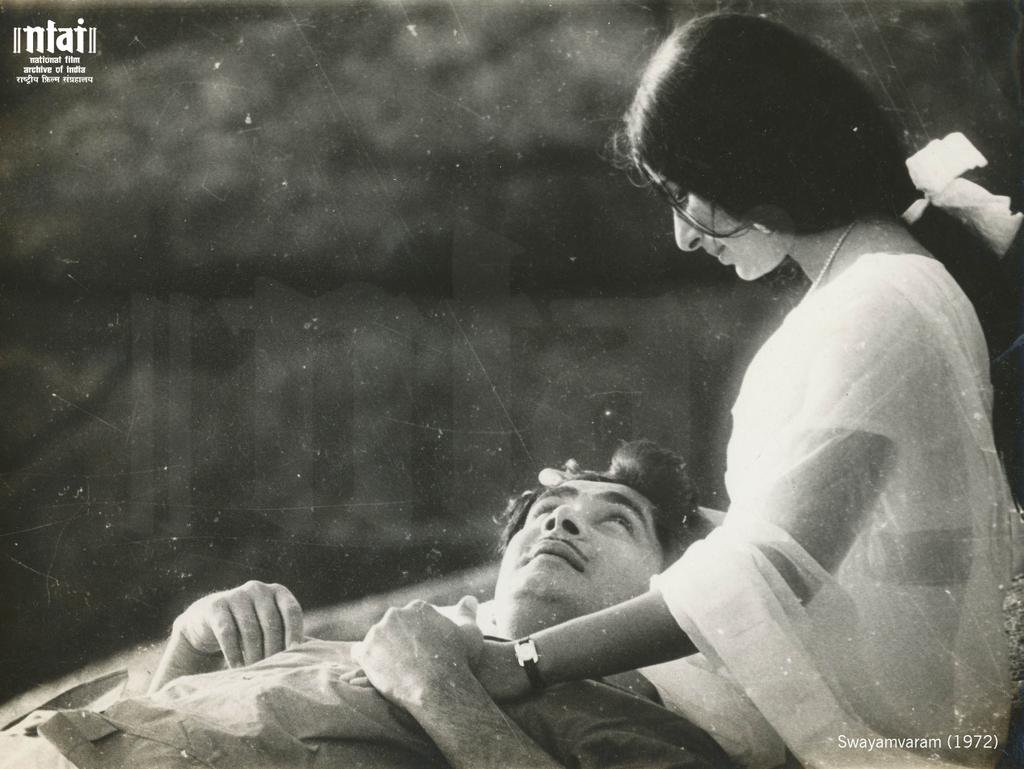
The power of Swayamvaram is significantly amplified by its stellar cast, whose nuanced performances bring the characters to life with remarkable authenticity.
Madhu, in the role of Vishwam, delivers an excellent and understated performance. He masterfully captures the complex emotional arc of his character – from the initial flush of love and determination to the gradual onset of despair and frustration. Madhu maintains a measured and restrained presence throughout, allowing the audience to witness Vishwam’s internal struggles without overt theatricality. His portrayal is a testament to his ability to convey profound emotion through subtle expressions and body language.
Sharada, as Sita, is even more restrained, relying primarily on her expressive eyes and delicate facial expressions to communicate her character’s inner turmoil. Her performance is a masterclass in understated acting, matching and complementing Madhu’s intensity. The chemistry between Madhu and Sharada is palpable, lending immense credibility to their portrayal of a deeply in-love couple facing insurmountable odds. Their interactions feel genuine, making their eventual descent into despair all the more heartbreaking. Sharada’s performance earned her the National Film Award for Best Actress, a clear recognition of her profound contribution to the film’s emotional core.
The supporting cast also delivers memorable performances, enriching the film’s tapestry. K. P. A. C. Lalitha, as Kalyani, the prostitute next door, stands out with her vibrant and compelling portrayal. Her chatty, cheerful, and somewhat cheeky demeanor offers a stark and compelling contrast to the more subdued central performances of Vishwam and Sita. Kalyani’s character provides moments of levity and human connection, while also serving as a poignant symbol of the marginalized in society.
Furthermore, Swayamvaram marks the debut of Bharath Gopi, who would go on to become one of Malayalam cinema’s most acclaimed actors. Though his role in Swayamvaram is relatively minor, it offered a glimpse into the raw talent that would later define his illustrious career. The ensemble cast, including veteran actors like Thikkurisi Sukumaran Nair and Adoor Bhavani, contributes significantly to the film’s rich texture and realism.
Cinematic Craftsmanship: Varma’s Lens and Ramesan’s Edit
The technical brilliance of Swayamvaram is undeniable, with Mankada Ravi Varma’s cinematography being particularly exquisite. Varma, a frequent collaborator with Adoor Gopalakrishnan, captures a variety of settings – from the bustling streets of a new city to the cramped interiors of impoverished homes – with both striking realism and artistic sensitivity. His ability to seamlessly blend the aesthetics of social drama with a documentary-like approach is particularly impressive, ensuring that the transitions between these visual styles feel organic and natural.
Varma’s camera work is characterized by its unobtrusive yet deeply observant quality. The use of real locations is enhanced by his natural lighting techniques and compositions, which imbue each scene with an authentic sense of place and atmosphere. A distinctive visual element in the film is the recurring motif of voyeuristic shots, often presented through the gaze of an unnamed observer who watches the couple. These shots add another layer of intrigue, suggesting a broader societal observation of their struggles and perhaps even a commentary on the audience’s own role as spectators.
Ramesan’s editing complements Varma’s cinematography, resulting in a relatively brisk pace that suits the narrative’s unfolding tragedy. Despite the film’s deliberate exploration of hardship, the 131-minute duration never feels excessive. Ramesan skillfully crafts the narrative flow, ensuring that each scene contributes meaningfully to the story’s progression and thematic development. The editing rhythm allows for moments of quiet observation while also maintaining a sense of urgency as the couple’s circumstances deteriorate. The precise cuts and transitions contribute to the film’s overall coherence and emotional impact, making it a masterclass in cinematic storytelling.
Critical Acclaim and Lasting Legacy
Upon its release, Swayamvaram garnered widespread critical acclaim, immediately establishing Adoor Gopalakrishnan as a formidable new voice in Indian cinema. While its art-house sensibilities meant limited commercial success compared to mainstream blockbusters, its artistic merit was universally recognized.
The film swept the 20th National Film Awards (for films released in 1972), winning four prestigious accolades:
- Best Feature Film: Recognizing its overall excellence and significant contribution to Indian cinema.
- Best Director: For Adoor Gopalakrishnan’s visionary direction and pioneering approach.
- Best Actress: For Sharada’s poignant and restrained performance as Sita.
- Best Cinematography (Black and White): For Mankada Ravi Varma’s exceptional visual artistry.
These awards were not merely a recognition of individual talent but a powerful endorsement of the nascent parallel cinema movement. The National Film Awards, instituted in 1954, serve as the highest honors in Indian cinema, celebrating artistic and technical excellence across various languages. Swayamvaram‘s success at these awards signaled a shift in critical appreciation, validating films that dared to be different.
Beyond national recognition, Swayamvaram also traveled to international film festivals, including the Moscow International Film Festival, further solidifying its reputation on the global stage. Its presence at such prestigious events introduced Indian parallel cinema to a wider international audience, paving the way for future Indian filmmakers to gain recognition abroad.
Over the decades, Swayamvaram has come to be regarded as one of the most important works in Indian cinema. Its significance lies not only in its thematic maturity – its unflinching portrayal of economic hardship, societal apathy, and the erosion of hope – but also in its pioneering a new cinematic language. Gopalakrishnan’s deliberate departure from mainstream conventions, his commitment to realism, synchronized sound, and on-location shooting, influenced generations of filmmakers in Kerala and beyond. Directors like G. Aravindan and others who followed in the Malayalam New Wave drew inspiration from Swayamvaram‘s artistic integrity and its ability to tell authentically Indian stories with universal appeal.
Enduring Relevance and Impact
More than fifty years after its release, Swayamvaram retains its accessibility and profound relevance. It functions effectively both as a deeply human family drama and as a powerful piece of social commentary. The themes it explores – economic struggle, the search for identity, the fragility of dreams, and the impact of societal structures on individual lives – remain timeless and universal.
Adoor Gopalakrishnan’s debut film did more than just launch a career; it inaugurated an era. It demonstrated that Indian cinema could be both artistically rigorous and deeply resonant, capable of exploring complex socio-political issues without resorting to simplistic narratives. Swayamvaram is not merely a film; it is a historical document, a socio-political statement, and a timeless work of art that continues to inspire and provoke thought, cementing its place as an indispensable masterpiece in the annals of Indian and world cinema. Its legacy is evident in the continued vibrancy of independent filmmaking in Kerala and its enduring influence on how stories are told on screen.