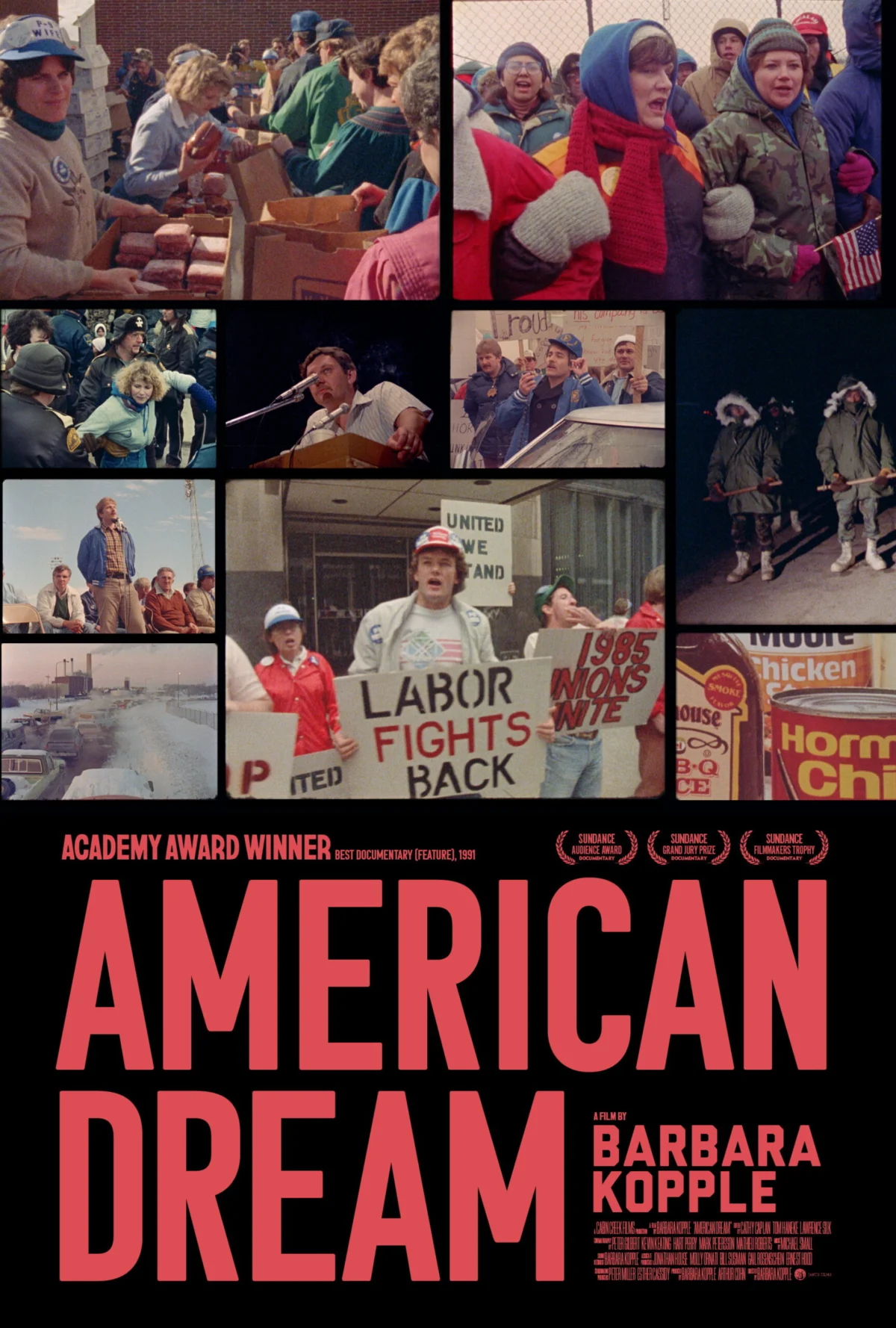
Janus Films and The Criterion Collection have officially announced the 4K digital restoration and nationwide theatrical re-release of Barbara Kopple’s seminal documentary, American Dream. Originally released in 1990, the film remains one of the most poignant and harrowing accounts of labor relations in the United States, capturing a pivotal moment in the decline of the American middle class. The restoration, supervised and approved by Kopple herself, is scheduled to begin a nationwide art-house tour on May 1, 2026—a date intentionally chosen to coincide with International Workers’ Day.
The film, which won the Academy Award for Best Documentary Feature in 1991, serves as a spiritual and thematic successor to Kopple’s 1976 masterpiece, Harlan County, USA. While the earlier film depicted a hard-fought victory for coal miners, American Dream offers a more sobering perspective, documenting the internal fractures and ultimate setbacks of a strike that divided a community and signaled a shift in the power dynamics of American capitalism.
The Historical Context of the Hormel Strike
To understand the weight of American Dream, one must look at the economic climate of the mid-1980s. The film centers on the 1985–1986 labor dispute at the Hormel Foods Corporation plant in Austin, Minnesota. At the time, Hormel was a profitable company, yet it sought to impose significant wage cuts and benefit reductions on its workforce. The company proposed slashing hourly wages from $10.69 to $8.25, a move that the local union, Local P-9 of the United Food and Commercial Workers (UFCW), found unacceptable given the company’s $29 million in annual profits.
The strike occurred during the height of the "Reaganomics" era, a period characterized by deregulation, tax cuts, and a decidedly anti-union stance from the federal government. This era began in earnest with the 1981 firing of more than 11,000 striking air traffic controllers by President Ronald Reagan, an event that many historians cite as the beginning of the end for the golden age of organized labor. By the time Kopple began filming in Austin, the leverage held by American workers had begun to erode, and the Hormel strike became a microcosm of this national struggle.
A Chronology of the Conflict
The documentary meticulously tracks the timeline of the dispute, providing a day-by-day account of the escalating tensions. The conflict began in 1984 when contract negotiations stalled. In August 1985, the workers of Local P-9 officially walked off the job.
The strike was notable for the involvement of Ray Rogers and his firm, Corporate Campaign, Inc. Rogers employed a non-traditional strategy that aimed to pressure the company by targeting its financial backers and public reputation rather than relying solely on the picket line. This tactic, however, created a deep rift between the local Austin union and the international leadership of the UFCW. The international union viewed Rogers’ methods as expensive and ineffective, eventually ordering the local chapter to cease its strike and accept the company’s terms.

By early 1986, the situation reached a breaking point. Hormel began hiring replacement workers, commonly referred to as "scabs," to restart production. This led to violent confrontations at the plant gates, prompting Minnesota Governor Rudy Perpich to mobilize the National Guard to protect the replacement workers and ensure the plant remained operational. The film captures the gut-wrenching scenes of lifelong friends and family members turning against one another as some workers, desperate to provide for their families, chose to cross the picket line while others remained steadfast in their resistance.
Technical Details of the 4K Restoration
The upcoming re-release is the result of a meticulous preservation effort by Janus Films and The Criterion Collection. The restoration was undertaken from a high-resolution scan of the original 16 mm internegative, the highest-quality surviving film element. Because the film was shot using cinema verité techniques—relying on natural light and hand-held cameras—the 4K process was essential in stabilizing the image and bringing out the grain and texture of the original 16 mm stock without losing its documentary authenticity.
The audio has undergone an equally rigorous transformation. The original monaural soundtrack was remastered from the 35 mm DME (Dialogue, Music, and Effects) magnetic track. This process involved removing decades of hiss, pops, and environmental noise that had accumulated on previous home video releases, allowing the voices of the workers and the sounds of the picket line to be heard with newfound clarity. The result is a presentation that honors the grit of the original production while meeting modern theatrical standards.
Leadership and Internal Fracture
One of the most compelling aspects of American Dream is its unflinching look at the leadership of the labor movement. Barbara Kopple was granted unprecedented access to the strategy meetings of Local P-9, led by Jim Guyette. Guyette is portrayed as a charismatic and principled leader, but the film does not shy away from the criticism he faced for his refusal to compromise.
The documentary features extensive interviews with figures such as Jesse Jackson, who visited Austin to show solidarity with the workers, as well as representatives from the UFCW international leadership. The tension between the local’s idealism and the international’s pragmatism serves as the film’s central conflict. As the international union eventually placed Local P-9 into trusteeship—effectively seizing control of the local and ending the strike—the film documents a profound sense of betrayal that lingered in the Austin community for decades.
Broader Implications and Socio-Economic Impact
The legacy of the Hormel strike, as captured in American Dream, continues to resonate in contemporary discussions about the "gig economy," wage stagnation, and the decline of the manufacturing sector. The strike’s failure marked a turning point where corporations realized they could successfully replace entire workforces if they were willing to endure the short-term PR fallout and legal costs.
Supporting data from the Bureau of Labor Statistics highlights the trend that American Dream foreshadowed. In the mid-1950s, roughly one-third of American workers were union members. By the time of the Hormel strike in 1985, that number had fallen to approximately 18%. Today, union membership in the private sector hovers around 6%. Kopple’s film provides a visceral look at the specific moment when this downward trajectory accelerated.

The film also examines the human cost of industrial decline. Austin, Minnesota, was a "company town" where the plant provided not just a paycheck, but a social fabric. The documentary shows the psychological toll on workers who lost their homes, their pensions, and their standing in the community. It serves as a stark reminder that labor disputes are rarely just about cents per hour; they are about dignity and the definition of the American social contract.
Reception and Award History
Upon its debut at the 1990 New York Film Festival and its subsequent screening at the 1991 Sundance Film Festival, American Dream was hailed as a landmark achievement in documentary filmmaking. Critics praised Kopple for her ability to remain objective while still conveying the profound tragedy of the situation.
At the 63rd Academy Awards, the film won the Oscar for Best Documentary Feature, cementing Kopple’s status as one of the preeminent chroniclers of the American experience. Unlike many documentaries of the era that relied on retrospective interviews and "talking heads," American Dream utilized the "fly-on-the-wall" style that allowed the drama to unfold in real-time, providing a level of intimacy that remains rare in the genre.
The 2026 Re-Release Strategy
The decision by Janus Films to re-release the film in May 2026 reflects a growing interest in labor history among younger generations. The theatrical tour will focus on art-house cinemas and university towns, often accompanied by panel discussions and Q&A sessions.
"This restoration ensures that a new generation of viewers can witness this critical chapter of our history," a spokesperson for Janus Films stated. "Barbara Kopple’s work is more than just a record of a strike; it is a profound study of human resilience and the complexities of the American identity."
As the film prepares to return to the big screen, it remains a hauntingly relevant piece of cinema. In an era where labor unions are seeing a modest resurgence in sectors like technology and service, the lessons of the Hormel strike—and the fractures documented in American Dream—provide essential context for the challenges that continue to face the American worker. The 4K restoration ensures that this "war" in the heartland of Minnesota will not be forgotten, preserved in a format that captures every detail of the struggle.