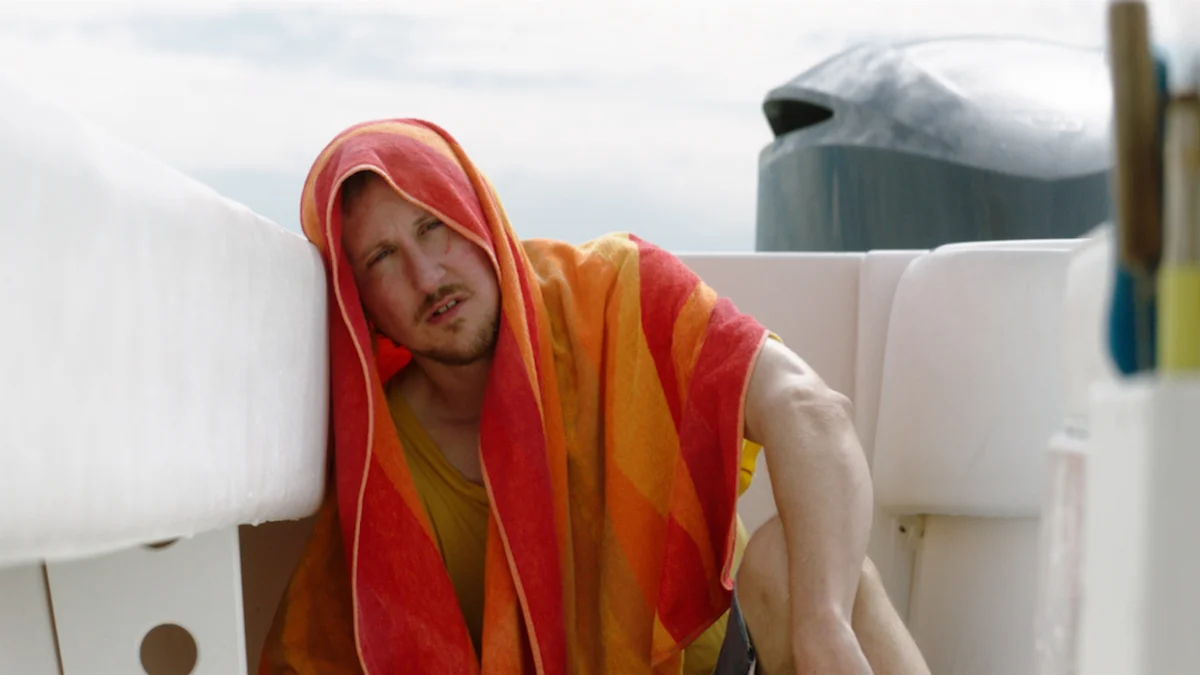
Tyler Cornack’s latest feature film, Mermaid, released on April 8 via Utopia, offers a darkly comedic and uniquely naturalistic exploration of the infamous "Florida Man" phenomenon, delving into themes of loneliness, addiction, and the bizarre underbelly of American eccentricity. Following his 2019 cult debut Butt Boy, Cornack solidifies his distinctive filmmaking voice by marrying an outrageous premise with a grounded, often serious tone, creating one of the year’s most unexpectedly compelling independent comedies. The film centers on Doug (Johnny Pemberton), a solitary drug addict on the brink of suicide, whose life takes an unimaginable turn when he discovers an injured, decidedly unglamorous mermaid in the waters near his dilapidated beachside home.
The "Florida Man" Archetype and its Cinematic Dissection
The concept of "Florida Man" has permeated popular culture, evolving from a local curiosity into a viral internet meme. This archetype typically refers to headlines from Florida that describe bizarre, often criminal, and frequently absurd exploits of men in the state. The phenomenon is largely attributed to Florida’s unusually broad public records laws, which make police reports and arrest affidavits readily accessible to the media, leading to a higher volume of peculiar stories entering the public consciousness. Cornack, a Florida native, leverages this cultural touchstone not merely for comedic effect but as a lens through which to examine deeper societal issues and the human condition in extreme circumstances.
In Mermaid, Cornack interrogates the myth of this "cryptid-like civilian" by portraying Doug as a quintessential, albeit deeply empathetic, "Florida Man." Doug is a man on his last leg, isolated and grappling with profound personal demons. His discovery of the mermaid, an equally outlandish and unexpected event, serves as a catalyst for a narrative that, while absurd on its surface, probes the raw vulnerabilities and desperate attempts at connection that often underpin such eccentric figures. The film posits that beneath the sensational headlines and bizarre incidents lies a complex tapestry of human struggle, often exacerbated by the unique socio-economic and cultural landscape of Florida itself. The state, known for its diverse subcultures, transient populations, and significant challenges with drug addiction, provides a fertile ground for stories that defy easy categorization, a reality that Cornack keenly observes and reflects in his work.
Tyler Cornack’s Signature Style: Blending Absurdity with Naturalism
Cornack’s filmmaking is characterized by a deliberate and often unsettling juxtaposition of the profoundly ridiculous with an unyieldingly naturalistic approach. This aesthetic was first prominently displayed in Butt Boy, a film renowned for its surreal premise involving a detective who can absorb objects, and eventually people, into his posterior. In both Butt Boy and Mermaid, Cornack maintains a consistent, serious tone, allowing the inherent absurdity of the situations to generate a unique brand of humor rather than relying on overt comedic performances.
"I like to take actors and create an environment that’s as realistic as possible, but what’s going on in the world is not happening," Cornack explained in an interview. "It’s like combining the supernatural with the extremely, extremely natural. I find it interesting. It’s a language I’m very intrigued by." This method creates a disorienting yet engaging experience for the audience, where the deadpan delivery of outrageous dialogue and the earnest reactions to fantastical events become the primary source of comedy. The performances in Mermaid are strikingly straight, which, according to Cornack, creates "another layer of a joke" and allows for "new ways of making you laugh, because it is played so straight." This stylistic choice demands a delicate balance, which Cornack actively seeks to maintain, often experimenting with different takes during filming and in the editing room to find the precise equilibrium between the farcical and the grounded. He describes this process as a "wire walk," constantly measuring how far to push the boundaries without disrupting the internal logic of the film’s idiosyncratic world.
The Empathy of the Anti-Hero: Johnny Pemberton as Doug
A central tenet of Cornack’s storytelling is his fascination with anti-heroes, particularly men who appear to have nothing left to lose. Doug, in Mermaid, embodies this archetype perfectly. A drug addict living in squalor, contemplating suicide, he represents a man at his absolute lowest ebb. Yet, Cornack imbues Doug with a profound, if often misguided, humanity. This portrayal is significantly enhanced by Johnny Pemberton’s performance. Pemberton, typically known for his lighter, more overtly comedic roles, brings an unexpected likability and vulnerability to Doug, preventing him from devolving into a mere caricature or an intolerable figure.
"If you take somebody like him, and then you have this script where this guy is kind of a deadbeat, he’s automatically going to make it more likable," Cornack observed. "Because there’s a dark version of Mermaid where a different actor wouldn’t be as tolerable with the decisions he’s making." Doug’s isolation, his inability to articulate his thoughts and feelings, and his struggle to connect with others are portrayed with a raw honesty that resonates despite his questionable actions. He’s not a monster, but a deeply flawed individual searching for meaning and connection, a search that unexpectedly manifests in his relationship with the feral mermaid. This empathetic approach to an anti-hero is a hallmark of Cornack’s work, challenging audiences to find common ground and understanding even with characters who make profoundly poor decisions.
A New Vision of Mermaids: Feral, Unapologetic, and Raw

One of the most striking aspects of Mermaid is its radical reinterpretation of the titular creature. Far from the enchanting, beautiful sea maidens depicted in films like Splash or Disney’s The Little Mermaid, Cornack’s mermaid is a primal, "gnarly" beast, more akin to a creature from The Shape of Water but with its intensity dialed up significantly. This vision was inspired, in part, by a viral TikTok video depicting terrifying shrieks in the ocean, prompting Cornack to consider a mermaid that was an animal first and foremost.
"Nobody’s treated them like a wild animal," Cornack stated, outlining his approach. "What if they’re not as beautiful as they’re portrayed in Disney movies? That’s how I approached it with the team. A mermaid that’s an animal first and foremost, and unapologetically one. She’s feral. She’s not gonna budge. She’s just an animal that needs to be in the water."
The creation of this unique creature was a testament to the ingenuity and resilience of independent filmmaking. Despite four months of initial design work falling through at the last minute, the special effects team, led by Mark Villalobos of Villalobos Studios and Heather Mages, managed to construct the mermaid from scratch in a mere ten days, even as shooting had already commenced. This stressful, collaborative effort resulted in a creature that is both terrifying and strangely compelling, a physical manifestation of the untamed, unpredictable elements that permeate Doug’s life and the Florida landscape itself. The mermaid, in its raw, unadulterated form, serves as a powerful symbol of nature’s indifference and the wild, uncontainable forces that often clash with human attempts at control and domestication.
Florida: A Character and a "Love Letter"
Beyond its eccentric inhabitants, Florida itself plays a pivotal role in Mermaid, serving as both the film’s backdrop and an integral character. Cornack, who grew up in the state, describes the film as "A Love Letter To Florida," highlighting his deep personal connection and fascination with its unique energy. The production was a highly personal endeavor, filmed in Cornack’s hometown on a beach he frequented as a child, with the primary house location being his executive producer’s aunt’s residence.
Cornack’s affection for Florida stems from its diverse "pockets and subcultures" – from the manufactured fantasy of theme parks to the insular world of suburban gated communities, and particularly, the "unhinged" energy of its beach towns. He recalls watching "beach bums" and "sun-kissed guys at the bar, telling stories" during his childhood, figures who felt "from another universe." This sense of anything being possible, of a pervasive eccentricity, is what drew him to set Mermaid in this specific environment. The film also touches upon Florida’s well-documented struggles with drug addiction, a personal issue for Cornack who lost friends to the crisis. This layering of personal history, cultural observation, and social commentary enriches the film’s narrative, grounding its fantastical elements in a palpable reality. Cornack’s inspirations extended beyond the mermaid myth to classic "beach movies" like Jaws and Flipper, and especially Splash, which he aimed to turn "on its head" to create "the darkest comedy ever." The inclusion of SpaghettiOs, a nostalgic nod to Flipper, further underscores the personal and historical layers embedded within the film.
The Vomit Scene: A Pinnacle of Outrageousness
Among Mermaid‘s many memorable moments, the scene where the mermaid projectile vomits over Doug’s daughter Layla’s (Devyn McDowell) birthday party stands out as a masterclass in controlled chaos. Shot with a "warzone" intensity and featuring dramatic slow-motion, this sequence serves as a pivotal turning point, shifting the film into a "pulpier direction." Cornack meticulously planned the scene to take things to "11 real quick" before allowing the narrative to resettle.
Despite the grand vision, the execution of the scene involved significant improvisation due to time and budget constraints. Practical effects were paramount, with a large hose rigged to dispense "black bile," unleashing a torrent of viscous liquid over the unsuspecting partygoers. The children involved in the scene reportedly had a "blast" acting scared and getting covered in the goo, a testament to Cornack’s ability to orchestrate moments of extreme absurdity that remain strangely grounded within the film’s unique tonal framework. This scene encapsulates the essence of Mermaid: an audacious blend of the disgusting and the delightful, pushing boundaries while maintaining a cohesive, albeit bizarre, narrative.
Implications for Independent Cinema and Cultural Commentary
Mermaid stands as a significant contribution to independent cinema, further cementing Tyler Cornack’s reputation as a visionary filmmaker unafraid to tackle unconventional narratives and challenging genre expectations. Its distribution by Utopia, a company known for supporting unique and often boundary-pushing films, underscores its position within a vibrant segment of the industry dedicated to artistic originality over mainstream appeal.
The film’s exploration of the "Florida Man" phenomenon offers a timely cultural commentary, inviting audiences to look beyond sensational headlines and consider the human stories behind the spectacle. By blending surreal comedy with stark realism, Cornack pushes the boundaries of how we define genre, creating a work that is simultaneously hilarious, unsettling, and thought-provoking. Critics are likely to be polarized by its audacious premise and unconventional tone, yet it is precisely this polarizing nature that often cultivates a devoted cult following. Mermaid serves as a testament to the power of independent film to interrogate societal myths, explore complex characters, and deliver narratives that defy easy categorization, solidifying Cornack’s place as a distinctive and essential voice in contemporary filmmaking.