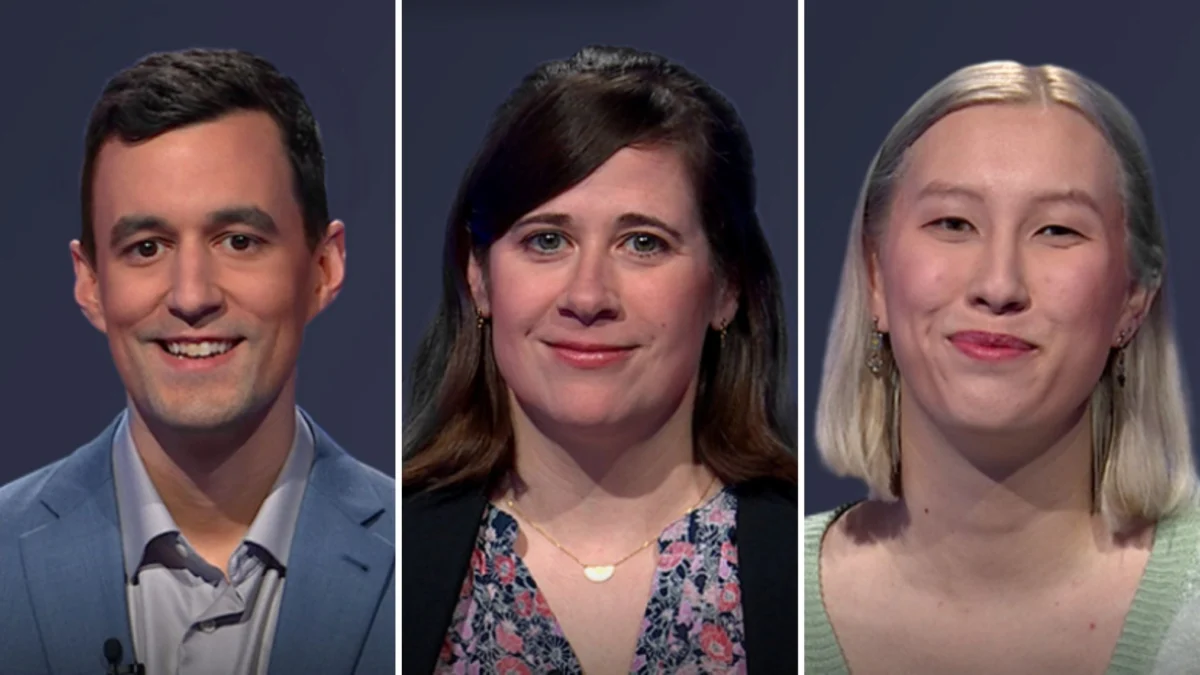
The current landscape of the long-running syndicated game show Jeopardy! remains in a state of high volatility as the program struggles to produce a long-term champion following the historic run of Jamie Ding. In the episode aired on Monday, May 6, the cycle of single-day victories continued when challenger Tristan Williams, a data scientist from Lincoln, Nebraska, defeated the incumbent champion Shannon Crisenbury. The match, which saw significant swings in momentum and several high-stakes wagering errors, underscored the precarious nature of the "Jeopardy! curse" that has plagued contestants since Ding’s 31-game dominance ended earlier this spring.
Shannon Crisenbury, a data annotator from St. Clair, Michigan, entered the May 6 episode with high expectations following a robust debut performance. In her first appearance, Crisenbury secured $38,400, a total that placed her among the more successful one-day winners of the current season. Her victory had been characterized by a dramatic comeback in the Double Jeopardy! round, where she leveraged two Daily Doubles to overtake her opponents. However, as host Ken Jennings noted during the opening of the May 6 broadcast, the "Jeopardy! journey" for many recent champions has been remarkably brief. Jennings highlighted that for four consecutive games, the program has crowned a new champion each day, a trend that Tristan Williams would eventually extend.
The Jeopardy! Round: Early Errors and Strategic Leads
The first round of play featured Shannon Crisenbury defending her title against Tristan Williams and Lauren Black, a sales assistant from San Jose, California. The game began with a competitive pace, but the first major turning point occurred at the 11th clue in the "Big Business" category. Williams, holding an early lead of $5,200, uncovered the first Daily Double of the match.
In a move reflecting the aggressive wagering strategies common in the post-James Holzhauer era, Williams bet $4,000. The clue required him to identify a massive tech conglomerate: “Though this company has made billions of Galaxies, its name is Korean for just ‘3 stars.’” Williams incorrectly responded with “What is Mitsubishi?” The error—confusing a Japanese conglomerate with a Korean one—proved costly, as the correct response was Samsung. The $4,000 loss dropped Williams to $1,200, though he remained in first place due to the slow start of his competitors.
As the round progressed toward the first commercial break, Crisenbury began to narrow the gap. By the 15th clue, Williams held $2,000, with Crisenbury trailing closely at $1,600. The struggle for dominance continued through the latter half of the round. By clue 18, the two leaders were tied. Williams eventually regained his footing, finishing the Jeopardy! round with $3,400. Crisenbury followed with $2,600, while Black struggled with negative momentum, ending the round at -$800.
Double Jeopardy! and the Ferromagnetism Pitfall
The Double Jeopardy! round saw Tristan Williams take command of the board, though not without further volatility. Williams found the second Daily Double early in the round on the fifth clue under the category “1840s America.” Having built his total to $5,000, he once again wagered $4,000. The clue read: “In Nov. 1842 Father Edward Sorin & friends took possession of 500 acres of snow in Indiana, the start of this school.” Williams correctly identified the institution as Notre Dame, bringing his total to $9,000 and establishing a commanding lead.
Fortune seemed to favor Williams as he uncovered the third and final Daily Double on the very next clue. Playing in the category “It’s Simple Physics,” Williams wagered $5,000 on the clue: “This type of attraction isn’t limited to iron, from which its name is derived; it also applies to nickel & cobalt.” Seeking to put the game out of reach, Williams responded with “What is magnetic attraction?” However, Jennings informed him that the response was too broad. The specific scientific term required was “ferromagnetism.”
The loss of $5,000 brought Williams back down to $4,000, effectively resetting his lead. Despite this setback, Williams dominated the remainder of the round through superior buzzer speed and correct responses in high-value categories. By the end of Double Jeopardy!, Williams had amassed a significant lead of $20,400. Crisenbury finished with a respectable $7,400, but was far from a "runaway" scenario. Lauren Black, unfortunately, ended the round with a negative balance of -$800, which, according to Jeopardy! rules, disqualified her from participating in the Final Jeopardy! round.
Final Jeopardy! and the Geopolitical Puzzle
The Final Jeopardy! round focused on the category “Geographic History.” The clue provided a complex historical timeline for a specific territory: “About 10,000 sq. miles, this region was the subject of a 19th c. war, declared independence in 1917, reorganized in 1921 & is under dispute to this day.”
The clue required contestants to synthesize knowledge of the 19th-century Crimean War with the modern geopolitical conflicts involving Russia and Ukraine. Shannon Crisenbury, demonstrating the same late-game prowess that won her the previous match, correctly identified the region as Crimea. In a high-risk move designed to capitalize on any potential error by Williams, she wagered her entire $7,400, bringing her total to $14,800.
Tristan Williams, however, was unable to provide a correct response, leaving his answer space mostly blank. Despite his lack of an answer, Williams’ strategic wagering proved decisive. Having entered the round with $20,400, he wagered only $400, a conservative bet designed to protect his lead even in the event of an incorrect response. His final total of $20,000 was enough to secure the victory, making him the new Jeopardy! champion and ending Crisenbury’s brief tenure.
Analysis of the "One-Day Champion" Phenomenon
The defeat of Shannon Crisenbury marks a continuation of what fans and analysts have dubbed the "post-super-champion slump." Since Jamie Ding’s 31-game winning streak—one of the longest in the show’s 60-year history—the program has seen a revolving door of champions. Following Ding’s departure, Greg Shahade managed to secure three victories before being ousted. Since Shahade’s exit, the winner’s podium has seen a new face nearly every day.
Statistical analysis of Jeopardy! history suggests that periods of extreme dominance, like those of Ding, Ken Jennings, or James Holzhauer, are often followed by periods of high turnover. This is attributed to several factors:
- Buzzer Parity: When no single player dominates the timing of the signaling device, games are decided by Daily Double placement and wagering strategy rather than pure knowledge recall.
- Aggressive Wagering: Modern contestants are increasingly likely to make "all-in" or large bets on Daily Doubles. While this can lead to massive scores, it also increases the likelihood of a leader falling behind due to a single incorrect response.
- The "Giant Killer" Effect: Contestants who defeat a long-term champion often face an emotional and physical "letdown" in subsequent games, making them vulnerable to fresh challengers.
Implications for the Tournament of Champions
The current lack of a multi-day champion has significant implications for the show’s annual Tournament of Champions (ToC). Typically, the ToC field is comprised of players who have won at least five games, though the show has recently invited three- and four-game winners to fill the roster. If the trend of one-day champions continues, the producers may face a challenge in assembling a field of seasoned veterans for the next elite competition.
Tristan Williams’ victory with $20,000 is a solid start, but his path to the Tournament of Champions remains long. To break the current "curse," he will need to navigate the hazards of the signaling device and the pressure of the Double Jeopardy! round in his second game, scheduled for Tuesday.
As the season progresses, Jeopardy! producers and viewers alike are watching to see if a new "super-champion" will emerge to stabilize the podium. For now, the game remains a battle of attrition, where strategic wagering and niche knowledge in fields like physics and geographic history determine who stays and who goes. Tristan Williams returns for his second game on Thursday, May 9, carrying the weight of a show looking for its next long-term star.