Released in 1971, Secret Flower emerged as a significant work during a transitional phase in the career of controversial Japanese director Koji Wakamatsu. While ostensibly produced as a commercial "pink film" at the behest of distributors, the movie nonetheless bears the unmistakable stylistic and thematic hallmarks of its creator, masterfully intertwining raw eroticism with profound existential despair. This production is particularly noteworthy as it predates Wakamatsu’s and frequent collaborator Masao Adachi’s (who also features as an actor in Secret Flower) departure for Palestine to film the radical documentary Red Army/PFLP: Declaration of World War. Consequently, Secret Flower stands as one of the final expressions of Wakamatsu’s deeply inward-looking romantic nihilism before his cinematic focus shifted towards more overtly political and revolutionary themes.
The Genesis of a Transitional Work: Wakamatsu, Pink Films, and the Art Theater Guild
To fully appreciate Secret Flower, it is crucial to contextualize its creation within the broader landscape of Japanese cinema in the late 1960s and early 1970s. This era was marked by significant social upheaval, student protests, and a burgeoning independent film movement. Koji Wakamatsu, a prolific director, had already established himself as a prominent figure in the "pink film" genre – low-budget, softcore pornographic films that often served as a vehicle for directors to explore avant-garde narratives and political critiques, bypassing the stringent censorship of mainstream studios. While commercially driven, these films provided an unexpected platform for artistic experimentation and social commentary, often characterized by their provocative content, experimental structures, and philosophical undertones.
Secret Flower was produced during a period when the lines between commercial exploitation and art-house cinema were increasingly blurred, especially for directors like Wakamatsu. His association with the Art Theater Guild (ATG), a groundbreaking independent production and distribution company, further facilitated this unique blend. ATG, founded in 1961, became a vital force in Japanese cinema, championing experimental and auteur-driven projects that mainstream studios often shunned. While Secret Flower might have originated as a distributor-requested pink film, its subsequent critical reception and thematic depth align it more closely with the challenging, thought-provoking cinema that ATG sought to promote. The film’s inclusion in discussions of Wakamatsu’s pivotal works underscores its artistic merit beyond its genre classification.
A Narrative Unveiling Oppressive Atmospheres and Existential Quandaries
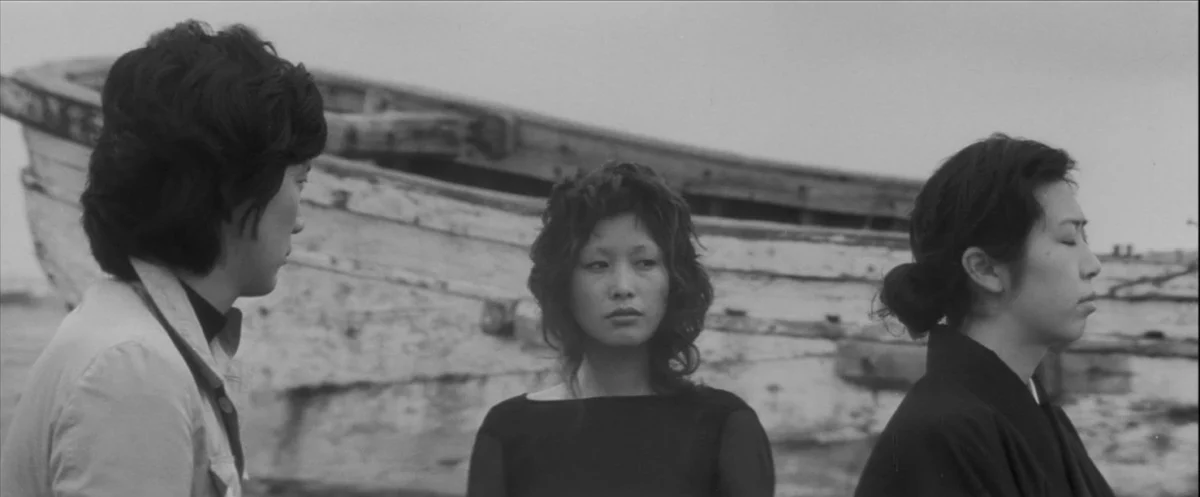
The narrative of Secret Flower commences with an immediate establishment of its oppressive and bleak atmosphere. The opening sequence unfolds within a decaying wooden boat, abandoned on a desolate beach. Here, a man and a woman engage in a sexually charged encounter that culminates in a chilling act: after the man reaches orgasm, the woman brutally stabs him to death. This shocking act, underscored by mournful piano music, immediately immerses the viewer in the pervasive sense of dread that will dominate the remainder of the film. Initially, the scene suggests a lovers’ suicide pact gone awry, but as the intricate layers of the story peel back, it becomes clear that the truth is far more complex and psychologically unsettling.
Three years later, the woman, now perpetually clad in mourning attire, haunts the shoreline like a spectral figure, seemingly trapped in a purgatorial state, unable to escape the past or move forward. Her spectral presence contrasts sharply with, yet ironically mirrors, a younger couple who have taken residence in a shabby seaside inn nearby. This younger pair is locked in a relentless cycle of conversation, arguments, and sexual encounters, their discussions frequently circling the grim prospect of double suicide. The young man is gradually revealed to be a former student activist, a disillusioned figure who abandoned the fervent political struggles of the era. This retreat from activism has left him spiritually hollow, incapable of finding genuine meaning or purpose in either life or death. His girlfriend, initially drawn to him out of love, begins to question the profound emptiness underpinning his fatalistic desires, embarking on her own journey of existential re-evaluation.
Intertwining Destinies: Love, Death, and Political Disillusionment
As these two seemingly disparate narratives intertwine, Wakamatsu meticulously constructs a suffocating meditation on the interconnectedness of love, death, jealousy, memory, and political disillusionment. The male protagonist’s revolutionary past, though conveyed through a handful of fragmented flashbacks, remains a crucial contextual element. His abandonment of political ideals, coupled with his subsequent aimless existence and fixation on suicide as the only perceived path to revolution, speaks volumes about the tumultuous political climate of 1970s Japan. The film subtly critiques the mentality of a generation of youth grappling with the aftermath of failed revolutionary movements and the ensuing sense of apathy and despair.
Despite the palpable political undertones, Wakamatsu’s focus in Secret Flower appears to pivot towards the destructive facets of love and the relentless, often futile, search for it. He portrays love as a concept so potent that it can consume and supersede any ideological conviction, transforming those who succumb to its intoxicating power into utterly broken individuals. This thematic exploration is predominantly channeled through the female characters, making Secret Flower one of Wakamatsu’s most overtly feminine works. The emotional gravity of the narrative rests almost entirely on the women, their inner lives and struggles becoming the central focus.
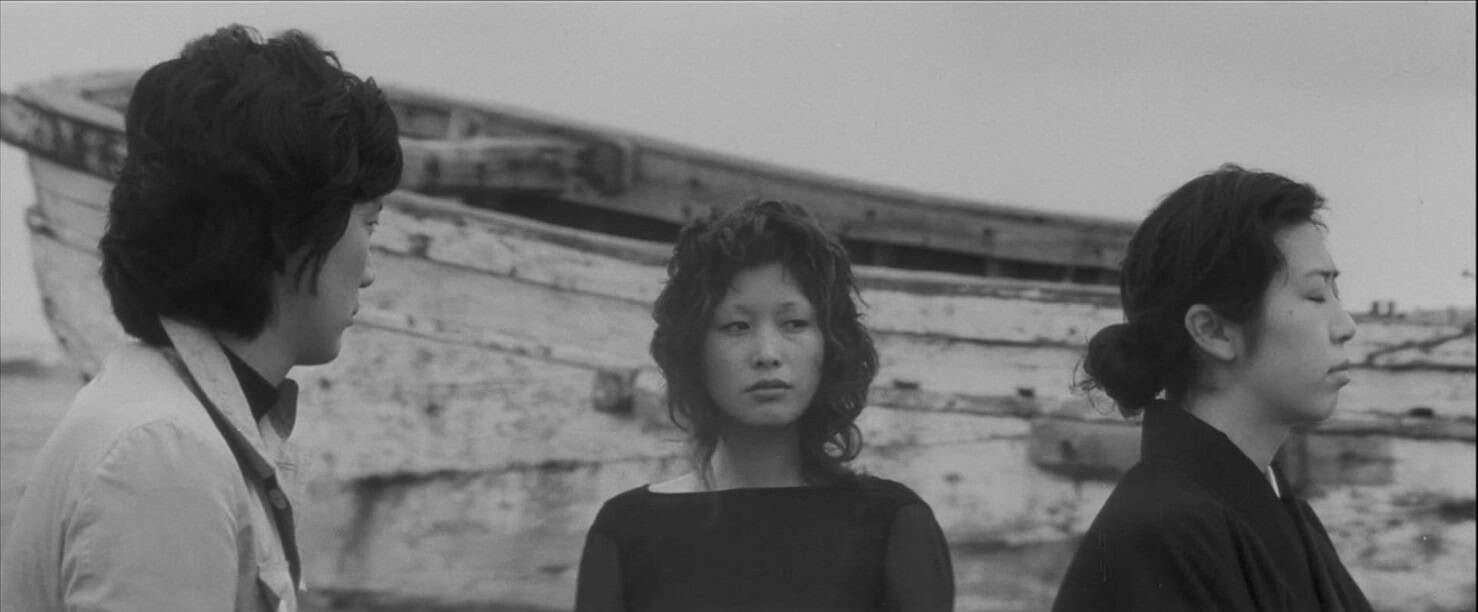
The Women of Secret Flower: Neurosis, Resilience, and Existential Endurance
Both female characters are depicted as deeply internalized and neurotic figures, their inner turmoil often expressed through poetic monologues and dreamlike, often cryptic, dialogue. The older woman’s inability to extricate herself from the traumatic memory of her failed lovers’ suicide transforms her into a living corpse, a spectral embodiment of unresolved grief and guilt. In stark contrast, the younger woman, through her entanglement with the disillusioned activist, gradually awakens to the chilling realization that death without purpose or conviction is ultimately meaningless.
One of the film’s most profound central ideas emerges from the powerful juxtaposition of these two women: men, Wakamatsu suggests, may search for grand ideological justifications to embrace death, but women, despite their suffering, possess an inherent capacity to endure existence, regardless of its perceived meaning or lack thereof. In this regard, Wakamatsu seems to propose that female resilience ultimately transcends both the often-fragile idealism of political movements and the self-destructive tendencies of masculine nihilism. However, the narrative is grounded by the visceral human emotion of jealousy that the young woman experiences when the older woman enters the picture, hinting at the looming possibility of an erotic triangle. This human element prevents the film from becoming purely abstract, maintaining a tether to conventional drama even amidst its avant-garde approach.
Striking Symbolism and Visceral Cinematography
The symbolism interwoven throughout Secret Flower is remarkably striking and contributes significantly to its unsettling atmosphere. The recurring image of the rusting, abandoned ship on the desolate beach serves as an obvious, yet potent, metaphor for emotional decay, stagnant time, and shattered hopes, directly mirroring the psychological state of the mourning woman. Equally unforgettable is the infamous chastity belt, lined with menacing, shark-like spikes. This grotesque object is unveiled in one of the movie’s most unsettling scenes and reappears several times, becoming a potent symbol. At once erotic, horrifying, and profoundly tragic, the chastity belt encapsulates the central contradictions of the narrative: desire transformed into imprisonment, and sexuality inextricably fused with emotional death and self-punishment.
Visually, Secret Flower stands as one of Wakamatsu’s strongest efforts of the era. Hideo Ito’s masterful cinematography captures the raw power of the violent sea, the desolate beauty of the lonely shoreline, and the haunting decay of the ruined ship with an almost painterly quality, creating an atmosphere that often evokes a post-apocalyptic or "end of the world" sensation. An early frame, showcasing the couple gazing from their hotel window towards the beach, where the older woman is presented through a stark long shot, immediately highlights the exceptional quality and deliberate composition of the cinematography. Furthermore, the deliberate and impactful way color eventually bleeds into the predominantly monochrome imagery is visually arresting, with the climactic fire scene particularly standing out for its vivid, symbolic use of color.
Editing, Performances, and Lasting Impact
Isamu Nakajima’s editing further intensifies the sense of confusion and psychological disarray experienced by the protagonists. The frequent shifts between past and present, and the seamless blurring of dream and reality, contribute to the film’s disorienting and oppressive atmosphere. While the cuts are often abrupt, contributing to a sense of fragmentation, the overall pace of the film remains deliberately slow, allowing the existential dread to permeate every frame. Although the narrative occasionally verges on convolution or seems to crumble under its own weight, the ultimate artistic result transcends these potential issues. Crucially, at a runtime of approximately 70 minutes, the movie avoids overextending its welcome, ensuring that its intense themes resonate without becoming tedious.
The performances in Secret Flower further solidify the production’s profound impact. Ken Yoshizawa delivers a compelling portrayal of the defeated student radical, his nihilistic screen presence perfectly embodying the character’s spiritual hollowness and political disillusionment. Rie Yokoyama, as the younger woman, offers an emotionally exposed and vulnerable performance, relying as much on physical expressiveness and raw emotionality as on dialogue to convey her character’s evolving understanding of life and death.
Secret Flower does not fundamentally break the stylistic or thematic mold of Koji Wakamatsu’s earlier works from this period. However, this is not a detraction; rather, it underscores the director’s consistent vision. The film’s potent combination of eroticism, exploitation elements, intense existential tension, and incisive political undertones, all presented through both literal and metaphorical lenses, results in yet another powerful cinematic statement. It exemplifies Wakamatsu’s signature approach, where the constraints of limited funding often became the very impetus for creative ingenuity and stylistic innovation. This resourceful, audacious spirit—a hallmark of Wakamatsu and his dedicated crew—is precisely what defines the enduring legacy of films like Secret Flower. It remains a crucial piece in understanding the multifaceted artistry of a director who consistently challenged societal norms and cinematic conventions.