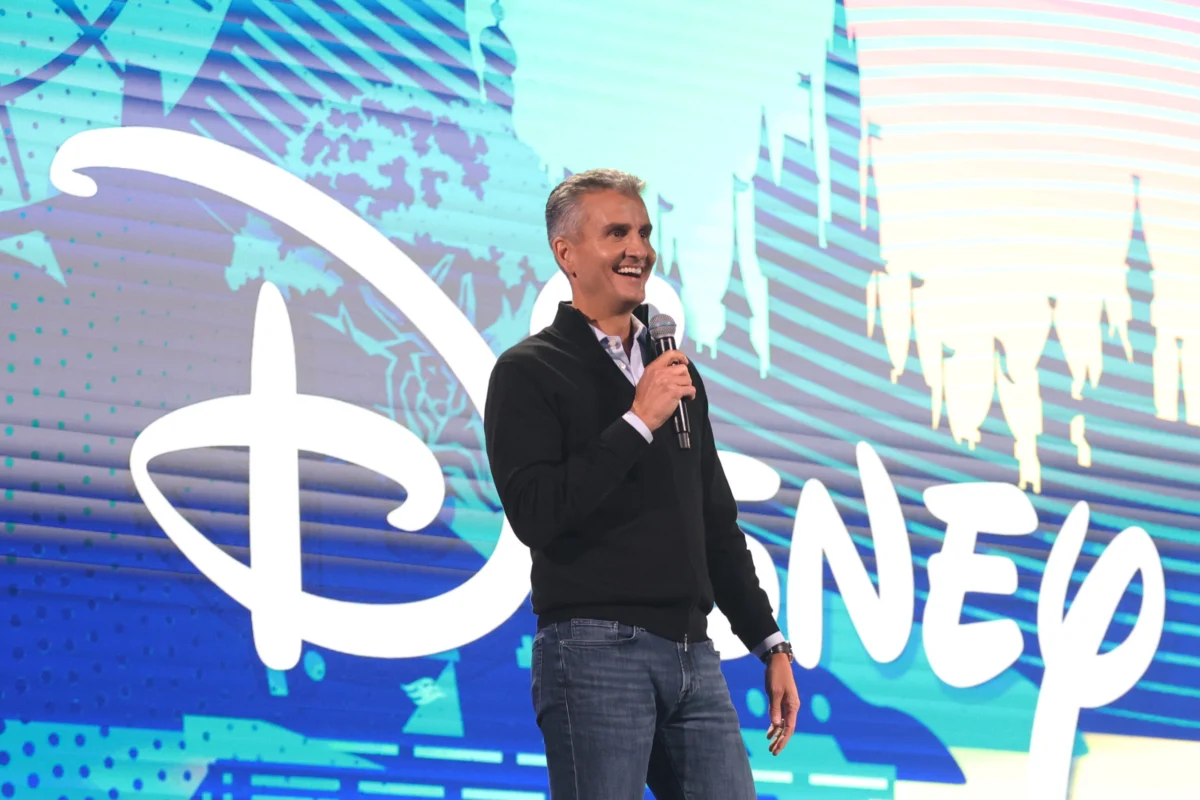
The Walt Disney Company utilized its annual upfront presentation at the Jacob Javits Convention Center on Tuesday to articulate a vision of stability and cultural permanence amid a period of unprecedented volatility in the media and entertainment sectors. Led by Josh D’Amaro, Chairman of Disney Experiences, the presentation served as a strategic pivot, positioning the legacy media giant not as a participant in the current industry-wide scramble for scale, but as the benchmark toward which all other competitors are striving. The event, attended by thousands of advertisers, media buyers, and industry analysts, sought to reinforce Disney’s unique market position by contrasting its century-long brand equity with the algorithmic-driven models of newer tech-focused entrants.
The presentation commenced with a high-production sizzle reel inspired by the upcoming Devil Wears Prada sequel, setting a tone of cultural relevance and institutional authority. Academy Award winner Anne Hathaway introduced D’Amaro, jokingly comparing him to the formidable Miranda Priestly while acknowledging his reputation for a more approachable leadership style. This celebrity-driven opening served as a prelude to a more somber and calculated business argument: that while the rest of the industry is racing to assemble the components of a modern media conglomerate, Disney has already completed the puzzle.
The Strategic Framework: A Category of One
D’Amaro’s keynote address focused on the concept of Disney as a "category of one." He argued that the recent flurry of mergers, acquisitions, and restructuring efforts seen across the landscape—involving giants like Amazon, Netflix, Paramount Global, and Warner Bros. Discovery—is essentially an attempt to replicate the integrated ecosystem Disney has spent decades perfecting.
“Everybody, in their own way, is racing to assemble something,” D’Amaro told the audience. “Studios. Streaming services. Sports rights. Live events. And brands that audiences feel something about. It is, in a way, a real compliment to this company. Because what they are racing to assemble is, more or less, the picture of what we already are.”
This narrative seeks to address investor concerns regarding the "streaming wars." While Netflix has pioneered the subscription model and Amazon has leveraged its retail dominance to fuel Prime Video, Disney’s pitch is centered on the multi-generational "trust" and "belonging" that its brands—including Marvel, Star Wars, Pixar, and National Geographic—command. D’Amaro emphasized that while capital can buy content and technology can optimize distribution, the emotional resonance of the Disney brand remains an inimitable asset.
Historical Context and the Evolution of the Upfronts
The "upfronts" traditionally serve as a critical period in the television industry where networks showcase their upcoming programming to secure advance advertising commitments. Historically, this was a broadcast-centric event. However, the 2024 cycle highlights a definitive shift toward a "total audience" approach, where linear television, streaming (Disney+ and Hulu), and live sports (ESPN) are sold as a single, unified inventory.
Disney’s current position is the result of a decade of aggressive consolidation, most notably the $71.3 billion acquisition of 21st Century Fox in 2019. That deal provided Disney with the library depth and production capacity necessary to launch Disney+ and take a controlling stake in Hulu. In the years following the Fox acquisition, Disney has focused on internal integration, recently launching "Hulu on Disney+" in the United States to create a more frictionless experience for subscribers and a more robust platform for advertisers.
By contrast, many of Disney’s peers are still in the midst of structural upheaval. Warner Bros. Discovery continues to manage the fallout of the Discovery-WarnerMedia merger, Paramount Global is navigating complex sale negotiations, and tech giants like Netflix and Amazon are only now building out the sophisticated advertising tiers that Disney has operated for years through its linear and Hulu properties.
Supporting Data: The Financial and Operational Backbone
The "Category of One" claim is supported by Disney’s massive operational scale. In its most recent quarterly earnings report, Disney’s entertainment streaming business (Disney+ and Hulu) turned a profit for the first time, a significant milestone that validates the company’s transition from a legacy broadcaster to a digital powerhouse.
Key metrics currently defining Disney’s market strength include:
- Streaming Reach: Disney+ and Hulu combined boast over 150 million global subscribers, providing a massive first-party data set for targeted advertising.
- Park Revenue: The Disney Experiences division, which D’Amaro oversees, reported record revenues in recent quarters. The company has announced plans to invest $60 billion in its parks and cruises over the next decade, ensuring that the physical touchpoints of the brand continue to drive affinity for its media content.
- Ad-Tech Sophistication: Disney’s "Bridge ID" and other proprietary ad-tech tools allow advertisers to target audiences across the Disney ecosystem with a level of precision that rivals social media platforms while maintaining a "brand-safe" environment.
Advertisers at the Javits Center were presented with data showing that Disney’s audience engagement spans every demographic. The inclusion of Mickey and Minnie Mouse greeting guests as they entered the venue was a tactical reminder of this cross-generational appeal. As D’Amaro noted, the "castle" is not just a logo but a psychological anchor for consumers, a sentiment that algorithms cannot easily replicate.
Official Responses and Industry Reactions
While competitors have not issued formal rebuttals to D’Amaro’s "Category of One" claim, the market reaction suggests a recognition of Disney’s unique position. Media buyers present at the event noted that Disney’s advantage lies in its "omnichannel" presence.
"What Disney is selling is not just a 30-second spot on a sitcom; they are selling an association with a cultural institution," said one veteran media buyer who requested anonymity. "Netflix has the tech, and Warner has the HBO prestige, but Disney has the ecosystem that follows a consumer from their living room to a theme park to a cruise ship."
However, the presentation also comes at a time when Disney is facing pressure to maintain this lead. The company recently survived a high-profile proxy battle with activist investor Nelson Peltz, who criticized the company’s succession planning and streaming strategy. D’Amaro’s prominent role at the upfronts is seen by many analysts as a signal of his growing influence within the company and his potential as a future successor to CEO Bob Iger.
The Role of ESPN and Live Sports
A significant portion of the upfront pitch was dedicated to ESPN, which remains the "crown jewel" of Disney’s advertising portfolio. In an era where cord-cutting has eroded linear television ratings, live sports remain the last bastion of "appointment viewing" that can guarantee massive, simultaneous audiences.
Disney is currently preparing for the launch of a new flagship ESPN direct-to-consumer service in 2025, as well as a joint venture sports streaming platform (internally dubbed "Venu Sports") with Fox and Warner Bros. Discovery. By emphasizing sports alongside its entertainment franchises, Disney sought to prove that it owns the two most valuable commodities in modern media: emotional storytelling and live, unmissable events.
Broad Impact and Future Implications
The narrative presented by Disney reflects a broader maturation of the streaming era. The "race to assemble" that D’Amaro referenced is reaching its conclusion, and the industry is entering a "harvesting" phase where profitability and brand loyalty are more important than raw subscriber growth.
Disney’s strategy of "resting on its laurels"—as D’Amaro framed it—is not a sign of stagnation but of a shift toward optimization. By leaning into its century of "trust" and "belonging," Disney is betting that in an age of infinite content, consumers and advertisers will gravitate toward the brands they already know and love.
The implications for the broader media landscape are clear: to compete with Disney, rivals must do more than just build a large library of content; they must build a cultural identity. As D’Amaro concluded, "In a marketplace where everyone is racing to assemble what we already have, Disney is in a category of one."
As the 2024 upfront season continues, the focus will remain on whether Disney can translate this perceived "emotional monopoly" into the increased advertising rates and long-term investor confidence required to sustain its dominance in a rapidly evolving digital world. For now, the company has made its stance clear: while others are building their empires, Disney is busy managing the one it has already perfected.