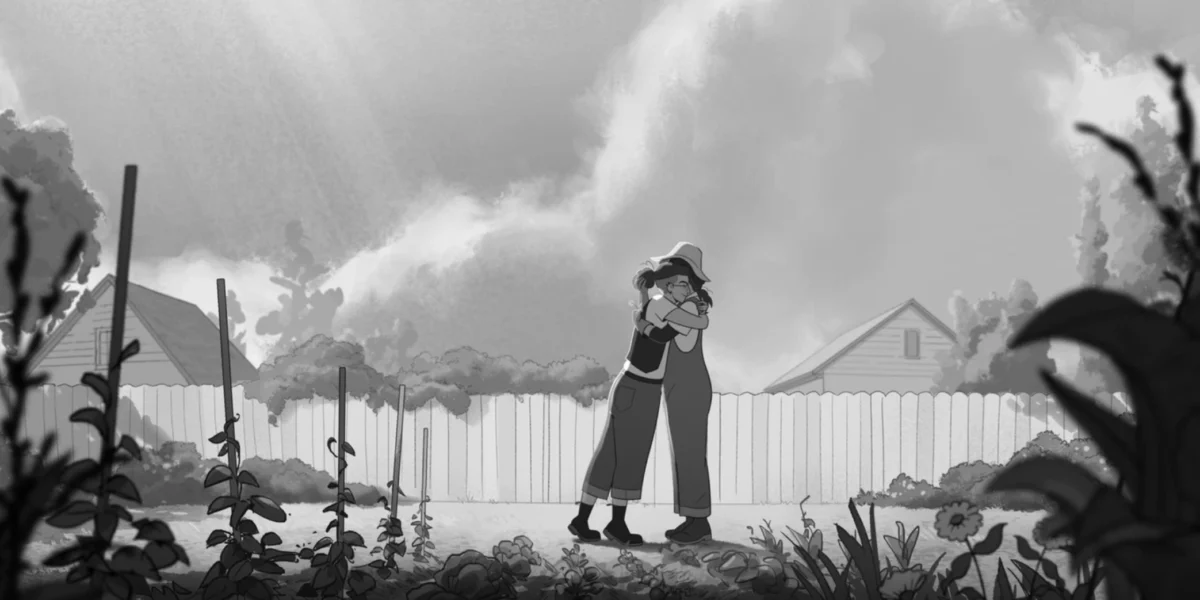
Tangles is a 102-minute animated feature film directed and written by Leah Nelson, adapted from the critically acclaimed graphic novel memoir by Sarah Leavitt. The production marks a significant entry into the genre of adult-oriented animation, utilizing a stark black-and-white aesthetic to chronicle the domestic and emotional upheaval caused by Alzheimer’s disease. Featuring a high-profile voice cast led by Julia Louis-Dreyfus and Abbi Jacobson, the film explores the complexities of caregiving, the erosion of identity, and the resilience of familial bonds within a 1990s cultural framework.
Narrative Overview and Setting
The story follows Sarah (voiced by Abbi Jacobson), a young activist and illustrator living an independent life in San Francisco during the mid-1990s. Sarah’s life is defined by her creative work at a queer magazine and her burgeoning relationship with her girlfriend, Donimo (Samira Wiley). However, this trajectory is interrupted when her mother, Midge (Julia Louis-Dreyfus), begins to exhibit the early, disorienting symptoms of Alzheimer’s disease.
Sarah chooses to leave her metropolitan life to return to her conservative hometown and her eccentric, "crunchy" family. What begins as a temporary mission to "manage" her mother’s condition evolves into a long-term journey of acceptance. The narrative tracks the family’s transition from denial to a grueling daily reality as Midge’s vibrant personality is gradually erased by the neurodegenerative condition. The film specifically highlights the friction between Sarah’s modern, progressive identity and the traditionalist environment of her youth, providing a nuanced look at the 1990s queer experience.
Chronology of the Filmic Adaptation
The development of the film follows a distinct timeline rooted in the success of the original source material.
- 2010: Sarah Leavitt publishes the graphic memoir Tangles: A Story About Alzheimer’s, My Mother and Me. The book receives international acclaim for its raw honesty and becomes a seminal work in the field of "graphic medicine."
- Pre-Production Phase: Director Leah Nelson, alongside writers Sarah Leavitt and Trev Renney, began the process of translating the static line drawings of the memoir into a cinematic format. The decision was made early on to retain the black-and-white palette to honor the original artwork.
- Casting: A significant milestone was reached when Julia Louis-Dreyfus and Abbi Jacobson were attached to the project, bringing mainstream visibility to an independent animated feature.
- Production: The animation process focused on integrating surrealist sequences into a documentary-style narrative, allowing the visual medium to represent the internal confusion of both the patient and the caregiver.
- Release and Runtime: The completed film, clocking in at 102 minutes, provides a comprehensive look at the multi-year progression of the disease within the family unit.
Supporting Data: The Reality of Alzheimer’s Disease
To understand the stakes of the film, it is necessary to examine the medical and social context of the disease it depicts. According to data from the Alzheimer’s Association, more than 6 million Americans are currently living with the disease, a number projected to rise to nearly 13 million by 2050.
The film portrays specific clinical milestones often associated with the condition:
- The Clock Test: A pivotal scene in the film involves Midge attempting to complete a neurological screening where she is asked to draw a clock. Medically, this is a standard cognitive assessment tool used to evaluate executive function and spatial representation.
- Caregiver Burden: Sarah’s experience reflects a broader societal reality. Approximately 11 million Americans provide unpaid care for people with Alzheimer’s or other dementias. These caregivers often face significant mental health challenges, including higher rates of depression and anxiety, as depicted in Sarah’s emotional outbursts and moments of isolation.
- Gender and Caregiving: Statistically, two-thirds of caregivers for Alzheimer’s patients are women, a dynamic explored through the central relationship between Sarah and her mother.
Visual Artistry and Technical Execution
Director Leah Nelson employs a specific animation style that deviates from contemporary high-gloss 3D trends. By utilizing line-drawing animation, the film maintains a "hand-drawn" feel that suggests intimacy and vulnerability. This aesthetic choice serves as a metaphor for the subject matter; just as memories become blurred and "tangled," the animation shifts from realistic depictions to surrealist imagery.
Notable technical sequences include:
- Surrealist Expansion: When Midge becomes lost in a crowd during a Mexican street parade, the animation warps into a demonic, nightmare-like aesthetic, externalizing Sarah’s panic.
- Metaphorical Environments: Upon returning to her childhood home, Sarah is depicted wading through rising waters, a visual representation of the overwhelming nature of her new responsibilities.
- Transitional Symbolism: The film uses impressionistic transitions, such as morphing a character’s frustrated expression into a fire-breathing dragon on a restaurant wall, to bridge the gap between internal emotion and external reality.
The auditory landscape of the film is equally deliberate. Nelson curated a soundtrack consisting of female-fronted rock and alternative music from the 1990s. This serves to ground the film in its specific era while reflecting Sarah’s personal identity and rebellious spirit.
Voice Cast and Character Analysis
The ensemble cast provides a layer of gravitas to the animated medium, with several actors playing against their traditional comedic personas.
- Abbi Jacobson (Sarah): Jacobson portrays Sarah as a woman caught between her sense of duty and her desire for a personal life. Her performance captures the "charming awkwardness" of the character while effectively conveying the anger and exhaustion of a primary caregiver.
- Julia Louis-Dreyfus (Midge): Louis-Dreyfus delivers a performance that spans the spectrum of the disease, from the initial "stilted" quality of early-stage cognitive decline to the profound loss of faculties in later stages. Industry analysts note that her involvement brings a "shortcut to the audience’s heart," leveraging her status as a beloved performer to heighten the tragedy of her character’s decline.
- Supporting Ensemble: The cast is rounded out by Bryan Cranston, Seth Rogen, Wanda Sykes, Bowen Yang, Pamela Adlon, Sarah Silverman, and Beanie Feldstein. This collection of talent suggests a high-level commitment to the project’s blend of humor and pathos.
Official Context and Source Material Background
The film is an adaptation of Sarah Leavitt’s memoir, which was a finalist for the Writers’ Trust of Canada Non-Fiction Prize. The source material is often cited in medical schools and nursing programs as a vital resource for understanding the "lived experience" of dementia. By bringing this story to the screen, the production team aims to reach a broader audience that may not typically engage with graphic novels.
The film’s focus on a queer protagonist in the 1990s also adds a layer of historical context. One montage illustrates Sarah’s journey of self-discovery through phone calls with her mother, highlighting a supportive family dynamic that was relatively progressive for the era. This "refreshing queer story" avoids the tropes of rejection, focusing instead on the universal struggle of loss.
Broader Impact and Implications for the Animation Industry
The release of Tangles contributes to a growing movement within the film industry to use animation for serious, adult-oriented storytelling. Following in the footsteps of films like Flee and The Red Turtle, Tangles demonstrates that the medium is uniquely suited for portraying psychological and neurological states that live-action might struggle to capture.
The film’s implications are twofold:
- Cultural Awareness: By humanizing the statistics of Alzheimer’s, the film serves as a tool for empathy and education, potentially influencing public discourse on caregiving resources and aging.
- Industry Trends: The success of such a high-profile animated drama may encourage studios to invest in non-traditional narratives that do not rely on the "all-ages" or "family-friendly" marketing models typically associated with animation.
Tangles stands as a testament to the power of "human artistry" in visualizing the invisible struggles of the mind. It operates as a meticulous document of a family’s most difficult chapter, utilizing humor and heartbreak to bridge the gap between the specific experiences of the Leavitt family and the universal reality of human mortality. Through its 102-minute runtime, the film provides a space for reflection on what remains of a person when their memories are stripped away, and the enduring nature of the love that fills that void.