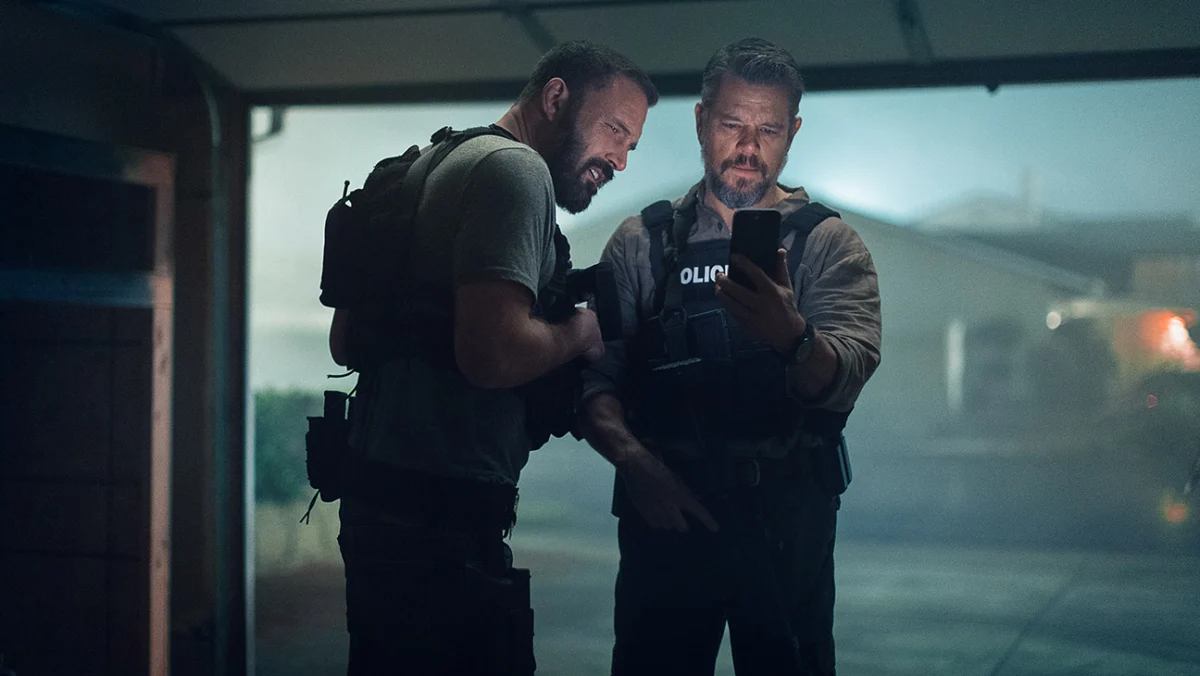
A groundbreaking moment in Hollywood’s evolving compensation landscape has arrived, as the 1,200-person team behind the crime drama The Rip has received additional compensation in the form of a performance bonus. This payout, initiated by Artists Equity, the production banner co-founded by industry veterans Ben Affleck and Matt Damon, marks a significant departure from traditional streaming remuneration structures, particularly with streaming giant Netflix. The announcement underscores Artists Equity’s core philosophy of ensuring creators and crew share in the financial success of their projects, a principle that could reshape future deals across the entertainment industry.
The news, revealed on Wednesday, confirms that Artists Equity disbursed a performance-based bonus to the entire cast and crew of The Rip. This unprecedented move stems from a uniquely structured deal negotiated with Netflix, which stipulated that a bonus would be triggered should the film meet predefined viewership thresholds. This mechanism stands in stark contrast to Netflix’s long-standing practice of offering a flat, upfront fee for content acquisition, a model that has often been a point of contention among creators and talent guilds in recent years.
The Genesis of a New Model: Artists Equity’s Vision
Artists Equity, launched in 2022 with substantial financing from Gerry Cardinale and his RedBird Capital Partners, was founded on a distinct business model: to empower filmmakers and ensure a more equitable distribution of profits. Affleck and Damon, with decades of experience navigating the complexities of Hollywood’s financial ecosystem, envisioned a company that would not only produce high-quality content but also fundamentally alter how value is shared. Their stated belief, "We built Artists Equity on the belief that filmmakers should share in the value they bring to a project," serves as the bedrock of their operational philosophy.
This ethos directly addresses a growing sentiment within the industry that the traditional upfront payment model, especially prevalent in the streaming era, often disincentivizes long-term success for creatives. While an upfront payment provides immediate financial security, it typically severs the talent’s connection to a project’s subsequent performance, even if a show or film garners millions of viewers and contributes significantly to a streamer’s subscriber growth and retention. By linking compensation to viewership, Artists Equity is championing a return to a form of profit participation, albeit adapted for the digital age, ensuring that the collective effort truly benefits from collective success.
A Landmark Deal with Netflix: Breaking the Mold
The deal for The Rip with Netflix is particularly notable because it challenged and ultimately altered the streaming giant’s established financial paradigm. Netflix, as the pioneer and dominant force in subscription video-on-demand (SVOD), built its content acquisition strategy around a "cost-plus" model, where it pays a production company a fixed fee plus a percentage for overhead, then assumes all ownership and intellectual property rights. This model, while simplifying negotiations and providing budgetary certainty, has been criticized for cutting out talent from the backend profits, which were historically a significant component of compensation in traditional theatrical releases and broadcast television.
For The Rip, Artists Equity successfully negotiated a deviation, securing a provision for a performance bonus contingent on viewership. This strategic negotiation signals a potential shift in Netflix’s willingness to experiment with compensation structures, perhaps in response to increasing pressure from talent and a more competitive streaming landscape. The success of The Rip in triggering these bonuses provides a tangible "proof point," as Affleck and Damon articulated, validating both their company’s model and Netflix’s openness to innovative partnerships. "We’d also like to thank Netflix for their belief in this project and the unique structure around it. This is a great proof point for our new partnership, and we’re confident it will be just the first in many shared hits," the co-founders stated, emphasizing the collaborative nature of this breakthrough.
Performance of The Rip and Its Impact
The Rip, a crime drama directed by Joe Carnahan, premiered on Netflix in January and quickly demonstrated its popularity, amassing an impressive 41.6 million views within its first three days of release. While specific viewership thresholds for the bonus payout were not publicly disclosed, this strong initial performance clearly met or exceeded the agreed-upon metrics, underscoring the film’s appeal and the effectiveness of the underlying deal structure. The film’s success not only delivered entertainment to a vast global audience but also delivered tangible financial benefits to the hundreds of individuals who brought it to life.
This immediate success of The Rip on the platform likely played a crucial role in cementing Artists Equity’s relationship with Netflix. Following the film’s debut, Netflix formalized a first-look deal with Artists Equity in March, indicating a deeper, more strategic partnership between the two entities. This agreement suggests that Netflix sees value not just in the content Artists Equity produces, but also in its innovative business model, potentially recognizing it as a means to attract top-tier talent and foster loyalty among creative teams.
A Broader Industry Context: The Battle for Fair Compensation
The timing of this announcement is particularly pertinent, coming amidst a period of intense labor disputes and widespread discussions about fair compensation in Hollywood. The recent Writers Guild of America (WGA) and SAG-AFTRA strikes, which brought the industry to a standstill for months, had backend compensation from streaming as a central demand. Both unions argued that the traditional streaming model, with its opaque viewership data and lack of residuals tied to performance, unfairly disadvantaged writers and actors.
Artists Equity’s model, independently developed, directly addresses many of the concerns raised by these unions. By transparently tying compensation to viewership performance, it offers a tangible solution to the problem of creators not sharing in the long-term success of their work on streaming platforms. While not a direct result of union negotiations, the success of The Rip’s bonus structure provides a real-world example of how performance-based compensation can be implemented, offering a potential blueprint for future industry-wide agreements. As Affleck noted back in January when the deal was first revealed, "We wanted to institute fairness and address some of the real issues that are present and urgent for our business." This statement resonates deeply with the sentiments expressed by striking workers and highlights Artists Equity’s alignment with broader calls for equity.
RedBird Capital Partners: Investing in Disruption
The strategic vision of Artists Equity is further bolstered by the financial backing of RedBird Capital Partners, led by its founder and managing partner, Gerry Cardinale. RedBird Capital is known for its opportunistic investments in sports, media, entertainment, and financial services, often targeting companies that are poised to disrupt traditional industries. Their investment in Artists Equity signals a belief not just in Affleck and Damon’s creative prowess, but in the viability and potential scalability of their innovative business model.
Cardinale’s philosophy typically involves partnering with proven management teams to build businesses that capitalize on macro trends and create long-term value. In the context of Artists Equity, RedBird’s investment represents a bet on the future of content creation and compensation. By supporting a model that aims to retain talent and foster a more collaborative and financially inclusive environment, RedBird is positioning Artists Equity as a leader in a potentially transformative shift within the entertainment industry’s economic framework. Their capital has allowed Artists Equity the latitude to experiment with deal structures that major studios might be hesitant to embrace, thereby becoming a testing ground for new industry norms.
Implications and Future Outlook
The bonus payout for The Rip has several significant implications for the future of Hollywood:
- Validation of Artists Equity’s Model: This success story firmly validates Artists Equity’s founding principles. It demonstrates that a model prioritizing talent participation can be both creatively successful and financially viable, attracting both top-tier talent and major distribution partners like Netflix.
- Pressure on Other Streamers: The successful implementation of a performance bonus by Netflix, even if initially an exception, could exert pressure on other streaming services to reconsider their own compensation models. As talent increasingly demands fairer terms, deals like The Rip will serve as powerful precedents.
- Empowerment of Talent: This development empowers creators, from lead actors to below-the-line crew members, by demonstrating that alternative compensation structures are achievable. It could lead to more robust negotiations for backend participation in future projects across the industry.
- Transparency and Data: While Netflix’s viewership data remains largely proprietary, the existence of viewership thresholds for bonuses implicitly acknowledges that performance metrics can and should be used to reward success. This could pave the way for greater transparency in data sharing, which was a key demand during the recent strikes.
- Attracting Top Talent: For Artists Equity, the ability to offer performance bonuses makes it an incredibly attractive partner for filmmakers. The promise of sharing in a project’s success, rather than just an upfront fee, can be a powerful differentiator in a competitive market for talent.
- Future Projects: With a first-look deal in place with Netflix, Artists Equity is poised to continue its innovative approach. Their upcoming project, Animals, directed by Affleck and starring Steven Yeun, Kerry Washington, and Gillian Anderson, will be another test of this partnership and model. Each successive project that employs this performance-based compensation structure will further solidify its place as a viable alternative.
Industry analysts are closely watching Artists Equity’s trajectory. Many view this development as a crucial step towards a more sustainable and equitable ecosystem for content creators in the streaming era. "This isn’t just about a bonus check; it’s about shifting the paradigm," commented a hypothetical industry analyst. "For years, the industry has grappled with how to fairly compensate talent in a streaming-first world. Artists Equity, with Netflix’s collaboration, has shown a concrete path forward that benefits everyone involved, from the studio to the last person on set." Similarly, a representative from a hypothetical labor advocacy group might state, "This move by Artists Equity aligns perfectly with the principles we championed during the strikes. It proves that performance-based compensation is not only feasible but essential for the long-term health of our creative community."
In conclusion, the performance bonus payout for The Rip is more than just an isolated financial transaction; it represents a significant milestone in the ongoing redefinition of value in Hollywood. By successfully implementing a compensation model that links a project’s success directly to the financial rewards for its creators, Artists Equity, supported by Netflix, has not only honored its foundational promise but also potentially laid the groundwork for a more equitable and transparent future for the entire entertainment industry. The ripples from The Rip‘s success are likely to be felt across streaming platforms and production houses for years to come.