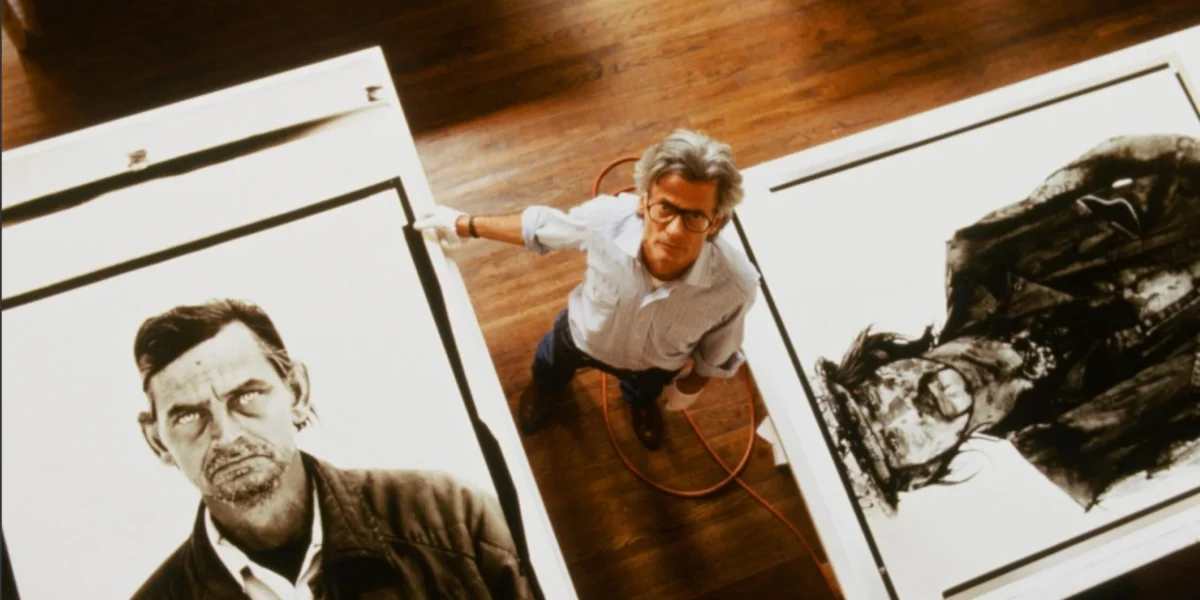
AVEDON, a feature-length documentary directed by Academy Award winner Ron Howard, offers an exhaustive examination of the life, career, and enduring cultural impact of Richard Avedon, the photographer whose work defined the visual language of the 20th century. Spanning 104 minutes, the film serves as both a biographical chronicle and a technical analysis of an artist who transitioned seamlessly between the high-gloss world of fashion and the gritty realities of political and social portraiture. Produced in close collaboration with the Richard Avedon Foundation, the documentary utilizes unprecedented access to the artist’s personal archives, featuring never-before-seen stills, intimate behind-the-lens footage, and a wealth of archival recordings of Avedon himself. By synthesizing these primary sources with contemporary interviews from family members and high-profile collaborators, Howard constructs a narrative that explores how a single individual’s eye could reshape global perceptions of beauty, power, and identity.
A Chronological Examination of a Sixty-Year Career
Richard Avedon’s professional journey, as outlined in the documentary, began in the mid-1940s and continued until his death in 2004. The film traces his early years, including his service in the Merchant Marine during World War II, where he was tasked with taking identification portraits of crewmen. This formative experience, though utilitarian, arguably sowed the seeds for his lifelong fascination with the human face and the technical precision required to capture it.
Following the war, Avedon’s rise was meteoric. The documentary highlights his tenure at Harper’s Bazaar under the mentorship of legendary art director Alexey Brodovitch. During this period, Avedon revolutionized fashion photography by moving models out of the static environment of the studio and into the streets of Paris, introducing a sense of motion and narrative that was previously absent from the genre. The film meticulously documents his transition to Vogue in 1966 and his eventual role as the first staff photographer for The New Yorker in 1992. This timeline serves to illustrate not just personal success, but the evolution of the American media landscape over six decades.
The Architectural Minimalism of the Avedon Style
A central theme of Howard’s documentary is the technical and philosophical "Avedon Style." The film provides a deep dive into Avedon’s preference for the stark, white background—a choice that became his signature. By removing all environmental context, Avedon forced the viewer to confront the subject directly. The documentary explains that this was not merely an aesthetic choice but a psychological one; the white background acted as a vacuum, stripping away the subject’s social status and leaving only their physical presence and emotional state.
One of the most significant segments of the film focuses on Avedon’s 1957 portrait of Marilyn Monroe. The documentary recounts the hours-long session where Monroe performed for the camera, providing the "magical, yet performative" smile expected of a Hollywood icon. Howard uses archival footage and commentary to describe the exact moment when the performance ended—a split second where Monroe, exhausted, allowed her guard to drop. The resulting photograph, which captures a look of profound melancholy, is presented as the ultimate proof of Avedon’s patience and his commitment to capturing a sense of reality beneath the artifice of celebrity.
The Intersection of Biography and Cinema: The "Funny Face" Connection
The documentary reveals a fascinating intersection between Avedon’s life and Hollywood history that may be unfamiliar to general audiences. It details how Avedon served as the direct inspiration for the 1957 musical film Funny Face, starring Fred Astaire and Audrey Hepburn. The film’s writer, Leonard Gershe, was a close friend of Avedon and based the protagonist, Dick Avery, on the photographer.
Furthermore, the documentary explains that Avedon’s actual romance with model Dorcas Marie Nowell provided the narrative backbone for the film’s romantic arc. Beyond just a biographical footnote, Avedon’s involvement in Funny Face extended to his role as a visual consultant, ensuring that the film’s photographic sequences mirrored his own innovative techniques. This segment of the documentary underscores Avedon’s influence not just on the printed page, but on the broader cinematic and pop-culture aesthetics of the 1950s.
Political Portrayals and Social Responsibility
While Avedon is often associated with the glamour of fashion, Ron Howard’s film places significant emphasis on the photographer’s political engagement. The documentary explores Avedon’s work during the Vietnam War, particularly his portraits of military leaders, government officials, and the victims of the conflict in Saigon. These images are contrasted with his fashion work to show the breadth of his range.
The film also touches upon Avedon’s civil rights photography, including his portraits of leaders like Malcolm X and the members of the Student Nonviolent Coordinating Committee (SNCC). Howard notes Avedon’s "disregard for prominent figures" in a way that suggests a democratic approach to his lens; whether he was photographing a member of a royal family or a mental health patient in a state asylum, he applied the same rigorous scrutiny. The documentary suggests that Avedon used his platform to challenge the power structures of the time, often upsetting those in positions of authority by refusing to provide the flattering depictions they expected.
Collaborative Insights and Personal Reflections
To round out the archival footage, Howard incorporates new interviews with a diverse group of individuals who knew Avedon intimately. Among the contributors are Isabella Rossellini and Lauren Hutton, both of whom worked extensively with Avedon. Their testimonies provide a nuanced view of his working methods, which they describe as intense and, at times, "ruthless." They depict a man who was uncompromising in his search for a specific truth, often pushing his subjects until they revealed something they hadn’t intended to show.
The inclusion of Avedon’s son, John F. Avedon, provides a more personal dimension to the narrative. He offers insights into his father’s upbringing and the personal drives that fueled his relentless work ethic. While the documentary, being produced in association with the Richard Avedon Foundation, maintains a largely celebratory tone, these interviews hint at the complexities and personal costs of maintaining such a high level of artistic output over sixty years.
Directorial Approach and Technical Contrast
Ron Howard’s directorial choices in AVEDON are characterized by a "invisible" style that allows the subject matter to remain the primary focus. The documentary utilizes a straightforward narrative structure, which some critics have noted resembles a "filmed Wikipedia entry" in its efficiency and clarity. However, this approach serves a specific purpose: it avoids distracting the audience from Avedon’s own visual legacy.
A notable technical aspect of the film is the contrast between the archival materials and the modern interviews. The archival footage is often grainy, shot on 16mm or 35mm film, reflecting the analog era in which Avedon operated. In contrast, the contemporary interviews are shot with modern digital equipment, featuring the clean, high-definition look typical of 21st-century Hollywood productions. This visual dichotomy serves as a subtle reminder of the shift from the chemical processes of the 20th century to the digital landscape of today—a transition that Avedon only lived to see the beginning of.
Broader Impact and the Legacy of the Image
The documentary concludes by analyzing Avedon’s lasting impact on the contemporary world. In an era where digital photography and social media have made image-making a universal activity, the film argues that Avedon’s work remains the "blueprint for our image-driven world." His ability to distill a person’s essence into a single frame set a standard that continues to influence photographers, filmmakers, and digital creators.
AVEDON suggests that the photographer’s true legacy lies in his democratization of the portrait. By using the same stark aesthetic for world leaders as he did for drifters in the American West, he challenged the notion that some lives were more worthy of artistic documentation than others. For students of art history, photography enthusiasts, and those interested in the cultural history of the 20th century, the film provides a comprehensive look at an artist who did not just record the world, but actively participated in its reinvention.
Ultimately, Howard’s film serves as a respectful tribute to a figure who bridged the gap between commercial success and high art. While it may avoid a "scathing" critique of its subject, it succeeds in communicating the sheer scale of Avedon’s contribution to visual culture. The documentary reinforces the idea that even the most iconic image is only half the story; the other half lies in the intent, the process, and the relentless drive of the person behind the lens.