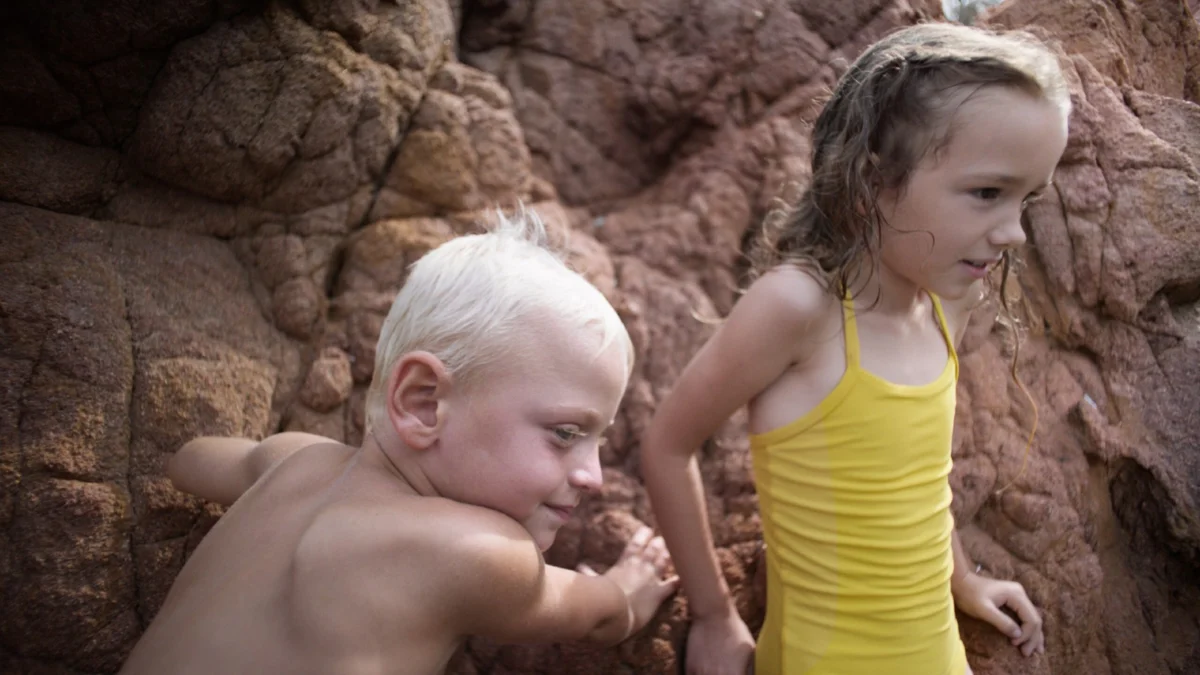
Cannes, France – Acclaimed French auteur Bruno Dumont, a filmmaker renowned for his uncompromising and often polarizing artistic vision, has once again defied cinematic expectations with his latest feature, Red Rocks (Les Roches rouges), which premiered at the prestigious Cannes Film Festival’s Directors’ Fortnight. The film represents a stark departure from his recent forays into genre pastiche, such as the sci-fi spoof The Empire, instead opting for a minimalist, docu-style drama starring an ensemble of non-professional child actors ranging in age from five to seven. This stylistic pivot underscores Dumont’s enduring commitment to experimentation, solidifying his reputation as an iconoclast of contemporary arthouse cinema, consistently pushing boundaries in form, narrative, and thematic exploration.
A Return to Rawness: The Premise of Red Rocks
Red Rocks strips away the elaborate visual effects and satirical humor of its predecessor, presenting a narrative framework so threadbare it borders on abstraction. Set against the breathtaking, sun-drenched vistas of the French Côte d’Azur, the film immerses viewers in the unvarnished daily lives of a small gang of children navigating the liminal space between innocence and nascent rebellion. The premise has drawn comparisons to a Rebel Without a Cause reimagined with a cast barely old enough to read, highlighting a deliberate choice by Dumont to explore fundamental human dynamics through the unfiltered lens of early childhood.
The narrative centers on Géo (Kaylon Lancel), a feisty, baby-blond boy who asserts his leadership over the group, riding his mini-moped with an air of precocious authority. Alongside his companions, Rouben (Mohamed Coly) and Manon (Louise Podolski), Géo’s summer days unfold in a series of unstructured adventures, characterized by playful mischief and a burgeoning sense of independence. This idyllic, albeit subtly transgressive, existence is subtly disrupted by the arrival of Eve (Kelsie Verdeilles), a new girl whose presence introduces the delicate complexities of puppy love and interpersonal rivalry into the children’s world.
Visual Splendor and Deliberate Minimalism
A defining characteristic of Red Rocks is its stunning cinematography, masterfully executed by Director of Photography Carlos Alfonso Corral, known for his work on films like The Damned. Employing short lenses and relying predominantly on natural light, Corral captures the rugged beauty of the Mediterranean coastline and the untamed energy of the child protagonists with a striking, almost painterly quality. The film’s aesthetic is arguably its most immediate and powerful selling point, transforming the sun-baked landscapes and the children’s spontaneous interactions into a visually arresting spectacle. This meticulous attention to visual detail, even within a minimalist framework, serves to ground the otherwise ethereal narrative in a palpable sense of place and atmosphere.
Dumont’s direction of his young, non-professional cast is particularly noteworthy. Eschewing conventional acting methods, he reportedly allowed the children a significant degree of improvisation and natural behavior, guiding them subtly rather than imposing rigid performances. This approach yields a raw authenticity that is both charming and disarmingly profound, capturing the genuine nuances of childhood emotion and interaction. The dialogue, sparse and often delivered with the hesitant cadence of early speech, further contributes to the film’s documentary-like realism, drawing the audience into the children’s world without artifice.
Bruno Dumont’s Unpredictable Artistic Trajectory
Bruno Dumont’s career is a testament to an artist’s relentless pursuit of new forms and ideas, often to the consternation of those who seek easily categorizable cinema. Since his 1997 breakthrough, The Life of Jesus, which earned him international acclaim for its stark portrayal of rural French life and its unflinching look at human brutality, Dumont has consistently reinvented his cinematic language. His filmography spans a remarkable spectrum, from the brutal realism of L’Humanité (for which he won the Grand Prix du Jury at Cannes in 1999) and Flanders, to the comedic absurdism of his acclaimed television series Li’l Quinquin (P’tit Quinquin), and the aforementioned sci-fi satire The Empire.
The Empire, his previous feature, was a bold, almost audacious, venture into a Star Wars spoof, complete with elaborate CGI — including a Gothic cathedral transforming into a spaceship — and a distinctly irreverent tone. While few saw it, its sheer audacity ensured it was not easily forgotten. Red Rocks positions itself at the absolute opposite end of this spectrum, demonstrating Dumont’s unique ability to oscillate between grand, fantastical canvases and intimate, almost microscopic, studies of human existence. This oscillation is not merely a stylistic whim but indicative of a deeper artistic philosophy that views cinema as a boundless medium for ongoing experimentation.
Themes of Innocence, Transgression, and Nascent Romance
While Red Rocks largely sidesteps the extreme depictions of violence and degradation found in some of Dumont’s earlier works, it retains his characteristic exploration of human nature’s darker undercurrents, albeit in a remarkably toned-down fashion. The pint-sized protagonists, while adorable, are not immune to the universal impulses of defiance and rule-breaking. Their adventures include daring jumps off the dazzling natural cliffs lining the Mediterranean, a visual metaphor for their burgeoning sense of freedom and the inherent risks of childhood exploration.
The burgeoning "puppy love" between Géo and Eve forms the emotional core of the film, told through Dumont’s typically distanced, observational approach. This style, while aesthetically consistent with his body of work, can at times make the film feel "thin" once the initial novelty of seeing young children enact an adult drama wears off, as some critics have noted. However, the film also benefits from Dumont’s unique brand of offbeat humor, reminiscent of Li’l Quinquin. A particularly memorable sequence sees Géo and Eve embarking on an impromptu journey by train across the border into Italy, where Eve visits her grandparents in a seaside mansion. This segment introduces a surreal, almost absurdist interlude, featuring an elderly man taking tennis lessons amidst a trio of Russian hunting dogs playfully snatching balls. While its direct relevance to the main plot is ambiguous, it injects a delightful vein of comic relief and further highlights Dumont’s penchant for the unexpected.
The children’s idyllic summer eventually gives way to a familiar trope of tragic romance: the emergence of a jealous rival. B (Alessandro Piquera), a boy slightly older and physically larger than Géo, threatens the nascent bond between Géo and Eve. Their inevitable confrontation culminates in a showdown at the seashore, which, while featuring some of the "raw violence" associated with Dumont, is significantly pared down and ultimately less brutal than his previous works. This narrative arc, though played out by very young children, touches upon universal themes of jealousy, confrontation, and the complexities of human relationships, filtered through a prism of early childhood.
The Cannes Directors’ Fortnight and Broader Implications
The selection of Red Rocks for the Directors’ Fortnight (Quinzaine des Cinéastes) at Cannes is particularly fitting. This parallel section of the festival, established in 1969, is renowned for its independent spirit and its commitment to showcasing innovative and unconventional cinema, often by emerging talents or established auteurs pushing artistic boundaries. Dumont, with his history of challenging cinematic norms, finds a natural home here, reaffirming the festival’s role as a vital platform for artistic discovery and challenging conventional filmmaking. His previous success at Cannes, including the Grand Prix du Jury for L’Humanité, underscores his deep ties to the festival circuit and its embrace of his distinctive vision.
The film’s focus on non-professional child actors also raises interesting discussions about ethical considerations and artistic methodology. Dumont has often stated his preference for non-professional actors, believing they bring an authenticity and unfiltered presence that trained actors often lose. In the context of Red Rocks, this choice amplifies the film’s docu-style realism, making the children’s interactions feel remarkably genuine. This approach, while artistically rewarding, requires careful and sensitive direction, particularly with subjects so young. It speaks to Dumont’s specific directorial philosophy that he manages to elicit such naturalistic performances without exploiting their innocence or subjecting them to the more extreme narrative elements found in his other works.
Dumont’s Evolving Edge: A Softening, or a New Frontier?
The relative gentleness of Red Rocks, particularly in comparison to the often-brutal themes of films like The Life of Jesus or L’Humanité, leads to speculation about a potential "softening" in Dumont’s artistic temperament as he ages. The thought of Géo and his friends enduring the atrocities that befall characters in some of his other films is indeed jarring, and highly unlikely given the involvement of child actors and their parents. However, to conclude that Dumont has lost his "edge" would be a misinterpretation of his consistent drive for reinvention. Instead, Red Rocks can be seen as a sophisticated exploration of the very foundations of human behavior – love, jealousy, friendship, and rebellion – examined at their most nascent stage.
The film’s critical reception will undoubtedly be varied, mirroring the often-polarized opinions on Dumont’s entire oeuvre. Some will undoubtedly laud its visual poetry and its daring approach to childhood narrative, while others may find its minimalist plot and distanced perspective challenging. Yet, what remains undeniable is Dumont’s singular vision and his unwavering commitment to cinema as a medium for profound, often unsettling, inquiry. Red Rocks stands as a testament to an artist who refuses to be pigeonholed, continuously seeking new ways to provoke thought, challenge perception, and explore the complex tapestry of the human condition, even when presented through the seemingly simple world of children at play. It confirms that Bruno Dumont, in his perpetual quest for the unoriginal, remains one of the most vital and unpredictable voices in contemporary cinema.