The cinematic history of Darren Aronofsky’s The Fountain serves as a quintessential study in the perseverance of artistic vision within the volatile landscape of major studio production. Released in late 2006, the film remains one of the most ambitious and polarizing entries in modern science fiction and fantasy. Spanning a narrative arc of one thousand years, the project explored themes of mortality, the quest for eternal life, and the acceptance of death through three interlocking storylines. While the film’s commercial performance at the time of its release was underwhelming, its reputation has undergone a significant transformation over the last two decades, evolving from a misunderstood box office failure into a celebrated cult masterpiece noted for its visual ingenuity and philosophical depth.
The Evolution of Production and Development Challenges
The development of The Fountain was characterized by a series of high-profile setbacks that nearly resulted in the project’s permanent cancellation. Following the critical success of Requiem for a Dream in 2000, Darren Aronofsky began developing the concept for The Fountain with a projected budget of $70 million. At that stage, the production was backed by Warner Bros. and Village Roadshow, with Brad Pitt and Cate Blanchett signed on to play the lead roles. The scale of the film was significantly larger than the final version, involving massive sets in Australia and hundreds of extras for elaborate battle sequences set in the 16th century.
However, the production collapsed in 2002, just seven weeks before principal photography was scheduled to begin. Brad Pitt departed the project due to creative differences and scheduling conflicts, leading Warner Bros. to halt production. The sets were dismantled and sold, and the project was effectively mothballed. Despite this catastrophic failure, Aronofsky spent the subsequent two years refining the screenplay, stripping away the more expensive action elements to focus on the intimate, emotional core of the story. By reducing the budget to $35 million, he managed to secure new financing and cast Hugh Jackman and Rachel Weisz in the lead roles, effectively resurrecting the film from development hell.
Narrative Structure and Thematic Framework
The Fountain utilizes a non-linear narrative structure that weaves together three distinct timelines, each featuring characters portrayed by Jackman and Weisz. These timelines are not merely chronological sequels to one another but are often interpreted as metaphorical or literary layers within the film’s internal logic.

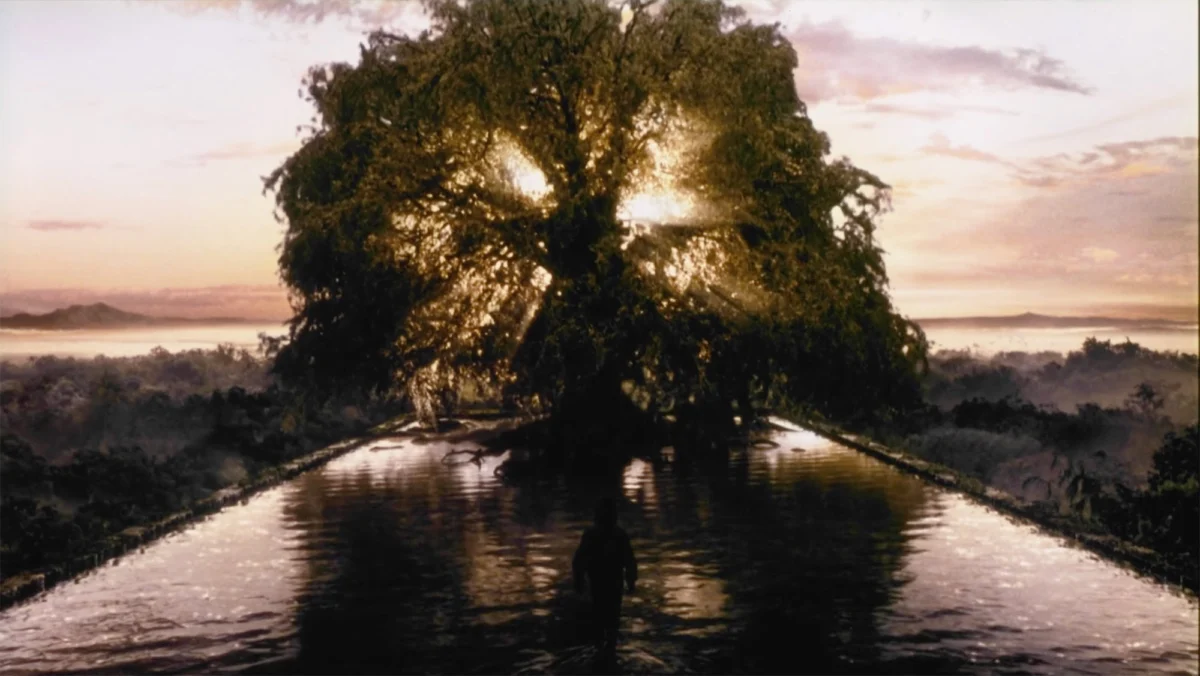
The first timeline takes place in 16th-century Spain, where a conquistador named Tomas seeks the legendary Tree of Life in the Mayan jungle to save his Queen, Isabel, from the religious and political threats of the Spanish Inquisition. The second timeline, set in the present day (circa 2005), follows Dr. Tom Creo, a neuroscientist desperately searching for a cure for the brain tumor afflicting his wife, Izzi. The third timeline, set in the year 2500, depicts a space traveler named Tom drifting through the cosmos in a transparent spherical spacecraft containing a dying tree, heading toward the golden nebula of Xibalba.
Thematically, the film acts as a triptych on the human struggle against the inevitability of death. While the 16th-century and 21st-century segments focus on the frantic struggle to preserve physical life, the futuristic segment represents a spiritual or psychological synthesis, where the protagonist finally grapples with the concept of death as an act of creation. This thematic density was a primary point of contention among critics during the film’s initial release, with some praising its metaphysical ambition and others dismissing it as overblown.
Technical Innovation and Visual Artistry
One of the most enduring aspects of The Fountain is its visual presentation, which deliberately eschewed the burgeoning trend of heavy Computer-Generated Imagery (CGI) that defined mid-2000s cinema. To create the ethereal, celestial environments of the space-travel sequences, Aronofsky and cinematographer Matthew Libatique collaborated with macro-photographer Peter Parks.
Parks used chemical reactions and micro-organisms in Petri dishes—including yeast, dyes, and solvents—photographing them at high magnification to simulate the appearance of deep-space nebulas and exploding stars. This organic approach gave the film a timeless aesthetic quality, ensuring that the visuals did not age as rapidly as contemporary digital effects. The film’s color palette is also highly deliberate, utilizing gold and white to represent life and spirituality, contrasted with the sterile clinical blues and blacks of the hospital and deep space.
The auditory experience of the film was equally significant. The score, composed by Clint Mansell and performed by the Kronos Quartet and the Scottish post-rock band Mogwai, is frequently cited as one of the greatest film scores of the 21st century. The music serves as a connective tissue between the three timelines, utilizing recurring motifs that build in intensity, mirroring the protagonist’s increasing desperation and eventual transcendence.

Financial Performance and Critical Reception
The Fountain premiered at the 63rd Venice International Film Festival in September 2006, where it famously received a polarized reaction, including both boos and a standing ovation. Upon its wide release on November 22, 2006, the film struggled to find a mainstream audience. It opened in 1,472 theaters in the United States, grossing only $3.7 million in its opening weekend. By the end of its theatrical run, it had earned approximately $10.1 million domestically and $5.8 million internationally, for a total global gross of $15.9 million—less than half of its $35 million production budget.
Critical reception at the time was sharply divided. Aggregator sites like Rotten Tomatoes initially showed a "rotten" rating, as critics struggled with the film’s earnestness and non-linear logic. Prominent critics like Roger Ebert, however, championed the film, recognizing its attempt to tackle "the most difficult of all subjects: the fact that we are born, we live, and we must die." Over time, the critical consensus has shifted toward the positive, with many retrospective reviews acknowledging the film’s bravery in a landscape dominated by safer, franchise-driven content.
Official Responses and Historical Context
In the years following the release, Darren Aronofsky has frequently spoken about the grueling process of bringing the film to fruition. He has described the project as a "labor of love" and noted that the constraints imposed by the budget cut actually improved the film by forcing him to focus on the characters rather than the spectacle. Hugh Jackman has also consistently cited his role in The Fountain as one of the most rewarding of his career, noting that the physical and emotional demands of playing three versions of the same man required a level of vulnerability rarely seen in blockbuster cinema.
Industry analysts often point to The Fountain as a turning point for Aronofsky. The financial failure of the film led him to direct The Wrestler (2008), a gritty, low-budget character study that revitalized his career and paved the way for the massive commercial and critical success of Black Swan (2010). In this context, The Fountain is seen as the "experimental" bridge between his early independent work and his later status as an A-list auteur.
Broader Impact and Enduring Legacy
The legacy of The Fountain is visible in the subsequent wave of "philosophical science fiction" that emerged in the 2010s. Films such as Cloud Atlas, Interstellar, and Arrival share The Fountain’s DNA in their willingness to use genre tropes to explore complex human emotions and temporal distortions. The film also predated the modern era of "elevated genre" filmmaking, where directors are given leeway to pursue highly personal, visually distinct projects that defy easy categorization.

Furthermore, the film’s exploration of Mayan mythology and the concept of Xibalba (the underworld) sparked a brief surge of interest in pre-Columbian cosmology within popular culture. Its use of the "Tree of Life" motif remains a powerful visual shorthand for the intersection of biology and spirituality.
As of 2026, The Fountain continues to be a staple of retrospective screenings and film studies curricula. While it may not have achieved the commercial success Warner Bros. originally envisioned for a $70 million Brad Pitt vehicle, it has achieved a different kind of immortality. By stripping the story down to its essence and refusing to compromise on its challenging narrative structure, Aronofsky created a film that remains as relevant and visually arresting today as it was upon its debut two decades ago. The film stands as a testament to the idea that true cinematic value is not always measured in opening weekend box office receipts, but in the longevity of the ideas and images it leaves behind.