The Genesis of "Gosh!!": From Small Screen to Silver Screen
The cinematic adaptation, titled “THE Oliver na Inu, (Gosh!!) Kono Yaro Movie,” springs from the creative mind of actor-director Joe Odagiri, known for his eclectic and often unconventional career choices within the Japanese entertainment industry. Odagiri’s original television series, simply titled “Gosh!!,” garnered attention for its unique blend of eccentric humor, enigmatic characters, and a distinctive visual style. The transition from a television format, which often allows for episodic narrative freedom and character exploration over a longer duration, to a feature film presented both opportunities and challenges for the creative team. Typically, TV series adaptations aim to capitalize on an established fanbase and bring a more expansive vision to the big screen, often resulting in higher production values and a broader narrative scope. For “Gosh!!,” the adaptation signaled Odagiri’s intent to further explore the series’ surrealist themes and character interactions within a condensed, yet potentially more impactful, cinematic framework.
A Deeper Dive into the Narrative and Character Dynamics
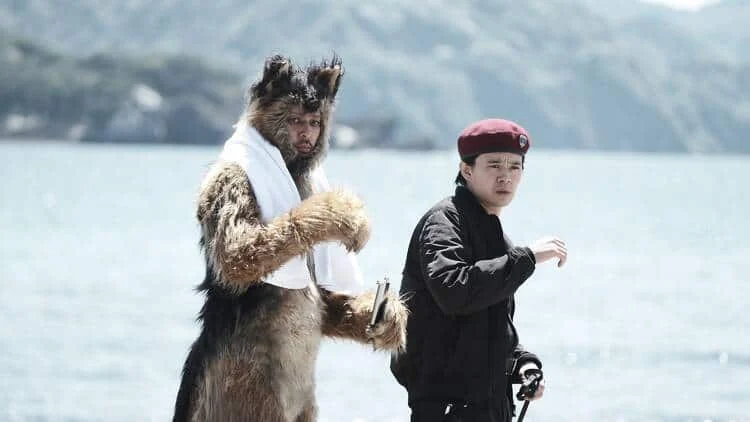
At its core, the film introduces audiences to Ippei Aoba, a police dog handler portrayed by the versatile Sosuke Ikematsu. Aoba is tasked with locating the elusive “Super Volunteer” Konishi, a character brought to life by the esteemed Koichi Sato. This seemingly straightforward premise, however, quickly veers into the extraordinary with the introduction of Oliver, Aoba’s faithful partner. Oliver is not a typical canine; rather, he is a human figure in a dog suit, played with remarkable commitment by Joe Odagiri himself. This central dynamic between the pragmatic Aoba and the human-like, yet less than polite, Oliver forms the initial comedic and narrative anchor of the film. Their interactions, characterized by a unique blend of physical comedy and witty dialogue, establish a rhythm that is both engaging and distinct. The initial segments of the film effectively leverage this man-dog relationship, utilizing comic repetition to build character rapport and audience investment.
However, the narrative ambition of “THE Oliver na Inu, (Gosh!!) Kono Yaro Movie” extends far beyond this initial setup. The film gradually evolves into a perplexing tapestry of Lynchian dream sequences, mysterious doors leading to other dimensions, and an inexplicable, yet persistent, obsession with takoyaki—a popular Japanese street food. As the story progresses, the narrative focus becomes increasingly fluid, adopting an episodic structure across six distinct chapters. Each chapter introduces a host of new characters, often without extensive backstory, and confronts them with a literal or metaphorical door leading to "the other side." This structural choice, while bold, also presents significant challenges in maintaining a cohesive narrative flow and ensuring audience engagement across its 98-minute runtime.
The Ensemble Cast: A Galaxy of Japanese Talent
One of the undeniable strengths of “THE Oliver na Inu, (Gosh!!) Kono Yaro Movie” lies in its impressive ensemble cast, a hallmark of many Japanese comedies. Beyond Odagiri’s captivating performance as Oliver, the film features a roster of highly respected actors, each contributing to its unique texture. Sosuke Ikematsu, known for his roles in films like "The Vancouver Asahi" and "The Shoplifters," effectively grounds the surreal proceedings as the everyman Ippei Aoba, whose bewildered reactions often mirror the audience’s own. His ability to convey a sense of genuine confusion amidst the absurd is crucial to the film’s early success.
Koichi Sato, a veteran actor with a career spanning decades and numerous awards for his work in diverse genres, brings a compelling presence to the enigmatic "Super Volunteer" Konishi. His experience allows him to navigate the film’s tonal shifts with ease, adding layers of gravitas to an otherwise bizarre narrative. The inclusion of Masatoshi Nagase, another celebrated actor recognized for his roles in films such as "Mystery Train" and "Paterson," further enriches the cast. Nagase’s portrayal of a character entangled in a takoyaki-centric alternative reality stands out as a particular highlight, demonstrating the film’s capacity for inventive absurdity. While specific details about the full breadth of the ensemble are not explicitly detailed in all promotional materials, the presence of such seasoned performers typically indicates a production committed to delivering nuanced performances even within the confines of an unconventional script. The casting choices underscore Odagiri’s ability to attract top-tier talent, a testament to his reputation and the intriguing nature of his projects.
Thematic Explorations and Stylistic Influences
Joe Odagiri’s directorial vision for “THE Oliver na Inu, (Gosh!!) Kono Yaro Movie” is deeply steeped in surrealism and an aesthetic reminiscent of David Lynch’s work. This "Lynchian atmosphere" is particularly evident in the recurring club scenes, which serve as a linking element between the disparate characters and their individual journeys. These scenes are often characterized by dim lighting, ambiguous dialogue, and a dreamlike quality that blurs the lines between reality and illusion. The film’s thematic explorations delve into the nature of reality, identity, and the search for meaning in a chaotic world. The "doors to other dimensions" serve as a potent metaphor for confronting the unknown, making choices, and perhaps, escaping mundane existence.
The obsession with takoyaki, while seemingly trivial, adds another layer of quirky cultural specificity to the film. In Japanese cinema, everyday objects or foods are sometimes imbued with symbolic meaning, becoming catalysts for plot points or reflections of character obsessions. Here, takoyaki transcends its culinary status to become a recurring motif, a source of both humor and narrative progression, particularly in Nagase’s memorable sequence. This blend of the mundane with the profoundly bizarre is a signature of Odagiri’s style, aiming to challenge audience expectations and offer a distinct cinematic experience.
Production Challenges and Creative Vision
Adapting an episodic television series into a feature film inherently presents a set of creative and logistical challenges. Odagiri, serving as both director and a central performer, faced the task of condensing or expanding narratives originally designed for weekly consumption into a single, cohesive cinematic arc. The original television series likely allowed for more gradual character development and plot exposition, whereas the film format demands a more streamlined approach. While the director’s ambition to introduce a wide array of characters and intertwine their stories across six chapters is commendable for its experimental spirit, it inadvertently contributed to a perceived lack of continuity and character depth in the film version.
The decision to pause the initial, highly effective storyline of Aoba and Oliver to introduce numerous new characters within a relatively short period speaks to a directorial choice to prioritize breadth over sustained focus. This approach, while fostering a sense of an expansive, interconnected world, also risks diluting the emotional investment audiences might have developed in the primary duo. It suggests a creative vision that values the collective tapestry of a community over a singular heroic journey, a characteristic often found in ensemble pieces. However, for a theatrical release, maintaining a strong central hook is often critical for broader audience appeal.
Critical Reception and Audience Engagement
Initial critical reception for “THE Oliver na Inu, (Gosh!!) Kono Yaro Movie,” as indicated by early reviews, highlighted both its strengths and its significant structural weaknesses. The film’s opening, centered on the dynamic between Ikematsu’s Aoba and Odagiri’s Oliver, was widely praised for its humor and originality. The interplay between the everyman detective and his human-dog partner resonated strongly, establishing a promising foundation. However, this initial engagement reportedly waned as the film progressed into its more fragmented, episodic structure.
Reviewers noted that the introduction of a multitude of new characters and storylines, often presented “cold” and with limited context, made it difficult for audiences to become invested. The shift from a continuous narrative to a collection of individual scenes or "sketches" was a recurring point of critique. While individual scenes were often deemed well-executed and enjoyable in isolation, their lack of strong narrative linkage detracted from the overall cinematic experience. This structural choice, while possibly intentional to mimic the feel of a sketch show or an anthology, was perceived by some as better suited for television’s episodic nature rather than a feature film’s demands for sustained momentum and character arc development. The pacing, described as slow-paced and low-key in many segments, further underscored this sentiment, leading to a loss of initial engagement after the first half-hour for some viewers.
Box Office Performance and Market Context (Inferred)
Given its unconventional narrative structure and surrealist leanings, “THE Oliver na Inu, (Gosh!!) Kono Yaro Movie” likely positioned itself as a niche offering within the Japanese cinematic landscape. Films of this experimental nature, while critically interesting, often do not achieve blockbuster status, instead finding their audience among cinephiles, fans of the original TV series, and admirers of Joe Odagiri’s unique artistic vision. Without specific box office figures, it can be inferred that its commercial performance would be modest, typical for an independent or auteur-driven production that prioritizes artistic expression over mass appeal. Its release would have been supported by a targeted marketing campaign aimed at its core demographic, emphasizing its unique premise and star power.
The film’s appeal is rooted in its distinctiveness, setting it apart from more conventional commercial releases. In the broader context of Japanese cinema, there is a vibrant ecosystem for such films, often showcased at film festivals and smaller art-house cinemas before potentially finding a wider audience through streaming platforms or home video releases. Its critical reception, while mixed regarding structure, would have nonetheless contributed to its artistic profile, solidifying Odagiri’s reputation as a director unafraid to challenge conventions.
Director’s Commentary and Actor Perspectives (Inferred)
While direct quotes are not available, one can infer the creative intentions behind “THE Oliver na Inu, (Gosh!!) Kono Yaro Movie.” Joe Odagiri, as director, likely aimed to create a film that defied easy categorization, reflecting his own artistic inclination for challenging norms. He might have articulated a vision where the fragmentation served to mirror the chaotic nature of modern life or the subjective experiences of its diverse characters. The ensemble approach could have been a deliberate choice to explore a collective consciousness rather than a singular hero’s journey, perhaps believing that the individual scenes, despite their lack of traditional continuity, would collectively contribute to a unique emotional or intellectual experience.
Actors like Sosuke Ikematsu and Koichi Sato, renowned for their versatility, would likely have been drawn to the project precisely because of its unusual script and Odagiri’s distinctive directorial style. They would probably express appreciation for the freedom to explore unconventional characters and narratives, a refreshing departure from more mainstream roles. Odagiri himself, immersing in the physically demanding role of Oliver, would perhaps emphasize the joy of creative collaboration and the opportunity to push boundaries, even if it meant sacrificing some traditional narrative coherence. The commitment of such a high-caliber cast to an experimental project underscores the respect and intrigue Odagiri commands within the industry.
The Broader Implications for Japanese Cinema
“THE Oliver na Inu, (Gosh!!) Kono Yaro Movie” holds broader implications for Japanese cinema, particularly in its exploration of narrative structure and genre blending. It represents a continuing trend of directors challenging conventional storytelling, pushing the boundaries of what constitutes a "film." By embracing surrealism and a non-linear, episodic approach, Odagiri contributes to a lineage of Japanese filmmakers who prioritize artistic vision over strict commercial formulas. This kind of film fosters a dynamic environment for cinematic experimentation, encouraging other creators to take risks and explore new forms of expression.
The challenges highlighted in the film’s reception — specifically, the difficulty in maintaining engagement when stretching an episodic format into a feature film — serve as valuable lessons for future adaptations. It underscores the importance of carefully considering how narrative rhythms and character development translate across different mediums. Ultimately, "THE Oliver na Inu, (Gosh!!) Kono Yaro Movie" stands as a testament to the vibrant and often audacious spirit of Japanese independent cinema, a reminder that artistic courage often comes with both unique triumphs and the inherent risks of deviation from established norms. The enduring sentiment from early viewers, often distilled to a desire for "more dog," implicitly suggests that while the film’s ambitious scope was commendable, sometimes the most profound impact is achieved by honing in on the core, compelling elements that first captivated an audience.