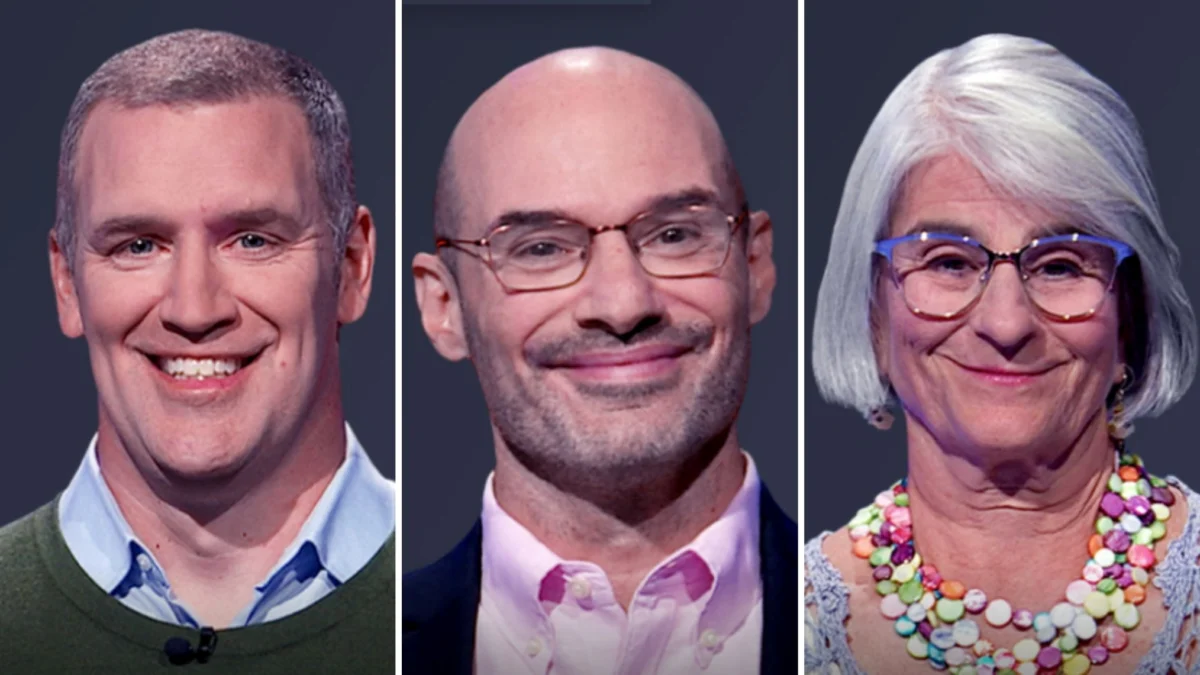
Greg Shahade, a professional chess master from Philadelphia, Pennsylvania, secured his third consecutive victory on the April 29 episode of Jeopardy!, bringing his cumulative three-day winnings to $74,602. Following a high-profile win against "super champion" Jamie Ding, Shahade faced a challenging match characterized by significant statistical swings, aggressive wagering, and a high frequency of unforced errors. Competing against Ian Samson, a firefighter from Matthews, North Carolina, and Beth Orlansky, a retired public interest attorney from Jackson, Mississippi, Shahade demonstrated the high-risk, high-reward tactical approach often associated with elite competitive strategists.
The Jeopardy! Round: Early Dominance and Strategic Wagers
Shahade entered the match with considerable momentum, having already amassed $54,601 in his previous two appearances. The first round of play saw Shahade maintaining a perfect response rate through the initial clues, establishing an early lead that he sought to capitalize on via the Daily Double.
The first Daily Double appeared on the sixth clue of the game under the category "Talking About Fight Club." Shahade, holding $4,400, opted for a "True Daily Double," wagering his entire bankroll. The clue referenced a historical airline branding: "Until 2005, this airline had a customer loyalty program called the Flying Dutchman." After a brief moment of deliberation—a pause that has become a signature of Shahade’s deliberate playstyle—he correctly identified the airline as KLM (Koninklijke Luchtvaart Maatschappij).
This successful wager doubled his score to $8,800. By the first commercial break, Shahade held a commanding lead with $9,400. At the conclusion of the first round, the standings reflected Shahade’s dominance: he held $11,800, while Samson trailed with $2,400 and Orlansky sat in third with $1,000.
Double Jeopardy!: Volatility and the Cost of Aggression
The second round, Double Jeopardy!, introduced a period of significant volatility for the returning champion. Shahade located the first of the two available Daily Doubles on the third clue of the round. The category was "The English Romantic Poets," and the clue read: "Keats tells this subject of an ode, ‘Thou wast not born for death, immortal bird!’" Shahade correctly identified the subject as a "nightingale," adding $5,000 to his total and bringing his score to $16,400.
However, the momentum shifted almost immediately. On the very next clue, Shahade uncovered the third and final Daily Double in the category "On The ‘M’ap." Waging $6,000, he faced the following prompt: "The name of this Alberta city refers to an actual accessory called a saamis." Shahade incorrectly responded with "Moose Jaw," a city located in Saskatchewan, rather than the correct answer, Medicine Hat. This error resulted in a $6,000 loss, dropping his score to $10,400.
The remainder of the Double Jeopardy! round was marked by a rare statistical anomaly for a three-day champion. While Shahade successfully answered seven consecutive clues following his Daily Double loss to rebuild his lead to $17,600, he subsequently committed nine incorrect responses throughout the rest of the round. This "error-ridden" phase allowed Ian Samson to close the gap significantly. Samson, capitalizing on Shahade’s misses, answered three clues in a row to reach $8,000. By the time the round concluded, Shahade led with $16,000, Samson followed with $10,000, and Orlansky remained in contention with $4,200.
Final Jeopardy! and the Seneca Falls Declaration
The outcome of the match hinged on the Final Jeopardy! category, "Historic Destinations." The clue required contestants to demonstrate knowledge of American civil rights history: "The 1848 Seneca Falls Declaration added these 2 words to the declaration of independence line beginning, ‘we hold these truths…’"
The Seneca Falls Convention, held in July 1848 in New York, is widely regarded as the birthplace of the organized women’s rights movement in the United States. The "Declaration of Sentiments," primarily authored by Elizabeth Cady Stanton, deliberately mirrored the language of the 1776 Declaration of Independence to highlight the inconsistency of American democratic ideals.
Beth Orlansky correctly identified the missing words as "and women," bringing her total to $4,233 after a modest $33 wager. Ian Samson, however, failed to provide the correct response, answering "What is self-evident?" and wagering his entire $10,000 bankroll, leaving him with a final score of $0.
Shahade provided the correct response, "What are ‘and women’?" Maintaining his aggressive wagering strategy, he bet $4,001, securing a final total of $20,001 for the day. This victory brought his total three-day winnings to $74,602 and confirmed his status as a formidable, albeit unconventional, competitor.
Statistical Analysis and Contestant Performance
Shahade’s performance on April 29 provides a compelling case study in the intersection of speed and accuracy. While his high number of incorrect responses in the latter half of the game would typically jeopardize a lead, his dominance on high-value clues and successful navigation of two out of three Daily Doubles provided the necessary cushion to survive Samson’s late-game surge.
The Coryat score—a metric used by Jeopardy! analysts to measure a contestant’s performance excluding wagers—reveals a more competitive match than the final scores might suggest. Shahade’s tendency to "ring in" aggressively reflects his background as an International Master in chess, where time pressure and calculated risks are fundamental to the game. However, the nine errors recorded in a single round represent an unusually high margin of error for a returning champion, suggesting either a lack of familiarity with the specific categories in the second round or a strategic choice to prioritize buzzer speed over certainty.
| Contestant | Starting Score (FJ) | Wager | Final Score |
|---|---|---|---|
| Greg Shahade | $16,000 | $4,001 | $20,001 |
| Ian Samson | $10,000 | ($10,000) | $0 |
| Beth Orlansky | $4,200 | $33 | $4,233 |
Background: The Transition from the Jamie Ding Era
The context of Shahade’s current run is notable for its timing. He ascended to the champion’s lectern after defeating Jamie Ding, a player who had garnered significant attention for his consistent play and "super champion" potential. Defeating a high-level incumbent often places a "giant-killer" narrative on the new champion, a role Shahade has embraced through a playstyle that emphasizes large wagers and rapid-fire responses.
Shahade’s professional background as a chess master has been a recurring point of interest for the show’s audience. As the founder of the U.S. Chess School and a prominent figure in the American chess community, Shahade is accustomed to the psychological pressures of tournament play. Observers have noted that his comfort with "True Daily Doubles" and his ability to remain composed after a $6,000 loss are traits honed through years of competitive board play.
Historical and Cultural Context of the Clues
The clues featured in this episode spanned a wide array of disciplines, from commercial aviation history to 19th-century literature. The "Flying Dutchman" clue highlighted the branding history of KLM, the flag carrier of the Netherlands and the oldest operating airline in the world. The "Flying Dutchman" name was used for their loyalty program until the airline’s merger with Air France in 2004, after which it was integrated into the "Flying Blue" program.
The literary reference to John Keats’ "Ode to a Nightingale" touched upon one of the most celebrated works of the English Romantic period. Written in 1819, the poem explores themes of mortality and the transcendence of art, specifically through the "immortal" song of the bird. Such clues test a contestant’s breadth of liberal arts knowledge, a staple of the Jeopardy! format.
The Final Jeopardy! clue regarding the Seneca Falls Convention underscored the enduring relevance of the Declaration of Sentiments. By adding the words "and women" to the phrase "all men are created equal," the 1848 delegates challenged the social, legal, and political status quo of the mid-19th century. Shahade’s correct response to this clue demonstrates the well-rounded knowledge base required to sustain a multi-day winning streak.
Broader Implications and Tournament of Champions Prospects
With three wins and over $74,000 in winnings, Shahade is now on the radar for potential inclusion in the annual Tournament of Champions (ToC). While the qualifying criteria typically favor contestants with five or more wins, the total prize money accumulated in a three-game span can occasionally secure a spot or an invitation to a "Champions Wildcard" event.
Shahade’s survival despite a high error count suggests that his opponents must match his buzzer speed to prevent him from controlling the board. As his streak continues, future contestants will likely analyze his wagering patterns—specifically his willingness to bet large sums on Daily Doubles—to formulate defensive strategies.
The success of the program continues to be driven by contestants like Shahade, who bring diverse professional expertise and high-stakes gambling instincts to the game. His performance serves as a reminder that Jeopardy! is as much a game of psychological endurance and strategic risk management as it is a test of factual recall.
Jeopardy! continues to air weekdays, with viewers encouraged to check local listings for exact times. Episodes are also available for streaming the following day on platforms including Hulu and Peacock. Shahade will return for his fourth game to defend his title against two new challengers, as he aims to further cement his place in the show’s storied history.