Social media algorithms have transitioned from simple curators of personal updates to complex delivery systems for a mix of authentic, staged, and entirely synthetic media. As users scroll through platforms such as Facebook, TikTok, and Instagram, the content they encounter ranges from lifestyle aesthetics and viral pet videos to breaking news from volatile regions like the Middle East. However, a significant shift in the digital landscape has occurred: the influx of generative artificial intelligence (AI) has made it increasingly difficult for the average consumer to distinguish between what is real and what is a sophisticated digital fabrication. This phenomenon, often referred to as the rise of synthetic media, poses a dual challenge—it offers new avenues for creative entertainment while simultaneously threatening the foundations of public trust and information integrity.
The current saturation of social media with AI-generated content is no longer a fringe occurrence. What began as low-resolution "deepfakes" has evolved into high-fidelity video and imagery that can deceive even discerning observers. A recent investigation by The Hollywood Reporter highlights the severity of this issue, revealing that methods of detection used just a few years ago are now largely obsolete. As synthetic media becomes abundant, a psychological shift occurs within the audience; studies indicate that when people are frequently exposed to "dupes," they begin to lose faith in verified, authentic video, leading to a broader societal erosion of objective truth.
The Evolution of Synthetic Media: A Chronology of Innovation and Deception
The trajectory of AI-generated content on social media can be traced through several key milestones. In 2017, the world saw the debut of Shudu Gram, widely recognized as the first digital supermodel. Created by photographer Cameron-James Wilson, Shudu was a proof-of-concept for the "digital human" industry. While her existence was eventually disclosed, her initial appearance fooled many, leading to high-profile collaborations with luxury brands like Balmain. This marked the beginning of the "virtual influencer" era, where digital entities began competing with human creators for engagement and advertising revenue.
By 2022 and 2023, the democratization of generative AI tools—such as Midjourney for images and early iterations of video generators—allowed non-experts to create synthetic content at scale. The year 2024 saw the introduction of even more advanced models, including OpenAI’s Sora and its successors. These tools enabled the creation of complex, photorealistic scenes from simple text prompts. By 2025 and 2026, as evidenced by current social media trends, the technology reached a point where AI could replicate human movement, emotional expression, and environmental lighting with near-perfect accuracy.
This technological progression has created a "mirage effect" in the creator economy. Influencers like Nara Smith and Quenlin Blackwell, who are real individuals with millions of followers, often find their content scrutinized by users who suspect AI intervention. Smith, known for her highly stylized, labor-intensive cooking videos, and Blackwell, a comedian and model, represent the peak of human-produced "aesthetic" content. Their videos are so polished that they often trigger the same "uncanny valley" response as AI, demonstrating how the lines between human perfection and digital simulation have blurred.
Case Studies in Digital Discernment: From Lifestyle to Geopolitics
The spectrum of AI content ranges from harmless entertainment to dangerous disinformation. On the lighter side of the scale are viral "engagement bait" videos. For example, a widely circulated video featuring children expressing confusion over a "duplicated" baby sibling was recently revealed to be a complete AI fabrication. Similarly, videos of "shelter dogs choosing their owners" went viral, pulling at the heartstrings of millions before being debunked as creations of Sora 2. While these examples may seem benign, they represent a monetization of deception, where AI is used to manufacture emotional responses for clicks and ad revenue.
More predatory are the AI-generated health and fitness trends. A prominent example includes videos promoting "Tai Chi" routines that promise dramatic physical transformations, such as "rock-hard abs in 28 days." Many professional Tai Chi practitioners have called out these videos for being AI-generated, noting that they promise unrealistic results to lure users into expensive or deceptive subscription services. This highlights how AI is being weaponized in the "scam economy" to exploit the insecurities of social media users.
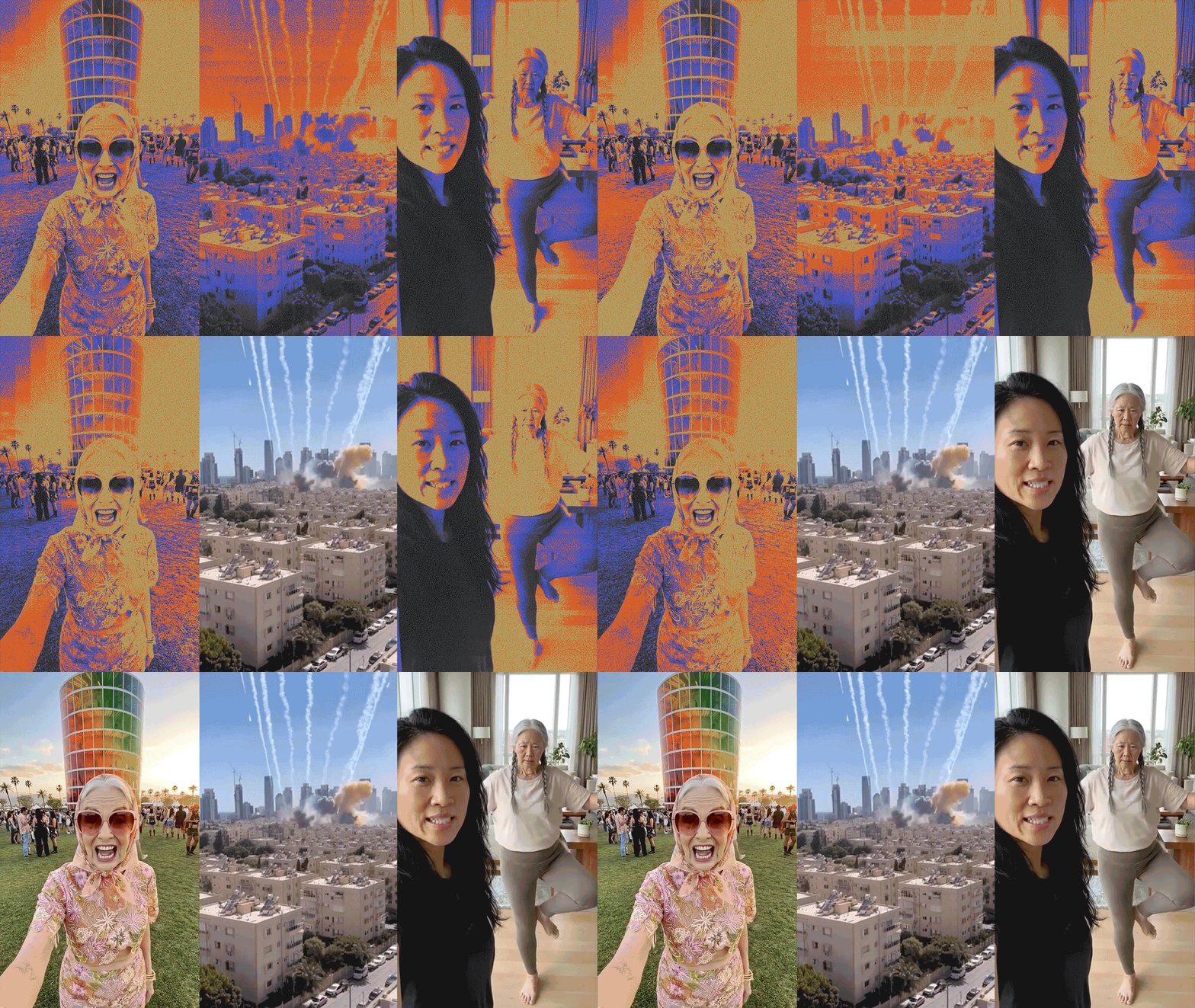
The most critical threat, however, lies in the realm of geopolitical disinformation. In the context of recent conflicts in the Middle East, social media has been flooded with synthetic combat footage. A notable case involved a video purportedly showing an Iranian missile strike on Tel Aviv. The video was widely circulated before being debunked by The New York Times. Analysts noted that the video contained "tells" common in AI-generated war footage, such as a perfectly placed flag in the foreground and a cinematic quality that differs from the grainy, distant, and often nighttime footage captured by real witnesses. In contrast, a genuine video of a strike on a fuel storage facility in Bahrain, verified by the Bahrain National Communication Center and reported by CNN, served as a grim reminder that real-world tragedies are now competing for attention with AI-generated "war porn."
Supporting Data and the "Liar’s Dividend"
Data from the Global Investigative Journalism Network (GIJN) suggests that the "success rate" of AI-generated disinformation is increasing. As detection tools struggle to keep pace with generative models, the burden of proof has shifted to the consumer. This environment creates what researchers call the "Liar’s Dividend." This phenomenon occurs when the mere existence of AI-generated content allows public figures or bad actors to dismiss real, incriminating evidence as "fake" or "AI-generated."
According to recent digital literacy surveys, approximately 60% of social media users admit to having been fooled by an AI-generated post at least once. Furthermore, the "Granny Spills" phenomenon—an AI-generated persona with 2 million followers who "attends" events like Coachella and poses with celebrities like Justin Bieber—demonstrates that a significant portion of the audience is willing to engage with "openly" synthetic personas for entertainment. However, the danger remains that as the technology improves, the "openly" part of the equation disappears, leaving users unable to distinguish between a real influencer and a corporate-owned algorithm.
Official Responses and the Challenge of Verification
Governments and tech platforms have begun to respond to the proliferation of synthetic media, though many experts argue the response is insufficient. The European Union’s AI Act and various U.S. executive orders have called for the watermarking of AI-generated content. However, these watermarks are easily stripped or bypassed by those with malicious intent.
Journalistic organizations are also adapting. The GIJN has released comprehensive guides for detecting AI, urging journalists to look for inconsistencies in physics, light reflections, and "hallucinated" details in the background of videos. Yet, even these experts acknowledge that as AI begins to understand the laws of physics more accurately—a goal of models like Sora—visual detection will become impossible. Verification will instead rely on "provenance" metadata—digital trails that prove where a file originated and how it was edited.
Broader Impact and the Future of Reality
The long-term implications of an AI-saturated social media landscape are profound. Beyond the immediate risks of scams and political disinformation, there is a burgeoning "identity crisis" in the digital world. If an AI persona like Granny Spills or Shudu Gram can command the same influence as a human like Quenlin Blackwell, the value of human experience and authenticity is called into question.
Moreover, the "zoning out" behavior of social media users—scrolling as a form of relaxation—makes them particularly vulnerable. When the brain is in a passive state, it is less likely to engage the critical thinking required to spot a "hallucinated" Iranian missile or a synthetic dog shelter. This passivity is the primary engine of the disinformation age.
In conclusion, the rise of AI-generated content on social media represents a permanent shift in how information is consumed and processed. While the technology offers remarkable creative potential, as seen in the entertainment value of digital influencers, its role in the spread of false claims and the erosion of trust cannot be overlooked. As detection methods become obsolete, the responsibility for maintaining a "real" world falls on the shoulders of platforms to enforce transparency and on users to maintain a heightened state of digital skepticism. The "AI Issue" of modern media is not just a technological challenge; it is a fundamental test of the public’s ability to safeguard reality in an era of perfect simulation.