The Japanese film industry, particularly between the 1960s and early 1970s, entered a profoundly dynamic and experimental phase, challenging traditional cinematic conventions and pushing the boundaries of genre filmmaking. This era was characterized by a potent blend of artistic innovation, socio-political commentary, and a burgeoning creative energy that gave birth to some of Japanese cinema’s most iconic figures and narratives. Amidst the genre-bending artistry of directors like Seijun Suzuki, whose vibrant, anarchic style often subverted studio expectations, and the fiercely rebellious, politically charged features from the likes of Nagisa Oshima, a key figure in the Japanese New Wave, genre cinema achieved an extraordinary creative zenith. This period proved fertile ground for memorable characters, ranging from the stoic vengeance of Nami in "Female Prisoner Scorpion" to the legendary blind swordsman Zatoichi, a role indelibly linked to Tomisaburo Wakayama’s brother, Shintaro Katsu. Within this rich tapestry, Tomisaburo Wakayama emerged as one of the era’s most prominent leading men, perhaps best known for his portrayal of Itto Ogami in the globally celebrated "Lone Wolf and Cub" series. However, before embarking on the "path of hell" as the disgraced executioner, Wakayama cemented his status as a formidable genre star in the "Bounty Hunter" series, a lively and innovative blend of action, adventure, and jidaigeki that encapsulated the remarkable creative vitality of Japanese genre cinema. The recent restoration and release of these films underscore their historical and cinematic importance, allowing a new generation of audiences to appreciate Wakayama’s foundational work and the innovative spirit of the time.
The Shifting Landscape of Japanese Cinema in the 1960s and 1970s
To fully appreciate the "Bounty Hunter" series and Wakayama’s contribution, it is essential to understand the seismic shifts occurring within the Japanese film industry during the 1960s and early 1970s. Following the post-war golden age, the traditional studio system, dominated by giants like Toei, Nikkatsu, Shochiku, Daiei, and Toho, began to face unprecedented challenges. The proliferation of television sets in Japanese households dramatically impacted cinema attendance, forcing studios to re-evaluate their production strategies. This economic pressure inadvertently fostered an environment ripe for experimentation.
Rather than relying solely on lavish productions or adaptations of literary works, studios increasingly turned to genre films—yakuza features, samurai epics (jidaigeki), monster movies (kaiju), and even the burgeoning "pink film" (pinku eiga) movement—to attract audiences. This shift allowed directors and actors more creative latitude within established frameworks, leading to a flourishing of distinctive directorial voices and the emergence of new cinematic styles. Seijun Suzuki, for instance, often pushed the boundaries of Nikkatsu’s low-budget genre assignments, imbuing them with surreal aesthetics, fragmented narratives, and a rebellious spirit that initially bewildered studio executives but later earned him cult status. Similarly, the Japanese New Wave, championed by directors like Nagisa Oshima, Masahiro Shinoda, and Shohei Imamura, directly confronted contemporary social and political issues, utilizing provocative imagery and challenging narratives to critique Japanese society, often reflecting the widespread student protests and anti-establishment sentiments of the era. Within this dynamic environment, action-oriented jidaigeki and yakuza films provided a popular outlet for exploring themes of honor, justice, betrayal, and individual struggle against oppressive systems, resonating deeply with a populace navigating rapid modernization and socio-political upheaval.
Tomisaburo Wakayama: A Martial Arts Legend’s Ascent
Tomisaburo Wakayama (born Masaru Okumura) was a pivotal figure in this era, known for his imposing physical presence, intense gaze, and mastery of martial arts. Born in 1929, he came from a distinguished lineage of performers; his father, Kanya Katsutōji, was a kabuki actor, and his younger brother was the legendary Shintaro Katsu. Wakayama’s early life was steeped in traditional Japanese performing arts and martial training. He was a practitioner of kendo, judo, and karate, disciplines that would later define his on-screen persona.
Wakayama initially pursued a career in kabuki before transitioning to film in the mid-1950s. His early roles often saw him in supporting parts, steadily building his reputation as a reliable and charismatic performer in action films. While his brother Shintaro Katsu achieved international fame earlier with the "Zatoichi" series, Tomisaburo carved his own niche, often portraying stoic, battle-hardened warriors. His distinctive style—a blend of brutal efficiency in combat, understated charisma, and a capacity for profound emotional depth beneath a hardened exterior—set him apart. He possessed a gravitas that lent credibility to his portrayals of complex anti-heroes and morally ambiguous figures. The "Bounty Hunter" series provided him with an early opportunity to showcase these multifaceted talents, laying crucial groundwork for his later, more globally recognized role as Itto Ogami.
The Genesis of the ‘Bounty Hunter’ Trilogy
The "Bounty Hunter" series, produced by the prolific Toei Company, represented a significant chapter in Wakayama’s career, preceding his monumental success with "Lone Wolf and Cub" (1972-1974). The first film, "Killer’s Mission" (1969), directed by Shigehiro Ozawa, premiered at a time when Toei was actively diversifying its output beyond its successful yakuza and samurai franchises, seeking new narratives and character archetypes to captivate audiences. Ozawa, a seasoned director within the Toei system, was known for his efficient and dynamic direction of action films, having helmed numerous yakuza pictures and jidaigeki throughout the 1960s. His collaboration with Wakayama on "Killer’s Mission" proved to be a fertile creative partnership, allowing Wakayama to explore a character that combined traditional samurai ideals with elements of a modern espionage thriller.
The series, comprising "Killer’s Mission" (1969), "The Fangs of the Cobra" (1969), and "The Trail of the Serpent" (1970), positioned Wakayama as a unique hero. While sharing similarities with other contemporary samurai films, it distinguished itself through its protagonist’s unconventional methods and the intricate political backdrop against which the action unfolded. The films offered a potent mix of intense swordplay, intricate detective work, and morally grey protagonists, reflecting the evolving tastes of Japanese audiences who were increasingly drawn to complex narratives and anti-heroic figures.
"Killer’s Mission": A Deep Dive into Political Intrigue and Espionage
"Killer’s Mission," the inaugural film in the "Bounty Hunter" trilogy, immediately plunges viewers into a volatile political landscape, drawing upon historical anxieties surrounding foreign influence and internal power struggles within the Tokugawa shogunate. The central premise revolves around the arrival of Dutch ships in Japan, seeking to broker a lucrative arms deal with powerful regional leaders, specifically targeting the influential Satsuma clan. This proposed agreement threatens to upset the delicate balance of power meticulously maintained by the shogunate, potentially empowering a rival domain with advanced European weaponry.
Historically, while Japan maintained a policy of national isolation (sakoku) for much of the Edo period, limited trade with the Dutch was permitted through the port of Dejima. However, the film’s premise exaggerates this historical reality for dramatic effect, tapping into a deeper societal unease about external forces and the potential for internal rebellion fueled by foreign technology. The Tokugawa government, seeking to prevent this destabilizing alliance, employs Ichibei Shikoro (Tomisaburo Wakayama), a formidable bounty hunter and physician. Ichibei is not merely a master swordsman; he is a man of remarkable cunning, a master of disguise and deception, and an innovator in his use of an impressive array of gadgets and tools. These devices—which include a powerful telescope for reconnaissance and various hidden weapons—often grant him a crucial advantage in combat and infiltration, foreshadowing the ingenious arsenal later wielded by Itto Ogami in "Lone Wolf and Cub."
Ichibei’s mission to infiltrate Satsuma territory is fraught with peril, forcing him to acknowledge the necessity of allies. During his journey, he encounters Tokuro (Kenji Ushio), a wandering ronin whose jovial demeanor provides welcome comic relief, and Kagero (Yumiko Nogawa), a resolute woman equally determined to penetrate Satsuma’s heavily guarded borders. Although their individual motivations differ, a shared objective—to confront the Satsuma clan, which has been brutally executing shogunate spies along its frontier—binds them together. As the trio ventures deeper into enemy territory, Ichibei gradually uncovers a conspiracy far more intricate and dangerous than he initially anticipated, one driven by layers of political intrigue and competing interests that threaten to engulf the entire shogunate. To survive and complete his mission, he must rely not only on his formidable skills but also on every trick at his disposal and the unwavering support of his newfound companions.
Ichibei Shikoro: The Proto-Anti-Hero
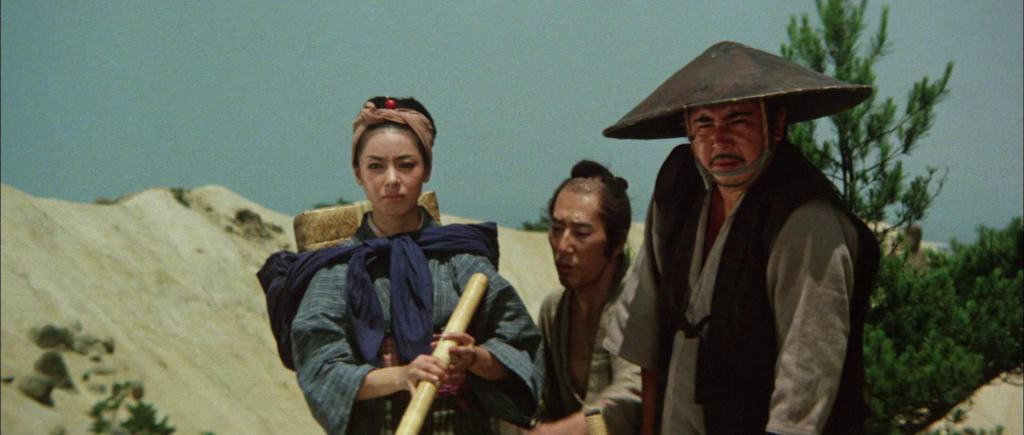
Ichibei Shikoro stands as a fascinating proto-anti-hero, a character whose complexity transcends the typical samurai archetype. Much like Itto Ogami, he is more than just a skilled combatant. His identity as a physician offers a stark contrast to his violent profession, hinting at a duality within his character—a capacity for healing alongside his aptitude for destruction. This blend of attributes imbues him with a depth that makes him uniquely compelling.
Wakayama’s portrayal of Ichibei is characterized by a restrained charisma and an understated intensity. He projects an aura of quiet competence and ruthless efficiency. Ichibei’s reliance on gadgets and ingenuity—such as specialized darts, concealed blades, and the aforementioned powerful telescope—distinguishes him from more traditional samurai, positioning him as a figure who embraces innovation while remaining deeply rooted in the martial traditions of his era. He is an excellent marksman, capable of precision with various projectile weapons, further cementing his versatility.
Crucially, Ichibei’s intelligence and capacity for deception are as potent as his sword arm. A particularly memorable sequence sees him expertly impersonating a blind masseur, a clear and affectionate homage to the "Zatoichi" series, a role famously played by his brother, Shintaro Katsu. This act of mimicry not only highlights his mastery of disguise but also subtly connects him to a broader cinematic legacy, while simultaneously differentiating him. Unlike Zatoichi, whose blindness is both a vulnerability and a source of heightened senses, Ichibei’s impersonation is a calculated tactical maneuver, a weapon in his espionage toolkit.
Ichibei’s moral compass, however, is not always perfectly aligned with conventional heroism. Some of his actions, particularly in his dealings with women, are morally questionable, challenging audience sympathy. Yet, similar to Itto Ogami, he consistently navigates a fine line between eliciting criticism and earning the audience’s unwavering support. Even when his methods are ethically ambiguous, viewers are compelled to root for him as he confronts an enemy whose true power and insidious nature only become apparent through the course of his dangerous mission. This moral ambiguity was a hallmark of the era’s anti-heroes, reflecting a societal disillusionment with traditional authority and a growing appreciation for characters who operated outside established norms.
Themes: Individual Agency vs. Systemic Oppression
While "Killer’s Mission" might not be an overt political allegory, it is undeniably shaped by its historical and contemporary contexts. The film subtly engages with the socio-political tensions of late 1960s Japan, an era marked by intense student activism, anti-establishment sentiment, and a questioning of traditional power structures.
Ichibei, though employed by representatives of the shogunate, never truly belongs to the system he serves. He prefers to operate independently, embodying a spirit of individual agency that resonates with the era’s yearning for personal freedom and defiance against conformity. He is not a revolutionary, yet he stands in opposition to an oppressive force—the Satsuma clan—whose ambition to dominate the political landscape is dangerously augmented by advanced Dutch weaponry. This narrative choice cleverly integrates the historical anxieties of foreign intervention with the contemporary fear of unchecked power.
A key thematic distinction emerges when comparing "Killer’s Mission" to "Lone Wolf and Cub." While "Lone Wolf and Cub" presents a protagonist, Itto Ogami, who ultimately accepts his life as an outcast, forever walking a "path of hell" after realizing the pervasive corruption of the regime, "Killer’s Mission" maintains a considerably more optimistic outlook. Despite its pervasive violence and bloodshed, the film subtly suggests that determined individuals can still influence history or, at the very least, aid those who are willing to instigate change from within the system. Ichibei, unlike Ogami, still harbors a belief that the system is not entirely beyond redemption, or at least that individual action can make a meaningful difference. This optimism reflects a nuanced perspective on rebellion and systemic change, suggesting that the fight for justice can take many forms, not solely outright revolution.
Supporting Cast and Narrative Depth
The thematic optimism of "Killer’s Mission" is further amplified by its supporting cast. Yumiko Nogawa’s portrayal of Kagero is particularly impactful. She represents those who actively resist a corrupt and power-hungry system, embodying a quiet strength and resilience. Nogawa skillfully conveys the emotional burden of opposing an overwhelming enemy, making Kagero not only vulnerable but arguably the most emotionally engaging character in the story. Her presence adds a crucial human element to Ichibei’s otherwise solitary and ruthless mission, underscoring the collective nature of resistance.
Kenji Ushio, as the wandering ronin Tokuro, provides welcome moments of comic relief. His lighter, more boisterous performance creates an enjoyable and necessary contrast to Wakayama’s stoic and intense presence. This dynamic interplay between the serious and the comedic elements prevents the film from becoming overly bleak, reinforcing its adventurous spirit. The trio’s evolving camaraderie illustrates the power of alliances formed under duress, further enhancing the film’s narrative depth and emotional resonance.
Legacy and Rediscovery
"Killer’s Mission" stands as a strong opening chapter to the "Bounty Hunter" series, a testament to the creative prowess of Japanese popular cinema during the late 1960s. Anchored by Tomisaburo Wakayama’s charismatic and nuanced performance, director Shigehiro Ozawa crafted an entertaining genre feature that not only delivered thrilling action but also quietly engaged with many of the social and political tensions of its era. The film’s blend of jidaigeki, espionage, and action-adventure elements, coupled with its distinctive anti-hero, marked it as a forward-thinking entry in the genre.
Although perhaps less cynical or overtly brutal than later works like "Female Prisoner Scorpion" or "Lone Wolf and Cub," "Killer’s Mission" nevertheless offers a compelling portrait of individuals struggling against systems far greater than themselves. Its unique approach to the samurai narrative, incorporating proto-spy thriller elements and a nuanced protagonist, ensured its place in the pantheon of innovative Japanese genre films.
The enduring appeal of the "Bounty Hunter" series has been significantly bolstered by its recent rediscovery and restoration for home video. The availability of high-quality Blu-ray editions, such as the one from Terracotta Distribution mentioned in the original context, has allowed both long-time fans and new audiences to experience these films in their intended glory. This resurgence of interest highlights the lasting impact of Tomisaburo Wakayama’s contributions to Japanese cinema and reaffirms the "Bounty Hunter" trilogy as a vital precursor to his more internationally renowned work. It showcases an era when Japanese filmmakers, under pressure, responded with unparalleled creativity, producing films that were both commercially successful and artistically adventurous, ultimately shaping the landscape of global genre cinema. The "Bounty Hunter" series remains a powerful example of how compelling storytelling, robust character development, and innovative filmmaking can transcend time, offering relevant insights into human struggle and resilience against the backdrop of historical and political upheaval.